The Depression Quiz Doctors Actually Use — and What Your Score Means
This depression quiz isn't one of the invented questionnaires that float around social media — it's the PHQ-9, the exact nine-item screening your doctor most likely uses. Back in 2001, three researchers — Kroenke, Spitzer, and Williams — published it in the Journal of General Internal Medicine after validating it on roughly 6,000 patients across primary care and OB/GYN clinics. The result was something rare in medicine: a depression test short enough to finish in two minutes, yet accurate enough that hospitals, armies, and research trials worldwide still rely on it more than two decades later.
The Test That Replaced a Diagnosis Marathon
Before the PHQ-9, screening someone for depression in a busy clinic was clumsy. The older tools were long, some were copyrighted and expensive, and most needed a trained interviewer to administer. A family doctor with fifteen minutes per patient simply didn't have time. So a lot of depression went uncaught — people came in for headaches, back pain, or fatigue, and the underlying mood disorder never came up.
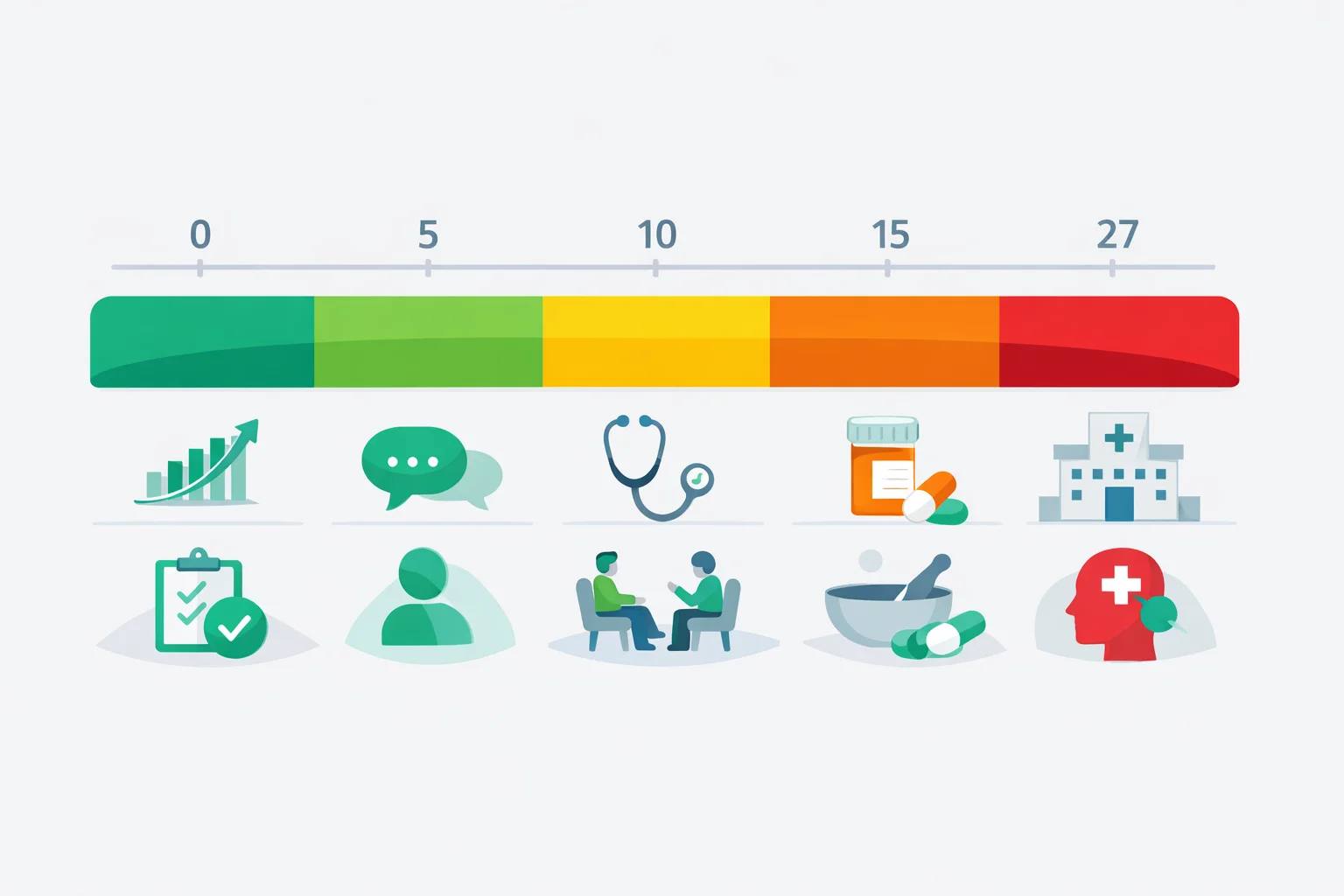
The PHQ-9 fixed that by doing something elegant: it maps one question onto each of the nine official symptoms of major depressive disorder from the psychiatric diagnostic manual. Nine criteria, nine questions. You answer each on a simple scale — "not at all," "several days," "more than half the days," or "nearly every day" — worth 0 to 3 points. Add them up and you get a number from 0 to 27 that tracks how heavy the last two weeks have been. It's now free to use, translated into more than 30 languages, and baked into electronic health records around the world.
How the 0-to-27 Score Maps to Severity
The scoring isn't arbitrary. Researchers calibrated the cutoffs against confirmed diagnoses, and the bands have held up across hundreds of follow-up studies. Here's what each range means:
| Score | Severity | What it typically suggests |
|---|---|---|
| 0–4 | Minimal | Few or no symptoms; monitoring is enough |
| 5–9 | Mild | Often stress or a low patch; watchful waiting |
| 10–14 | Moderate | Crosses the clinical threshold; evaluation recommended |
| 15–19 | Moderately severe | Active treatment usually warranted |
| 20–27 | Severe | Prompt, often combined, treatment advised |
The number that matters most is 10. That's the standard cutoff: a 2007 meta-analysis found that a score of 10 or higher catches major depression with around 88% sensitivity and 88% specificity — a rare balance where the tool rarely misses real cases and rarely raises false alarms. If your result landed at 10 or above, that's the line clinicians treat as "worth a proper look," not a verdict.
Why Question 9 Matters More Than the Other Eight
Eight of the nine questions add up to a severity score. The ninth — about thoughts of being better off dead or of hurting yourself — is treated differently. In clinical settings, any answer above "not at all" on question 9 triggers a follow-up conversation, regardless of the total score. Someone can have a relatively modest overall number and still need immediate support because of that single item.
This is why our quiz shows crisis resources the moment question 9 is answered above zero, separate from your severity band. If that's you: those thoughts are a symptom, not a plan, and they don't have to be faced alone. In the US, calling or texting 988 connects you to the Suicide & Crisis Lifeline — free, confidential, around the clock. Reaching out when that item lights up is exactly what the PHQ-9 was designed to prompt.
Is It Depression, or Just a Rough Couple of Weeks?
This is the question almost everyone arrives with. The honest answer: a single quiz can't draw that line perfectly, but it can point you in the right direction. Two things separate clinical depression from ordinary sadness — duration and pervasiveness. Sadness is usually tied to something specific and lifts when circumstances change. Depression settles in for weeks, colors most of the day most days, and often shows up even when nothing obvious is "wrong."
That two-week window in the PHQ-9 instructions isn't decoration — it's the diagnostic threshold for major depression. If you answered for a single bad day, your score is inflated; if your symptoms have genuinely stretched across a fortnight, that persistence is itself meaningful. Worth knowing, too: depression rarely travels alone — roughly half of people who screen positive for it also screen positive for anxiety, so if the worry and dread feel as loud as the low mood, our anxiety quiz is worth taking alongside this one. The same early-life emotional wiring that shapes how we handle stress plays a role here too, which is why our attachment style quiz can be a useful companion — insecure attachment patterns are a documented risk factor for depressive symptoms in adulthood. Adversity that runs deeper than attachment matters too: childhood abuse, neglect, and household dysfunction are among the strongest predictors of adult depression, which our ACE quiz measures directly. And if the trouble concentrating is the symptom that bothers you most, it's worth ruling out attention issues too — our ADHD quiz screens for a pattern that mimics depressive brain fog but has a very different cause.
Here's the Part Most People Miss: Depression Is Physical
Look back at the nine questions and count how many are about emotions. Only four — interest, mood, self-worth, and the self-harm item. The other five are about the body: sleep, appetite, energy, concentration, and the speed at which you move and speak. That ratio is deliberate, and it explains one of the most common surprises on this quiz: people who score moderate or higher while swearing their mood is "fine."
Depression is, in large part, a physiological condition. It disrupts the systems that govern sleep architecture, hunger signaling, and motivation. That's also why depression is so easily mistaken for — and tangled up with — purely physical illnesses. Crushing fatigue and brain fog, for instance, sit at the overlap of depression and conditions like dysautonomia; if standing up makes your heart race and your energy crater, our POTS syndrome quiz screens for a pattern that's frequently misread as "just depression." Hormonal shifts muddy the picture too — the mood swings and fatigue of PCOS overlap with depressive symptoms, which our PCOS symptom quiz helps untangle. The takeaway: a high PHQ-9 score is a reason to look at the whole body, not just the mind.
What a Screening Score Can and Can't Tell You
Here's where honesty matters, because overselling a screening tool does real harm. The PHQ-9 is a screening instrument, not a diagnostic one. It can flag the likelihood of depression and gauge its severity, but it can't tell you why you feel this way or rule out conditions that mimic depression. Several things can push a score up that aren't major depressive disorder at all:
- Thyroid problems, anemia, and vitamin deficiencies all produce fatigue, low mood, and brain fog — which is why a good doctor often runs bloodwork before settling on a diagnosis.
- Bipolar disorder includes depressive episodes, but treating it as plain depression can backfire; the PHQ-9 doesn't screen for the manic side, so our bipolar disorder quiz is worth taking if your lows ever flip into unusual highs.
- Grief, burnout, and acute stress can look identical to depression on a symptom checklist for a few weeks before they resolve. Burnout is the easiest of the three to mistake for depression, because the fix is different: it's occupational by definition and it lifts when the job changes. Our burnout stage quiz scores exhaustion, cynicism and efficacy separately and specifically tests whether the flatness stops at the office door.
- Borderline personality disorder brings frequent crashes too, but they last hours and follow relationship triggers rather than weeks of steady low mood; our BPD quiz checks for that pattern if your lows feel sudden and tied to other people.
- OCD wears people down until the exhaustion reads as depression, yet the obsessions and compulsions underneath need their own treatment; our OCD quiz checks for that pattern.
- Heavy drinking both mimics depression and deepens it — alcohol is a depressant, so a regular drinking habit can drag a PHQ-9 score upward; our alcohol use quiz checks whether that's part of the picture.
- Eating disorders drain mood and energy through malnutrition and shame, so depression and disordered eating constantly feed each other; our eating disorder quiz checks whether food and body image are part of what's dragging your score up.
- Complex PTSD produces the same numbness, hopelessness, and harsh self-image as depression, but it's driven by prolonged trauma rather than mood chemistry; our Complex PTSD quiz checks whether a trauma pattern is underneath the low mood.
- Underreporting works the other way — someone genuinely struggling may answer optimistically and score low.
So treat your number as the opening line of a conversation, not the conclusion. The single most valuable thing this quiz can do isn't label you — it's give you a concrete score to bring to a professional, who uses the very same scale. And if you're not even sure mood is the right place to start, the broader mental health check screens five areas at once and points you to the screening that fits best.
All 5 PHQ-9 Severity Levels Explained
🌤️ Minimal (0–4): Few or no symptoms over the last two weeks. This range suggests depression isn't currently driving how you feel. The useful move here is noticing what's keeping you steady — sleep, movement, connection — and protecting it. A low score doesn't invalidate hard feelings; it just means they're not forming a clinical pattern right now.
🌥️ Mild (5–9): Some symptoms are present, usually reflecting stress or a temporary low patch rather than a disorder. This is the sweet spot for prevention. Tightening sleep, daily movement, and real meals genuinely shifts scores in this band. If symptoms are still around in two weeks, that's your cue to check in with a doctor.
🌧️ Moderate (10–14): Your score crosses the clinical threshold where evaluation is recommended. Symptoms at this level usually start interfering with daily life, but moderate depression responds well to therapy and lifestyle change. The biggest barrier is almost always just starting — and you now have a number to bring to that first appointment.
⛈️ Moderately severe (15–19): Significant symptoms that are likely making work, relationships, or routines harder. This isn't a willpower issue. At this level, clinicians often combine therapy with medication because the pairing outperforms either alone. Getting on a schedule soon matters more than waiting to "feel bad enough."
🌑 Severe (20–27): Intense, wide-ranging symptoms that warrant prompt professional support. Two truths hold at once: depression distorts how permanent this feels, and severe depression is highly treatable. The priority is connecting with help quickly — and if you ever feel unsafe, a crisis line or emergency services come first.
What to Do With Your Score This Week
Whatever your result, the next step isn't to ruminate on the number — it's to act on it this week. If you scored 10 or above, book a check-in with your primary care doctor and tell them your PHQ-9 score directly; they'll know exactly what it means and can take it from there. The National Institute of Mental Health is a solid, jargon-free place to read about treatment options before that appointment.
If you scored lower, use the momentum anyway. Pick one lever — a consistent sleep window, a daily walk, one honest conversation with someone who matters — and protect it for two weeks, then retake the quiz to see the trend. Feeling supported is itself protective against depression, so if connection is where you feel thin, our love language quiz can help you ask for care in the way you're most likely to actually receive it. And whatever the number says, remember the one rule that overrides every score on this page: if something feels seriously wrong, trust that instinct and reach out — to a professional, a trusted person, or 988 — today.