Most of What You've Heard About Eating Disorders Is Wrong
Most people picture an eating disorder as a teenage girl who has stopped eating and is visibly, alarmingly thin. That picture is wrong far more often than it's right — and the belief itself is dangerous, because it's the reason so many people never get help. This eating disorder quiz is built to look past the stereotype: it scores your thoughts and behaviors around food, not your body size, using items drawn from the two screens clinicians actually trust — the SCOFF and the EAT-26. Before you read your result, it's worth dismantling the myths that keep people sick, because at least one of them probably shaped how you answered.
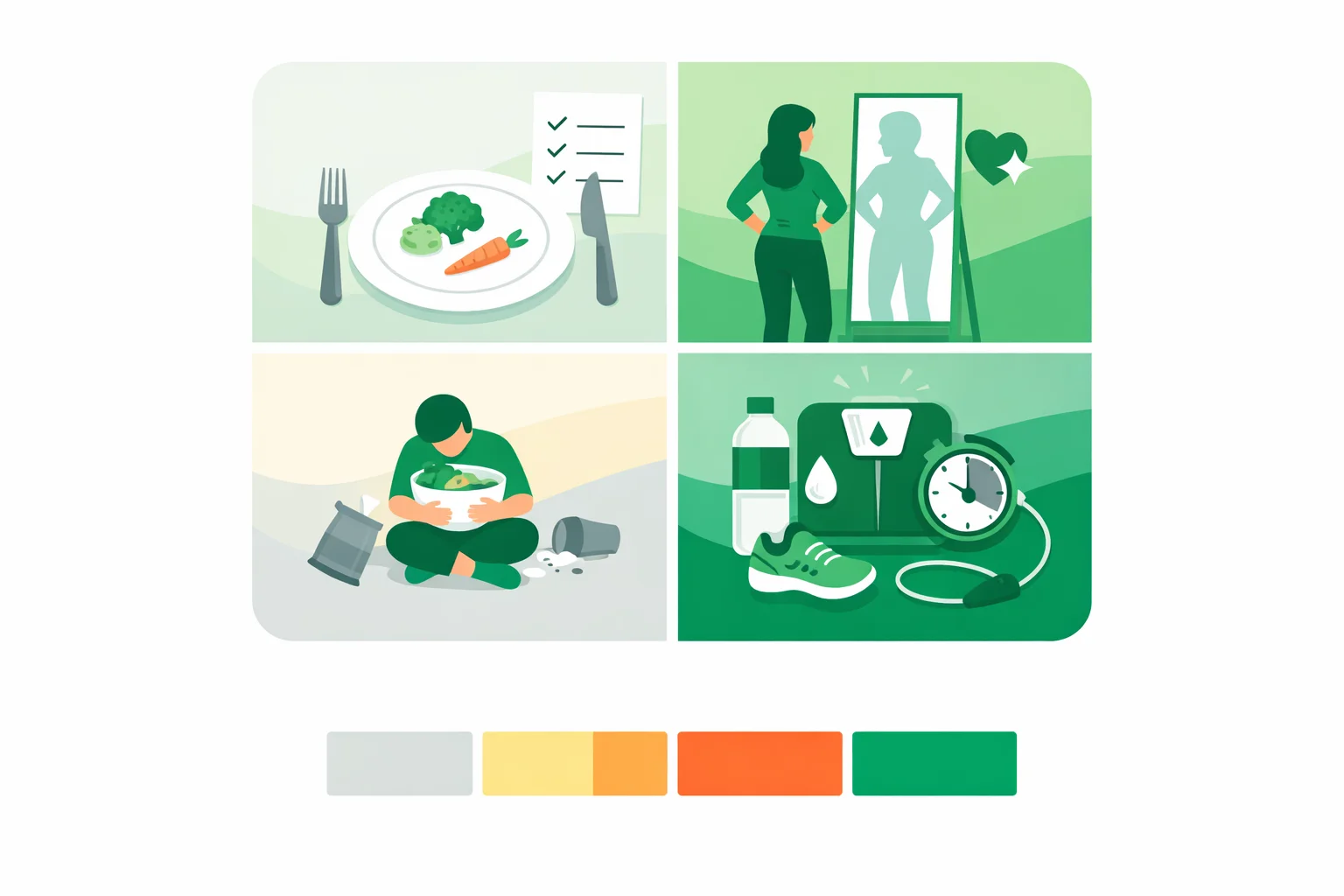
The Deadliest Mental Illness Nobody Talks About This Way
Here's a fact that should be common knowledge and somehow isn't: eating disorders have among the highest mortality rates of any mental illness, and anorexia in particular is frequently cited as the deadliest psychiatric diagnosis there is. People die from the medical complications — heart failure, organ damage, electrolyte collapse — and from suicide, which is tragically common in this group. Yet eating disorders are still treated culturally as a vanity problem, a phase, or a diet that went a little too far.
That gap between how lethal these illnesses are and how lightly they're taken is exactly why a quiz like this earns its place. Not because a 12-question screen can diagnose anyone — it can't — but because the single biggest barrier to recovery is people not realizing, or not admitting, that what they're doing has crossed a line. The National Institute of Mental Health estimates eating disorders will affect a meaningful slice of the population at some point in their lives, and most of those people will never be formally diagnosed.
You Cannot Tell an Eating Disorder by Looking
The myth: you can spot someone with an eating disorder. The reality: you almost never can. The fastest-growing diagnosis in the field is atypical anorexia — people who meet every criterion for anorexia, including the dangerous restriction, the fear of weight gain, and significant weight loss, except they happen to be at a normal or higher body weight. Their hearts can slow and their electrolytes can crash just like someone who is visibly underweight, but because they don't fit the picture, they're routinely told they look "healthy" and sent home.
Then there's binge eating disorder, which is more common than anorexia and bulimia combined and typically occurs in people who are not underweight at all. This is the whole reason question 3 of this quiz asks about the fear of gaining weight rather than your actual weight, and why none of the 12 items ask what you weigh. A screen that leaned on body size would miss the majority of people who are genuinely struggling. Weight is one of the worst predictors of how sick someone is — it just happens to be the most visible.
What These 12 Questions Actually Measure
The quiz blends two validated tools. The SCOFF is a five-item screen published in the BMJ in 1999 — its name is an acronym for its questions about being Sick, losing Control, the One stone of weight loss, feeling Fat, and Food dominating life. Answering "yes" to two or more flags a likely eating disorder with roughly 85% sensitivity. The EAT-26 (Eating Attitudes Test) is a longer 26-item questionnaire measuring dieting attitudes, food preoccupation, and oral control, with a standard concern cutoff of 20.
Rather than dump 31 raw items on you, this quiz pulls the highest-signal questions from both and sorts them into four domains, so your result tells you where the trouble sits, not just how much of it there is:
| Domain | What it captures | Example behaviors |
|---|---|---|
| Restriction & Rules | Limiting intake and rigid food laws | Skipping meals, cutting food groups, fear of weight gain |
| Body & Self-Worth | How much shape and weight run your self-image | Body checking, preoccupation, self-worth tied to weight |
| Loss of Control | Bingeing and the shame around it | Eating until you can't stop, secret eating, guilt |
| Compensating | Undoing food through purging or punishment | Vomiting, laxatives, fasting, driven exercise |
Two people can land on the same total score with completely different profiles — one all restriction and body obsession, another all bingeing and compensating. That distinction matters enormously for what kind of help actually fits, which is why the result screen breaks your score down by domain instead of handing you a single number and leaving you to guess.
Why Purging and Over-Exercise Get Flagged Separately
You may have noticed the quiz treats three items — vomiting and diet pills, compulsive exercise, and long fasts — differently, surfacing them on their own if you endorse any of them. That's deliberate, and it mirrors how a clinician thinks. Compensatory behaviors carry a physical danger that doesn't care about your total score. Self-induced vomiting and laxative misuse can drive potassium and other electrolytes low enough to trigger dangerous heart rhythms, sometimes in people who otherwise look and feel functional.
Compulsive exercise is the sneakiest of the three because our culture applauds it. "Earning" food, punishing a meal with a workout, or training through injury and illness because stopping feels unbearable — these read as discipline from the outside while functioning as compensation from the inside. The tell isn't how much you move; it's whether skipping it fills you with dread. If the quiz flagged you here, take that seriously regardless of where your overall concern landed.
Here's the Thing — It Was Never Really About Food
Ask almost anyone in recovery and they'll tell you the same thing: the food was never the point. Eating disorders are, at their core, a way of managing feelings that feel otherwise unmanageable. Restriction can deliver a sense of control when life feels chaotic. A binge can numb. Purging can feel like relief or punishment. The behavior is the visible tip; underneath it is almost always anxiety, perfectionism, trauma, or a self-worth that's been hijacked.
That's why eating disorders rarely travel alone. Anxiety is so frequently underneath the food rules that screening for it often explains the whole pattern — if the dread and what-ifs feel as loud as the food thoughts, our anxiety quiz is worth taking alongside this one. The rigidity, counting, and rituals around eating overlap heavily with obsessive-compulsive patterns, which our OCD quiz screens for. And depression both feeds and follows disordered eating in a vicious loop — our depression quiz uses the clinical PHQ-9 to check where your mood actually stands. Treating the eating disorder usually means treating what it's standing in for, too.
Could a High Score Be Something Else?
A screen can flag a pattern, but it can't tell you the cause — and a few things can push your score up that aren't a classic eating disorder. Honesty about the limits is what separates a useful tool from a scary one:
- Orthorexia — an obsession with "clean" or "pure" eating — isn't a formal diagnosis, but it lights up the restriction and guilt items here. If your rules are about purity rather than weight, that's still disordered eating worth addressing.
- Medical conditions like diabetes, celiac disease, or food allergies impose real dietary restrictions; the difference is whether the rules come from your body's needs or from fear and self-worth.
- Emotion dysregulation can drive binge-purge cycles as part of a broader pattern rather than a standalone eating disorder — if your lows and impulses swing hard and fast around relationships, our BPD quiz checks for that picture.
- Normal dieting culture is so pervasive that some "concerning" answers are just background noise of living in a weight-obsessed world. Context matters, which is exactly what a professional adds.
So treat your score as the opening line of a conversation, not the conclusion. If you're genuinely unsure whether food is even the right starting point, our broader mental health check screens five areas at once and points you toward the assessment that fits best.
What Each of the 4 Concern Levels Means
🌱 Low Concern (0–8): Few of the screened patterns are present. Your relationship with food looks flexible — eating fits around your life rather than running it. An occasional diet thought or off day doesn't move you out of this band; it's the absence of a sustained pattern that matters. The useful move is noticing what keeps you steady and protecting it.
🌥️ Some Concerning Patterns (9–19): A few behaviors or attitudes — strict rules, body checking, guilt after eating — show up without forming a high-risk picture. This is the band where many people live for years calling it "being healthy." It's also the easiest stage to turn around, and you don't need a diagnosis to deserve support. Loosen the tightest rule and say it out loud to someone.
🟠 Significant Concern (20–31): Several patterns are at a level likely affecting your daily life, your body, or both. This isn't a character flaw — it's a signal that food has tipped from preference into something that runs the show. Eating disorders at this stage respond well to evidence-based therapies like CBT-E and family-based treatment, and reaching out now is far easier than waiting.
🔴 High Concern (32–48): Intense, wide-ranging disordered eating that's very likely taking a physical and mental toll. Two truths hold at once: the disorder distorts how serious it lets you believe this is, and even severe eating disorders are treatable. The priority is connecting with a professional soon and getting a medical check — restriction and purging can affect your heart silently.
What to Do This Week, Whatever Your Score
Whatever number you got, the worst thing you can do is ruminate on it. If you scored in the significant or high range — or the quiz flagged a compensating behavior — the move is to book a conversation with a doctor or a therapist who treats eating disorders, and to bring your four-domain breakdown so they have a concrete place to start. In the US, the ANAD Helpline (1-888-375-7767) is free and confidential, and the National Eating Disorders Association offers screening tools and treatment referrals.
If you scored lower but something still feels off, trust that feeling over the number. Pick one small experiment — eating a feared food, skipping a weigh-in, letting one rule go — and notice what comes up when you do. The discomfort is information. And whatever this page told you, hold on to the one fact that overrides every score on it: you do not have to be "sick enough" to deserve help. The belief that you do is the disorder talking, and reaching out anyway is how recovery actually starts.