What an Anxiety Quiz Can Actually Tell You — and the Myths It Quietly Kills
Before you read a single thing into this anxiety quiz, here's a myth worth dismantling: most people picture anxiety as a pounding heart and a panic attack in a crowded room. That's real, but it's the dramatic minority. The far more common version is quieter — a worry you can't turn off, a low buzz of dread, the inability to relax even when the day is technically fine. That second kind is exactly what the seven questions above measure, and it's the kind that hides in plain sight for years.
Five Anxiety Myths This Quiz Quietly Debunks
The reason a short screening like this one earns its keep isn't the score at the end — it's that the questions themselves contradict things almost everyone believes about anxiety. Here are five myths worth retiring, with what the evidence actually says.
Myth 1: "It's just stress — it'll pass." Sometimes, yes. But the defining feature of an anxiety disorder isn't intensity, it's persistence. Stress has an off-ramp; it fades when the deadline ships or the argument resolves. Generalized anxiety keeps running after the trigger is gone, which is precisely why the quiz asks about a full two-week window instead of a single bad afternoon.
Myth 2: "Anxiety is all in your head." Three of the seven items — trouble relaxing, restlessness, irritability — are about the body, not the mind. Anxiety is a whole-nervous-system event: it raises your resting heart rate, tightens muscles, and primes you to react. People who insist they're "not the anxious type" are often the ones grinding their teeth and snapping at coworkers.
Myth 3: "If you can still function, it's not real anxiety." This one does the most damage. Plenty of high performers hit a moderate score while looking completely composed from the outside. Functioning and suffering aren't opposites — more on that trap below. If the worry is specifically about being exposed as not good enough at a job you're demonstrably doing well, the imposter syndrome quiz measures that pattern directly — it's a close neighbour of anxiety, and the two get confused constantly.
Myth 4: "A high score means I have an anxiety disorder." No. The GAD-7 is a screening tool, not a diagnosis. A 10 tells you the odds are worth checking, the same way a smoke alarm tells you to look, not that the house is on fire. Diagnosis needs a clinician and a conversation.
Myth 5: "Avoiding what makes me anxious will calm me down." It's the opposite, and it's one of the most counterintuitive findings in all of psychology. Avoidance feels like relief in the moment and quietly makes the anxiety stronger over time. That mechanism gets its own section later, because it's the single most useful thing to understand about your result.
So Where Did the GAD-7 Come From?
The GAD-7 is barely older than the smartphone. A team led by psychiatrist Robert Spitzer published it in 2006 in the Archives of Internal Medicine, after testing it on 2,740 patients across 15 primary-care clinics. They wanted something a busy family doctor could hand over in the waiting room — short enough to finish in under two minutes, but accurate enough to trust. Seven questions was the sweet spot. Drop below that and you lose precision; add more and people stop finishing.
What makes it clever is that it doesn't try to diagnose a specific disorder. It measures the shared core of anxious distress — worry, tension, dread — which is why it picks up not just generalized anxiety but, to a lesser degree, panic disorder and social anxiety too. That breadth is also its limitation, and we'll get to the fine print.
What Your Number Actually Means
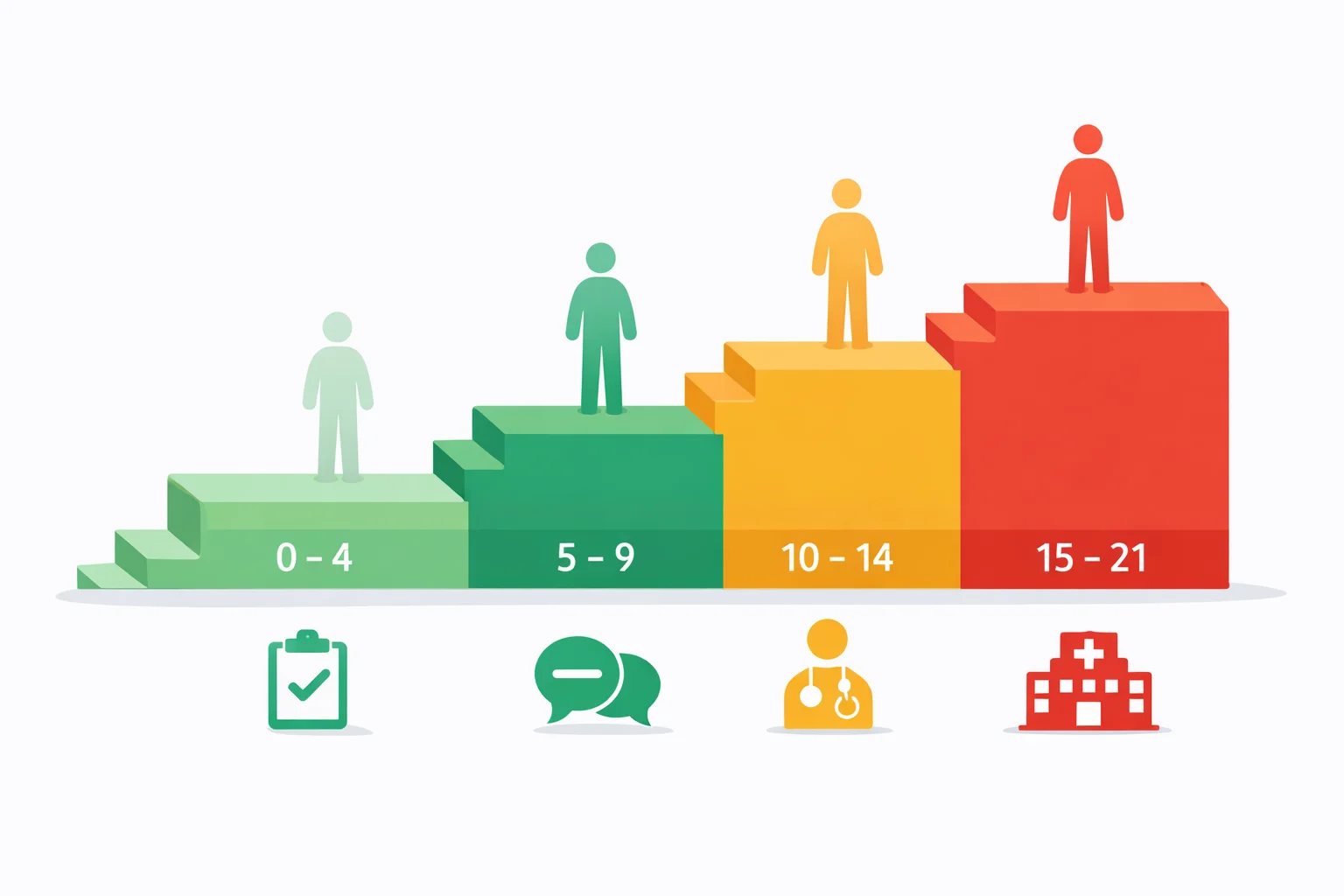
Each of the seven answers is worth 0 to 3 points, so your total lands somewhere between 0 and 21. The cutoffs aren't guesses — Spitzer's team calibrated them against confirmed diagnoses, and the bands have held up across hundreds of later studies. Minimal sits at 0 to 4, mild at 5 to 9, moderate at 10 to 14, and severe at 15 to 21.
The number that matters is 10. That's the threshold where the research says "worth a professional look": at 10 or above, the GAD-7 catches generalized anxiety disorder with roughly 89% sensitivity and 82% specificity. In plain terms, it rarely misses people who genuinely have it, and it's reasonably good at not false-alarming people who don't. If you scored a 10 or higher, that's not a verdict — it's a nudge to book a conversation.
One detail the quiz surfaces that most online tests don't: your GAD-2 sub-score. The first two questions — feeling on edge, and not being able to stop worrying — form a standalone ultra-short screen with its own cutoff of 3 out of 6. Many clinics start there and only run the full seven if you cross it. So even if your total looks modest, a GAD-2 of 3 or more is its own signal worth noticing.
GAD-7 vs the Other Anxiety Tests
The GAD-7 isn't the only anxiety scale out there, and it's genuinely useful to know what it does and doesn't cover compared with the alternatives you might run into.
| Tool | Length | What it measures | Best for |
|---|---|---|---|
| GAD-2 | 2 items | Core worry only | A 20-second first filter |
| GAD-7 | 7 items | Generalized worry + tension | Quick clinic screening & tracking |
| Beck Anxiety Inventory | 21 items | Heavily physical symptoms | Telling anxiety apart from depression |
| Hamilton (HAM-A) | 14 items | Mind + body, clinician-rated | Research and severity tracking |
Notice the trade-off. The Beck inventory leans hard on physical signs, so it's great at separating anxiety from low mood but can over-flag someone whose racing heart comes from caffeine or a thyroid issue. The GAD-7 stays balanced and fast, which is why it became the default. If your result here was high and you're not sure whether it's anxiety or something physical masquerading as it, the POTS syndrome quiz is a useful cross-check — a pounding heart on standing reads as panic far more often than it should.
The High-Functioning Anxiety Trap
Here's the result that surprises people most: a moderate score from someone who, by every outward measure, has it together. They hit deadlines early, answer emails at midnight, never miss a friend's birthday. The anxiety isn't despite the achievement — it's often the engine behind it. Worry gets channeled into productivity, and the productivity earns praise, which makes the whole loop feel like a personality trait rather than a symptom.
The catch is that "high-functioning anxiety" isn't a clinical diagnosis; it's a description of how a real anxiety disorder can hide. The cost shows up backstage — in the 3 a.m. wake-ups, the inability to sit through a movie without checking your phone, the irritability that question 6 quietly catches. If you scored moderate while thinking "but I'm fine, I get things done," that gap between how you look and how you feel is the finding.
Why Dodging Anxiety Makes It Louder
Back to that fifth myth, because it's the lever that changes outcomes. Anxiety runs on a simple, brutal loop: something feels threatening, you avoid it, you feel instant relief, and your brain files away "avoiding that worked." Next time the threat feels a little bigger and the avoidance a little more automatic. The relief is real, which is exactly what makes it a trap — you're training the fear every time you flinch from it. Worth knowing that avoidance has more than one shape: leaving the room, going blank, and agreeing with everyone all buy the same instant relief. The trauma response quiz sorts which of those your nervous system reaches for first.
Cognitive behavioral therapy works by reversing that loop. Instead of avoiding the feared thing, you approach it in small, tolerable doses and let your nervous system learn that the catastrophe doesn't come. It's unglamorous and it works better than almost anything else we have. A lot of anxiety also lives in our closest relationships — the fear of being too much, or not enough, for the people we love. If your worry clusters there, the attachment style quiz can show you which early pattern is doing the talking.
When a Quiz Isn't Enough
Honesty matters here, because overselling a screening tool does real harm. The GAD-7 measures one slice of anxiety — generalized worry — and it can miss the rest. A few things it isn't built to catch:
- Panic disorder centers on sudden surges of terror with physical symptoms; this quiz barely asks about them.
- OCD and phobias involve intense, specific anxiety that a generalized screen can completely overlook; if your worry is tied to intrusive thoughts or rituals you can't resist, our OCD quiz maps that pattern instead.
- Thyroid problems, too much caffeine, and certain medications mimic anxiety symptoms convincingly, which is why a good doctor sometimes orders bloodwork before settling on a label. An overactive thyroid is the classic impostor here — racing pulse, restlessness, broken sleep, a tremor — and it gets filed as anxiety for years surprisingly often; the tells that separate them are physical rather than mental, and our thyroid symptom quiz scores those directly.
- ADHD drives a restless, racing-mind kind of anxiety that the GAD-7 reads as worry but treats differently; our ADHD quiz helps tell the two apart.
- Autistic burnout can read as relentless anxiety when it's really the toll of masking and sensory overload; our autism quiz screens for the traits underneath.
- High sensitivity produces overwhelm that looks like anxiety until you change the room. The tell is conditionality: a sensitive nervous system settles once the noise, lighting and demands drop away, while anxiety follows you into the quiet. If your worst hours are reliably the loudest ones, our highly sensitive person quiz scores the trait itself rather than the distress it causes.
- Depression overlaps heavily — about half of anxious people also screen positive for low mood, so a high anxiety score is a fair reason to check the other side too.
- Gut symptoms get treated as a consequence of anxiety when the traffic often runs the other way. A 12-year population study in Gut found the brain-gut link is bidirectional: among people who started with irritable bowel symptoms and no psychological distress, the gut trouble predicted anxiety arriving later, not the reverse. If your worry came after years of an unpredictable stomach rather than before, our IBS symptom quiz measures the other half of that loop.
- Job burnout produces a very convincing kind of dread that peaks on Sunday evening and eases on the first morning of a real holiday; if your worry has a weekly shape and an obvious source, our burnout stage quiz is the better instrument for it.
- Bipolar disorder often shows up as agitated, restless anxiety during its mood episodes; if your worry arrives in waves alongside unusual highs, our bipolar disorder quiz screens for the pattern underneath.
- Drinking to take the edge off is one of the most common ways anxiety hides — alcohol calms worry for an hour and amplifies it the next day; our alcohol use quiz checks whether that coping loop has started to take hold.
- Eating disorders are frequently anxiety in disguise — rigid food rules can become the main way someone manages dread; if worry has latched onto food, weight, or your body, our eating disorder quiz screens for that pattern.
That last overlap is worth taking seriously. Anxiety and depression are less like separate rooms and more like two windows into the same house. If your number here ran high, spend five minutes with the depression quiz as well — the combination tells a more honest story than either score alone. Not sure anxiety is even the main event? The broader mental health check screens five areas at once and points you to the right one. For a plain-language overview of the full anxiety spectrum, the National Institute of Mental Health is a solid, jargon-free place to start.
All 4 GAD-7 Anxiety Levels, Explained
🌿 Minimal (0–4): Few or no anxiety symptoms over the last two weeks. This range suggests worry isn't currently steering your days. The smart move is noticing what keeps you grounded — sleep, movement, connection — and defending it. A low score doesn't mean you never feel anxious; it means it isn't forming a clinical pattern right now.
🍃 Mild (5–9): Some symptoms are present, usually reflecting a stressful stretch rather than a disorder. This is the prevention sweet spot. Trimming caffeine, protecting sleep, and naming your worries out loud genuinely move scores in this band. If symptoms are still around in two weeks, that's your cue to talk to a doctor.
🌧️ Moderate (10–14): Your score crosses the clinical threshold where evaluation is recommended. Symptoms at this level usually start interfering with daily life, but moderate anxiety responds well to therapy — cognitive behavioral therapy especially. The biggest hurdle is almost always just starting, and you now have a number to bring to that first appointment.
⛈️ Severe (15–21): Intense, wide-ranging anxiety that's likely making work, relationships, or routines harder. This isn't a willpower issue. At this level, clinicians often pair therapy with medication because the combination outperforms either alone. Getting on a schedule soon matters more than waiting to feel "bad enough" — and if anxiety ever tips into thoughts of self-harm, treat it as urgent.
One Experiment to Run Before You Spiral Again
Whatever your score, skip the urge to ruminate on the number and try one small thing instead: scheduled worry time. Pick fifteen minutes each afternoon, and when an anxious thought shows up outside that window, jot it down and tell yourself you'll handle it at the appointed time. It sounds almost too simple, but it's a documented CBT technique — and it works because it interrupts the loop without forcing you to suppress anything. Most worries lose their grip by the time the window arrives, and the ones that don't are usually the ones worth a real plan.
If you scored at 10 or above, run the experiment and book the appointment — tell your doctor your GAD-7 number directly, since they read the same scale. And whatever the result says, hold onto the one rule that overrides every cutoff on this page: if something feels seriously wrong, trust that instinct and reach out to a professional, a trusted person, or 988, today.