Am I an Alcoholic? Why That Question Is the Wrong One to Ask
If you searched "am I an alcoholic" and landed on this quiz, here's something the question itself gets wrong: addiction specialists quietly stopped asking it years ago. The word "alcoholic" draws a hard line — you either are one or you aren't — and that binary turns out to be a poor map of how drinking problems actually develop. This screening uses the AUDIT, the World Health Organization's ten-question test, because it does something the old yes-or-no framing never could: it places you on a spectrum of risk instead of pinning a label on you.
Medicine Quietly Retired the Word "Alcoholic"
For most of the twentieth century, alcohol problems were treated as a switch: you were a normal drinker or you were an alcoholic, with nothing in between. That framing did real damage. It let heavy drinkers off the hook ("I'm not waking up needing a drink, so I'm fine") and it scared people away from honest self-assessment, because admitting a problem meant accepting a frightening, all-or-nothing identity.
In 2013, the psychiatric diagnostic manual — the DSM-5 — formally scrapped the old categories of "alcohol abuse" and "alcohol dependence." In their place it put a single diagnosis, alcohol use disorder, measured on a sliding scale of mild, moderate, or severe across eleven criteria. The change reflected decades of evidence that drinking problems sit on a continuum. Someone can drink in a clearly risky way for years before — or without ever — meeting the old definition of dependence. That's the reality the AUDIT was built to catch, and it's why a more useful question than "am I an alcoholic?" is simply "is my drinking raising my risk of harm?"
From a Four-Letter Memory Trick to a Global Standard
The first screening tool to go mainstream was almost charmingly simple. In 1968, Dr. John Ewing — who later founded the alcohol studies center at the University of North Carolina — built a four-question screen around a mnemonic anyone could remember: CAGE. Have you ever felt you should Cut down? Have people Annoyed you by criticizing your drinking? Have you felt Guilty about it? And have you ever needed an Eye-opener — a morning drink to steady yourself? Two yeses and a clinician took notice.
CAGE was fast and easy to remember, and for spotting entrenched, severe problems it worked. But it had a blind spot the size of a bar: it almost completely missed early, hazardous drinking. By the time someone answered yes to guilt and eye-openers, the problem was usually well advanced. The World Health Organization wanted a tool that caught risk earlier and worked across wildly different drinking cultures. So in 1989, after a six-country research collaboration spanning Norway, Australia, Kenya, Bulgaria, Mexico, and the United States, it released the AUDIT. It was the first screen specifically engineered to flag risky drinking before dependence sets in — and it remains the most validated alcohol screening test in the world. The eye-opener question survived from CAGE; it's question 6 on this quiz.
How Your 0-to-40 Score Maps to Risk
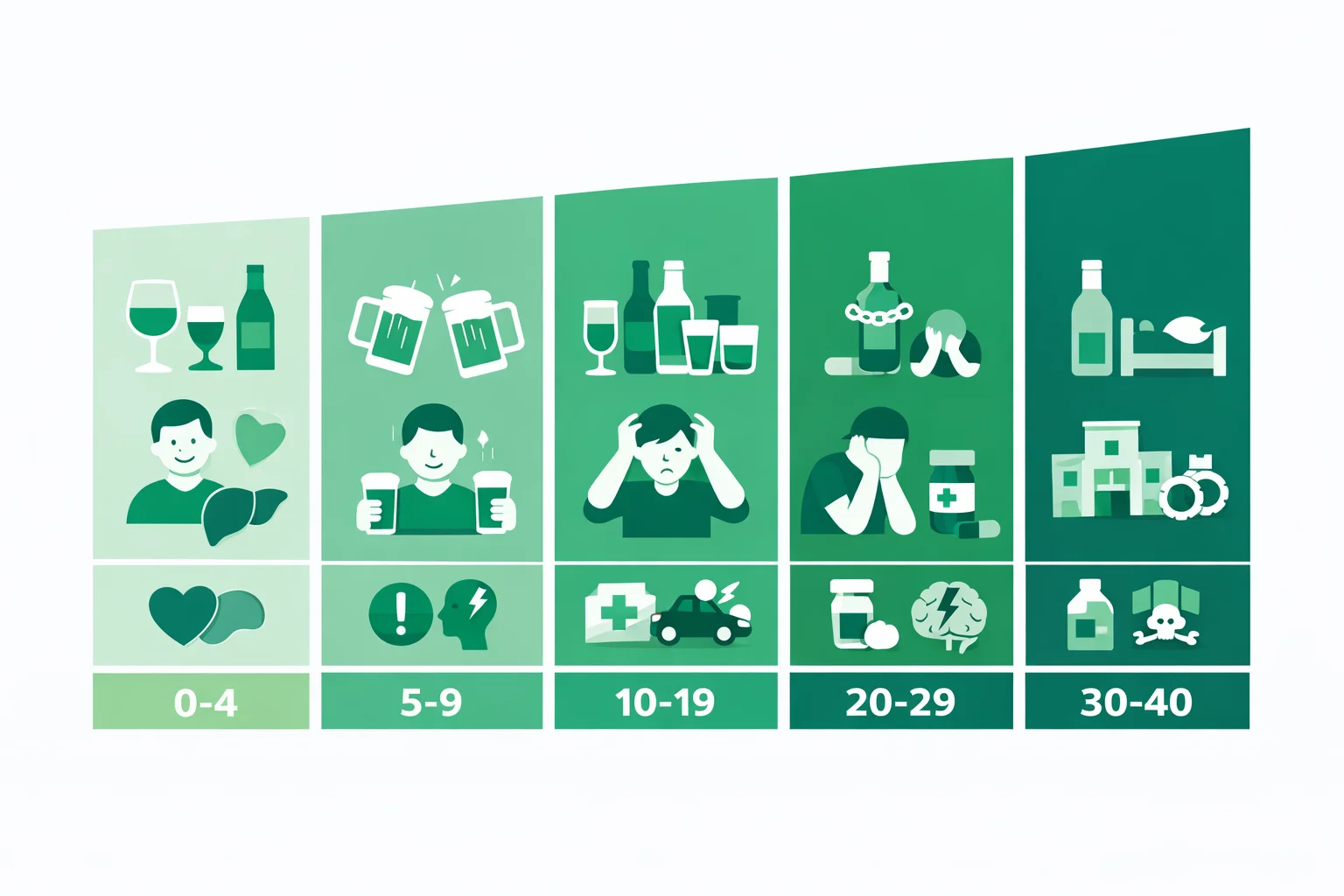
Each of the ten questions scores 0 to 4, for a maximum of 40. The cutoffs weren't guessed — they were calibrated against clinical assessments across those six countries and have held up in hundreds of studies since. Here's what the bands mean:
| Score | Risk level | What it typically suggests |
|---|---|---|
| 0–7 | Low risk | Little or no risky drinking; simple awareness is enough |
| 8–15 | Increasing risk (hazardous) | Early-warning zone; brief self-directed change works best |
| 16–19 | Higher risk (harmful) | Likely causing harm; professional support recommended |
| 20–40 | Possible dependence | Full assessment warranted; don't quit abruptly alone |
The number that matters most is 8. That's the standard threshold where the WHO considers drinking hazardous and worth a conversation. It's set deliberately low — the whole point of the AUDIT is to catch people early, while a few small changes can still head off years of trouble. If you landed at 8 or above, read that as a yellow light, not a verdict.
Why "How Much" Matters Less Than What Happens When You Drink
Here's the design detail almost no one notices: the AUDIT's ten questions split cleanly into three groups, and only the first three are about quantity. Questions 1 to 3 measure consumption — how often and how much. Questions 4 to 6 probe dependence — losing control, neglecting responsibilities, needing a morning drink. Questions 7 to 10 measure harm — guilt, blackouts, injuries, and other people's concern. That's why your results screen breaks your score into those same three bars.
The split exists because two people who drink identical amounts can carry wildly different risk. One person has four beers on a Friday and that's the whole story. Another has the same four beers but can't stop at four, wakes up with no memory of the night, and has a partner quietly worried. Same consumption, very different AUDIT scores — because the test cares far more about consequences and control than about the number in your glass. It's a more honest way to look at drinking than counting units alone, and it explains how someone can drink less than a friend yet sit at higher risk. If you notice drinking creeping into how you manage hard feelings, the pattern often points back to mood — our depression quiz and anxiety quiz are worth taking alongside this one, because drinking to cope and the conditions that drive it tend to escalate together. That quietly worried partner in the second example has a literature of their own, incidentally: the word codependency was coined in Minnesota treatment centres in the late 1970s to name exactly that person, and our codependency quiz scores the point where concern for a drinker tips into a life organised entirely around theirs.
The Most Dangerous Myth About Quitting
There's a piece of folk wisdom that can genuinely get people killed: the idea that the bravest, purest way to stop drinking is to go cold turkey and white-knuckle through it. For most substances, abrupt withdrawal is miserable but not deadly. Alcohol is one of the rare exceptions. After the brain has adapted to heavy, sustained drinking, suddenly removing alcohol can tip it into a state of dangerous overexcitement — which can cause withdrawal seizures and delirium tremens, a medical emergency that, left untreated, has historically killed a meaningful share of the people who develop it.
This is the single most important thing on this page if you scored in the dependence range. Stopping is the right goal — but the safe path runs through a doctor, not through sheer willpower. A medically supervised detox uses medication and monitoring to keep withdrawal safe, and it's widely available. If you can't go a day or two without feeling shaky, sweaty, anxious, or sick, that's a sign of physical dependence and a reason to get medical advice before you cut down. The SAMHSA National Helpline (1-800-662-4357) can point you to local options, free and confidential.
What This Screening Can't See
The AUDIT is excellent at what it does, but overselling any screen does harm, so here's where it falls short. It's a screening tool, not a diagnosis — it can flag risk, but it can't confirm an alcohol use disorder or rate its severity the way a clinician can. A few specific blind spots are worth naming:
- It measures the "what," not the "why." Drinking to numb anxiety, depression, or trauma is one of the most common engines of escalating use, and the AUDIT doesn't ask about it. If your drinking tracks your mood, screening the mood is half the job.
- It ignores the interactions and conditions that make even "moderate" drinking risky for some people — pregnancy, liver disease, and certain prescription medications all change the math.
- It uses one scale for everyone, even though women generally reach a higher blood alcohol level on the same number of drinks. If you're a woman near a cutoff, treat the lower edge of each band as your line.
- Underreporting is common and human. It's genuinely hard to count your own drinks honestly, and most people undercount. A low score earned by rounding down isn't reassurance.
Impulsivity and untreated attention problems also quietly raise the odds of heavy drinking, which is why our ADHD quiz can be a useful companion if focus and impulse control have always been a struggle. And if you're not sure which thread to pull first, the broader mental health check screens several areas at once and points you toward a sensible next step.
All 4 AUDIT Risk Levels Explained
🟢 Low risk (0–7): Your drinking falls in the range linked to little or no alcohol-related harm. Most people here either drink rarely or keep their amounts modest. The useful move is simply staying aware — drinking tends to creep up quietly during stressful seasons, and home pours are usually bigger than a standard drink. Nothing here suggests you're on a worrying path.
🟡 Increasing risk (8–15): The AUDIT's early-warning band, which the WHO calls hazardous drinking. It usually doesn't mean dependence — it means your current pattern, continued, raises the odds of future harm. This is the sweet spot for change: setting drink-free days and a per-occasion cap at this stage prevents most of the problems that show up later. Re-take the quiz in a month to see if your changes moved the number.
🟠 Higher risk (16–19): The harmful-drinking band, where alcohol is likely already taking a toll on your body, mood, work, or relationships. Self-directed cutting back is often no longer enough on its own here. Brief professional support — a conversation with a doctor, a few counseling sessions — has strong evidence at this level and tends to work faster than going it alone.
🔴 Possible dependence (20–40): A score this high points to a pattern consistent with alcohol dependence, where body and brain have adapted to alcohol. Two things are true at once: this is a recognized, treatable medical condition, and the safest first step is a professional assessment — not quitting cold turkey, which can be dangerous after heavy use. Recovery rates are far higher than the stigma suggests.
What to Do With Your Score
Whatever your number, the point isn't to brand yourself — it's to do one concrete thing this week. If you scored 8 or above, the highest-leverage move is an honest conversation with your doctor; tell them your AUDIT score directly, because they use the same tool and will know exactly what it means. Before that, the NIAAA's Rethinking Drinking site is a calm, judgment-free place to see how your drinking compares and to find practical strategies for cutting back.
If you scored low, use the awareness anyway: pick one small guardrail — a couple of alcohol-free days a week, an honest count of what you actually pour — and keep it. And if any part of this stirred up worry about the reasons behind your drinking, follow that thread. Pairing this with the depression screen often reveals more than either quiz does alone. The one rule that overrides every score on this page: if you feel physically unwell when you don't drink, talk to a professional before cutting down — and if you need someone now, 1-800-662-4357 is free, confidential, and answered around the clock.