What an ADHD Quiz Can — and Can't — Tell You About the Way Your Brain Works
She was 34 when her son's pediatrician handed her a pamphlet about childhood ADHD, and halfway down the list of symptoms she stopped reading because she recognized herself, not her kid. The lost keys. The half-finished knitting projects in three different baskets. The way a simple email could sit unanswered for nine days, not because she didn't care but because starting it felt like pushing a car uphill. She'd spent three decades being called scatterbrained, dreamy, a little flaky — and it had never once occurred to her that an ADHD quiz might describe her better than it described any hyperactive boy. That gap, between who gets diagnosed and who quietly struggles, is exactly what the screening above is built to close.
The Diagnosis That Arrived 30 Years Late
Stories like hers have become almost a genre. Adult ADHD diagnoses have climbed sharply over the last decade, and a striking share of them are people in their thirties, forties, and beyond who assumed ADHD was something you grew out of — or never had in the first place because nobody flagged it at seven. The reality is that ADHD doesn't expire. Roughly 4.4% of adults meet the criteria according to the landmark National Comorbidity Survey Replication, and a large chunk of them have no idea, because the version they live with never looked like the cartoon of a boy who can't sit still.
What changes in adulthood is the camouflage. A kid with ADHD has teachers, parents, and a rigid schedule scaffolding their day. Strip that away — hand someone an open-plan job, a mortgage, and a phone that buzzes 200 times a day — and the cracks that were always there suddenly become a daily emergency. That's why so many people take an ADHD quiz for the first time during a life transition: a new job, a baby, a degree. The demands finally outran the workarounds.
What the ASRS Checklist Is Really Testing
The questions above aren't random. They're the Adult ADHD Self-Report Scale — the ASRS — developed in 2005 by a team led by Ronald Kessler in partnership with the World Health Organization. They distilled the full diagnostic criteria into eighteen plain-language questions, then did something clever: they figured out which six carried the most predictive weight. Those six became "Part A," the screener your result highlights separately.
Here's the part most online quizzes get wrong. ADHD screening isn't about adding up a big number — it's about which answers cross a threshold. On Part A, some items count only if you answered "Often" or "Very Often," while others count from "Sometimes" upward, because the research showed those specific patterns separated ADHD from ordinary forgetfulness. Hit four or more of those shaded marks and you've cleared the bar that researchers found best predicts a real diagnosis. The total out of 72 we show alongside it is useful texture, but the six-question screener is the part clinicians actually trust. You can read the WHO's own write-up of the instrument through the Harvard National Comorbidity Survey.
Why ADHD Hides So Well in Women and Girls
Back to the woman with the knitting baskets, because her story isn't an outlier — it's practically the template. For decades ADHD research was done almost entirely on hyperactive young boys, and the diagnostic picture baked that bias right in. Girls, who lean heavily toward the inattentive presentation, didn't fit the template, so they slipped through. Childhood diagnosis rates have historically run around three boys for every girl, but in adulthood that gap narrows dramatically — which doesn't mean women develop ADHD later. It means they were missed.
Two things make ADHD especially sneaky in women. The first is masking: girls are socialized to be organized, agreeable, and quiet, so a girl with ADHD often pours enormous effort into looking like she has it together, exhausting herself to pass as "normal." The second is internalizing. Where a hyperactive boy acts out, an inattentive girl tends to turn it inward — and the result frequently gets misdiagnosed as anxiety or depression. If you're a woman who scored high here, that's worth holding onto: many women spend years treating the anxiety that's actually a symptom while the ADHD underneath goes untouched. It's often worth taking an anxiety screening too, so you can see how the two patterns stack up side by side. The same overlap runs toward autism — the combination is common enough that it has its own nickname, "AuDHD" — so if change, routine, and sensory input also feature in your story, our autism quiz is a natural companion screen.
Inattentive, Hyperactive, or Both?
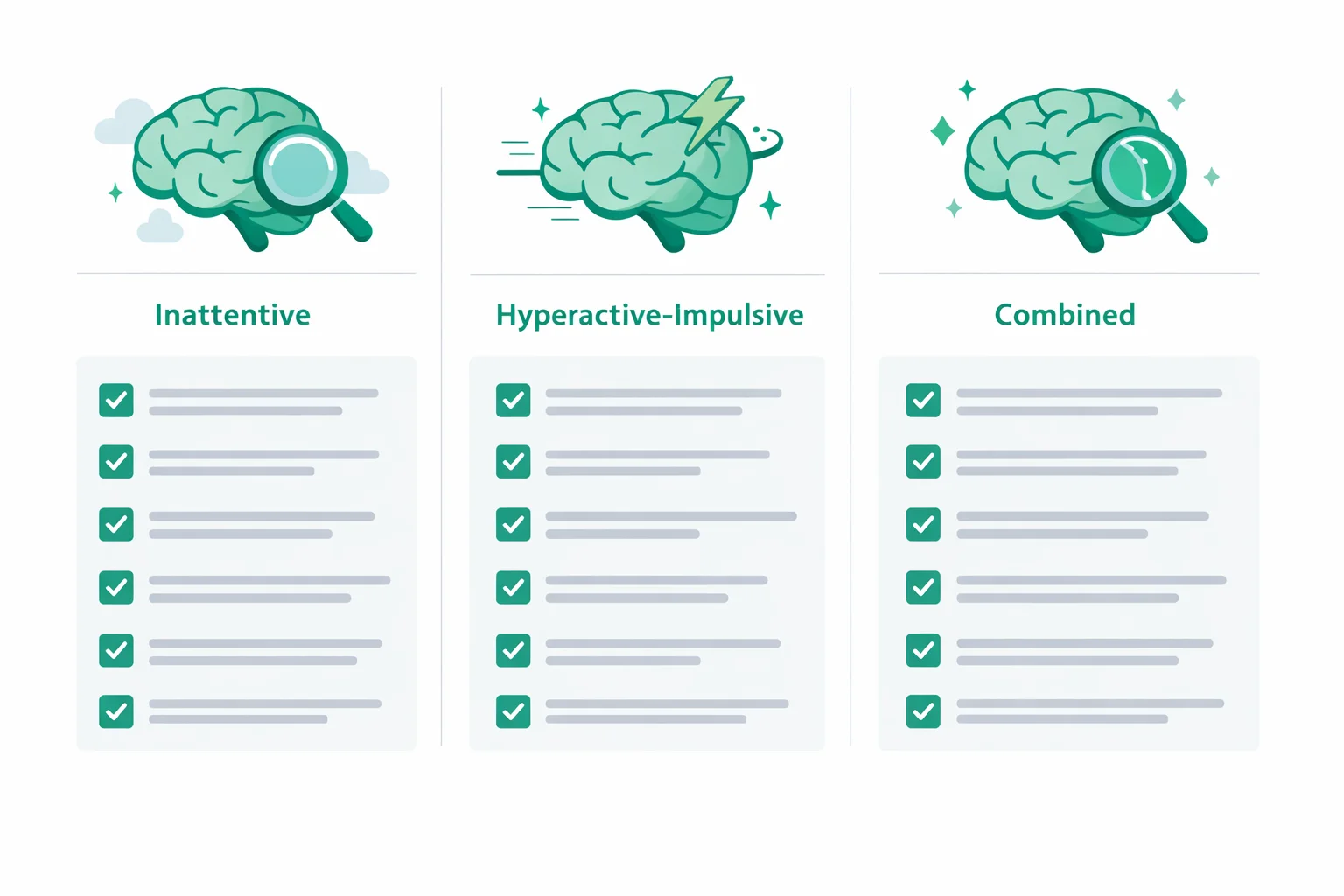
ADHD isn't one thing. The current diagnostic manual recognizes three presentations, and your result estimates which one fits you by comparing your inattention cluster against your hyperactivity-impulsivity cluster. The distinction matters because it shapes everything from how you'll be assessed to which coping strategies will actually help.
| Presentation | What leads | Often looks like | Most missed in |
|---|---|---|---|
| Predominantly Inattentive | Focus, memory, follow-through | Daydreamy, disorganized, "flaky" | Women, adults, quiet kids |
| Predominantly Hyperactive-Impulsive | Restlessness, impulse control | Can't sit still, interrupts, blurts | Rarely missed — it's visible |
| Combined | Both clusters together | The full spectrum at once | Most common adult form |
One quirk worth naming: hyperactivity tends to soften with age. The boy who literally couldn't stay in his chair becomes an adult whose hyperactivity has gone internal — a relentless mental restlessness, a leg that won't stop bouncing, a discomfort with downtime. So an adult who reads "predominantly inattentive" today might have been textbook combined as a child. The presentation is a snapshot, not a permanent label.
The Symptom That Isn't in the Manual
Here's something the official checklist won't ask you about, and arguably should: the emotional side of ADHD. Clinicians who specialize in it, like psychiatrist William Dodson, describe an experience many people with ADHD report as the single hardest part — an intense, almost physical wave of pain in response to perceived rejection or criticism. It's informally called rejection sensitive dysphoria, and while it isn't a formal diagnosis, the emotional dysregulation behind it is increasingly recognized as a core feature of ADHD rather than a side effect.
Why does this matter for your quiz result? Because emotional dysregulation is the piece that gets people misdiagnosed. A teenager whose moods swing hard and fast in response to social slights can look bipolar; an adult who feels everything at maximum volume can look like they have a personality disorder. The ADHD framing reorganizes all of it: the same brain that can't modulate attention often can't modulate emotion either. If your relationships feel like a minefield of overreactions you can't quite control, that's not a separate problem from the focus issues — it may be the same wiring. The way you read and respond to other people's signals also ties into your attachment style, which is worth exploring if rejection sensitivity rang a bell.
ASRS vs the Other ADHD Screeners
The ASRS isn't the only ADHD tool you'll bump into, and knowing the landscape helps you take any single result with the right grain of salt. Each instrument was built for a slightly different job.
| Tool | Length | Built for | Catch |
|---|---|---|---|
| ASRS v1.1 (Part A) | 6 items | Fast adult self-screening | Screens, never diagnoses |
| Full ASRS | 18 items | Symptom-load detail | Total isn't a clinical cutoff |
| Conners (CAARS) | 66 items | In-depth clinical assessment | Long; needs a clinician |
| Vanderbilt | ~55 items | Children, with teacher input | Not designed for adults |
Notice that none of these — not even the long ones — diagnose ADHD by themselves. A self-report scale captures how you experience your own attention, which is invaluable and also limited; people are famously unreliable narrators of their own focus. That's why a real evaluation pulls in a developmental history, sometimes a partner's or parent's observations, and a careful look at what else might be going on.
When a High Score Means Something Else
A high score is a reason to look closer, not a conclusion — because several very different conditions produce nearly identical symptoms. Honest screening means naming them.
- Chronic sleep deprivation wrecks attention, working memory, and impulse control. A tired brain is functionally an inattentive one, and the overlap is enormous.
- Anxiety hijacks concentration with intrusive worry, which reads as distractibility but has a different engine. The clinical tell is whether your mind is blank or racing.
- Depression drains the energy required to start and finish tasks, and that can mimic the inattentive presentation almost perfectly. If both showed up, the depression screening is worth a few minutes.
- Thyroid problems and other medical issues can blunt focus and energy, which is why a good clinician sometimes orders bloodwork before settling on a label.
The single most useful question for sorting ADHD from its imposters is timing. ADHD is a lifelong, developmental condition — the signs are there in childhood, even if nobody named them. Symptoms that appeared out of nowhere in your late twenties alongside stress or low mood are far more likely to be something else. If your focus was fine until two years ago, that's a clue worth taking to a professional. If you're still not sure which lane your symptoms belong in, the wider mental health check screens focus alongside mood, worry, and energy so you can see which one stands out most. The National Institute of Mental Health keeps a clear, jargon-free overview of how the condition is actually defined.
All 4 Result Levels, Explained
🌤️ Minimal Signs (0–24): Few of the persistent attention or restlessness patterns ADHD produces. Most people have occasional scattered days; this range means they aren't adding up to a lifelong pattern. If focus recently got worse, the usual suspects are sleep, stress, and screen overload rather than ADHD.
🔆 Some Traits (25–40): A genuine cluster of ADHD-style traits, but a mixed picture. This middle band is honestly ambiguous — it can reflect ADHD, or anxiety, burnout, or a season that's simply overloaded. The deciding factor is whether these patterns trace back to childhood. Keep a log and watch the trend.
🎯 Strong Indicators (41–56): Symptoms line up closely with how adult ADHD typically presents, across attention, restlessness, and impulse control. It doesn't confirm anything alone, but it's well past the point where a professional assessment makes sense. ADHD is highly treatable, and a clear name is usually a relief.
🚀 Significant Indicators (57–72): Nearly every pattern resonated strongly — a clear case for follow-up. Symptoms at this level are likely shaping work, relationships, and daily routines. This isn't a discipline problem; it's a nervous system wired to chase novelty and reward. Effective help exists, from coaching and therapy to medication.
So You Scored High — Now What?
Don't spiral on the number — do one concrete thing with it. Write down three specific, recent examples of where your attention or impulsivity cost you something real: the bill you forgot, the conversation you talked over, the project that stalled at 90%. Clinicians don't diagnose from a quiz; they diagnose from lived patterns, and walking in with examples plus your Part A result turns a vague "I think something's off" into a conversation a doctor can actually work with.
And whatever the score said, hold onto the reframe that helps most: ADHD traits aren't a character defect waiting to be disciplined away. The same brain that loses the keys is often the one that hyperfocuses for six hours on something it loves, connects ideas nobody else links, and thrives under exactly the kind of novelty that bores everyone else. The goal of getting assessed isn't to slap on a label — it's to finally understand the operating system you've been running this whole time, and to stop blaming yourself for not being a different machine.