POTS Syndrome: Why Standing Up Sets Off Your Heart — and How to Get Answers
If you're taking a "do I have POTS syndrome" quiz, you're reaching for a label that's barely three decades old. Postural Orthostatic Tachycardia Syndrome wasn't even named until 1993, when researchers at the Mayo Clinic put a term to a cluster of symptoms doctors had been puzzling over since the American Civil War. The condition is ancient. The recognition is brand new. And that gap is exactly why so many people spend years being told nothing is wrong before anyone measures what happens to their heart when they stand up.
From "Soldier's Heart" to a 1993 Diagnosis
In 1871, a Philadelphia physician named Jacob Mendez Da Costa described soldiers who returned from battle with a racing heart, breathlessness, dizziness, and exhaustion that no wound could explain. He called it "irritable heart." Others called it "soldier's heart" or, later, Da Costa's syndrome. For more than a century the symptoms drifted between cardiology, psychiatry, and the catch-all bin of conditions nobody could pin down.
The breakthrough came in 1993, when Mayo Clinic neurologist Ronald Schondorf and his colleague Phillip Low formally defined Postural Orthostatic Tachycardia Syndrome and gave clinicians a measurable benchmark: a sustained heart-rate jump on standing, without the blood-pressure crash seen in other conditions. Suddenly the "irritable heart" had a number attached to it. That number — which you'll measure yourself in a few paragraphs — is what turned a vague complaint into a diagnosable form of dysautonomia, a malfunction of the autonomic nervous system that runs your heart rate, blood pressure, and circulation on autopilot.
Why Standing Up Sets Off Your Heart
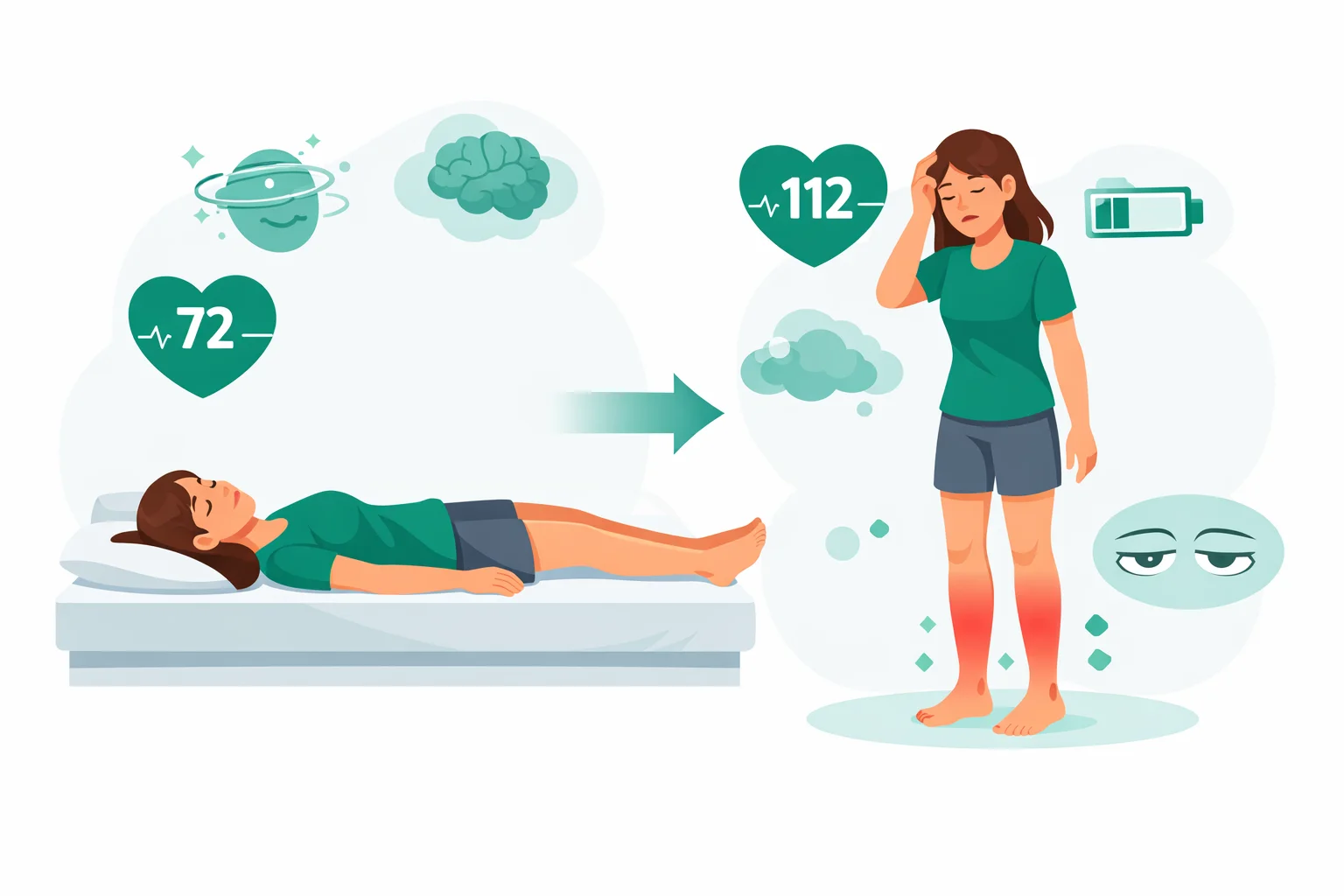
Here's the mechanical problem at the center of POTS. Every time you stand, gravity pulls roughly half a liter of blood down into your legs and abdomen. In a healthy body, blood vessels in the lower half clamp down within seconds and the heart adjusts by a modest 10 to 20 beats per minute. Crisis averted; you don't even notice.
In POTS, that automatic clamp-down fails. Blood pools in the legs, less of it returns to the heart, and the brain briefly gets shortchanged — which is why dizziness and brain fog hit. To compensate, the heart slams the accelerator, spiking 30, 40, sometimes 60 beats per minute just to keep blood moving to your head. That frantic compensation is the "tachycardia" in the name, and it's why your symptoms ease the moment you lie back down: gravity stops working against you, and your heart can finally relax. If your racing heart and lightheadedness reliably appear on standing and vanish when reclining, that position-dependence is the single most important clue separating POTS from almost everything else.
The 10-Minute Stand Test You Can Do Tonight
You don't need a hospital to get your first real data point. The "active stand test" is a simplified version of what cardiologists do, and it costs nothing but a heart-rate monitor or a finger on your pulse. Here's the protocol clinicians and POTS organizations recommend:
- Lie down flat and rest for 5 to 10 minutes. Don't skip this — your baseline has to be a true resting rate.
- Record your resting heart rate while still lying down (count for a full 60 seconds or read it off a fitness tracker or pulse oximeter).
- Stand up and stay standing as still as you safely can. Have a chair or wall nearby in case you feel faint.
- Re-check your heart rate at the 2, 5, and 10-minute marks while remaining upright.
- Subtract. A sustained rise of 30 beats per minute or more (40 or more if you're 12 to 19 years old) — without a major drop in blood pressure — is the threshold that defines POTS.
One caveat that trips people up: do this when you're not acutely dehydrated or sick, and repeat it on two or three separate days. POTS heart rates swing, and a single reading can mislead in either direction. If your numbers cross that 30-bpm line repeatedly, write them down and bring them to your doctor — a documented home stand test can be useful information to discuss. If you think you may be having a heart attack, contact local emergency services immediately. For education outside an emergency, our heart attack awareness quiz explains warning signs; it does not assess your symptoms.
Why So Many Patients Are Told "It's Just Anxiety"
Survey data from patient organizations has long pointed to an uncomfortable truth: people with POTS often wait years and see multiple doctors before getting diagnosed, and a large share are told their symptoms are anxiety or stress along the way. It's not hard to see why. A pounding heart, trembling hands, lightheadedness, and a wired, on-edge feeling describe a panic attack just as well as they describe an autonomic one.
But there's a tell, and it's the same one from the stand test. Anxiety doesn't care what position you're in — a panic attack can hit you lying in bed. POTS is mechanical: it's triggered by being upright and relieved by reclining. The fact that roughly 80% of POTS patients are women between 15 and 50 has also, historically, made the "it's just anxiety" dismissal more likely rather than less. If you've been handed that explanation but your symptoms march in lockstep with standing and sitting, that pattern is worth calmly insisting on. None of this means anxiety is never part of the picture — living with an undiagnosed condition is genuinely anxiety-provoking — so if the worry has taken on a life of its own, our anxiety quiz can help you see how much of it is generalized worry versus a misread physical signal. POTS overlaps with several women's-health conditions too — many patients also live with PCOS or endometriosis, the latter sharing both the crushing fatigue and the years-long diagnostic delay, which is why a thorough workup looks at the whole picture, not one symptom.
The Long-COVID Surge Nobody Saw Coming
For most of its short history, POTS was considered uncommon and underdiagnosed. Then 2020 happened. POTS is frequently triggered by a viral infection, and the pandemic produced a wave of people developing POTS-like symptoms in the weeks after COVID-19 — many of them previously healthy and athletic. Researchers studying cardiovascular complications of COVID began documenting new-onset autonomic dysfunction, and a meaningful fraction of people with long COVID turned out to meet POTS criteria on testing.
This matters for you in a practical way. If your symptoms started after a confirmed or suspected infection, that timeline isn't a coincidence to wave off — it's a clue that points your doctor toward a post-viral autonomic cause and away from the "stress" explanation. Question 9 in the quiz weighs a viral or physical trigger heavily for exactly this reason.
What POTS Isn't: The Common Look-Alikes
A high score on this quiz raises the question of POTS — it doesn't settle it. Several conditions produce overlapping symptoms but call for completely different treatment, which is why testing matters. Here's how the main look-alikes differ:
| Condition | What happens on standing | The key difference |
|---|---|---|
| POTS | Heart rate rises 30+ bpm; blood pressure stays roughly stable | Chronic, position-triggered, no major BP drop |
| Orthostatic hypotension | Blood pressure falls sharply (20+ systolic) on standing | It's the BP crash, not the heart rate, that defines it |
| Vasovagal syncope | Sudden BP and heart-rate drop leading to fainting | Episodic fainting, not a constant upright struggle |
| Anxiety / panic | Racing heart unrelated to body position | Can strike lying down; reclining doesn't fix it |
| Anemia / dehydration | Mild head-rush and faster pulse, often temporary | Resolves with treatment or fluids within days |
That last row is the one to rule out first, because it's the easiest to fix. Persistent fatigue and dizziness can stem from low iron, thyroid problems, or blood sugar issues — if those are on your radar, our diabetes risk quiz is a quick place to check a different cause before you assume autonomic dysfunction. The fatigue and brain fog of POTS also overlap heavily with depression, and the two are easy to confuse — our depression screening quiz uses the clinical PHQ-9 to help you tell a mood disorder apart from a circulatory one.
How This Quiz Scores Your Symptom Pattern
This isn't a checklist where every answer counts the same. The quiz weights answers by how diagnostically specific they are. A 30-plus-bpm rise you've actually measured on a stand test is worth the most points, because it maps directly onto the clinical threshold. Symptoms that ease when you lie down, blood pooling in the legs, classic heat-and-meal triggers, and a chronic duration of three-plus months are all flagged as "hallmark" features — collect several of them and the quiz bumps you into a higher likelihood band even if your raw point total sits at the edge.
Vaguer symptoms — general fatigue, occasional brain fog — still add points, but they don't move the needle as hard, because they show up in dozens of unrelated conditions. The five-part breakdown you see at the end (Standing Symptoms, Heart Response, Brain & Energy, Circulation Signs, and Pattern & Onset) shows which clusters drove your score, which is genuinely useful information to hand a clinician.
All 5 Likelihood Levels Explained
📘 Minimal Match. Your symptoms don't cluster the way POTS does. Occasional dizziness or tiredness here usually traces to ordinary causes like sleep, hydration, or low iron. No POTS-specific testing is suggested, though a basic check-up never hurts if something feels off.
💚 Low Likelihood. A few overlapping symptoms exist, but they don't form the upright-triggered pattern that defines POTS. This is the band where a home stand test earns its keep — a little data will quickly tell you whether your heart rate actually climbs on standing.
🟡 Moderate Match. Several features point toward dysautonomia, enough that the cluster deserves a real conversation rather than a brush-off. Bring specifics — timing, triggers, and what brings relief — and ask about orthostatic vital signs.
🔶 Strong Match. Your pattern fits POTS closely: upright racing heart, relief on reclining, fatigue, and fog. This is the band where people most often get stuck waiting for a diagnosis, so push for an actual stand or tilt-table test rather than accepting a stress label.
🧭 Very Strong Match. Almost every hallmark is present, often including a measured 30-plus-bpm jump on standing. A pattern this consistent warrants formal evaluation soon. Lead your appointment with your stand-test numbers and your symptom timeline.
What to Do If Your Score Is High
A strong or very strong result is a starting line, not a verdict. The most useful move is to walk into your appointment with evidence rather than a vague complaint. Bring three things: your home stand-test numbers across a few days, a short log of when symptoms hit and what triggers them, and any history of a viral illness, surgery, pregnancy, or concussion that lines up with when things started.
From there, a clinician can confirm or rule out POTS with an in-office stand test or a tilt-table study, and screen for the look-alikes in the table above. The encouraging part: POTS is manageable. First-line steps often include dramatically increasing fluids and salt, wearing compression garments, a carefully graded exercise program that rebuilds tolerance, and sometimes medications like beta blockers or ivabradine to calm the heart-rate spike. Many people improve substantially once they have a name for what's happening — which is the whole reason that 1993 definition mattered. Standing up shouldn't feel like a workout, and now you have the tools to find out why it does.