Allergies or Cold? The 12 Symptom Clues That Tell Them Apart
Wondering if you have allergies or a cold? The do I have allergies or a cold quiz above runs your symptoms through a 12-point checklist that doctors actually use — fever, eye itching, mucus consistency, sneezing pattern, duration, and a few others you'd miss on your own. You'll get a clean verdict in about 90 seconds. This guide explains exactly why those twelve questions work, and how to read the signals yourself next time you wake up stuffy at 3 a.m. and can't decide whether to reach for Claritin or DayQuil.
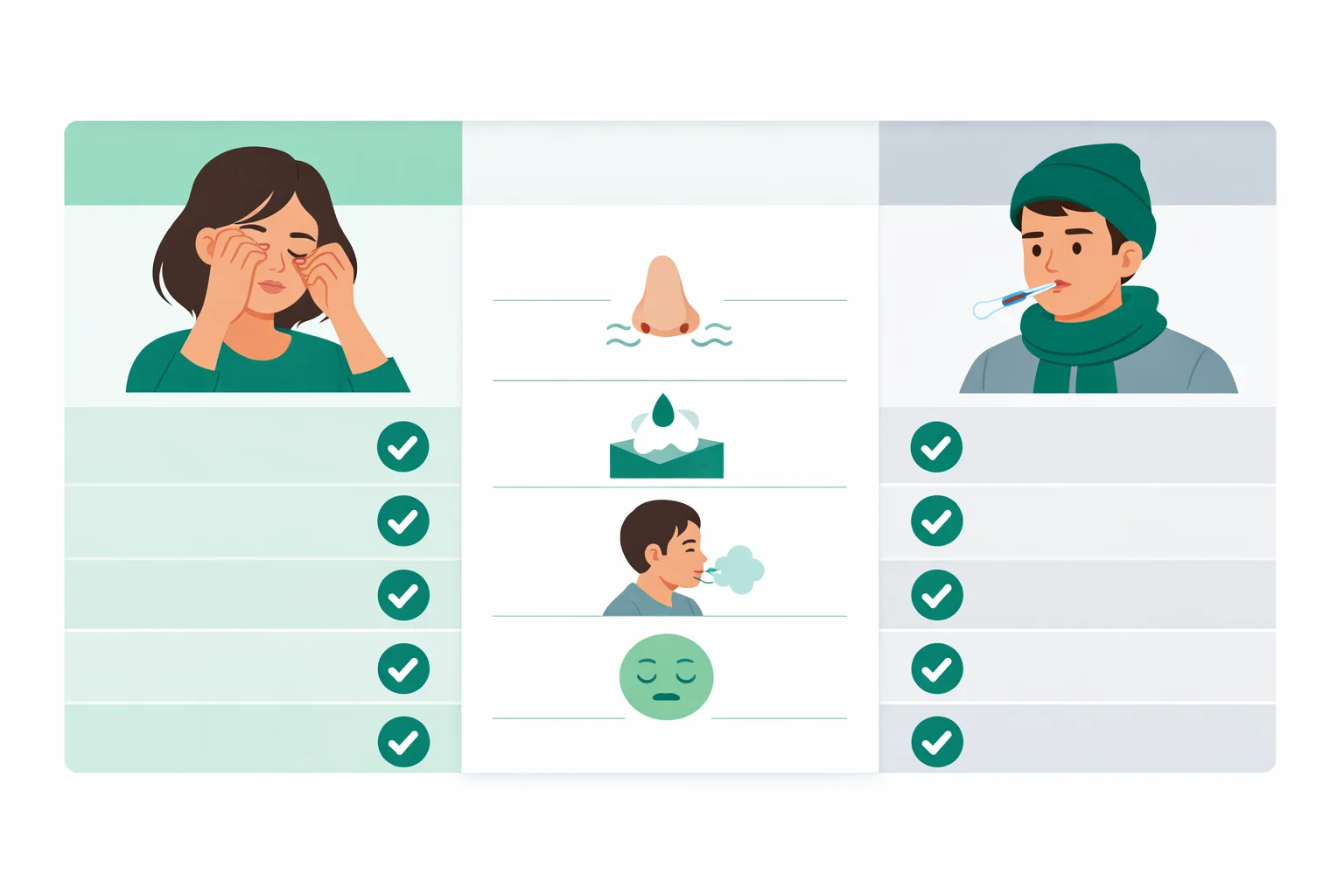
The Three Tells That Settle It in Under a Minute
Forget the long symptom checklists for a moment. If you had exactly sixty seconds to decide, there are three questions that do 80% of the diagnostic work — and they're the same three any allergist or primary-care doctor runs through in their head the moment you walk in.
Tell #1: Do your eyes itch? Not water — itch. If you find yourself rubbing them or they burn, that's histamine binding to H1 receptors in your conjunctiva. Viral colds don't do that. A 2018 review in the Journal of Allergy and Clinical Immunology found ocular itching has a positive predictive value of over 90% for allergic rhinitis when it's present. Itchy eyes alone is almost diagnostic.
Tell #2: Do you have a fever? If your thermometer reads 100.4°F (38°C) or higher, it's not allergies. Full stop. Allergies are inflammatory, not infectious — your body has no reason to raise core temperature. A measurable fever means something viral or bacterial is involved, and the most common candidate is a rhinovirus cold.
Tell #3: How long have you had this? Colds follow a tight arc: symptoms start fast, peak around day 3, and resolve by day 7-10. That's the CDC's published timeline for adult colds. Allergies don't arc. They stay at the same intensity for as long as you're exposed — which for spring pollen can be 6 straight weeks without a day's change.
If you have itchy eyes, no fever, and symptoms that have lasted more than two weeks at the same level, stop reading and grab an antihistamine. If you have a fever, body aches, and symptoms that showed up 72 hours ago, it's a cold — and the guide below will tell you exactly what to do.
Three Worked Examples From Real Symptom Patterns
The three-tell shortcut works for the clean cases. The messy ones — where half the signs point one way and half the other — are where people guess wrong and waste two days on the wrong medication. Here's how to work through them.
Example 1: "It hit me Friday afternoon after a meeting." Sudden onset within 1-2 hours of a specific exposure — particularly if it involved someone coughing or a crowded indoor space — points strongly to viral transmission. Rhinoviruses are aerosol-transmitted and take 1-3 days to produce symptoms after exposure, but people often remember the meeting or the dinner where "everyone at the table was sick." If that's you, and by Sunday you have a sore throat, body aches, and thicker mucus, you're on day 3 of a classic cold.
Example 2: "I've felt this way for a month and it's worst when I walk the dog." Duration of four weeks plus environmental trigger is allergies, not a cold. No viral infection lasts that long — your immune system would have cleared it by week two. The dog-walking trigger is the giveaway: pollen, outdoor mold, or grass exposure spiking your symptoms each time you're outside. This is textbook allergic rhinitis, and a daily antihistamine plus a steroid nasal spray would likely clear it within 72 hours.
Example 3: "Started as sneezing and itchy eyes last week, but now I have a sore throat and I'm achy." This is the hybrid case — the dual-result quiz zone. You had allergies, your nasal barrier was inflamed, and you then picked up a rhinovirus on top of it. A 2014 paper in Journal of Allergy and Clinical Immunology documented that allergic rhinitis sufferers show a 40% higher rate of rhinovirus infection during peak allergy season. The treatment approach: don't pick one side. Take your usual antihistamine AND treat the cold symptoms — rest, fluids, saline rinse, acetaminophen for the aches.
Side-by-Side: Allergies vs. Cold on Every Major Symptom
If you want the full diagnostic picture in one place, this is the table doctors teach medical students. Every row below is a symptom that can appear in both conditions but presents differently enough to tell them apart.
| Symptom | Allergies | Cold |
|---|---|---|
| Itchy eyes / nose / throat | Common — often severe | Rare |
| Fever | Never | Sometimes (low-grade) |
| Body aches | No | Common |
| Sneezing | Fits of 4-6+ in a row | Occasional single sneezes |
| Mucus | Clear and thin | Starts clear, turns thick/yellow/green |
| Sore throat | Tickly, not painful | Scratchy and painful when swallowing |
| Cough | Dry, often worse at night | Wet, productive |
| Duration | Weeks to months | 7-10 days |
| Onset | Immediately after exposure | 1-3 days after exposure |
| Triggered by environment | Yes — worse in specific places | No — same wherever you go |
| Responds to antihistamines | Yes, within 1-2 hours | No |
| Contagious | No | Yes |
Read that table horizontally for any symptom you have. If three or more rows have your pattern lining up cleanly on the left, you have your answer. If symptoms straddle both columns — as in our Example 3 above — you may be looking at both conditions at once. The period symptom quiz uses a similar two-axis scoring approach for distinguishing PMS from other causes.
Why These Two Get Confused in the First Place
Here's the uncomfortable truth: allergies and colds share a final common pathway. Both end up inflaming the same nasal epithelium, both trigger the same mucus production from the same goblet cells, both irritate the same trigeminal nerve branches that drive sneezing. The cause is different — histamine release versus viral replication — but the symptoms converge at the end of the pipeline.
This is why symptom-by-symptom matching often fails. A runny nose is a runny nose. Congestion feels like congestion. The diagnostic value isn't in any single symptom — it's in the pattern: what combination you have, how fast it started, how long it's lasted, and what context triggered it. That's why the quiz asks about environment, duration, and exposure history on top of the symptom questions. The pattern is the diagnosis.
It also helps to know that the word "hay fever" is a historical mistake. The term was coined in 1819 by English physician John Bostock, who correctly observed a seasonal syndrome in farm workers but incorrectly assumed the cause was an infection from hay — hence "fever." Allergic rhinitis causes no fever at all. The name stuck for two hundred years because it sounded scientific, which is a useful reminder that medical intuition isn't always right.
The Treatment Mismatch That Wastes 48 Hours
Here's the part of this that has real financial cost. Walk into any U.S. pharmacy and you'll find two aisles: allergy medications and cold/flu medications. They share almost no active ingredients, and taking the wrong aisle's products gets you zero of the intended effect.
Claritin, Zyrtec, Allegra, and Flonase are antihistamines and intranasal steroids. They target the histamine pathway and downstream inflammation. They do essentially nothing for a viral cold because viral colds don't release significant histamine. A 2015 Cochrane review of 18 trials concluded that antihistamines have "no clinically significant effect" on common cold symptoms in adults.
DayQuil, NyQuil, Mucinex, and Sudafed contain decongestants (pseudoephedrine or phenylephrine), expectorants (guaifenesin), cough suppressants (dextromethorphan), and pain relievers (acetaminophen). They treat the downstream symptoms of a cold but don't touch the histamine pathway. Taking DayQuil for allergies will suppress your cough temporarily and may dry you out, but by hour four you're back to square one.
The cost: if you reach for the wrong aisle on day one, you've burned 24-48 hours of potential relief before the mismatch becomes obvious. For allergies, that's two miserable days of itching and sneezing you didn't need to have. For a cold, that's two days when zinc lozenges — which a Cochrane review found can shorten duration if started within 24 hours of onset — are no longer useful.
When It's Actually Neither One
Sometimes the quiz returns an inconclusive result, and there's a real reason for it. About 1 in 6 people who genuinely have allergy-or-cold-like symptoms have something else entirely driving them.
The biggest impostor is non-allergic rhinitis, which affects roughly 19 million Americans according to the American College of Allergy, Asthma & Immunology. It produces the same runny nose and congestion as allergies, but it's triggered by strong smells, temperature changes, spicy food, or barometric pressure shifts — not by a specific allergen. Skin-prick tests come back negative. Antihistamines don't help much. A nasal steroid spray or ipratropium bromide spray is the usual fix.
The next impostor is acid reflux, or more specifically laryngopharyngeal reflux. Stomach acid refluxing up to the throat irritates the larynx and causes chronic throat-clearing, postnasal drip, and a dry cough — symptoms that mimic allergies but won't respond to any allergy medication. If your "allergies" are worst at night when you're lying down, or after big meals, this is worth investigating.
A third possibility is sinusitis, which often develops as a complication of either a cold or unmanaged allergies. Facial pressure, pain around the eyes or forehead, and thick colored discharge lasting beyond 10 days suggest a bacterial sinus infection that may need antibiotics. If you think you may be having a heart attack, contact local emergency services immediately. For education outside an emergency, our heart attack awareness quiz explains warning signs without assessing your symptoms.
All 6 Possible Quiz Results Explained
🌿 Most Likely Allergies — The strongest allergy pattern: itchy eyes, repetitive sneezing, clear thin mucus, no fever, symptoms tied to a season or environment. This result means your score cleared the decisive-diagnosis threshold. The standard first-line treatment is a daily non-drowsy antihistamine, with noticeable relief expected within 24 hours. Roughly 40% of quiz takers land here — allergies affect about 1 in 4 U.S. adults.
🌸 Leaning Toward Allergies — The pattern is allergic but not overwhelmingly so. Perhaps you have itchy eyes and seasonal timing but no environmental trigger, or you sneeze in fits but don't notice eye involvement. The evidence tips allergy, but you should try a 48-hour antihistamine test. If symptoms meaningfully improve, you have your answer. If not, reconsider as a cold or non-allergic rhinitis.
🤧 Most Likely a Cold — The classic viral cold fingerprint: fever, body aches, sore throat, thick colored mucus, rapid onset within 1-3 days, recent sick contacts. This result means antihistamines won't help you — the driver is viral replication, not histamine. Focus on rest, fluids, symptomatic relief, and the 7-10 day arc. About 28% of quiz takers land here.
🤧 Leaning Toward a Cold — Viral signs dominate but the classic triad (fever + aches + exposure) isn't fully present. You may be on day 1-2 before the cold has declared itself, or dealing with a mild strain. Treat supportively and reassess at day 4. Avoid antihistamines initially — they'll dry out your airway without helping.
🌪️ Likely Both — Cold Layered Over Allergies — Rare but real. You show high signal on both axes, which typically means you caught a rhinovirus while your seasonal allergies were already active. Treat both simultaneously: antihistamine for the allergy layer plus supportive care for the cold. This happens most often during April-May or September peaks.
🤔 Inconclusive — Likely Something Else — Neither pattern dominates. Your symptoms may fit non-allergic rhinitis, acid reflux with postnasal drip, a developing sinus infection, or very early-stage symptoms that haven't fully declared themselves. Track for 48-72 hours and retake the quiz if things change. If symptoms persist past two weeks, see a doctor.
What to Do With Your Result
A quiz result is a starting point, not an endpoint. Treat the result as a hypothesis and give it a 48-hour test. If you got an allergy result, pick up loratadine, cetirizine, or fexofenadine and take it once a day for two days. Real allergies show improvement within 24 hours of the first dose. No change after 48 hours means the hypothesis was wrong — try the other category, or see a doctor.
If you got a cold result, commit to the 7-10 day arc. Rest, fluids, zinc lozenges within the first day, saline rinses for congestion, acetaminophen or ibuprofen for aches. Don't layer on antihistamines hoping for extra relief — they don't add anything and can thicken mucus. If you're still sick past day 10 at the same severity, something else is going on.
The single most underrated move: if allergies show up seasonally every year, start your antihistamine a week before your usual trigger season begins. Pre-loading the medication primes your histamine receptors and substantially reduces peak-season symptoms — a strategy documented in the American Academy of Allergy, Asthma & Immunology's patient guidelines and one most people discover only after years of reactive treatment. For more symptom-tracking strategies, the CDC's common cold overview is a solid, jargon-free reference.