PCOS Quiz: Rotterdam Criteria, Androgen Patterns, and What Your Score Actually Means
A PCOS quiz can point you in the right direction — but the condition it's screening for is misunderstood by nearly everyone who takes one. A 2023 systematic review in Nature Reviews Endocrinology estimated that 8-13% of reproductive-age people worldwide have polycystic ovary syndrome, making it the most common endocrine disorder in this population. Yet the average time to diagnosis is over two years, and a 2017 survey in the Journal of Clinical Endocrinology & Metabolism found that a third of patients saw three or more doctors before receiving a correct diagnosis.
Why the delay? Partly because the name itself is misleading. PCOS doesn't require cysts, doesn't always involve the ovaries, and isn't a single disease — it's a syndrome with at least four distinct phenotypes that present differently in different people. The quiz above evaluates 15 symptom patterns across four categories, but understanding why those categories matter is what separates useful self-assessment from guesswork.
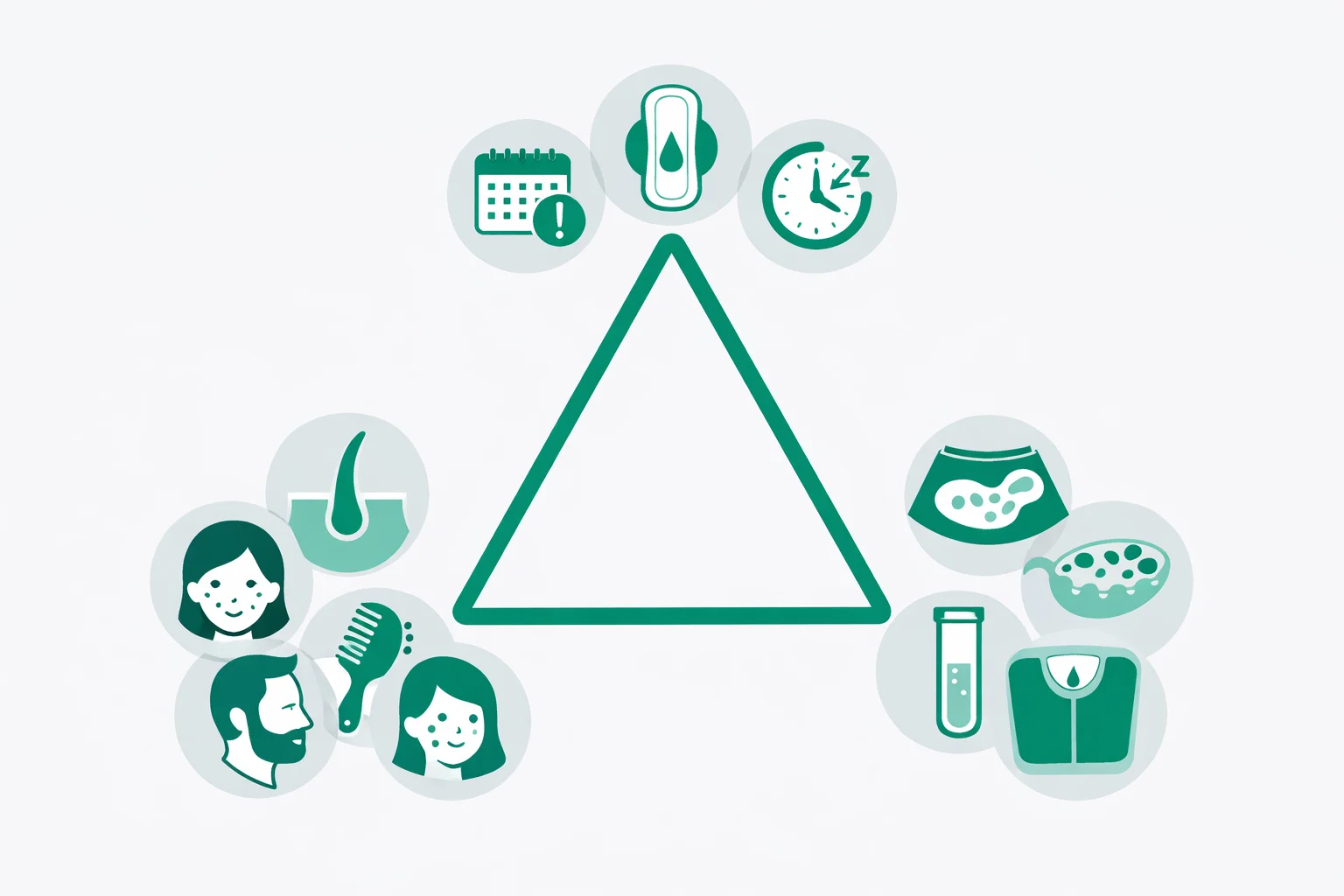
The Three-Legged Diagnostic Stool Most Quizzes Ignore
In 2003, a group of reproductive endocrinologists in Rotterdam, Netherlands established the criteria that clinicians still use today. To be diagnosed with PCOS, you need at least two of three:
| Criterion | What It Means Clinically | How It Shows Up in Daily Life |
|---|---|---|
| Oligo/anovulation | Fewer than 8 cycles per year, or cycles longer than 35 days | Skipped periods, unpredictable cycle length, very light or very heavy bleeding |
| Hyperandrogenism | Elevated testosterone or DHEA-S on blood work, OR visible signs | Hirsutism (coarse facial/body hair), hormonal acne along jawline, scalp hair thinning |
| Polycystic ovarian morphology | 12+ follicles per ovary or ovarian volume >10 mL on ultrasound | Often asymptomatic — you can't feel this. Only visible on imaging |
Here's the critical detail most online quizzes miss: you don't need all three. A person with perfectly regular periods can have PCOS if they have hyperandrogenism plus polycystic ovaries. Someone with irregular periods and acne but normal-looking ovaries on ultrasound still qualifies. This two-of-three rule creates four distinct phenotypes — and they have very different risk profiles. If you're also noticing symptoms like fatigue or missed periods that might suggest pregnancy rather than PCOS, our pregnancy symptom checker can help you distinguish between the two, since the overlap is significant.
Which of the Four PCOS Phenotypes Matches Your Pattern?
Not all PCOS is the same. A 2016 study in Fertility and Sterility analyzed over 1,000 patients and confirmed that the four phenotypes carry different metabolic risks, respond to different treatments, and even have different long-term prognoses.
| Phenotype | Criteria Present | Key Features | Metabolic Risk |
|---|---|---|---|
| A — Classic (Full) | All three | Irregular periods + high androgens + polycystic ovaries | Highest — insulin resistance in 60-80% |
| B — Classic (Non-PCO) | Anovulation + hyperandrogenism | Irregular periods + high androgens, normal ovaries on ultrasound | High — similar to Type A |
| C — Ovulatory | Hyperandrogenism + polycystic ovaries | Regular periods but acne, hirsutism, and cystic ovaries | Moderate — lower insulin resistance |
| D — Non-hyperandrogenic | Anovulation + polycystic ovaries | Irregular periods + cystic ovaries, no excess androgens | Lowest — mildest metabolic impact |
Phenotype A is what most people picture when they hear "PCOS" — the full triad. But phenotype D, which involves irregular periods and polycystic ovaries without any androgen excess, is often missed entirely because it doesn't fit the stereotype. A person with phenotype D won't have acne, hirsutism, or hair thinning. They'll just have frustratingly irregular periods and trouble conceiving — and many doctors will attribute that to stress.
The Insulin Problem That Drives 70% of PCOS Cases
If PCOS has a "root cause" in most people, it's insulin resistance — and this is the connection that transforms PCOS from a reproductive nuisance into a lifelong metabolic concern. A landmark 1989 study by Dunaif et al. in the Journal of Clinical Investigation first demonstrated that insulin resistance in PCOS is independent of obesity — meaning lean people with PCOS also have it, just less severely.
Here's how the cascade works: when cells become resistant to insulin, the pancreas produces more of it to compensate. Elevated insulin directly stimulates the ovaries to produce excess testosterone. That testosterone disrupts follicle development (causing the "cysts" that aren't really cysts — they're immature follicles), suppresses ovulation, and triggers the visible symptoms: hirsutism, acne, and scalp hair thinning. Meanwhile, the chronically elevated insulin promotes fat storage, especially visceral belly fat, which worsens insulin resistance further. It's a feedback loop.
This is why questions 6-9 in the quiz focus specifically on metabolic markers — weight gain concentrated around the midsection, energy crashes between meals, dark skin patches (acanthosis nigricans), and skin tags. These are all clinical signs of insulin resistance that you can see without blood work. A fasting insulin test confirms it, but the physical signs are remarkably reliable predictors. And because PCOS with insulin resistance carries a 5-10x higher risk of developing type 2 diabetes by age 40 according to The Endocrine Society, catching it early isn't just about managing acne — it's about long-term metabolic health. If that risk is on your radar, our diabetes risk quiz scores the same insulin-resistance factors from the blood-sugar side.
Losing Hair on Your Head While Growing It Everywhere Else
The cruelest trick of PCOS androgens: the same hormones that cause thick, dark hair to sprout on your chin, chest, and abdomen simultaneously thin the hair on your scalp. It feels contradictory, but the biology is straightforward. Hair follicles respond to androgens differently depending on their location.
Body and facial hair follicles have receptors that respond to dihydrotestosterone (DHT) by prolonging the growth phase — so hairs grow longer, thicker, and darker. Scalp follicles, particularly at the crown and temples, respond to DHT by shortening the growth phase and miniaturizing the follicle. Same hormone, opposite effect, different receptor behavior. A 2011 review in the Journal of the European Academy of Dermatology and Venereology measured this effect: women with PCOS showed a 35% reduction in scalp hair density at the vertex compared to controls, while simultaneously scoring 2-3x higher on the Ferriman-Gallwey hirsutism scale.
This pattern — simultaneous hirsutism and androgenic alopecia — is actually one of the most specific signs pointing toward PCOS rather than other causes. Thyroid-related hair loss, for instance, thins hair uniformly across the scalp without causing excess body hair. Stress-related shedding (telogen effluvium) causes diffuse loss without the characteristic temporal recession pattern. If you're losing hair on your head while finding new dark hairs on your jaw, your body is essentially telling you that androgens are elevated — whether or not you've confirmed it with blood work yet. If you're also tracking your menstrual readiness and cycle patterns, combining both assessments gives a fuller picture of what's happening hormonally.
Five Conditions That Look Like PCOS but Aren't
One reason PCOS takes so long to diagnose isn't just doctor unfamiliarity — it's that several other conditions produce nearly identical symptom clusters. Proper PCOS diagnosis requires ruling these out first:
Hypothyroidism causes irregular periods, weight gain, fatigue, hair thinning, and depression — overlapping with 5 of 15 questions on this quiz. A single TSH blood test distinguishes the two. About 1 in 8 people with ovaries will develop a thyroid condition in their lifetime, and hypothyroidism is far more common than PCOS. Worth knowing that the gland fails in both directions: an overactive thyroid also disrupts cycles, just by making them lighter or absent rather than heavier. The thyroid symptom quiz scores both directions separately, which is the distinction a single TSH request tends to flatten.
Non-classic congenital adrenal hyperplasia (NCAH) is the great PCOS mimic. It causes excess androgens (acne, hirsutism), irregular periods, and sometimes polycystic-appearing ovaries. NCAH affects roughly 1 in 100-200 people and is caused by a genetic enzyme deficiency (21-hydroxylase). The distinguishing blood test is 17-hydroxyprogesterone — if your doctor didn't order it, NCAH hasn't been ruled out.
Cushing's syndrome (cortisol excess) produces central weight gain, acne, hirsutism, irregular periods, and insulin resistance. It's rare but can be caused by certain medications (particularly long-term corticosteroids) or adrenal/pituitary tumors. If your symptoms appeared suddenly alongside rapid weight gain, this deserves consideration.
Hypothalamic amenorrhea causes missed periods in people who are underweight, over-exercising, or under severe stress. It's the functional opposite of PCOS — low hormones instead of high — but the primary complaint ("my period is gone") is identical. If you score high on menstrual symptoms but low on androgen and metabolic symptoms, this may be more likely than PCOS.
Prolactinoma (a benign pituitary tumor) causes irregular or absent periods, sometimes alongside headaches and breast discharge. Elevated prolactin levels suppress the reproductive axis in a way that can look like PCOS on the surface. A prolactin blood test rules this out within 24 hours.
One condition that isn't on this list deserves a mention anyway: endometriosis. It doesn't mimic PCOS hormonally — androgens and insulin aren't part of its picture — but it's the diagnosis people most often get bounced toward and away from when the presenting complaint is pelvic pain. The two can coexist, and the tell is timing: PCOS pain tends to be a dull ache tied to enlarged ovaries, while endometriosis pain escalates over years and keeps to the cycle, often reaching the bowel or bladder. If pain rather than irregular cycles is your loudest symptom, our endometriosis symptom quiz maps that pattern instead.
The broader lesson: overlapping symptoms are why medicine relies on pattern-matching across multiple signs rather than any single complaint. The same logic drives our allergies or cold quiz, which weighs 12 symptoms against two possible diagnoses to separate an immune overreaction from a viral infection — the methodology mirrors how an allergist or primary-care doctor differentiates common conditions in 60 seconds.
How This Symptom Checker Maps to Rotterdam Criteria
Most PCOS quizzes online are glorified checklists — count the symptoms, give a number. This quiz does something different: it maps your answers to the four diagnostic categories that matter clinically, then evaluates the pattern across categories rather than relying on a single total score.
Menstrual symptoms (questions 1, 2, 13) carry the highest combined weight because oligo/anovulation is the most common PCOS criterion — present in roughly 75% of diagnosed cases. A person with absent periods and a family history of PCOS will score high here even if their skin is clear and their weight is stable.
Androgen symptoms (questions 3, 4, 5) target visible hyperandrogenism. The quiz weights severe hirsutism (question 3) heavily because a Ferriman-Gallwey score above 8 is considered clinical hirsutism in most populations. Jawline acne and temporal hair thinning are weighted separately because each reflects a different androgen pathway — and having both is more significant than having either alone.
Metabolic symptoms (questions 6, 7, 8, 9) assess insulin resistance markers that most online quizzes ignore entirely. Acanthosis nigricans (dark, velvety skin patches) is an 88% positive predictor of insulin resistance according to a 2012 study in Clinical Dermatology. Skin tags, central weight gain, and reactive hypoglycemia symptoms round out the metabolic picture.
Reproductive and context (questions 10-15) capture family history, fertility experience, mood patterns, pelvic symptoms, and prior diagnostic testing. These don't map directly to Rotterdam criteria, but they add crucial context — especially family history, since PCOS heritability is estimated at 70%. Our heart attack awareness quiz teaches warning signs and emergency action; it does not evaluate symptoms or personal risk. PCOS also frequently overlaps with POTS in young women, so if you battle dizziness and a pounding heart on standing, our POTS syndrome quiz is worth a look too. And because the hormonal swings of PCOS roughly double the odds of depression, if low mood and fatigue have lingered for weeks, our depression screening quiz can help you gauge whether it's crossed a clinical threshold.
All 5 PCOS Concern Levels Explained
Your quiz result places you in one of five levels based on your total weighted score across all 15 questions. Each level reflects a different combination of symptom intensity and diagnostic probability:
💚 Low Concern — You scored below 15% of the maximum. Your symptom profile shows minimal overlap with PCOS patterns. Most people here have regular periods, no androgen symptoms, and stable metabolic markers. About 31% of quiz takers fall into this range. Continue routine health monitoring and revisit if new symptoms develop.
💛 Mild Indicators — You scored between 15-30%. A few symptoms overlap with PCOS, but they're equally consistent with stress, thyroid issues, or normal hormonal variation. About 26% of quiz takers score here. Track your symptoms over 3-6 months before pursuing workup — isolated symptoms rarely indicate PCOS.
🧡 Moderate Concern — You scored between 30-50%. You're showing a meaningful symptom cluster across multiple categories, which is the pattern that warrants clinical evaluation. About 22% of quiz takers reach this level. Schedule an appointment with a gynecologist or endocrinologist and request baseline blood work.
🩷 Elevated Concern — You scored between 50-70%. Multiple PCOS indicators are present, often spanning menstrual, androgen, and metabolic categories. About 14% of quiz takers score here. This combination — particularly irregular periods alongside visible androgen signs — is the classic presentation that leads to PCOS diagnosis. Seek evaluation promptly.
💜 High Concern — You scored above 70%. Your symptom profile strongly aligns with PCOS across nearly every diagnostic category. Only about 7% of quiz takers reach this level. If you haven't been diagnosed yet, prioritize seeing an endocrinologist. If you're already diagnosed, your score suggests that current treatment may need adjustment.
The Blood Tests That Actually Confirm (or Rule Out) PCOS
No quiz — including this one — can diagnose PCOS. Only blood work and imaging can. But knowing which tests to ask for is half the battle, because many general practitioners don't order the full panel. Here's the specific workup recommended by the Endocrine Society's 2013 Clinical Practice Guideline:
Total and free testosterone — the single most important test. Elevated testosterone confirms biochemical hyperandrogenism even when clinical signs (acne, hirsutism) are ambiguous. Free testosterone is more sensitive than total testosterone because it reflects the biologically active fraction.
DHEA-S — an adrenal androgen that, when markedly elevated, can point toward adrenal causes (like NCAH or an adrenal tumor) rather than ovarian PCOS.
17-hydroxyprogesterone — rules out non-classic congenital adrenal hyperplasia. This test is frequently skipped, which means NCAH is frequently missed.
TSH — rules out thyroid disease. Simple, cheap, and essential before attributing irregular periods to PCOS.
Fasting insulin and fasting glucose — assesses insulin resistance. Some clinicians also order a 2-hour glucose tolerance test, which is more sensitive than fasting glucose alone for detecting prediabetes in PCOS.
Pelvic ultrasound — looks for polycystic ovarian morphology (12+ follicles per ovary). A transvaginal ultrasound is more accurate than transabdominal, but either provides useful information. Remember: polycystic-appearing ovaries on ultrasound alone don't diagnose PCOS — they're just one of three possible criteria.
If your doctor dismisses your concerns without running these tests, you have every right to ask for a referral to an endocrinologist or reproductive endocrinologist. PCOS is real, it's common, and early identification changes outcomes — particularly for insulin resistance management and fertility preservation.