Am I Pregnant Quiz: Early Pregnancy Symptoms Week by Week and When to Test
The am i pregnant quiz you just took evaluates 15 symptoms — but here's what most symptom lists online won't tell you: the majority of "early pregnancy signs" are indistinguishable from PMS without a test. A 2020 systematic review in BMC Pregnancy and Childbirth confirmed what OB-GYNs have known for decades — 89% of common early pregnancy symptoms overlap with premenstrual symptoms. Breast tenderness, fatigue, mood swings, bloating, mild cramps? Those happen every cycle for millions of people who aren't pregnant.
So why does this quiz exist if symptoms alone can't tell you? Because pattern matters more than any single symptom. One sore breast means nothing. A missed period combined with nausea, heightened smell sensitivity, unusual fatigue, and implantation-type spotting paints a very different picture. The quiz above uses weighted scoring to evaluate the full combination, not individual checkboxes.
5 Pregnancy Symptom Myths That Mislead Thousands of People
Google "early pregnancy symptoms" and you'll find lists that confidently state you'll feel nauseous within days of conception, crave pickles, or "just know." Here's what the research actually shows:
Myth 1: Morning sickness starts immediately after conception. Reality: hCG — the hormone that triggers nausea — doesn't reach meaningful levels until after implantation, which takes 6-12 days post-ovulation. A 2000 study in the New England Journal of Medicine found that nausea onset peaks at week 8, not week 2. If you feel nauseous two days after unprotected sex, it isn't morning sickness.
Myth 2: A missed period guarantees pregnancy. Reality: the American College of Obstetricians and Gynecologists (ACOG) notes that irregular periods affect up to 30% of people of reproductive age. Stress, weight changes, thyroid dysfunction, and PCOS all cause missed periods without pregnancy — and if you're younger, irregular cycles are especially common in the first 1-2 years after menarche (our period quiz covers what to expect during that transition). A missed period is the strongest non-test indicator — but "strong" isn't "proof."
Myth 3: Cravings and aversions appear within the first week. Reality: food aversions are driven by rising hCG and estrogen, which don't surge until weeks 5-6. The classic "I suddenly hated coffee" story is real — but it doesn't happen until at least 2-3 weeks after conception in most cases.
Myth 4: Implantation bleeding always happens and looks a specific way. Reality: only about 25% of pregnancies involve noticeable implantation bleeding according to the American College of Obstetricians and Gynecologists. When it does occur, it's typically light pink or brown spotting lasting 1-2 days — but plenty of non-pregnancy spotting looks identical.
Myth 5: If you "feel pregnant," you probably are. Reality: confirmation bias is powerful. A 2016 study in Psychosomatic Medicine demonstrated that people actively trying to conceive reported more "pregnancy symptoms" during cycles where they didn't conceive than cycles where they did. Your brain manufactures symptoms when you're looking for them.
When Do Pregnancy Symptoms Actually Start?
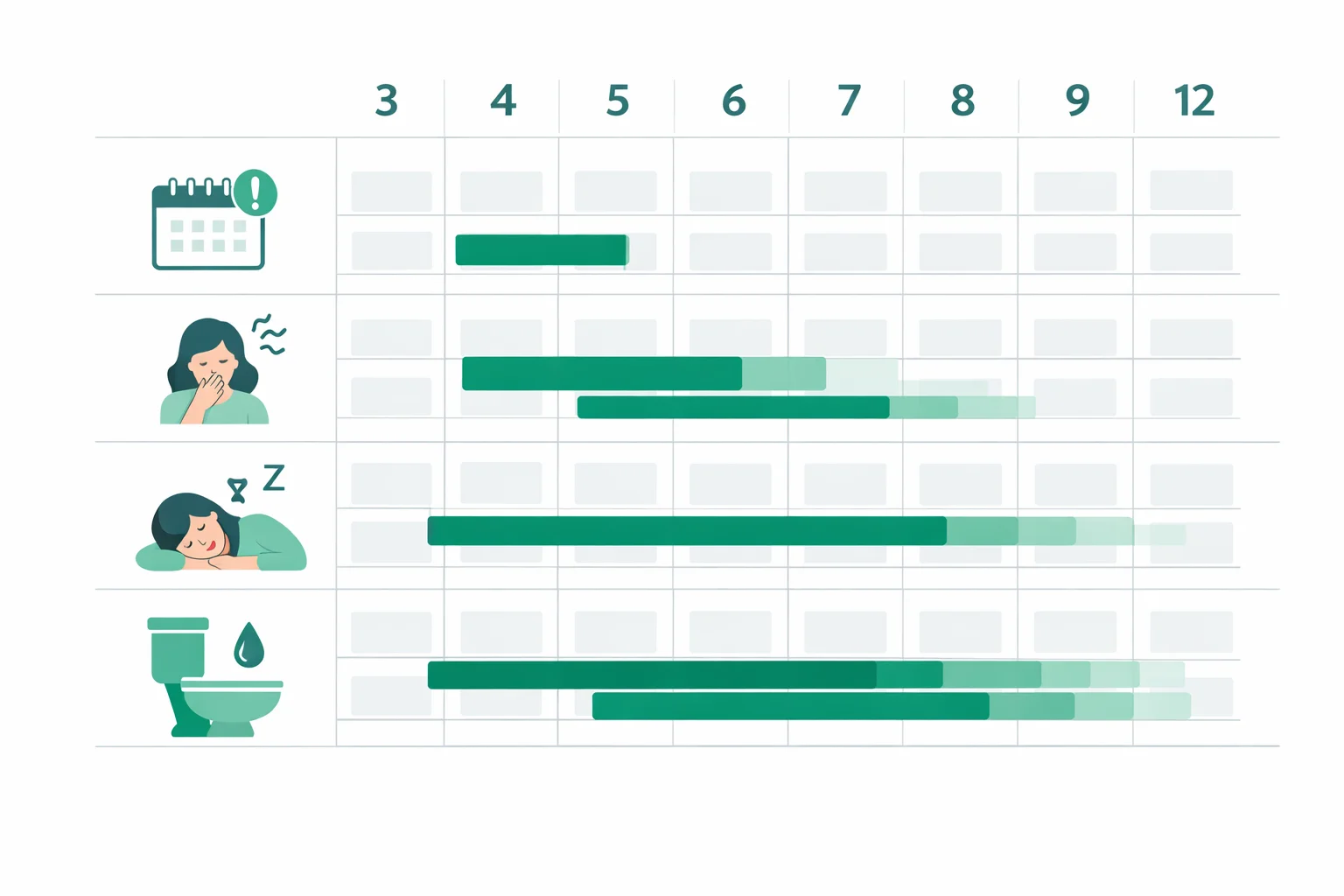
Timing separates real early pregnancy signals from wishful thinking or PMS anxiety. Here's what happens biologically, week by week:
| Week Post-Ovulation | What's Happening | Possible Symptoms |
|---|---|---|
| Week 1-2 | Fertilization, then the embryo travels down the fallopian tube | None — it's too early for any symptoms |
| Week 3 (implantation) | Embryo implants in uterine wall; hCG production begins | Possible implantation spotting (25% of cases), mild cramping |
| Week 4 (missed period) | hCG doubles every 48-72 hours; progesterone surges | Missed period, breast tenderness, fatigue, mild bloating |
| Week 5-6 | hCG peaks; estrogen rises significantly | Nausea begins, food aversions, frequent urination, mood shifts |
| Week 7-8 | Blood volume increases 30-50%; hormones plateau | Nausea peaks, heightened smell, dizziness, vivid dreams |
| Week 9-12 | Placenta begins taking over hormone production | Symptoms may start easing — or intensify before improving |
The critical takeaway: if you're only 1-2 weeks past ovulation and haven't missed your period, most symptoms you're noticing are more likely cycle-related than pregnancy-related. The quiz weights your answers accordingly — a missed period plus nausea scores far higher than fatigue alone.
PMS or Pregnant? The Symptoms That Actually Differ
Here's something most pregnancy quizzes online completely ignore: researchers have identified a few symptoms that actually do differ between PMS and early pregnancy, even though the vast majority overlap. If you're trying to figure out which camp you fall into before your test, these are the ones worth paying attention to.
| Symptom | PMS Pattern | Pregnancy Pattern |
|---|---|---|
| Breast tenderness | Peaks before period, resolves once bleeding starts | Persists and intensifies after missed period; nipples darken |
| Cramping | Strong, rhythmic cramps that lead into period flow | Mild, intermittent pulling/tugging sensation; no heavy flow follows |
| Fatigue | Moderate; improves once period starts | Extreme, described as "drugged" tiredness; worsens for weeks |
| Nausea | Rare in PMS; if present, usually mild | Persistent, often triggered by specific smells; can include vomiting |
| Smell sensitivity | Almost never occurs with PMS | Heightened sense of smell is one of the most pregnancy-specific symptoms |
| Spotting | Leads into increasing flow over 1-2 days | Light spotting that stops; doesn't progress to full flow |
The standout differentiator? Heightened smell sensitivity. A 2004 study in Chemical Senses found that pregnant individuals showed measurably increased olfactory sensitivity as early as the first missed period — and this symptom almost never occurs with PMS alone. Question 10 in the quiz above specifically targets this signal because of its unusually high specificity for pregnancy.
The hCG Curve and Why Testing Timing Matters
Home pregnancy tests detect human chorionic gonadotropin (hCG) in urine. The problem? hCG levels vary enormously between individuals in early pregnancy. At 4 weeks (around the time of a missed period), hCG can range from 5 to 426 mIU/mL — an 85-fold difference between people at the same gestational age. Most home tests claim to detect hCG at 25 mIU/mL, but a 2014 analysis in the Journal of the American Pharmacists Association found that only 16% of tests achieved their advertised sensitivity at that threshold.
This is why timing matters more than test brand. Testing on the day of your expected period catches about 54% of pregnancies. Waiting until one week after the missed period catches over 99%. If you scored "elevated" or higher on this quiz but got a negative test, it doesn't mean you aren't pregnant — it may mean your hCG hasn't reached the test's detection threshold yet.
Blood tests at your doctor's office are significantly more sensitive, detecting hCG levels as low as 1-2 mIU/mL. If your symptoms persist and urine tests stay negative, a blood draw is the definitive next step. Your career priorities or daily routine might make scheduling that appointment feel inconvenient — but it's worth the clarity.
How This Symptom Checker Weights Your Answers
Not all symptoms carry equal diagnostic weight, and this is where most online pregnancy quizzes fail — they treat "I'm tired" the same as "I missed my period." Our quiz uses evidence-based weighted scoring across four categories:
Menstrual indicators (highest weight): A missed period combined with exposure to pregnancy is the strongest non-test signal. Question 1 alone can contribute up to 7 points because a late period shifts the probability curve more than any other single symptom.
Physical symptoms (moderate-high weight): Nausea, breast changes, smell sensitivity, urination frequency, and spotting patterns. These are weighted by their specificity — smell sensitivity scores higher than general fatigue because it's more pregnancy-specific.
Emotional/sleep symptoms (moderate weight): Mood swings, sleep disruption, and vivid dreams. These are real pregnancy symptoms, but they also overlap heavily with stress and PMS, so they carry less individual weight.
General context (variable weight): Your sexual activity and contraception status, whether you've already tested, and the metallic taste symptom (dysgeusia). A positive home test result in question 15 carries the highest single-question weight because it's the closest thing to confirmation this quiz can capture.
When Symptoms Lie: Conditions That Mimic Pregnancy
If you scored high on this quiz but your pregnancy test is negative, don't panic — but don't ignore the symptoms either. Several conditions produce pregnancy-like symptom clusters that deserve medical attention on their own:
Thyroid disorders (both hypo- and hyperthyroidism) cause fatigue, missed periods, mood swings, and weight changes. About 1 in 8 people with ovaries will develop a thyroid condition in their lifetime according to the American Thyroid Association. A simple blood test (TSH level) can rule this out.
Polycystic ovary syndrome (PCOS) affects up to 12% of reproductive-age people and commonly causes irregular periods, nausea, bloating, acne, and fatigue — overlapping significantly with early pregnancy symptoms. If your pregnancy tests keep coming back negative but your periods are irregular, our PCOS symptom quiz evaluates 15 androgen, metabolic, and menstrual patterns that distinguish PCOS from other causes.
Early perimenopause can begin in the late 30s or 40s and produces missed periods, breast tenderness, mood swings, and sleep disruption that closely mirror pregnancy. If you're over 38 and experiencing these symptoms cyclically, it's worth discussing with your doctor. If you think you may be having a heart attack, contact local emergency services immediately. Our heart attack awareness quiz is for education outside an emergency and cannot assess your symptoms.
Pseudocyesis (false pregnancy) is rare but documented — the mind produces real physical symptoms including nausea, breast enlargement, and even a sensation of fetal movement without an actual pregnancy. Stress and intense desire or fear of pregnancy are triggers. A 2013 review in Psychosomatics found about 1-6 cases per 22,000 births in the U.S. A final worth-noting overlap: persistent fatigue, congestion, and head pressure in early pregnancy can be mistaken for a lingering viral illness — our allergies or cold quiz uses a similar differential-scoring approach if respiratory symptoms are what's really bothering you. If you want to understand how your body responds to stress in general, our animal personality quiz explores how different temperaments handle uncertainty — a lighter way to process the waiting period.
All 5 Likelihood Levels Explained
Your quiz result falls into one of five levels based on the total weighted score across all 15 questions. Here's what each level means and the typical symptom profile behind it:
💚 Low Likelihood — You scored below 15% of the maximum points. Your symptom profile shows minimal overlap with early pregnancy patterns. Most people at this level have on-time periods, no exposure risk, and symptoms that are better explained by normal cycle variations, stress, or minor health changes. About 34% of quiz takers land here. The single best thing you can do: wait for your period and move on. If it doesn't come, test.
💛 Moderate Likelihood — You scored between 15-30% of maximum points. A few of your symptoms overlap with early pregnancy, but they're equally consistent with PMS, stress, or hormonal fluctuations. This is the most ambiguous zone — about 28% of quiz takers land here. The differentiating factor is usually time: if these symptoms resolve when your period starts, pregnancy was unlikely. If your period doesn't come, test immediately.
🧡 Elevated Likelihood — You scored between 30-50% of maximum points. You have a meaningful cluster of symptoms that, taken together, warrant a pregnancy test if you haven't taken one. About 19% of quiz takers reach this level. At this tier, the pattern — not any single symptom — is what matters. Multiple moderate-weight symptoms combining creates a signal that's worth investigating.
🩷 High Likelihood — You scored between 50-70% of maximum points. Your symptom profile is strongly consistent with weeks 4-8 of pregnancy. Multiple high-weight indicators (missed period, nausea, breast changes, exposure history) are present. About 13% of quiz takers score here. At this level, the question isn't "should I test?" — it's "when is my first prenatal appointment?"
💜 Very High Likelihood — You scored above 70% of maximum points, often including a positive or faint-positive home test. Nearly every category shows elevated signals. Only about 6% of quiz takers reach this level. If you haven't confirmed with a test yet, do so today. If you have a positive test, your next call should be to your healthcare provider.
Your Real Next Step (It Isn't Another Quiz)
If you're reading this section, you're probably still uncertain — and that's okay. Uncertainty is exactly why you took this quiz in the first place. But the honest answer is simple: take a real pregnancy test. Not another online quiz, not a symptom tracker, not a Reddit thread. A $1 test from a dollar store uses the same hCG detection technology as a $15 brand-name test. The science is identical.
Test with your first morning urine — it contains the highest hCG concentration. If the result is negative but your period still hasn't come after 7 more days, test again. If the second test is also negative, schedule a visit with your doctor to explore other causes for your symptoms.
If the result is positive — even a faint line — you are almost certainly pregnant. False positives are extremely rare (they occur primarily with certain medications or very recent pregnancy loss). Contact your healthcare provider to schedule a confirmation blood test and begin prenatal care — which will include glucose screening, since gestational diabetes affects up to 1 in 10 pregnancies and raises your long-term odds of type 2 (our diabetes risk quiz explains why that screening matters beyond the pregnancy). The Office on Women's Health offers free, evidence-based guidance on first trimester steps. Whether this news is exciting, terrifying, or somewhere in between, you deserve support — and a quick mental challenge might help take the edge off while you process.