Period Quiz: Signs Your First Period Is Coming and What to Expect
A period quiz can feel like the one thing standing between confusion and clarity — especially when your body is changing faster than anyone explains. You notice your jeans fitting differently, a weird stain in your underwear, classmates whispering about who started and who hasn't. A 2019 study in the Journal of Pediatric and Adolescent Gynecology found that 58% of girls felt "unprepared or surprised" by their first period, even in countries with health education programs. That statistic is what this quiz and article aim to fix.
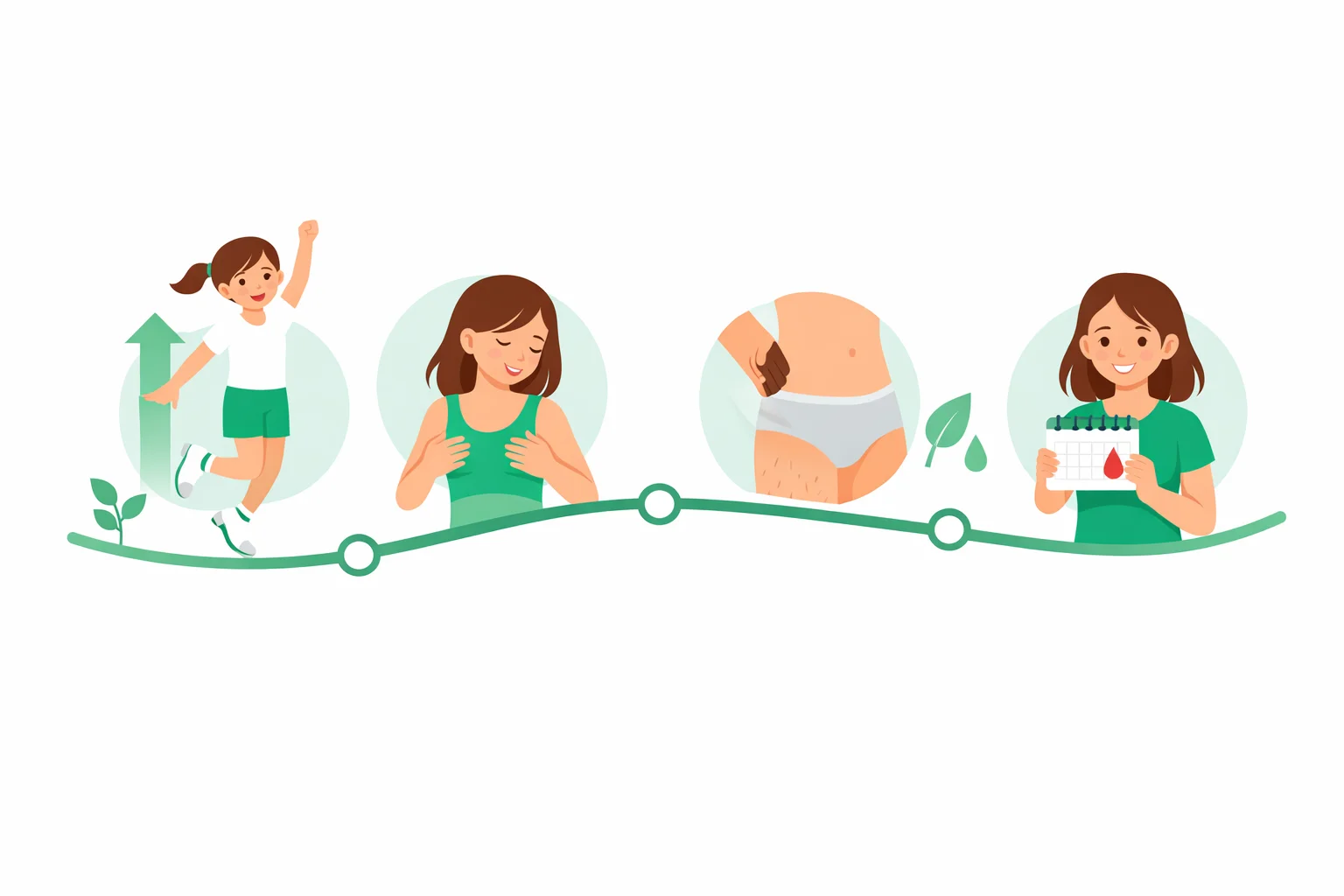
The Day Everything Changed (And Why Nobody Warned Her)
Here's a scene that plays out thousands of times every day. A 12-year-old — let's call her Mia — notices a brownish smudge on her underwear during lunch break. She panics. Was it something she ate? Is she sick? She balls up toilet paper and stuffs it in her underwear, tells no one, and spends the rest of the school day terrified. What Mia didn't know: that smudge was her first period. It wasn't bright red like she expected from movies. It wasn't dramatic. It was a brownish stain that looked nothing like what she imagined.
Mia's story is far from unusual. A first period (doctors call it menarche) rarely looks like the depictions in health class videos. A 2021 survey by UNICEF found that the number one thing girls wish they had known is that first periods are usually light and brown — not the heavy red flow they feared. Knowing what's coming strips away most of that panic. And that starts with understanding the biological signs your body gives you months (sometimes years) before that first day arrives.
Tanner Stages: Your Body's Built-In Checklist
In 1969, British pediatrician James Tanner published a classification system that mapped puberty into 5 stages. More than 50 years later, the American Academy of Pediatrics still uses Tanner staging as the gold standard for tracking pubertal development. Here's the simplified version — and where your period fits in:
| Stage | What's Happening | Period Status |
|---|---|---|
| 1 | No visible puberty signs yet — childhood body | Far away (2-4+ years) |
| 2 | Breast buds appear, fine pubic hair starts, growth speeds up | Not yet (1.5-3 years) |
| 3 | Breasts grow larger, pubic hair darkens, peak growth spurt, discharge begins | Getting close (6-18 months) |
| 4 | Breasts take adult shape, hips widen, growth slows, underarm hair appears | Imminent or just started |
| 5 | Adult body proportions, growth complete | Usually regular by now |
The quiz you just took is designed around this staging system. By assessing visible signs — breast development, growth spurt timing, discharge, body hair — it estimates where you fall on the Tanner scale. Most first periods arrive during late Stage 3 or early Stage 4. That's the key insight: your period doesn't arrive randomly. It arrives after a predictable sequence of events.
5 Signs Your Period Is Closer Than You Think
Forget vague advice like "it'll come when it comes." These five indicators have strong medical evidence behind them, and they're listed in roughly the order they appear:
1. Breast buds have been growing for 2+ years. A 2013 longitudinal study in The Journal of Adolescent Health tracked 1,239 girls and found that the median time from first breast bud to menarche was 2.3 years. If you noticed breast buds before age 10, you're looking at a period around age 12. This is the single most reliable timeline marker.
2. Your growth spurt is slowing down. Peak height velocity (the fastest you'll ever grow) happens before your period — not after. Once your growth starts slowing, menarche is typically 6-12 months away. This surprises many people: they expect to keep growing fast after starting their period, but in reality most gain only 1-3 inches after that point.
3. Regular vaginal discharge. Clear or whitish discharge that's been happening consistently for 6+ months is one of the strongest short-term predictors. It means estrogen is high enough to affect the cervix — the same hormonal threshold that triggers a period. More on this below.
4. Body shape is changing visibly. Wider hips, rounder thighs, and overall curvier proportions indicate that your body is redistributing fat — which happens because estrogen directs fat to the hips and breasts. This change is functional, not just cosmetic: the body needs approximately 17% body fat to sustain menstruation.
5. Cramps or lower-belly aching with no period. Pre-menstrual cramping can start weeks or even months before the actual first period. If you're feeling dull aches in your lower abdomen that come and go every few weeks, your uterus is likely "rehearsing." Question 10 in the quiz specifically targets this signal.
The Growth Spurt Connection Nobody Talks About
Here's something most puberty guides bury in a footnote: your height growth and your period are directly linked through the same hormonal cascade. Estrogen triggers both the growth spurt and the eventual closing of growth plates in your bones. A 2018 study in Hormone Research in Paediatrics showed that girls who reach 95% of their adult height are within 6-12 months of menarche.
That's why the quiz asks you to compare your height to your mother's. If you're already close to her height, your growth plates are nearing closure — and your period is nearing arrival. Conversely, if you're still growing fast, your body prioritizes growth over reproductive maturity. Athletes like gymnasts and distance runners often experience this: intense training plus low body fat shifts the hormonal balance toward growth and delays menarche by 1-2 years.
If your quiz result said "Puberty in Progress" but you're currently in the middle of a growth spurt, that tracks perfectly — your body is likely focusing on getting taller first. The period comes after the growth peak, not during it. Wondering about your overall health trajectory? Our Heart Attack Awareness Quiz offers an educational round on warning signs, without assessing personal risk.
Discharge: The Sign Most People Miss
Nobody talks about vaginal discharge in school health class, and that's a problem — because it's arguably the best short-range predictor of a first period. A study published in Pediatrics (the AAP's official journal) found that 90% of girls experienced regular discharge for at least 6 months before menarche.
What does it actually look like? Clear, white, or slightly yellowish fluid on your underwear. It might leave a light stain that stiffens when it dries — all completely normal. What it means hormonally: estrogen is now high enough to affect the cervical glands, which produce mucus. That same estrogen level is what will eventually build the uterine lining thick enough to shed — your period.
The quiz weighted discharge heavily (question 6) for exactly this reason. If you're seeing regular discharge and your breast development has been underway for 1.5+ years, you're likely in the 6-to-12-month countdown window. It's a similar concept to symptom-pattern recognition in our Am I Pregnant Quiz, which also uses physical signs to estimate what's happening hormonally. Differential symptom checking works the same way in other areas too — our allergies or cold quiz uses a 12-point scoring approach to tell two overlapping conditions apart when the symptoms share a final common pathway.
What Your Genes Actually Predict
"When did your mom get her period?" isn't just small talk — it's the single strongest predictor of when you'll get yours. A 2020 genome-wide association study published in Nature Genetics identified over 389 genetic loci that influence the timing of menarche. But you don't need genetic testing: asking your biological mother gives you roughly the same information.
The heritability of menarche timing is about 50-80%, according to twin studies from the menarche research literature. That means if your mom started at age 11, you have a very high chance of starting between 10 and 13. If she started at 15, you're more likely to be in the 13-16 range. It's not an exact mirror — nutrition, weight, stress, and environmental factors fill in the remaining 20-50% — but maternal age at menarche remains the most predictive single data point any quiz can use.
The quiz accounts for this in question 2. If you don't know your mom's timing, the quiz assigns a middle score — it doesn't penalize you. But if you can ask, it's genuinely worth knowing. It's like having a rough GPS estimate instead of navigating blind.
All 5 Period Readiness Results Explained
Depending on how your puberty signs combine, the quiz places you into one of five stages. Here's what each means — and what you can do about it:
🌱 Early Puberty Stage. Few or no visible signs are present yet. You're at the beginning — possibly Tanner stage 1 or early stage 2. Your period is likely 2+ years away. There's nothing to worry about and nothing to rush. Use this time to learn what's coming so you feel calm when changes start.
🌿 Puberty in Progress. Some signs are underway — breast buds, maybe early body hair, possibly the start of a growth spurt. You're in Tanner stage 2 or early 3. Your period is roughly 1-2 years away. Start building your period kit and learning the basics, but there's no urgency.
🌸 Getting Closer. Multiple signs are present: clear breast development, body hair, discharge starting, growth spurt visible. You're likely mid-stage 3. Your period is an estimated 6-12 months away. This is the stage to get practically prepared — pads in your bag, dark underwear on crampy days, a trusted adult you can text.
🌺 Very Close. Nearly all signs are present: advanced breast development, regular discharge, growth slowing, body shape changing significantly. You're in late stage 3 or early stage 4. Your period could arrive within 1-6 months. Carry pads at all times. Your first period will likely be light and brownish — not the dramatic event you might expect.
🌷 Could Be Any Day. All indicators point to imminent menarche. You may have even had spotting already. You're in Tanner stage 4. Have supplies everywhere — backpack, locker, bathroom, friend's house. And remember: the first few periods are often irregular (anywhere from 3 to 8 weeks apart), light, and short. That's completely normal for the first 1-2 years.
What to Do With Your Result
Whatever stage the quiz placed you in, here's what actually matters: you now have a framework for understanding what your body is doing and roughly where you are on the timeline. That knowledge alone removes most of the anxiety.
If your result felt like it didn't match your gut feeling, consider two things. First, puberty isn't perfectly linear — you might be further along in breast development but earlier in growth, and the quiz averages everything out. Second, quiz answers are self-reported, and it's hard to objectively assess your own development. When in doubt, a pediatrician can assess your Tanner stage directly in under 30 seconds.
Retaking the quiz every 3-4 months is a great way to track your progression. As your answers change, you'll see your score shift — which makes the process feel more predictable and less scary. And if puberty feels like it's changing more than just your body, that's normal too. Growing up reshapes how you think about yourself and your future — which is exactly what our Career Quiz for Teens helps you explore from a strengths-and-interests angle.
One thing worth knowing before your periods actually start, because nobody says it early enough: cramps are normal, but pain that makes you vomit, faint, or miss school every single month is not. Endometriosis can begin with the very first period, and roughly two-thirds of adults who have it say their symptoms started before they turned twenty — yet teenage pain is the most likely of all to be waved off as "just bad cramps." If that ends up describing you a year or two from now, our endometriosis symptom quiz will help you put words to the pattern before an appointment.
One final thing: you are not behind, you are not weird, and you are not alone. Around the world, approximately 300 million people are on their period at any given moment. Every single one of them went through this exact stage — the wondering, the waiting, the "is it happening yet?" You'll get there. Your body knows the plan even when your brain doesn't.