The 80-Year Road From Two Doctors to the 10-Question Autism Quiz You Just Took
The autism quiz you just took fits on a single screen, yet the ten questions behind it sit at the end of an 80-year argument about what autism even is. To understand why a score of 6 matters, why you might score low and still be autistic, and why so many adults are only recognizing themselves now, it helps to go back to two doctors who never met — and who used the same brand-new word to describe what they thought were opposite things.
Two Doctors, One Word, Two Very Different Stories
In 1943, a psychiatrist named Leo Kanner, working in Baltimore, published a paper on eleven children who shared a striking pattern: an intense need for sameness and a kind of self-contained aloneness. He borrowed a word the Swiss psychiatrist Eugen Bleuler had coined back in 1911 — autism, from the Greek autos, meaning self. A year later and a continent away, a Viennese pediatrician named Hans Asperger described a strikingly similar group of children, except his patients were often articulate, deeply knowledgeable about narrow subjects, and what he called "little professors."
Here's the part that shaped everything after: the two men never coordinated, World War II severed Europe from American science, and Asperger's work — written in German — went largely unread in the English-speaking world for nearly four decades. So for a generation, "autism" meant Kanner's version: profound, early, and obvious. The quieter, verbal presentation Asperger saw simply didn't register as the same condition. That accident of history is still echoing in why some people sail through a screening like this one undetected.
The Myth That Stalled Autism Research for 30 Years
Most people have never heard of the "refrigerator mother," and that's probably for the best — it was one of the most damaging ideas in the history of psychiatry. Through the 1950s and 60s, the dominant theory, popularized by psychoanalyst Bruno Bettelheim, blamed autism on cold, emotionally distant mothers. Parents were told their child's neurology was their fault. It was wrong on every level, and it poisoned both research and family life for decades.
The man who broke it was Bernard Rimland, a psychologist who happened to also be the father of an autistic son. His 1964 book made the then-radical case that autism was a biological, neurodevelopmental condition — not a parenting failure. It took years for the field to catch up, but Rimland's work is why we now treat autism as a difference in brain development you are born with, rather than something done to you. Every modern screening, including the AQ-10, rests on that corrected foundation.
How 'Spectrum' Replaced a Checklist
The word "spectrum" feels obvious today, but someone had to discover it. That someone was British psychiatrist Lorna Wing. In 1981 she did two things at once: she rediscovered Hans Asperger's forgotten papers and translated them for the English-speaking world, and she proposed that autism wasn't a single box you were either in or out of. Drawing on her own research — and her own autistic daughter — Wing argued for a continuous range of related presentations, what she called the autism spectrum.
That reframing changed the questions clinicians ask. Instead of "Is this child autistic, yes or no?" the field moved toward "Where on a range of social communication, flexibility, and sensory traits does this person sit?" The official manuals followed slowly: autism entered the DSM-III in 1980, Asperger's syndrome got its own listing in 1994, and then in 2013 the DSM-5 folded everything back into one umbrella: autism spectrum disorder. Asperger's, as a separate diagnosis, vanished — even though plenty of people still use the term for themselves.
Where the AQ-10 Quiz Actually Fits In
Now the tool under the hood. In 2001, Cambridge researcher Simon Baron-Cohen and colleagues built the Autism Spectrum Quotient — a 50-question self-report meant to measure autistic traits in adults of normal intelligence. It was thorough but long. So in 2012, Carrie Allison, Bonnie Auyeung, and Baron-Cohen distilled it down to the ten items that best separated autistic adults from non-autistic ones. That shortlist is the AQ-10, and it's the exact instrument this quiz uses.
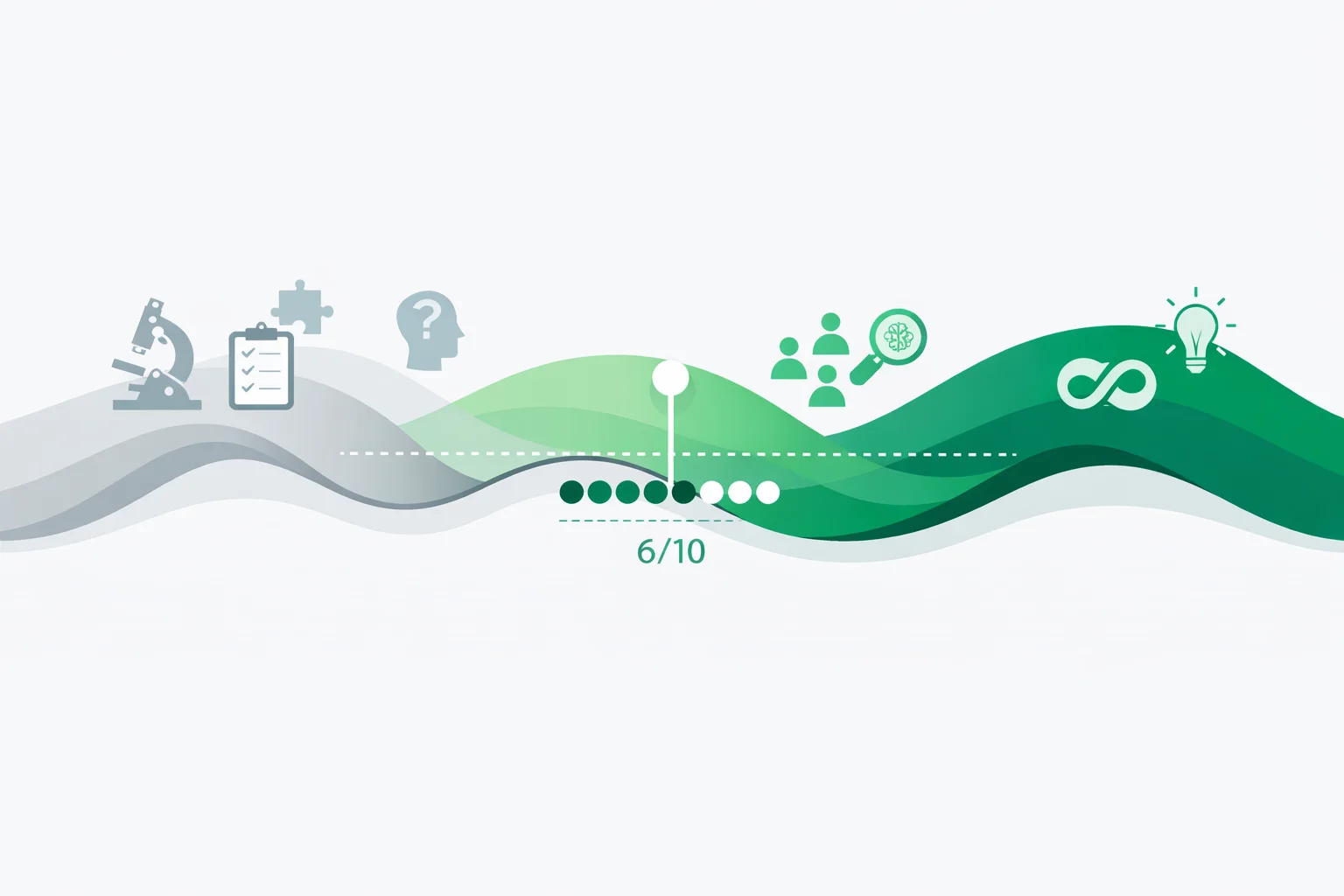
The scoring is deliberately blunt. Each of the ten statements earns one point when your answer falls on the autistic-trait side — and crucially, "slightly agree" counts the same as "definitely agree." That gives a maximum of 10. The authors set the referral cutoff at 6: score 6 or more, and the recommendation is to consider a full diagnostic assessment. The ten items aren't random, either — they sample three broad areas this quiz reports back to you: reading people and communication, mental flexibility and task-switching, and a sharp eye for detail and patterns. A short screen like this is the same first filter used in some ADHD pathways, which is why our ADHD quiz is worth a look if your results felt tangled — the two conditions overlap so often that clinicians informally call the combination "AuDHD."
What Does Your Score Really Mean?
A number out of 10 can feel weirdly final, so let's defuse it. The AQ-10 was designed to be sensitive, not precise — its job is to catch as many autistic adults as possible at the cost of some false positives. In validation work, a cutoff of 6 flagged the large majority of autistic adults, but a non-autistic person having a rough, overstimulated week can drift upward too. That's why a single score near the line is best treated as a prompt, not a conclusion.
The flip side matters more than most quizzes admit: scoring under 6 does not clear you. The AQ-10 leans heavily on the social and communication traits that were historically easiest to spot, and lighter on sensory sensitivity and rigid routines. If your real experience is sensory overwhelm in supermarkets or genuine distress when plans change, this particular test may undercount you. Rigid routines can also blur into a different condition — when the repetition is driven by dread rather than comfort, it points toward OCD, which our OCD quiz is built to tell apart. And then there's masking — the learned habit of copying social behavior so convincingly that you answer how you perform rather than how you feel. Masking is the single biggest reason a genuinely autistic person lands in the "some traits" band instead of above the line.
Sensory overwhelm cuts the other way too. It's the one experience shared by autism and sensory processing sensitivity, and it sends a lot of people down the wrong path for years. The dividing line is social cognition: sensitivity involves reading social cues intensely and usually accurately, while autism commonly makes those cues effortful to decode. If the supermarket lighting is the part you recognise but the social decoding isn't, the highly sensitive person quiz scores that channel on its own. Plenty of people are both — the two traits are not alternatives.
The Generation the Tests Quietly Missed
Because the early template for autism was built on young boys with obvious support needs, the diagnostic net had huge holes. Girls who made eye contact, scripted their social lines, and poured their intense interests into socially acceptable subjects — horses, books, a favorite band — rarely tripped the criteria. The same went for verbally fluent adults who'd spent a lifetime compensating. Researchers now talk about a "female autism phenotype," though it shows up in plenty of men too: same underlying wiring, better camouflage.
This is why autism diagnoses among adults and women have climbed sharply in recent years. It's not an epidemic; it's a backlog finally being cleared. Many people only start wondering after a child gets assessed and the questionnaire reads like a description of their own childhood. The exhaustion that comes from a lifetime of masking is real, and it often shows up as anxiety or low mood rather than anything obviously "autistic." If that resonates, screening tools like our anxiety quiz and depression quiz can help you map what's sitting on top of the autistic traits, because the two stories are almost always tangled together.
All Four AQ-10 Result Ranges, Explained
🌤️ Few Autistic Traits (0–2). Reading faces, juggling tasks, and catching subtext seem to come fairly easily to you, and the screen lands well below the referral line. The honest caveat: the AQ-10 is light on sensory and routine-based traits, so a low score answers the social question more than the whole-person one.
🌈 Some Autistic Traits (3–5). The most ambiguous band, and the most interesting. You relate to several items but stay just under the cutoff of 6. This is where masking does its quiet work — if you've trained yourself to look fluent, you may be scoring the performance rather than the experience. Worth a second, honest pass.
♾️ At the Screening Threshold (6–7). You've met the line the AQ-10's authors drew for recommending a proper look. It is not a diagnosis, but enough traits showed up that talking to a GP or specialist is a reasonable next step. Many people here finally get language for patterns they've carried for decades.
✨ A Strong Cluster of Autistic Traits (8–10). The screen lit up across social reading, flexibility, and detail focus alike. A quiz still can't diagnose you, but a result this high is rarely noise. Pursuing a formal assessment — and connecting with autistic-led communities — is well worth your time.
If Your Score Surprised You, Start Here
Whatever number you got, resist the urge to either dismiss it or treat it as a verdict. A clinician assessing autism barely glances at a screening score — they work from stories. So do the genuinely useful thing: open a note on your phone and write down three or four concrete examples for the traits that hit hardest. The time you melted down over a last-minute plan change. The way background noise in a café makes conversation impossible. The subject you can talk about for an hour without noticing time pass. Childhood examples are gold, because autism is something you're born with, and assessors trace it back to early life.
Then, if your score sat at 6 or above — or if it didn't but the traits still won't leave you alone — take that note to a GP and ask about an autism assessment referral. The AQ-10 is a recognized doorway, not a dead end. And remember that a label, if you choose to pursue one, isn't about putting yourself in a box. For a lot of people, it's the opposite: the first time the box they were always quietly stuffed into finally gets a door.