OCD Quiz: How to Tell an Obsession From a Quirk (and What Your Score Means)
This OCD quiz won't diagnose you — but it will do something more practical: show you exactly which of the five obsessive-compulsive symptom dimensions your mind leans toward, and whether that pattern crosses the line clinicians actually watch for. By the time you finish reading, you'll be able to do something most people take years to learn: tell the difference between a harmless quirk and a genuine OCD symptom. That single distinction is where every honest answer about "do I have OCD" begins.
Start With the Question That Separates OCD From a Quirk
Here's the test that cuts through most confusion: is the behavior something you want to do, or something you feel you have to do to stop a feeling of dread? Liking a tidy desk is a preference — it feels good, and skipping it costs you nothing. OCD is the opposite. Clinicians call it "ego-dystonic," which is a fancy way of saying the thoughts feel foreign and unwelcome, and the rituals are done to relieve anxiety, not because they're enjoyable. That's why the casual "I'm so OCD about my bookshelf" misses the mark so badly. Real OCD doesn't feel like a personality trait you're proud of. It feels like a hostage situation in your own head.
The numbers back up how serious that distinction is. About 1 in 40 adults in the US — roughly 2.3% over a lifetime, according to the National Institute of Mental Health — will experience OCD. Yet studies have found people wait, on average, more than a decade between their first symptoms and getting the right help. A big reason for that delay is the very confusion this quiz is built to clear up: people assume their checking or intrusive thoughts are "just how they are," so they never mention them.
How Your Five-Dimension Score Is Built
Most online tests hand you a single number and call it a day. This one is structured differently, and the structure is the point. The ten questions are drawn from the same symptom domains used by the Obsessive-Compulsive Inventory (the OCI-R), a widely used self-report measure in OCD research. Each item asks how much a given experience distressed you over the past month, rated from 0 ("Not at all") to 4 ("Extremely"). That's a deliberate choice: OCD is defined by distress and time lost, not by how often a behavior happens. Washing your hands ten times is meaningless on its own — washing them ten times because you're terrified of contaminating your family is the symptom.
Your answers roll up two ways. The total (out of 40) places you in one of four severity ranges, and the per-dimension scores build your "symptom fingerprint" — a profile of which kind of OCD shows up most for you. Two people can land on the same total of 22 and have completely different fingerprints: one all checking, the other all intrusive thoughts. Treatment looks different for each, which is exactly why a single score isn't enough.
The Five Faces of OCD — Which One Is Yours?
OCD is often pictured as germ-fear and handwashing, but that's only one of its faces. The quiz maps your answers onto five well-established dimensions. Knowing your dominant one is genuinely useful — it's the first thing an OCD specialist will want to understand.
| Dimension | The obsession (the fear) | The compulsion (the fix) |
|---|---|---|
| Contamination & Washing | Germs, dirt, illness, or a vague sense of being "unclean" | Washing, cleaning, avoiding "contaminated" objects |
| Checking & Doubt | That a mistake of yours will cause harm or disaster | Re-checking locks, stoves, emails; mentally retracing steps |
| Symmetry & Order | A "not just right" feeling when things are uneven | Arranging, aligning, repeating actions until they feel complete |
| Intrusive Thoughts | Unwanted violent, taboo, or sexual images that horrify you | Avoidance, mental neutralizing, seeking reassurance |
| Mental Rituals | That something bad will happen unless you "fix" a thought | Silent repeating, counting, praying, reviewing in your head |
Notice that most dimensions pair an invisible fear with a visible behavior — except the last two, where the compulsion happens entirely inside your mind. That's where OCD gets missed most often. If your fingerprint spikes on anxiety-driven dimensions, our anxiety quiz can show you how much general worry sits underneath the obsessions.
The Loop That Quietly Keeps OCD Running
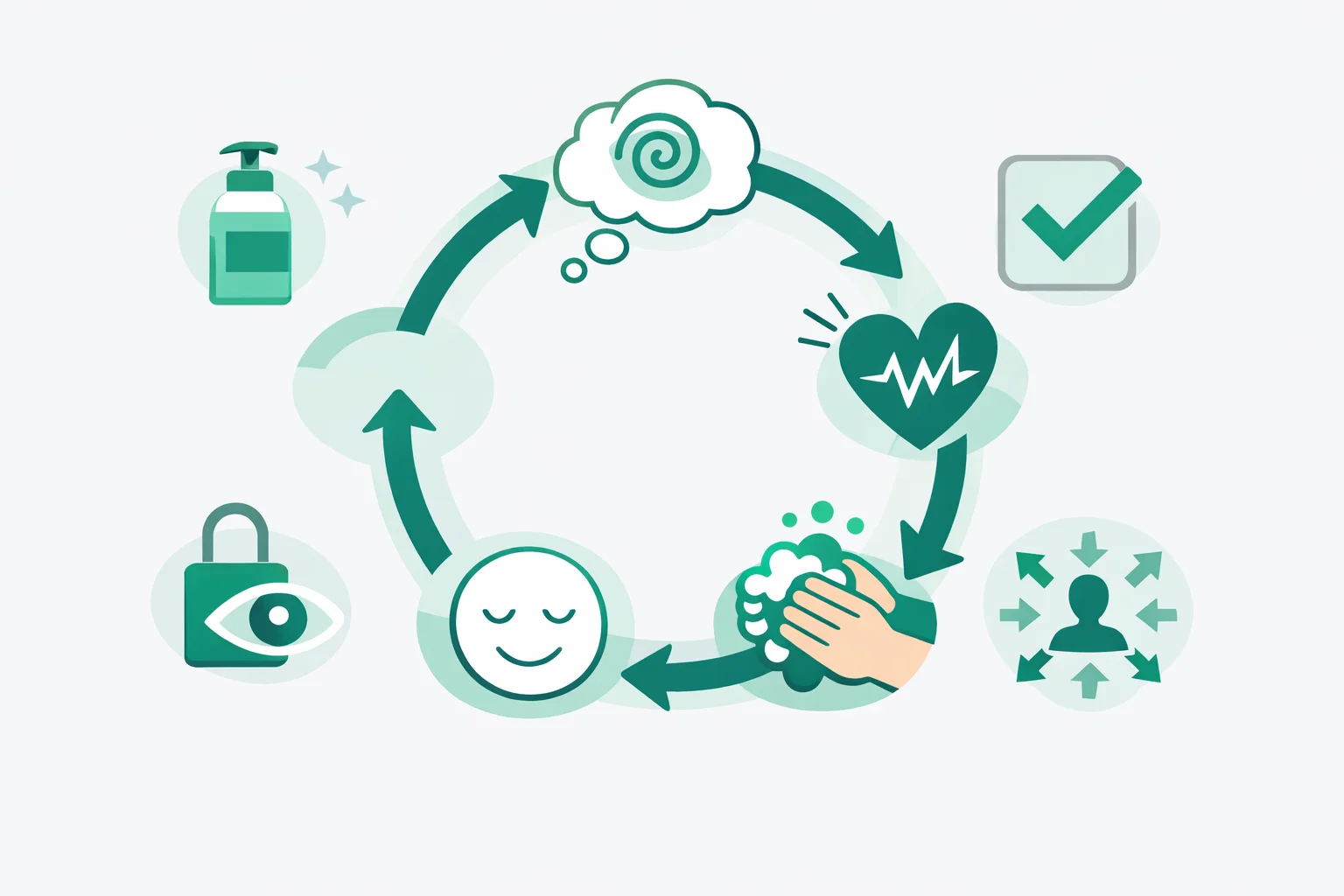
OCD survives on a four-step loop, and understanding it changes how you read your own score. Picture someone with checking OCD leaving for work. Step one: the intrusive thought — did I leave the stove on? Step two: a spike of anxiety, sharp and physical. Step three: the compulsion — they go back inside and check. Step four: relief, sweet but brief. Here's the cruel twist. That relief is exactly what teaches the brain the threat was real and the checking "worked." So next time the thought hits, the urge to check is even stronger. The compulsion isn't the cure for the anxiety — it's the fertilizer.
This is why "just stop doing it" advice fails, and why people can spend an hour or more a day trapped in rituals they desperately want to quit. The loop is self-reinforcing by design. Every treatment that actually works for OCD targets this loop at step three or four — the moment of the compulsion — rather than trying to argue away the thought at step one.
What If You Have No Visible Compulsions?
Plenty of people read about OCD, recognize the obsessions, and conclude they can't have it because they don't wash or check. This is one of the most common — and most costly — misreadings. There's a form often nicknamed "Pure O," where the obsessions are loud but the compulsions are entirely mental: silently reviewing a memory to make sure you didn't do something wrong, repeating a phrase to neutralize a bad thought, or endlessly seeking reassurance. The rituals are real; they're just invisible.
If your symptom fingerprint lit up on intrusive thoughts or mental rituals while staying low everywhere else, that's the pattern to take seriously rather than dismiss. It's also the one most likely to be misdiagnosed as generalized anxiety. And it's worth saying plainly: having a violent or taboo intrusive thought says nothing about your character. The research is consistent — people with harm-themed OCD are no more likely to act on those thoughts than anyone else. The horror you feel is the symptom.
Why ERP Beats Ordinary Talk Therapy
If your score suggests it's time to talk to someone, the type of therapy matters enormously. The first-line, evidence-based treatment for OCD is Exposure and Response Prevention (ERP), a specialized form of cognitive behavioral therapy. Standard supportive talk therapy — the kind that explores your feelings and your past — is well-meaning but tends to underperform for OCD, and can even backfire if it turns into reassurance. Here's the practical difference:
| ERP (the gold standard) | General talk therapy | |
|---|---|---|
| What you do | Face triggers on purpose while resisting the compulsion | Discuss feelings, history, and stressors |
| The mechanism | Teaches your brain the feared outcome doesn't come | Builds insight and coping, but leaves the loop intact |
| Typical result for OCD | Most people who complete it improve significantly | Often little change in the compulsions themselves |
The takeaway: if you seek help, ask specifically whether the therapist does ERP. The International OCD Foundation keeps a directory of specialists who do. OCD and other conditions overlap, too — repetitive routines also show up in autism, which is why some people take both this and our autism quiz to see which framework fits their experience better. The same rigid, rule-bound thinking can also fasten onto food — counting, rituals, and rules around eating share a lot of machinery with OCD — so if your compulsions circle around meals or your body, our eating disorder quiz screens for that overlap.
Here's the Trap: This Quiz Can Become a Compulsion
I have to be honest about something, because it's the most useful warning on this page. If you find yourself taking this quiz over and over, tweaking your answers, hunting for the "real" result — stop and notice that pulling feeling. Compulsive reassurance-seeking is itself an OCD behavior, and quizzes, search bars, and forums are three of its favorite hiding spots. The certainty you get from a clean score lasts about as long as the relief from checking a lock: minutes, then the doubt creeps back and you need another hit.
So use this tool the way it's meant to be used. Take it once. Sit with the result, even if it's uncomfortable. If it concerns you, bring it to a professional instead of re-running the test for a tidier number. The goal isn't certainty — chasing certainty is the trap. The goal is enough information to take one real step.
All 4 OCD Score Ranges, Explained
🌤️ Minimal Signs (0–8). Your responses fall in the everyday range — the occasional double-check or stray thought that almost everyone has. What separates this from OCD isn't the presence of a habit but the absence of distress and lost time. There's no clinical pattern here to act on, though it's always worth knowing the warning signs.
🌥️ Some OC Traits (9–16). You carry a few obsessive-compulsive tendencies that likely flare under stress without taking over your life. Many people live comfortably in this band. The thing to monitor is whether the rituals start demanding more time or the thoughts grow stickier over the coming weeks — that drift is the signal to pay closer attention.
🌧️ Clinically Significant Symptoms Possible (17–25). This is roughly where screening tools begin flagging symptoms as significant. It doesn't confirm OCD, but it strongly suggests the obsessions and compulsions are costing you time, energy, or peace of mind. A professional evaluation — ideally with an ERP-trained clinician — is a reasonable and worthwhile next step.
⛈️ Strongly Suggestive of OCD (26–40). A score this high points to symptoms that are taking real time and likely interfering with daily life. The encouraging part is that OCD is among the most treatable conditions in mental health, and ERP helps the majority of people who stick with it. Reaching out to a specialist soon is the single most useful move from here.
What to Do With Your Score This Week
Don't let this become another tab you close and forget. If you landed in the lower two bands, pick one ritual and try delaying it by ten minutes — that small experiment tells you more about how much control you have than any score does. If you landed in the upper two, do one concrete thing this week: open the IOCDF directory and find one ERP therapist's name, even if you're not ready to call yet. Naming a next step is how the decade-long delay finally gets shorter. OCD tells you that you have to be certain before you can act. You don't. You just have to take the step in front of you — and if mood has been dragging alongside the obsessions, our depression quiz is a sensible thing to check next, since the two so often travel together.