Love Language Quiz: How to Actually Use Your Five Love Languages
Most people take a love language quiz hoping to find the one way they want to be loved. Here's the twist: the researchers who study relationships for a living say that "one way" framing is exactly what trips couples up. The five love languages are real and useful — but almost everything people believe about how to use them is half wrong. So before you go memorizing your result like a horoscope, let's clear out the myths.
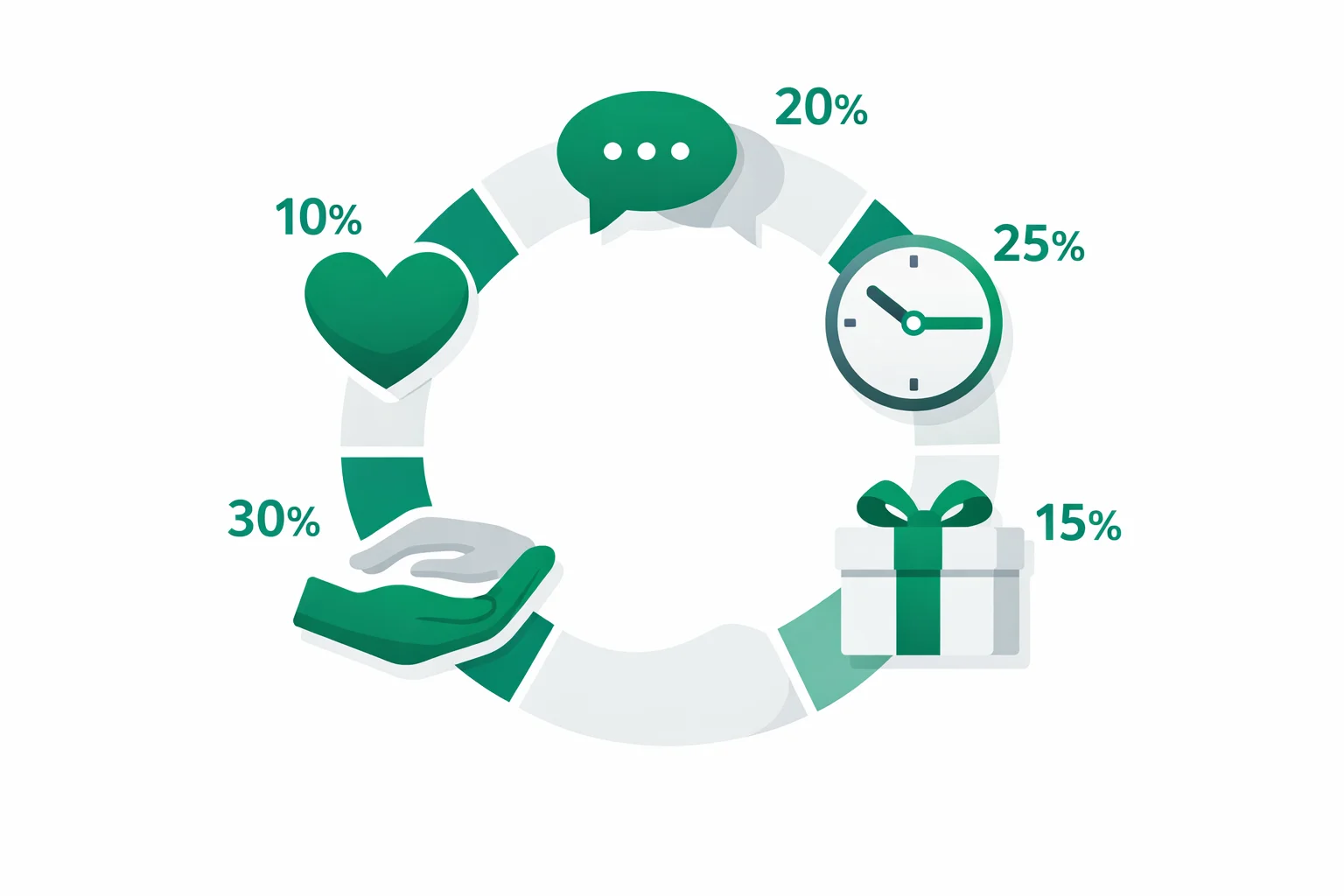
Five Stubborn Myths About Love Languages
The concept spread so fast that the misconceptions traveled with it. These are the five I see most often, and why each one quietly sabotages relationships.
Myth 1: You have exactly one love language. You don't. You have a ranking. Treating your top result as your whole identity ignores the fact that your second and third languages still matter — a partner who nails your #1 but completely neglects your #2 will still leave you feeling short-changed.
Myth 2: Your love language never changes. It shifts with circumstances. Exhausted new parents spike in Acts of Service. Couples in a long-distance stretch crave Physical Touch and Quality Time. What you need most is often whatever you're currently missing.
Myth 3: You should give love in your own language. This is the big one. Most people instinctively express love the way they like to receive it — which means a Words person showers their Acts-of-Service partner in compliments while the dishes pile up, and both feel unloved.
Myth 4: Matching languages means compatibility. Sharing a top language is convenient, not destiny. What predicts satisfaction is the willingness to learn and speak your partner's language, even when it isn't your native one.
Myth 5: Speaking the right language fixes everything. It doesn't override contempt, dishonesty, or unresolved conflict. Love languages are a communication tool, not couples therapy.
Where This Whole Idea Came From
The framework comes from The 5 Love Languages, a 1992 book by marriage counselor Gary Chapman. After years of listening to couples describe the same problem in different words — "I do so much and they still don't feel loved" — Chapman noticed people were essentially speaking different emotional dialects. He grouped the patterns into five categories: Words of Affirmation, Quality Time, Receiving Gifts, Acts of Service, and Physical Touch.
It's worth knowing the origin, because it explains both the strength and the weakness of the idea. Chapman built it from clinical observation, not laboratory data. That's why it resonates so deeply — it came from real couples — and also why the harder science took decades to catch up. You can read a fuller history on the Five Love Languages overview.
Does the Science Actually Hold Up?
Partly — and the nuance is the interesting part. Studies have found that people generally can identify a preferred way of receiving affection, and that acting in line with a partner's preferences is associated with higher relationship satisfaction. So the practical advice (pay attention to how your partner wants to be loved) checks out.
But a 2024 review in Current Directions in Psychological Science by Emily Impett and colleagues pushed back on the model's structure. Their argument, in plain terms: people have more than five ways of feeling loved, those needs aren't cleanly ranked into one "primary" language, and the happiest couples don't specialize — they use all five regularly. The researchers offered a better metaphor than language: a balanced diet. You don't survive on a single nutrient, and you don't thrive on a single love language either.
That reframe is why I'd treat your quiz result as a starting map, not a verdict. It tells you where you're hungriest right now — not the only thing you're allowed to eat.
Why Our Quiz Gives You a Ranking, Not a Label
Most versions of this assessment hand you a single primary language and stop. Ours scores all 20 scenarios and returns a full percentage ranking of every language, top to bottom. That design choice is deliberate, and it's backed by the criticism above: the insight usually lives in the gaps between your languages, not in the winner alone.
Here's a worked example. Say you score Quality Time 35%, Physical Touch 30%, and Receiving Gifts 5%. The headline is "Quality Time," but the real story is the cluster at the top (you need presence and closeness) plus that rock-bottom Gifts score — which means a partner who shows love mainly through presents may be trying hard and still missing you entirely. A single-label quiz would hide that completely. If you like seeing how you're wired across multiple dimensions, the same logic powers our leadership style quiz, which maps how you naturally communicate under pressure. Whether you lead with logic or empathy in those moments often comes down to the Thinking–Feeling axis measured in our personality quiz.
What Happens When Your Languages Don't Match?
Mismatched rankings are the norm, not a red flag. Roughly four out of five couples differ on their top language, and plenty of strong relationships pair, say, an Acts-of-Service person with a Words-of-Affirmation person. The mismatch only becomes a problem when neither person translates. And if the friction runs deeper than translation — if it's really about closeness and trust — your attachment style is usually the layer underneath the language. If you're questioning the feeling itself rather than how it's expressed, our am I in love quiz sorts real love from infatuation. And if you're not partnered yet and wondering what kind of person fits you in the first place, our soulmate quiz maps the partner archetype your wiring points to.
The fix is unglamorous but effective: treat your partner's top language as a skill to practice, not a personality trait you happen to lack. A Physical Touch person can learn to leave encouraging notes; a Quality Time person can learn to schedule it like any other priority. This also explains why a new crush can seem distant when he's actually interested — he may just be fluent in a language you're not watching for, which is exactly what our does he like me quiz helps you decode — and if you're still at the secret-crush stage, our does my crush like me quiz reads those quieter signals too. Curious how shared values factor in? Our Divergent faction quiz is a lighter way to spot what each of you instinctively cares about most. And once you both know your languages, our couples quiz is a fun way to test whether you've actually been using them — see how many of each other's answers you can guess. Friends have love languages too, and the best friend quiz turns that into a sharable challenge for your closest circle. And if you want to check how well you know your partner beyond their love language, the quiz to ask your boyfriend puts your knowledge of his favorites, fears, and dreams to the test.
| If your partner's top language is... | The cheapest way to "speak" it daily | The thing that quietly wounds them |
|---|---|---|
| Words of Affirmation | One specific, sincere compliment a day | Silence and offhand criticism |
| Quality Time | 15 phone-free minutes of real attention | Being half-present on a screen |
| Acts of Service | Doing one chore before being asked | Broken promises to help |
| Physical Touch | A hug on arrival and departure | Going days without affection |
| Receiving Gifts | A small "thought of you" token | Forgotten dates and occasions |
All 5 Love Language Results, Explained
💬 Words of Affirmation. If this tops your ranking, spoken and written appreciation lands deepest for you. Specific praise — "you handled that call so calmly" — outperforms generic niceties. Your strength is making others feel genuinely seen; your vulnerability is that careless words cut unusually deep and linger.
⏳ Quality Time. Undivided attention is your currency. You can tell the difference between someone being in the room and someone being with you. You build intimacy through focused presence and shared experiences, but you feel quietly abandoned when a partner is physically near yet mentally scrolling.
🛠️ Acts of Service. You read effort as love. When someone notices what needs doing and handles it, you feel cared for in your bones. You're often the dependable one others lean on — and your weak spot is that unkept promises register as "you don't care," even when affection is clearly there.
🤗 Physical Touch. Closeness reassures you faster than any explanation. A hand on the shoulder or sitting close resets your nervous system. You're warm and physically expressive, but a dry spell of affection makes you feel the distance immediately, long before anything is said out loud.
🎁 Receiving Gifts. Often the most misunderstood result — it was never about money. A gift is tangible proof that someone thought of you while you were apart. You hold onto the meaning behind objects, and a forgotten occasion can feel like being forgotten yourself. The right small token speaks volumes.
Turning Your Top Language Into Better Conversations
Your result is only useful if it leaves the screen. Start with one move: tell the people close to you not just your top language but your bottom one — the gap is where misfires happen. Then ask for theirs, and resist the urge to assume it matches yours. If your rankings differ, pick one concrete habit from the table above and try it for two weeks.
And retake this every so often. Your needs shift with stress, distance, and life stage, so the version of you that takes this love language quiz next year may rank things differently — which is exactly the point. Love isn't a fixed setting you discover once; it's a dialect you keep getting more fluent in.