Does He Like Me Quiz: How to Read the Signals That Actually Predict Interest
Here's something most people don't believe until they try it: a good does he like me quiz can read romantic interest more reliably than your gut can. Not because a quiz is magic, but because it forces you to weigh the signals that actually predict attraction — instead of the one ambiguous text that's been replaying in your head all week. Your brain is brilliant at obsessing over a single data point. It's terrible at stepping back and looking at the whole pattern. This page fixes that.
You Can Read Interest More Accurately Than You Think
The reason you feel uncertain isn't that you're bad at reading people. It's confirmation bias. Once you hope someone likes you, you replay the moments that support it (he laughed at your joke!) and quietly file away the ones that don't (he also took six hours to reply). Psychologists have documented this lopsided memory for decades — we notice and remember evidence that fits the story we want.
A structured assessment short-circuits that. Instead of one glowing moment, this quiz spreads your attention across 15 specific behaviors grouped into three categories that researchers and dating coaches consistently tie to genuine interest. You answer based on his pattern, the math adds it up, and you get a likelihood score with no wishful thinking baked in. That's the whole trick — and it works better than agonizing alone at 2 a.m.
The Three Signals That Actually Predict Interest
Every question here feeds one of three scores, because attraction shows up in three different channels — and the most telling results come from how they compare:
- Effort & Pursuit — who initiates, how he texts, whether he makes real plans, and whether he remembers the small things. Effort is the cheapest thing to fake for a day and the hardest to fake for a month.
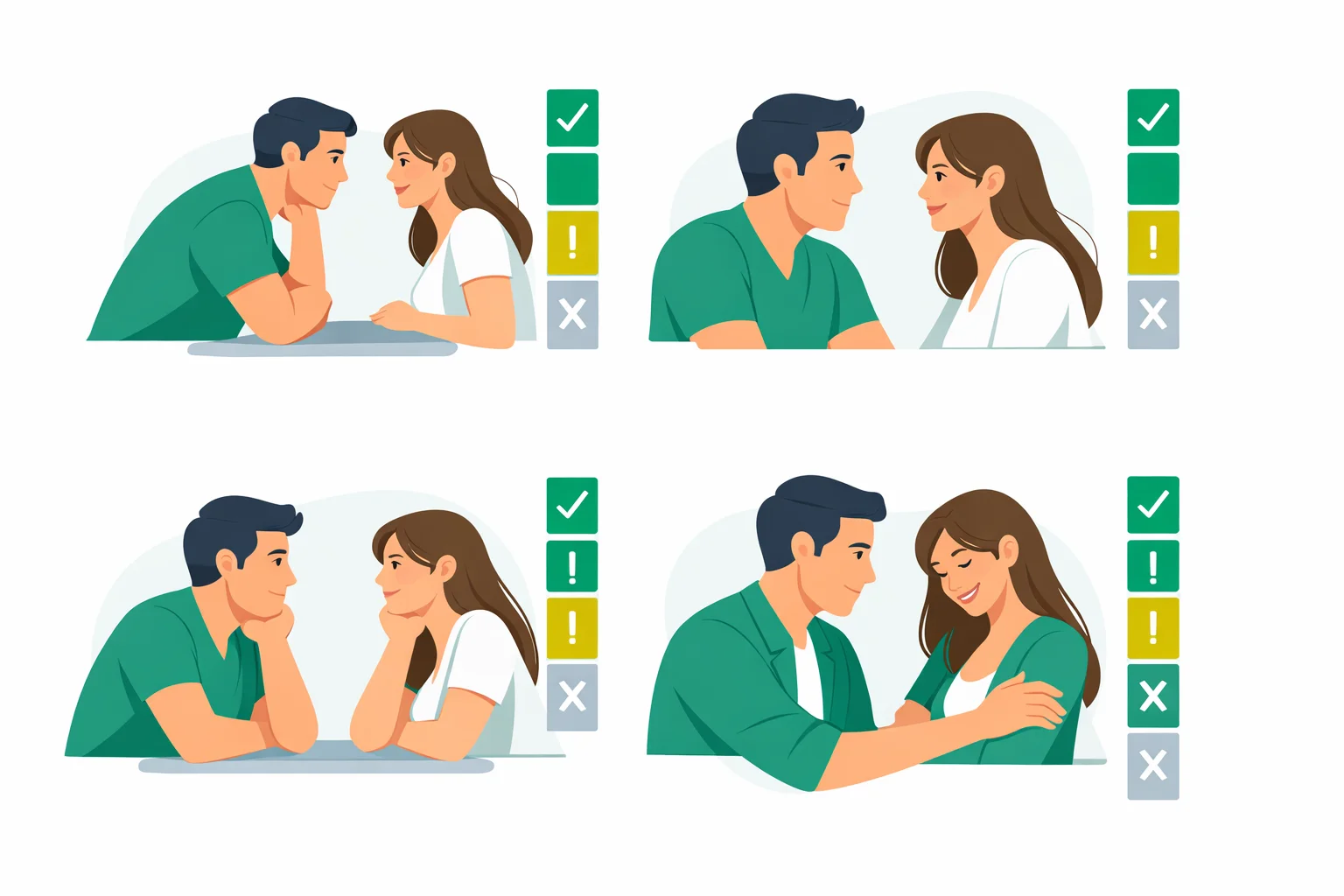
- Body Language — eye contact, physical closeness, where his body points, how animated he gets. This channel leaks the truth even when someone is too nervous to say a word.
- Emotional Investment — deep questions, future references, whether his friends know you exist, and how he reacts when other guys come up. This is the channel that separates a crush from a connection.
Here's why the breakdown matters more than the total. Say your Effort score lands at 85% but your Emotional Investment sits at 30%. That specific combination points to someone who enjoys your attention and likes the chase, but hasn't actually let you in — a pattern worth recognizing before you fall harder. Flip it, and high emotional openness with low effort often means a shy guy who likes you but freezes when it's time to act.
What His Texting Habits Really Tell You
Texting is where everyone over-analyzes, so let's be precise about what matters. It isn't raw response speed. There's no magic number of minutes that means love. What matters is consistency and reciprocity: does he keep the conversation alive by asking his own questions, or does he let it die the second you stop carrying it?
A quick worked example. Two guys both reply within ten minutes. Guy A sends "haha nice" and nothing else. Guy B replies, asks how your presentation went (which you mentioned three days ago), and floats a plan for the weekend. Same speed, completely different interest level. That's exactly the distinction question 2 and question 3 of the quiz are built to catch — effort isn't about how fast he types, it's about whether he's building something or just being polite. The double-texting panic, by the way, is mostly noise. A genuinely interested guy isn't scared off by a second message.
Why Eyes, Feet, and Distance Beat Words
When his words and his body disagree, bet on the body every time. Words are easy to script; the nervous system is not. Three nonverbal cues do most of the heavy lifting.
First, eye contact. A classic 1989 study by Joan Kellerman had strangers gaze into each other's eyes for two minutes and found it measurably increased feelings of affection and attraction. Sustained, soft eye contact paired with a smile is one of the strongest tells there is. Second, distance. Anthropologist Edward Hall mapped out human personal-space zones decades ago — we let people we're drawn to into the closer ones, and we instinctively create space from people we're not. If he keeps finding reasons to close the gap, that's information. Third, mirroring. When people are attracted to each other, they unconsciously sync up posture and gestures — the well-documented chameleon effect. If he leans in when you do, you're looking at one of the most honest signals on the list.
Stuck on Mixed Signals? Here's How to Break the Tie
Mixed signals are the most common quiz result for a reason: real interest and ordinary warmth genuinely can look identical from the outside. Two things usually explain the confusion. The first is his attachment style — someone with an avoidant pattern can like you and pull away in the same week, which feels like rejection but isn't. If his behavior runs hot and cold, our attachment style quiz can help you tell anxiety-driven distance from genuine disinterest.
The second is that he may be showing interest in a way you're not wired to notice. Some people lead with words, others with acts of service or quiet, steady presence. If he's not a big talker but keeps fixing your problems and showing up, you might be reading the wrong channel. Taking our love language quiz can recalibrate what "he likes me" actually looks like in his vocabulary. When you're still stuck, the tiebreaker is a small test: make one specific plan and watch whether he follows through. Action under a little pressure reveals more than another month of analysis. And if you're honestly at an earlier stage — barely talking, mostly reading him from across a room — our does my crush like me quiz is tuned for exactly that fuzzier moment. And if part of you isn't even sure how you feel about him, our do I like him quiz sorts that out before you spend more energy reading his side.
The Three Mistakes That Wreck Most People's Read
The biggest one is reading a single signal in isolation. He held eye contact once, so he must be in love. One cue is weather; the pattern is climate. The quiz exists specifically to stop you from staking your hopes on a single moment.
The second mistake is ignoring his baseline. Some guys are warm, flirty, and physically affectionate with literally everyone — bartenders, coworkers, their grandmother. If he treats you exactly the way he treats the whole world, that's not a green light. Question 8 is built to catch this: it asks how he acts around you compared to others, not just how he acts. The third mistake is the reverse — mistaking shyness or anxiety for disinterest. A guy who likes you but fears rejection can come across as cold, distant, or weirdly formal. That's why emotional and body-language cues are scored separately; a low effort score paired with strong nervous body language often means "interested but terrified," not "not interested."
What Each Likelihood Score Means
🔥 He's Almost Certainly Into You (78–100%). He's hitting nearly every marker across all three channels. This isn't politeness — it's consistent, repeated choosing of you. Guys in this range are usually just waiting for a clear, low-pressure opening to step forward.
💚 He Likes You — The Signs Are Clearly There (60–77%). Real interest, even if one channel lags. Often he's testing the waters or protecting himself after a past disappointment. Warm up your own signals a little and watch whether he matches you.
🤔 Mixed Signals — It Could Go Either Way (42–59%). Your answers are genuinely split, and that's real, not a failure to notice something. The smartest path is a small, concrete test rather than more guessing — his response to a clear bid will tell you what analysis can't.
🌱 Leaning Friendly, Not Romantic For Now (25–41%). Most of what he does reads as comfortable friendship. That's not a no forever — plenty of romances start here — but the active markers of pursuit aren't strong yet. Decide what you want before you invest more.
🧊 Probably Just Being Nice (0–24%). His behavior matches general kindness or mild distance more than romantic interest. It's a hard result to get, but a clear answer protects your time and heart far better than months of hopeful decoding.
What to Actually Do With Your Score
A score is only useful if it changes what you do next. If you landed high, your job isn't more certainty — it's courage. Give him a clean opening and let him take it. If you landed in the mixed middle, design one small test this week and let his behavior, not your imagination, supply the next data point. And if you scored low, treat that as a gift: it frees you to point your energy at someone whose interest you don't have to investigate. Reading a woman instead? The companion does she like me quiz runs the same logic for decoding female signals, which surface a little differently. The most attractive thing you can do at any score is stop auditioning for someone who hasn't clearly chosen you back.