Does She Like Me Quiz: How Women Actually Signal Interest (and What Gets Misread)
The smartest does she like me quiz doesn't ask you to trust your gut — it asks you to count. And the reason that works traces back to a quiet 1985 study by psychologist Monica Moore, who sat in singles bars, restaurants, and parties and catalogued the nonverbal behaviors women use around men they found attractive. She logged more than 50 distinct signals: the hair flip, the over-the-shoulder glance, the brief touch, the laugh that's a little bigger than the joke deserved. Her finding flipped the script most guys grow up believing. Women aren't passive in dating — they typically signal interest first, and the man who approaches is usually responding to a green light he didn't consciously register.
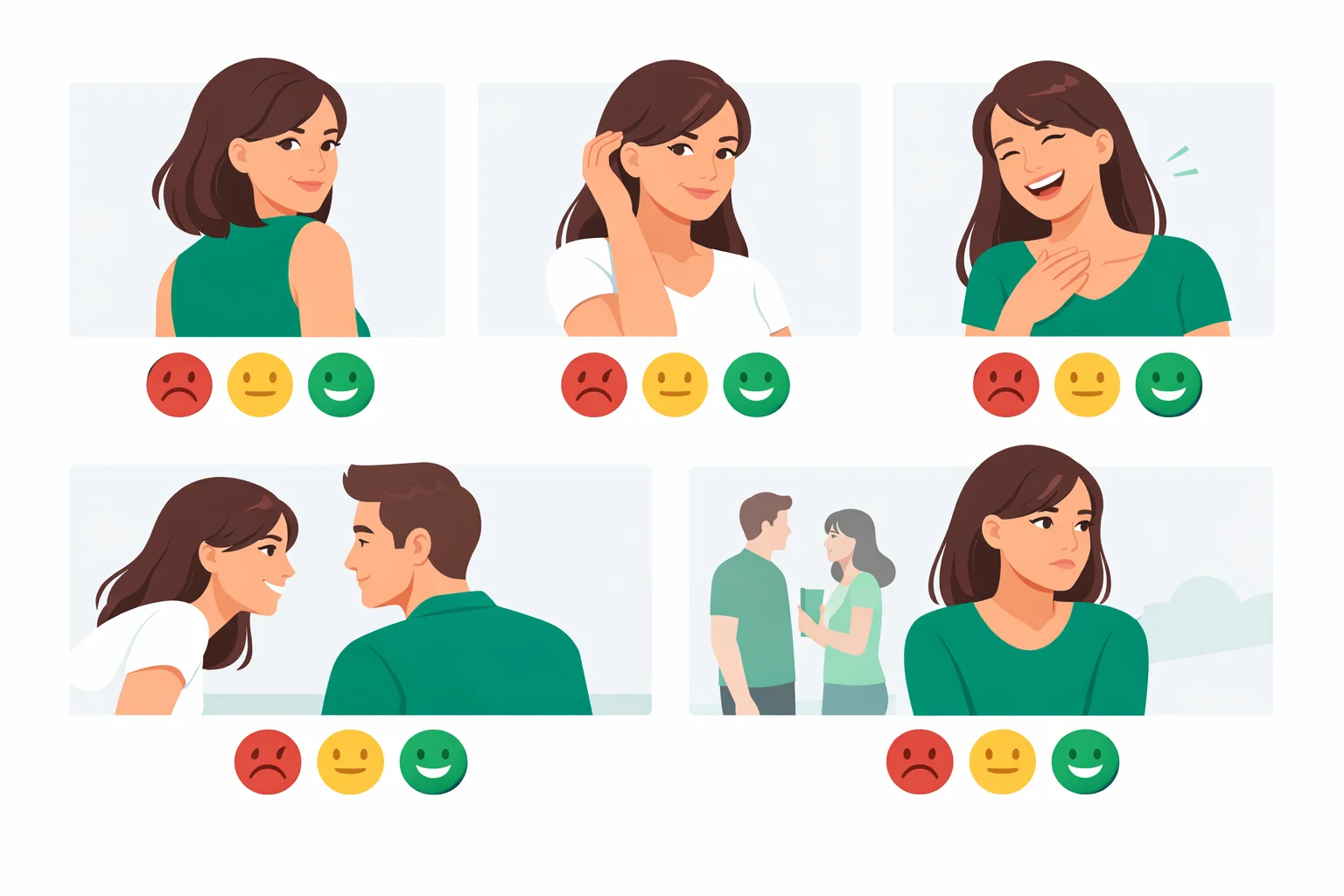
Women Open More Doors Than Most Guys Notice
Moore's research found something counterintuitive: in the venues she observed, the women who sent the most solicitation signals were approached far more often than the women who were simply conventionally attractive. The signaling drove the approach, not the looks. Yet most of those signals are subtle enough to fly under the radar of the man they're aimed at — which is exactly why so many guys end up stuck on the question this quiz answers.
Here's the problem your brain creates. Once you hope a particular woman likes you, confirmation bias kicks in: you replay the moment she laughed at your joke and quietly delete the three times she checked her phone mid-sentence. A structured assessment short-circuits that lopsided memory. Instead of one glowing scene, it spreads your attention across 15 specific behaviors and adds them up with no wishful thinking baked in. That's the entire trick — and it beats lying awake at 2 a.m. reconstructing a single text.
The Three Channels This Quiz Scores
Every question feeds one of three scores, because female interest tends to surface through three different channels — and the most useful insight usually comes from how they compare, not the total alone:
- 🌸 Proceptive Signals — the green-light cues researchers describe as "proceptive": initiating contact, drifting into your space, the across-the-room glance, self-touch and preening, handing you an opening. These are invitations, and they're the channel guys most often miss entirely.
- 🎯 Singling You Out — attention pointed at you specifically rather than sprayed across the room: sustained eye contact, laughing and teasing, remembering your details, peeling away from the group to talk only to you.
- 🔑 Letting You In — emotional access: personal disclosure, references to a future with you in it, whether her friends know you exist, and how she reacts when other women come up. This channel separates a passing spark from something with roots.
Why the breakdown beats the total: imagine your Singling-You-Out score lands at 85% but Letting-You-In sits at 25%. That specific shape points to someone who's drawn to you in the moment but hasn't opened up or decided you're safe yet — a "go slower" sign, not a rejection. Flip it, and high emotional openness with weak proceptive cues often means a shy woman who likes you but won't make the first visible move.
The Quiet Green Lights Guys Miss Most
The flashy signals — bold flirting, an outright compliment — are easy. It's the quiet ones that decide most real-life cases, and they cluster in the proceptive channel. The over-the-shoulder glance is a classic: she looks at you, you catch it, she looks away. That little loop is one of the most reliable invitations in Moore's catalogue, because nobody does it by accident with someone they're indifferent to. Watch, too, for proximity she manufactures — ending up next to you at the table, in your row, in your half of the room — and for self-touch when you talk, like adjusting her hair or playing with a necklace. None of these is proof on its own. Stacked together across a few weeks, they're a pattern.
A quick note on shyness, because it trips up the most well-meaning guys. A shy woman can be very interested and still send almost none of the confident signals. What leaks out instead are the nervous tells: the quick glance that darts away, a blush, fidgeting, a tendency to hover nearby without much to say. That's why the quiz scores quiet proximity separately from bold flirting — a low proceptive score paired with obvious nervousness around you often means "interested but scared," which is a completely different situation from disinterest.
Why Her Baseline Beats Any Single Smile
This is the mistake that wrecks more reads than any other, so it gets its own section. A woman being warm, smiley, and engaged does not, by itself, mean she likes you. Plenty of people are warm with everyone — it's a personality trait, not a love confession. The only way her friendliness becomes evidence is when it's aimed at you at a level above her baseline with everyone else. That contrast is the real signal, and it's why question 10 asks you to compare directly rather than just rate her warmth.
The table below is the lens to use. The left column is what people misread as interest; the right column is the version that actually counts because it's pointed at you specifically.
| General Friendliness (weak signal) | Aimed at You (strong signal) |
|---|---|
| Smiles warmly at everyone she meets | Smiles bigger and softer the moment she sees you |
| Friendly small talk with the whole group | Peels away to talk just to you, almost isolating the two of you |
| Polite eye contact, then glances around | Holds your gaze a beat too long, then looks down |
| Replies to texts when convenient | Texts first and keeps the thread alive with her own questions |
| Remembers nothing specific about you | Brings up a detail you mentioned once, weeks ago |
If you're finding it hard to tell the columns apart in your own situation, that's a sign you're reading the wrong channel — and our love language quiz can recalibrate what "she likes me" looks like in the way she naturally shows care.
Does Texting First Actually Mean Anything?
It's the most over-analyzed question in modern dating, so let's be precise. Texting first is a proceptive signal — she's opening a door. But on its own it's a weak one, because people text first for all kinds of low-stakes reasons. What upgrades it from "maybe" to "probably" is what comes next: does she carry the conversation with her own questions, reference things you said days ago, and steer toward seeing you in person? That's reciprocity, and it's the part that's hard to fake for more than a few days.
Two women both text you first on a Tuesday. One sends "haha true" and lets the thread die. The other asks how your interview went — the one you mentioned last week — and floats grabbing coffee. Same opening move, completely different interest level. If her digital behavior runs hot and cold in a way that genuinely confuses you, the cause is often her attachment wiring rather than her feelings; our attachment style quiz can help you tell anxious push-pull from real disinterest. And if you're honestly still at the across-the-room stage and barely texting at all, the crush quiz is tuned for that earlier, fuzzier moment.
The Misreads That Cost Guys the Most
The first and biggest is reading one signal in isolation. She held eye contact once, so it must be love. One cue is weather; the pattern is climate. This quiz exists specifically to stop you from betting your hopes on a single moment.
The second is the baseline error covered above — mistaking a naturally warm personality for personal interest. The third runs the opposite direction: reading shyness or caution as a no. A woman who likes you but has been hurt before, or who simply doesn't want to seem too eager, can come across as reserved or hard to read. That's why the quiz scores her emotional openness and her in-the-moment focus separately. A modest "letting you in" score sitting next to a strong "singling you out" score usually means the interest is real and just needs more time and safety — not that the door is closed. If you want to go deeper on the nonverbal side, the broader science of flirting and nonverbal communication backs up most of what this quiz measures.
What Each Interest Score Means
🔥 She's Clearly Into You (80–100%). She's hitting markers across all three channels — proceptive cues, focus aimed at you, and real emotional access. This isn't politeness; it's repeated, consistent choosing of you. Women in this range are usually just waiting for a clear, low-pressure opening to step through.
💚 The Green Lights Are On (62–79%). Real interest, even if one channel lags. Often she's testing the water or guarding herself after a past letdown. Warm up your own signals a little and watch whether she escalates back to match you.
🤔 Genuinely Mixed Signals (44–61%). Your answers are honestly split, and that's real information, not a failure to notice something. The smartest move is a small, concrete test instead of more guessing — her response to a clear bid reveals what analysis can't.
🌱 Friendly, Not Flirty Yet (26–43%). Most of what she does reads as comfortable friendship. That's not a forever-no — plenty of romances start here — but the active markers of pursuit toward you specifically aren't strong yet. Decide what you want before you invest more.
🧊 She's Being Kind, Not Interested (0–25%). Her behavior matches general warmth or mild distance more than romantic interest. It's a hard result to get, but a clear answer protects your time and heart far better than months of hopeful decoding.
Turning a Score Into an Actual Move
A score is only worth something if it changes what you do next. Land high, and your job isn't more certainty — it's nerve. Give her a clean, specific opening and let her take it. Land in the mixed middle, and design one small test this week so her behavior, not your imagination, supplies the next data point. Score low, and treat it as a gift: it frees you to aim your energy at someone whose interest you don't have to investigate. Curious how the read changes when the roles reverse? The companion does he like me quiz runs the same logic for decoding a guy. Either way, the most attractive thing you can do at any score is stop auditioning for someone who hasn't clearly chosen you back.