Attachment Style Quiz: The Two Dials That Quietly Run Your Love Life
This attachment style quiz is built on one of the most replicated ideas in relationship psychology: that the way you handle closeness as an adult was rehearsed long before your first date. In 1970, developmental psychologist Mary Ainsworth ran an experiment with 56 one-year-olds that quietly mapped the blueprint for how those same children would love decades later. She called it the Strange Situation, and it changed how we understand every relationship you've ever had.
A Strange Room, 56 Toddlers, and the Blueprint for Adult Love
Here's what Ainsworth actually did. She brought toddlers and their mothers into an unfamiliar room, then watched what happened when the mother briefly left and came back. The reunion told her everything. Some babies were upset when mom left, happy when she returned, and quickly soothed — secure. Some clung and screamed and couldn't be comforted even after she came back — anxious. And some acted like they barely noticed she'd gone, busying themselves with toys while their heart rates, researchers later found, were quietly spiking — avoidant.
For nearly two decades, that was a story about babies. Then in 1987, psychologists Cindy Hazan and Phillip Shaver published a study built around a newspaper "love quiz," and found that adults sorted into the same three patterns at strikingly similar rates — roughly 56% secure, 20% anxious, 24% avoidant. The childhood reunion behavior and the adult dating pattern were, it turned out, the same machinery running in a bigger body. A fourth style, fearful-avoidant, was added later to capture people who carry both fears at once.
Two Dials, Not Four Boxes: How Attachment Is Really Measured
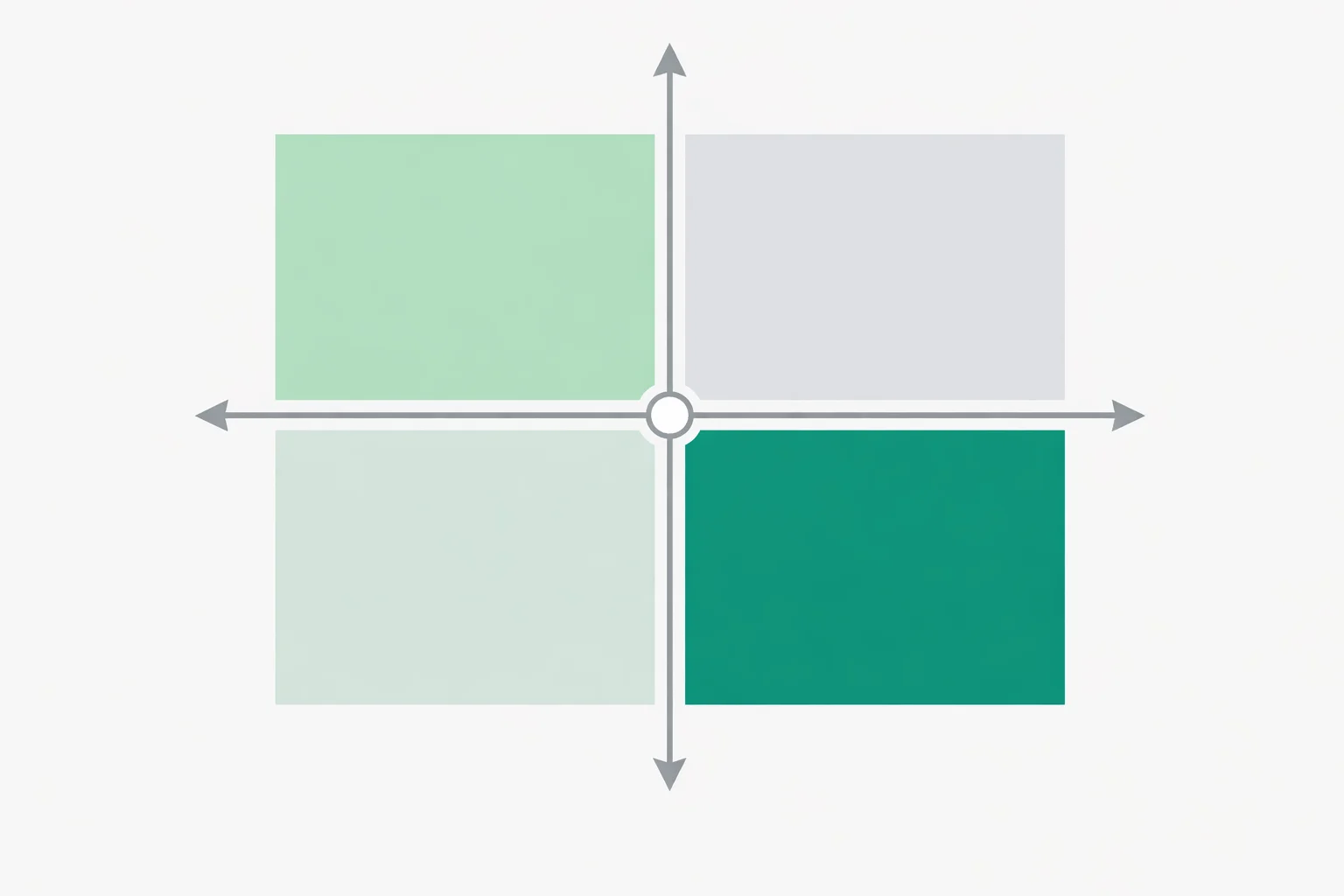
Most free quizzes drop you into one of four boxes and call it a day. That's not how researchers actually measure attachment, and it's why this quiz works differently. The gold-standard self-report tool, the Experiences in Close Relationships scale, doesn't hand you a label — it scores you on two independent dials: attachment anxiety (how much you fear distance and abandonment) and attachment avoidance (how much closeness and dependence make you want to bolt). Your "style" is just the corner of the grid where your two scores land.
That distinction matters more than it sounds. Two people can both be labeled "anxious," but one scores 90% anxiety and the other 55% — wildly different inner lives, same box. By showing you both numbers, this quiz tells you not just which pattern you lean toward, but how strongly. Here's how the main tools compare:
| Tool | Format | What it produces | Best for |
|---|---|---|---|
| Strange Situation | Observed lab reunion (infants) | Child attachment category | Developmental research |
| Adult Attachment Interview | Hour-long coded interview | Narrative coherence score | Clinical & research gold standard |
| ECR scale | 36 agree-disagree items | Two continuous scores | Academic self-report |
| This quiz | 18 scenario choices | Two dials + style | Fast self-insight |
Why So Many People Test Secure When They Aren't
Ask a room of adults to self-diagnose, and far more than half will confidently say "secure." The real-world number sits around 50-56%, so a lot of those people are wrong — and the reason is fascinating. Avoidant people, in particular, tend to over-report security, because the whole avoidant strategy is to believe you're fine and don't need anyone. "I'm very independent and relationships don't stress me out" can describe a genuinely secure person or a deeply avoidant one. They sound identical from the outside.
That's why the questions on this quiz ask about behavior in specific moments — the delayed text, the "we need to talk," the partner who wants a weekend away — rather than asking you to rate yourself. It's much harder to flatter yourself when the question is about what you actually do at 11pm when the reply hasn't come. If your results surprised you, that gap is worth sitting with. It also shapes how you read a new crush's mixed signals — anxious types tend to catastrophize a slow reply, so if you're currently decoding someone, our does he like me quiz pairs well with this one — or, if it's still early and the crush mostly lives in your head, our does my crush like me quiz. The same instinct shows up in how you give affection, which is why pairing this with our love language quiz often reveals more than either result alone.
Can Your Attachment Style Actually Change?
Yes — and this is the part the doom-scrolling relationship content tends to skip. Attachment is moderately stable, not carved in stone. Longitudinal work led by psychologist Chris Fraley suggests that while your style tends to persist, a meaningful slice of people — somewhere between a quarter and a third — shift category over a span of years. Psychologists call the hopeful direction earned secure attachment: someone who grew up anxious or avoidant gradually becoming secure, usually through a steady, responsive relationship or focused therapy.
The mechanism is almost boringly simple. Your nervous system updates its predictions based on evidence. Date enough people who actually show up, and the old forecast — "they'll leave" or "I can't rely on anyone" — slowly loses its grip. It also runs the other way: betrayal, a brutal breakup, or a long stretch of an on-again-off-again partner can nudge a once-secure person toward anxiety. Your result today is a snapshot, not a sentence.
What Happens When Two Styles Date
Attachment really earns its keep when two styles collide. The most notorious combination is the anxious-avoidant trap: an anxious partner craves closeness and chases it, which an avoidant partner reads as engulfment and answers with distance, which spikes the anxious partner's fear, which makes them chase harder. Each person triggers the other's deepest worry, and the cruel twist is that it can feel like intense chemistry. Avoidant attachment that comes wrapped in grandiosity and a need for admiration has a name of its own — our narcissist quiz checks whether that distance is self-protection or something closer to the entitled end of the spectrum. When anxious attachment is extreme enough that the fear of abandonment reshapes your whole sense of self, it can shade into borderline territory — our BPD quiz maps where that line falls. And if you're not sure whether what you feel is real love or that anxious adrenaline, our am I in love quiz breaks the feeling into intimacy, passion, and commitment so you can tell them apart.
Two secure partners, by contrast, are almost suspiciously calm — they argue, repair, and move on. A secure partner can also act like a stabilizer for an anxious or avoidant one, which is the single best argument for not writing off a relationship over a quiz result. Knowing your pairing doesn't doom you; it just tells you which loop to watch for. There's one anxious variation worth naming separately: when the chasing stops being about closeness and starts being about usefulness — when you keep the relationship by making yourself indispensable — that pattern has its own measure, and our codependency quiz scores it across external focus, self-sacrifice and reactivity. If you want a lighter read on how your temperament meshes with someone else's, the animal personality quiz is a fun companion to this one.
All Four Attachment Styles, Explained
🌿 Secure (about 56% of adults). Comfortable with both intimacy and independence. Secure people ask for what they need without melodrama and hear a partner's needs without panic. They treat conflict as solvable, so they tend to stay and repair. The one blind spot: their tolerance can make them slow to walk away from someone who genuinely doesn't treat them well.
🌊 Anxious-Preoccupied (about 20%). Loves intensely and feels every change in temperature. Anxious people are exquisitely tuned to a partner's moods, which makes them attentive but also prone to reading disaster into a short reply. The driving fear is abandonment, and reassurance soothes it only briefly. Their growth lies in learning to self-soothe before reaching out.
🏔️ Dismissive-Avoidant (about 23%). Fiercely self-reliant and calm on the surface. Avoidant people learned that depending on others is risky, so they keep a quiet distance even inside a committed relationship. They rarely lose themselves in a partner — but partners often feel locked out. The work is small, deliberate acts of vulnerability rather than a personality overhaul.
🌗 Fearful-Avoidant (about 7%). The rarest style, sometimes called disorganized. These people want closeness and expect it to hurt, so they swing between pulling a partner in and pushing them away. It usually traces back to early bonds that were both comforting and frightening. With steady, predictable partners and good support, it's also one of the most workable patterns to shift.
Turning Your Result Into One Concrete Change
Don't try to overhaul your attachment style this week — that's a recipe for giving up by Thursday. Pick the single lever that matches your result. If you scored anxious, install one rule: when a partner goes quiet and your mind starts writing the breakup speech, set a 20-minute timer before you send anything. Most of the time the reply lands first. If you scored avoidant, name one genuine need out loud each week, however small — "I had a rough day and I'd like to talk about it" counts. If you scored fearful, slow your relationships down on purpose; your system reads fast intensity as a threat, and steady is what actually heals it.
And if you scored secure? Use it. Secure people are the quiet repair crew of the dating world — the ones who can date an anxious or avoidant partner and gently model what safe looks like. Whatever your result, run it again sometime with one specific relationship in mind. The number you get when you picture your calmest partnership versus your most chaotic one is, honestly, the most useful data this quiz can hand you. For a lighter, pop-culture spin on the same instinct, the dere type quiz turns these attachment patterns into anime archetypes like the clingy yandere and the guarded kuudere. For a different lens on how you connect, try our love language quiz next — or, if you're curious which partner type would actually steady your attachment system, the soulmate quiz sketches the match that fits you. Already partnered? The couples quiz turns all this into a game — see how much of each other's inner world you can actually guess. And if you want to see how your attachment patterns are playing out across the whole relationship, the relationship health quiz scores trust, communication, and three other pillars at once. Attachment shapes friendships as much as romance, so for a lighter take, the best friend quiz tests how well your closest friends actually know you. And because insecure attachment is a well-documented risk factor for low mood, if these patterns are weighing on you, our depression screening quiz offers a clinical PHQ-9 check-in.
Want the deeper science? The adult attachment overview on Wikipedia and the original Hazan & Shaver (1987) study are the best places to start.