BPD Quiz: How to Read Your Borderline Personality Disorder Score
The night Maya finally typed "BPD quiz" into her phone at 2 a.m., she wasn't thinking about symptoms or criteria. She was thinking about one person — the friend whose unread message had hollowed out her entire week. When he replied, the world turned warm and safe. When he went quiet, she spiraled. She had a private name for him that she'd never said out loud: her favorite person. And somewhere in a forum thread, she'd just learned that phrase belonged to a whole community of people who lived the way she did — at the mercy of someone else's mood.
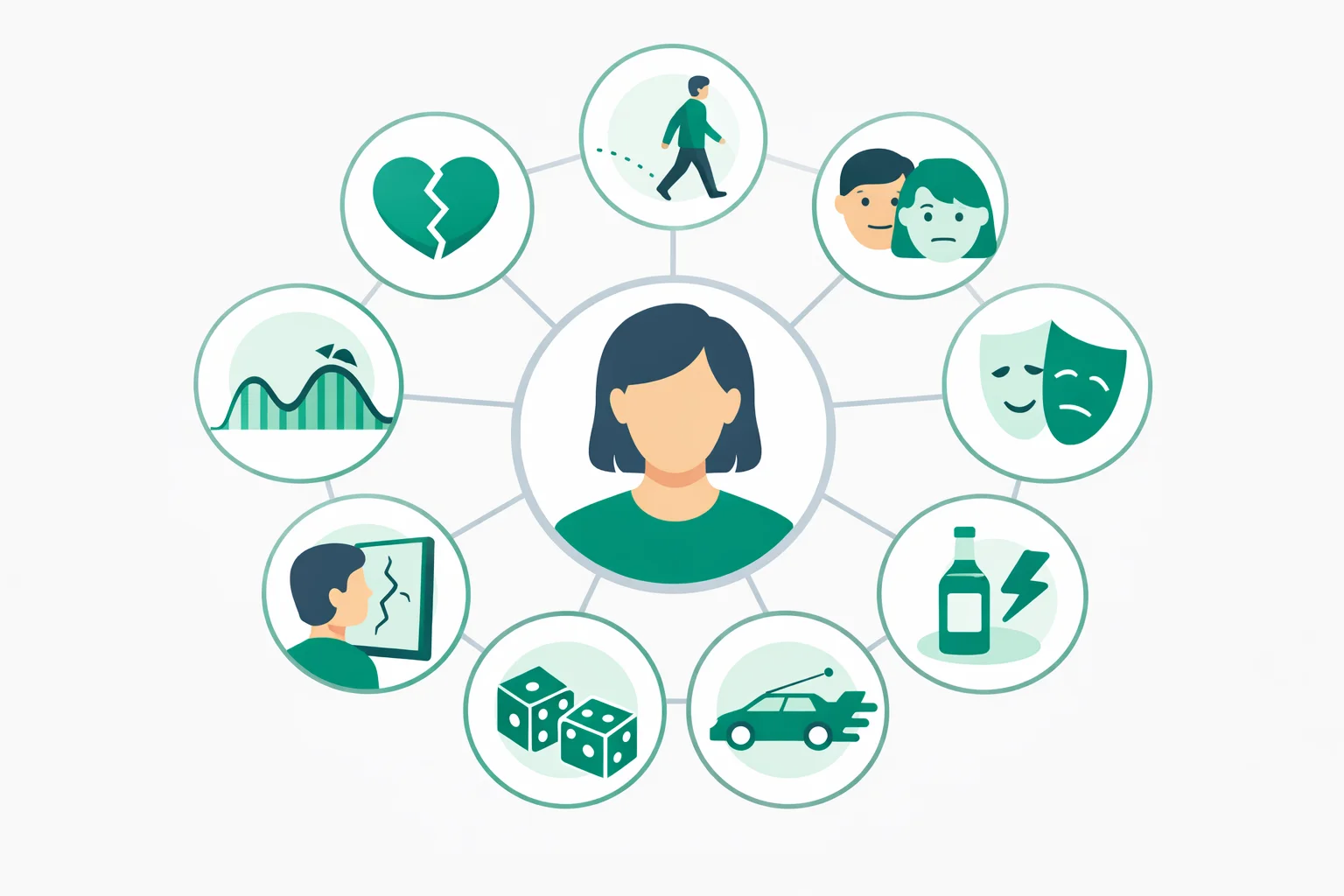
Maya is a composite — stitched together from the thousands of near-identical stories people share when they go looking for answers about borderline personality disorder. The details change, but the shape repeats: an emotional life lived at high volume, relationships that swing between heaven and abandonment, and a quiet suspicion that everyone else got an instruction manual you never received. This page is built around that experience, and the quiz above maps your answers to the nine clinical criteria that define BPD.
The 2 a.m. Search That Starts With a "Favorite Person"
Here's something you won't find in the diagnostic manual but will find in nearly every BPD support group: the favorite person, or FP. It's the one whose attention regulates your entire nervous system. Their approval feels like oxygen; their silence feels like proof you're being left. The FP can be a partner, a best friend, a parent, sometimes a therapist. What makes it a BPD signature rather than ordinary attachment is the intensity and the way your sense of stability outsources itself to someone else entirely.
I lead with the FP because it's the experience that most often gets someone to a quiz like this one — and because it sits right at the intersection of two of the nine criteria: frantic efforts to avoid abandonment, and unstable, intense relationships. If question 6 above hit a nerve, you already understand BPD better than most textbooks will explain it. The disorder isn't really about being "dramatic." It's about a fear of being left that's loud enough to reshape your behavior around keeping people close.
Borderline Runs on Nine Criteria, Not One Feeling
The National Institute of Mental Health defines BPD through nine criteria, and a diagnosis requires meeting at least five of them. That five-of-nine rule has a strange mathematical consequence most people never notice: two people can both have textbook BPD and share as little as one symptom. One person's borderline is rage and impulsivity; another's is emptiness, dissociation, and a self-image that dissolves in company. Same diagnosis, almost opposite lived experience.
The nine criteria are: frantic efforts to avoid abandonment, unstable relationships, identity disturbance, impulsivity in at least two self-damaging areas, recurrent self-harm or suicidal behavior, emotional instability, chronic emptiness, inappropriate intense anger, and stress-related paranoia or dissociation. The quiz above expands the two heaviest categories — emotions and relationships — into more than one question each, because those are where the borderline pattern shows up most strongly and where a single question would miss too much.
Why a 0-to-36 Score Beats a Yes-or-No Answer
Most clinical BPD screens, like the widely used McLean Screening Instrument, ask blunt yes-or-no questions and add up the yeses. That works in a doctor's office where a clinician interprets the result, but on its own it throws away information. "Sometimes I fear abandonment" and "abandonment terror runs my whole life" both become a single "yes." This quiz scores each of the twelve items from 0 to 3 instead, so intensity counts — and then it splits your total across five trait clusters so you can see the shape of your pattern, not just its size.
That shape is the part worth studying. A total of 20 spread evenly across all five clusters means something different from a 20 driven almost entirely by emotional intensity and relationships, with nothing on impulsivity. The first profile looks like classic BPD; the second might point toward an attachment wound or a mood issue instead. If the relationships cluster dominated your result, the attachment style quiz is a natural next step — anxious attachment and BPD's abandonment fear are close cousins, and telling them apart matters.
The Symptom Nobody Warns You About: Splitting
Ask someone to name a BPD symptom and they'll usually say "mood swings." Ask someone who actually lives with it, and they'll often say splitting. Splitting is the mind's inability to hold "this person is good" and "this person hurt me" at the same time. So it flips. One hour your partner is the love of your life; the next, a single careless comment recasts them as someone who never cared at all. The switch is total, and it feels like the truth in both directions.
Splitting is exhausting precisely because it isn't a choice. It's the unstable-relationships criterion playing out in real time, and it's why BPD relationships can feel like whiplash from the inside as much as the outside. Recognizing splitting as a pattern rather than a series of true revelations is one of the first things dialectical behavior therapy teaches — and it's often the first crack of light for people who thought they were just "bad at relationships."
BPD Is Not Bipolar — and the Difference Is Speed
BPD gets confused with bipolar disorder constantly, partly because both involve mood, and partly because the names sound vaguely related. They're not the same, and the cleanest way to tell them apart is timing. A bipolar episode lasts days or weeks and can roll in for no clear reason. A borderline mood shift lasts hours — sometimes minutes — and is almost always triggered by something between you and another person. Here's how the two, plus complex PTSD (which overlaps even more), actually compare:
| Dimension | Borderline (BPD) | Bipolar Disorder | Complex PTSD |
|---|---|---|---|
| Mood shift length | Hours, sometimes minutes | Days to weeks | Triggered flashbacks, variable |
| Main trigger | Relationships and abandonment | Often no clear trigger | Reminders of past trauma |
| Self-image | Unstable, shifts with others | Stable between episodes | Deeply negative, "damaged" |
| Core fear | Being abandoned | Not fear-driven | Being unsafe or re-traumatized |
| First-line treatment | DBT (therapy-led) | Medication (mood stabilizers) | Trauma-focused therapy |
That treatment row is the practical punchline. Bipolar disorder is managed primarily with medication; BPD responds best to therapy, especially DBT. Misdiagnosing one as the other sends people down the wrong road for years. If your moods run long and arrive unprovoked, the bipolar quiz is worth taking too — and since depression rides alongside both so often, the depression quiz can fill in another piece of the picture. BPD shares the Cluster B label with narcissistic personality, and the two get tangled constantly — if the intensity in your relationships looks more like entitlement and a hunger for admiration than fear of abandonment, the narcissist quiz maps that pattern instead. And because borderline traits are so often rooted in early trauma, it's worth knowing your ACE score — childhood abuse, neglect, and household chaos show up in the histories of a large share of people who relate to this quiz. That same trauma history is what separates BPD from its closest look-alike, complex PTSD; our Complex PTSD quiz checks whether your symptoms fit that pattern instead.
Can You Have "Quiet BPD" and Still Score Low?
Quiet BPD isn't an official diagnosis — there's no separate code for it. It's a description of people who aim every borderline symptom inward. Instead of rage, self-blame. Instead of confrontation, withdrawal and silence. Instead of visible chaos, a private collapse nobody sees. The pain is identical; it just doesn't make noise. And that creates a real blind spot for self-report quizzes like this one.
A few of the questions above were written with quiet BPD in mind — the ones about emptiness, dissociation, and how others' treatment reshapes your self-worth tap internal experience rather than outward behavior. But internalizers tend to minimize. If you read these questions and quietly thought "well, it's notthat bad," while also recognizing yourself in nearly every one, take your score as a floor rather than a ceiling. The reflex to downplay is itself part of the pattern.
All 4 BPD Screening Results, Explained
The quiz sorts your total into one of four ranges. None of them is a diagnosis — they describe how closely your answers resemble the borderline pattern, and what a sensible next step looks like.
🌤️ Few BPD Traits (0–8). Your answers don't track the borderline pattern in any consistent way. Emotional days and complicated relationships are universal; they're not a disorder. If a specific worry brought you here, it's still worth addressing — just probably not through a BPD lens.
🌥️ Some BPD Traits (9–17). A handful of traits show up — maybe the intensity, maybe the abandonment fear — without forming a full pattern. This is the most common range, and having traits is not the same as having the disorder. Your trait fingerprint matters more than the total here; one tall cluster is the real signal.
🌧️ Notable BPD Traits (18–26). Several core patterns cluster together in a way worth taking seriously. It's not a diagnosis, but it's a solid reason to book a professional assessment. The good news that surprises people: BPD is one of the more treatable conditions in this whole category.
⛈️ Strong BPD Traits (27–36). Your answers closely mirror the borderline pattern across multiple areas. A strong score is the start of an answer, not a label — and getting an accurate name for years of feeling "too much" is often the moment things begin to turn. The next step that helps most is a clinician who can confirm what's going on.
What to Actually Do With Your Score
Whatever range you landed in, here's the most important thing to carry away: BPD has one of the best long-term outlooks of any serious mental health condition. In a landmark long-term study, psychiatrist Mary Zanarini followed patients for a decade and found that roughly 85% no longer met the full criteria within ten years. That is not how most people imagine a "personality disorder," and it's the fact that gets buried under every scary headline.
If you scored in the notable or strong range, the single highest-value move is finding a therapist trained in dialectical behavior therapy. DBT was built specifically for BPD, and it teaches the exact skills the disorder erodes: riding out an emotional wave without acting on it, holding two truths at once instead of splitting, and tolerating the gap when a favorite person goes quiet. If you're ever in genuine crisis, don't wait for an appointment — call or text 988 in the US, any time, for free. Your score is a starting point. What you do with it is where the actual change lives.