Complex PTSD Quiz: How C-PTSD Differs from PTSD and What Your Symptoms Mean
Most people who take a complex PTSD quiz expect it to look like a standard PTSD test — flashbacks, nightmares, feeling permanently on edge. It doesn't, and that gap is the entire point. In 2018, a research team led by Marylène Cloitre published the International Trauma Questionnaire (ITQ) after validating it on thousands of trauma survivors, and it measures something the older PTSD checklists miss completely: what prolonged, inescapable trauma does to your sense of self. This screen is modeled on that framework, which is why it asks about your emotions, your self-worth, and your relationships — not just your memories.
Complex PTSD Isn't Just "Worse" PTSD
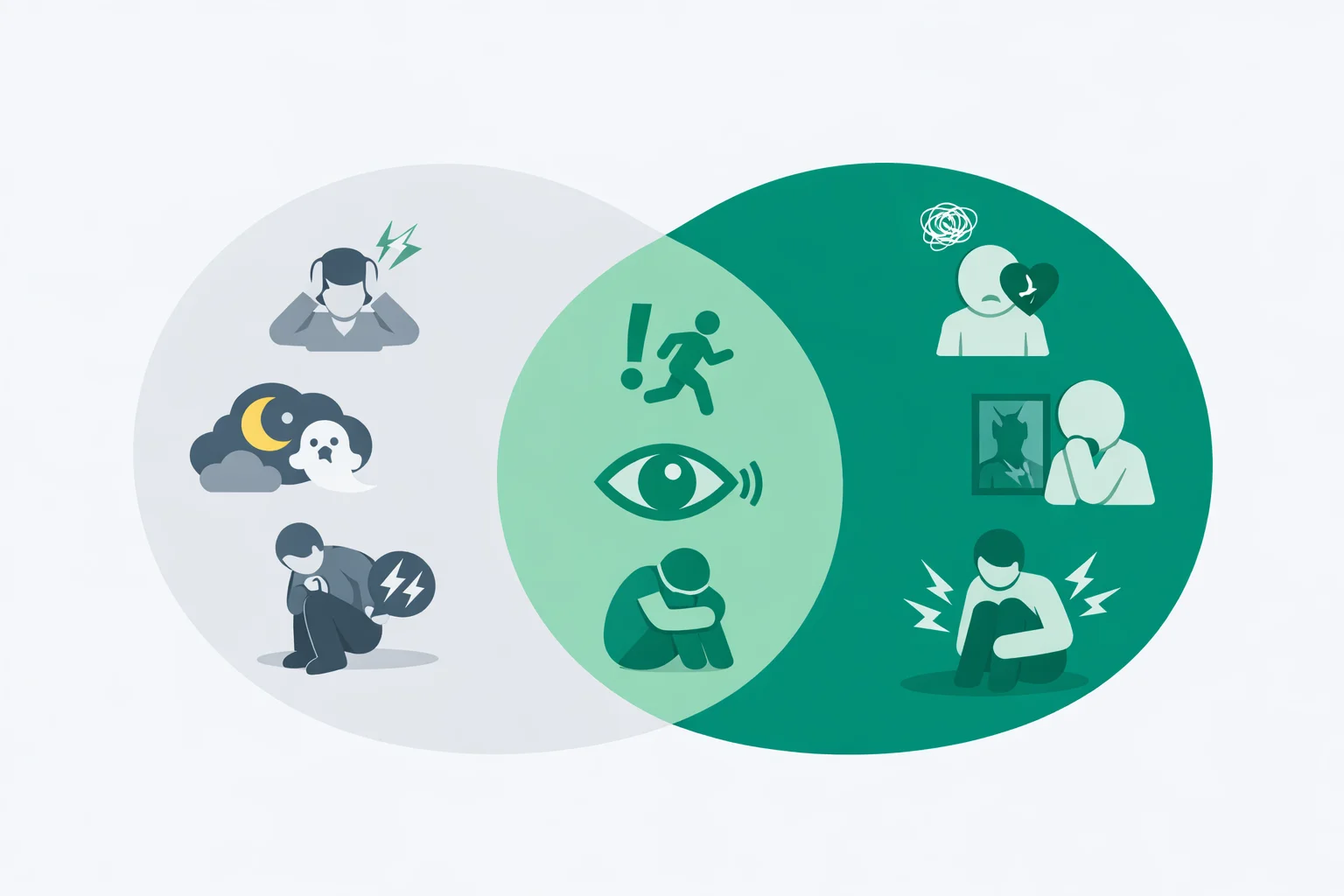
The most common misunderstanding is that Complex PTSD is simply PTSD with the volume turned up. It isn't. Under the World Health Organization's ICD-11 system, both diagnoses share the same three core clusters: re-experiencing the trauma in the present, avoiding reminders of it, and a persistent sense of current threat. Complex PTSD requires all of that — and then three more disturbances that ICD-11 groups under the clinical term disturbances in self-organization: trouble regulating emotions, a stubbornly negative self-concept, and difficulty feeling close to other people.
That second group is what this quiz is really testing for. You can score high on the PTSD clusters and low on the self-organization ones — that's ordinary PTSD. It's when both light up that the picture shifts to the complex form. The six-cluster breakdown in your result splits these out deliberately, so you can see which side of the line your answers fell on instead of getting a single, blurry severity number.
The Questionnaire This Screen Is Built On
The ITQ is short on purpose. Cloitre and her colleagues wanted a measure that mapped cleanly onto the ICD-11 definition rather than onto the older, sprawling symptom lists — so each of the six clusters gets just a couple of items, and an answer of "moderately" or higher counts as endorsing that symptom. A cluster is considered present if you endorse at least one of its symptoms. PTSD is flagged when all three core clusters are present; Complex PTSD is flagged when those three and all three self-organization clusters are present.
Here's the structure this quiz follows, cluster by cluster:
| Symptom group | Cluster | What it captures |
|---|---|---|
| Core PTSD | Re-experiencing | Flashbacks and intrusions that feel like the danger is happening now |
| Core PTSD | Avoidance | Steering clear of reminders, internal or external |
| Core PTSD | Sense of threat | Hypervigilance and an exaggerated startle response |
| Self-organization | Emotion regulation | Feelings that overwhelm and won't settle — or numbness and shutdown |
| Self-organization | Self-concept | Persistent worthlessness, failure, and shame about who you are |
| Self-organization | Relationships | Feeling cut off and unable to get close, even when you want to |
Several of these clusters overlap with other conditions, which is exactly why a screen like this points you toward a conversation rather than a verdict. The hypervigilance cluster, for instance, looks a lot like generalized anxiety — if that's where your answers concentrated, the anxiety quiz may give you a cleaner read on that piece specifically.
Why Your Doctor Might Not "Believe In" C-PTSD
Here's a genuinely strange fact that trips up a lot of people researching their symptoms: whether Complex PTSD "exists" as a diagnosis depends on which country you're in. The WHO's ICD-11, used across most of the world and adopted for global reporting in 2022, lists C-PTSD as its own distinct condition. The American Psychiatric Association's DSM-5 — the manual most US clinicians work from — does not. It folds those self-organization symptoms into a single, broader PTSD diagnosis instead.
That split is why you can read two reputable sources and come away thinking different things. A survivor in Berlin might be diagnosed with Complex PTSD; the same person in Boston might be told they have PTSD with additional features. The symptoms are identical — the label reflects a long-running professional disagreement about whether the complex presentation is a separate disorder or a severe variant. If a clinician tells you C-PTSD "isn't a real diagnosis," they're usually describing the DSM's position, not dismissing your experience.
Where Complex PTSD Actually Comes From
Single-incident PTSD tends to follow one overwhelming event — a crash, an assault, a disaster. Complex PTSD grows out of something different: trauma that is prolonged, repeated, and hard or impossible to escape. Childhood abuse and neglect, long-term domestic violence, trafficking, and captivity are the classic origins. The common thread isn't the severity of any single moment but the duration and the trapped quality of it — the nervous system adapting to chronic danger rather than recovering from one shock. The National Institute of Mental Health notes that this kind of sustained, developmental trauma reshapes the stress response in ways a single frightening event rarely does.
That's why so many people with C-PTSD can't point to a single defining trauma. When the harm is woven into years of daily life, especially early life, it shapes the developing sense of self instead of standing out as a discrete memory. The strongest predictor of this pattern is accumulated childhood adversity, which you can measure directly with the ACE Score Quiz — a high ACE score and a Complex PTSD pattern on this screen often travel together. Pete Walker, the therapist who popularised the term Complex PTSD, argued that years of that kind of pressure also harden one survival reflex into a default; the trauma response quiz ranks all four of his 4Fs — fight, flight, freeze and fawn — in the order they fire for you.
Is It Complex PTSD or Borderline Personality?
This is one of the most contested questions in trauma psychology, and it matters because the two are frequently confused — sometimes by clinicians. Both involve emotional storms and turbulent relationships, and both are linked to early trauma. But the distinctions are real and useful:
| Feature | Complex PTSD | Borderline Personality (BPD) |
|---|---|---|
| Self-image | Consistently negative — "I'm worthless" | Unstable — shifts rapidly between extremes |
| Fear of abandonment | Not a defining feature | Central and intense |
| Relationships | Avoided; closeness feels unsafe | Stormy; swings between idealizing and devaluing |
| Impulsivity | Not core to the diagnosis | Common — spending, risk-taking, self-harm |
In short, C-PTSD's negative self-view tends to be stable and entrenched, while BPD's is volatile, and BPD carries a fear of abandonment and impulsivity that aren't part of the C-PTSD picture. The two can also co-occur. If your relationship answers ran high and you recognize the abandonment pattern, the BPD quiz is worth taking alongside this one to compare the profiles.
What This Screen Can and Can't Tell You
A 12-item screen is a starting point, not a diagnosis — and the gap matters more here than with most quizzes. Trauma symptoms fluctuate with stress, sleep, anniversaries, and triggers, so a snapshot taken during a brutal week can read higher than your baseline. The ITQ framework was validated to flag a likely pattern for a clinician to confirm, not to replace that clinician. It also can't see context: numbness and a harsh self-concept show up in depression too, and hypervigilance overlaps with anxiety.
The one thing it does well is structure. By separating the core PTSD clusters from the self-organization clusters, it can tell you which kind of trauma response your answers fit — and that distinction genuinely changes what kind of help to look for. A "PTSD pattern" result points toward focused trauma processing; a "Complex PTSD pattern" points toward phased treatment that builds stability and emotional skills first. Use the result to ask a better question, not to close the book.
All 5 Result Patterns Explained
🌤️ Minimal Trauma Symptoms. Few or none of the six clusters crossed the threshold. Hard memories and occasional jumpiness are normal; this result simply means your answers don't form the clustered, persistent pattern that trauma disorders produce. Nothing to act on beyond protecting what already keeps you steady.
🌥️ Some Trauma-Related Symptoms. Real symptoms are present, but they don't yet add up to a full PTSD or C-PTSD pattern. This subthreshold zone often reflects unprocessed stress or symptoms still taking shape — and it's the easiest stage at which to get ahead of things with support.
🌧️ PTSD Symptom Pattern. All three core clusters are present — re-experiencing, avoidance, and a sense of threat — without the broader self-organization changes. This is the profile most tied to a single traumatic event, and it tends to respond quickly to trauma-focused therapy like EMDR or trauma-focused CBT.
🌧️ Self-Organization Difficulties. The deeper changes — emotional dysregulation, negative self-concept, relationship struggles — are present without the full PTSD clusters. This is the least clear-cut result, because those symptoms overlap heavily with depression and attachment difficulties, so a professional read matters most here.
⛈️ Complex PTSD Pattern. All six clusters crossed the threshold — the full ICD-11 picture. This pattern usually traces back to prolonged or repeated trauma and affects emotions, self-worth, and closeness all at once. It's very treatable with specialized, trauma-informed care, even though recovery tends to take longer than it does for single-incident PTSD.
What to Do With Your Result
Whatever pattern you landed on, the most useful move is the same: write down which clusters were marked "met" and bring that to someone qualified. A therapist who works with trauma can do in one session what no quiz can — separate trauma from depression, weigh the context, and recommend the right sequence of care. If your result pointed to the complex pattern, look specifically for a clinician experienced in developmental or complex trauma, and ask about phased treatment.
And if any of this stirred up more than you expected, that's worth honoring rather than pushing past. Reaching out isn't an overreaction. The 988 Suicide & Crisis Lifeline and the SAMHSA National Helpline listed in your result are free, confidential, and available whether or not you're in crisis — sometimes the first step is just saying the symptoms out loud to a real person.