ACE Quiz: What Your Adverse Childhood Experiences Score Really Predicts
The ACE quiz you just took has split the medical world into two camps. On one side are clinicians who want every patient screened for Adverse Childhood Experiences, convinced the score catches hidden risk early. On the other side are researchers — including one of the people who helped invent it — who warn that turning a population statistic into a personal report card does more harm than good. Both sides are looking at the same ten questions and the same landmark study. They just draw opposite conclusions about what your number is allowed to say about you.
Two Camps Can't Agree on What Your Score Means
In 2020, California became the first state to pay doctors to screen patients for ACEs — about $29 per screening through its ACEs Aware initiative, championed by then-Surgeon General Nadine Burke Harris. The logic is intuitive: if childhood adversity drives adult disease, find it early and intervene. Millions of screenings followed.
Then came the pushback, and it came from an unexpected place. Robert Anda, the CDC epidemiologist who co-authored the original ACE study, publicly cautioned that the score was never designed to screen individuals. As a research instrument it's brilliant at describing populations; as a personal diagnostic, he argued, its accuracy is "quite poor." A 2016 analysis in the journal Annals of Internal Medicine made the same point from a different angle — ACE scores predict group-level risk far better than they predict any one person's outcome. That tension is the single most important thing to understand before you read too much into your result.
Where Did These Ten Questions Come From?
The story starts in an obesity clinic, of all places. In the mid-1980s, Dr. Vincent Felitti ran a weight-loss program at Kaiser Permanente in San Diego and kept hitting a wall: his most successful patients — people losing 100-plus pounds — were the ones most likely to drop out. When he interviewed them, a pattern surfaced that nobody had gone looking for. A striking number had histories of childhood sexual abuse, and the weight had quietly become a kind of armor. Losing it felt dangerous.
Felitti teamed up with Anda at the CDC, and between 1995 and 1997 they surveyed more than 17,000 middle-class, mostly insured Kaiser members — hardly the population people picture when they hear "childhood trauma." The results, published in 1998 in the American Journal of Preventive Medicine, were so striking they reshaped public health. The ten questions you answered are the exact instrument from that study, unchanged. If your childhood shaped patterns you still wrestle with today, you might also recognize yourself in our depression quiz or anxiety quiz, since early adversity is one of the strongest predictors of both.
How a Score From 0 to 10 Is Built
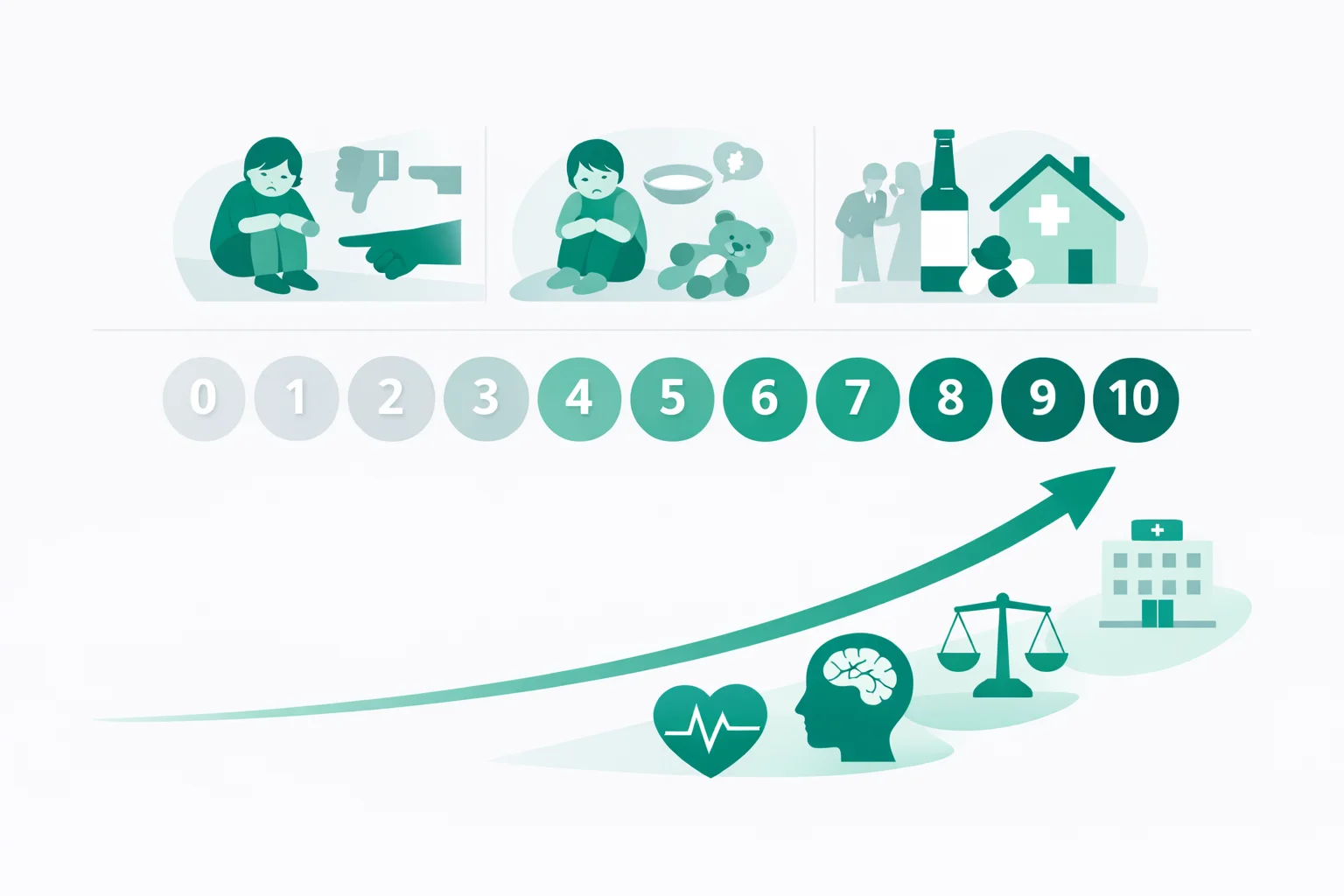
The scoring is deliberately blunt: one point for each "yes," zero for each "no," for a total between 0 and 10. There's no weighting — witnessing domestic violence counts the same single point as a parental divorce, which is one of the framework's known limitations. The ten items fall into three buckets, and seeing where your points cluster often tells you more than the total.
| Domain | What it covers | Items |
|---|---|---|
| Abuse | Emotional, physical, and sexual abuse directed at you | 3 |
| Neglect | Emotional and physical neglect — needs that went unmet | 2 |
| Household dysfunction | Divorce, domestic violence, substance abuse, mental illness, incarceration | 5 |
Notice what's missing. The original list only measured adversity inside the home, so bullying, poverty, racism, foster care, and neighborhood violence earn zero points no matter how heavy they were. That's why a low ACE score doesn't always mean an easy childhood — it can simply mean your hardships happened outside the four walls the study looked at.
Here's Why 4 Is the Number That Changes Everything
The headline finding wasn't that adversity is bad — everyone knew that. It was the dose-response curve: the more ACEs someone had, the steeper their risk for a long list of adult outcomes, climbing almost like compound interest. And the curve bent hardest around a score of four. Compared with people who scored zero, those with four or more ACEs showed dramatically higher rates across the board.
| Adult outcome (4+ ACEs vs. 0) | Approximate increase in risk |
|---|---|
| Depression | ~4.6× more likely |
| Alcohol problems | ~7× more likely |
| Attempted suicide | ~12× more likely |
| Smoking | ~2× more likely |
The most sobering statistic from the follow-up research: people with six or more ACEs died nearly 20 years earlier on average than those with none. Numbers like that are exactly why the screening camp feels such urgency. They're also exactly why the other camp worries — because it's painfully easy to read "12× more likely" and hear "this will happen to me." It won't necessarily, and the difference matters enormously. The link between high scores and problem drinking is real, but it's a probability, not a prophecy.
Your Score Predicts Populations, Not People
Here's the part that gets lost in viral posts about ACE scores. When you study 17,000 people, a high average ACE score reliably predicts that, as a group, they'll have more health problems. Zoom into any single person in that group and the prediction falls apart. Some with a score of 8 are thriving; some with a score of 1 are struggling. Statisticians call this the difference between the average and the individual, and it's why Anda himself resists using the number as a personal label.
What actually bends an individual's outcome is resilience — and that's measurable too. Research on "positive childhood experiences" found that things like feeling supported by family, having at least one safe and dependable adult, and a sense of belonging buffered adult mental health even among people with high ACE scores. One stable relationship can offset a lot. If your childhood adversity shows up today as intense emotions or turbulent relationships, the patterns explored in our BPD quiz may add another layer of self-understanding — and because prolonged childhood adversity is the most common root of complex trauma, our Complex PTSD quiz screens for exactly that pattern. And if you want to see how that history shows up in ordinary Tuesday pressure rather than in symptoms, the trauma response quiz scores whether you default to fight, flight, freeze or fawn — and whether that default holds up when someone with power over you is in the room. The ACE score tells you what the weather was like growing up. It doesn't tell you whether you brought an umbrella.
All Four ACE Score Ranges, Explained
🌱 Score of 0 (about a third of adults). None of the ten household adversities applied to you. That's a genuine protective foundation, though it doesn't capture hardships outside the home, and it doesn't make any current struggles less valid. Stability in childhood is an asset worth recognizing — and passing on.
🌤️ Score of 1 to 3 (roughly half of adults). This is the statistical norm, not a red flag. The research shows only a modest rise in long-term risk at this level, and supportive relationships do most of the work in determining how these experiences land. Most people here build healthy, ordinary lives without the score ever becoming a defining feature.
🌧️ Score of 4 to 6 (about one in eight adults). You've crossed the threshold researchers watch most closely, where statistical risk for depression, heart disease, and substance use rises noticeably. Crucially, that's a population pattern, not a personal sentence. This is a sensible point to bring your history into a conversation with a doctor or trauma-informed therapist.
⛈️ Score of 7 to 10 (a small minority of adults). A score this high reflects serious, repeated adversity — and the strength it took to survive it. The evidence on risk is real, but so is the evidence on recovery. People in this range heal, build stable families, and thrive every day, usually with good support. The number is a case for getting care, not a verdict about your future.
So What Do You Actually Do With Your Number?
Treat the score the way you'd treat a family history of heart disease: useful information that calls for attention, not alarm. If you scored high, the single most evidence-backed move is finding a trauma-informed therapist — and if you're seeing a doctor for unexplained anxiety, mood swings, or health issues, mentioning your ACE history gives them context that changes care for the better. If you scored low but still feel off, trust that feeling; the number was never meant to be the final word on your wellbeing. Either way, the most powerful thing the research points to isn't in the past at all. It's the one reliable, caring relationship — for you, or for a kid in your life right now — that quietly rewrites the odds.