Relationship Health Quiz: 5 Key Indicators of a Strong and Healthy Partnership
Most people think a good relationship quiz should tell them whether they fight too much. They're measuring the wrong thing. Decades of relationship research show that how often a couple argues says almost nothing about whether they'll last — what predicts a healthy partnership is the quieter stuff: whether you feel safe, supported, trusted, and like you're still growing in the same direction. That's exactly what this relationship health quiz scores, across the five pillars that actually hold a relationship together.
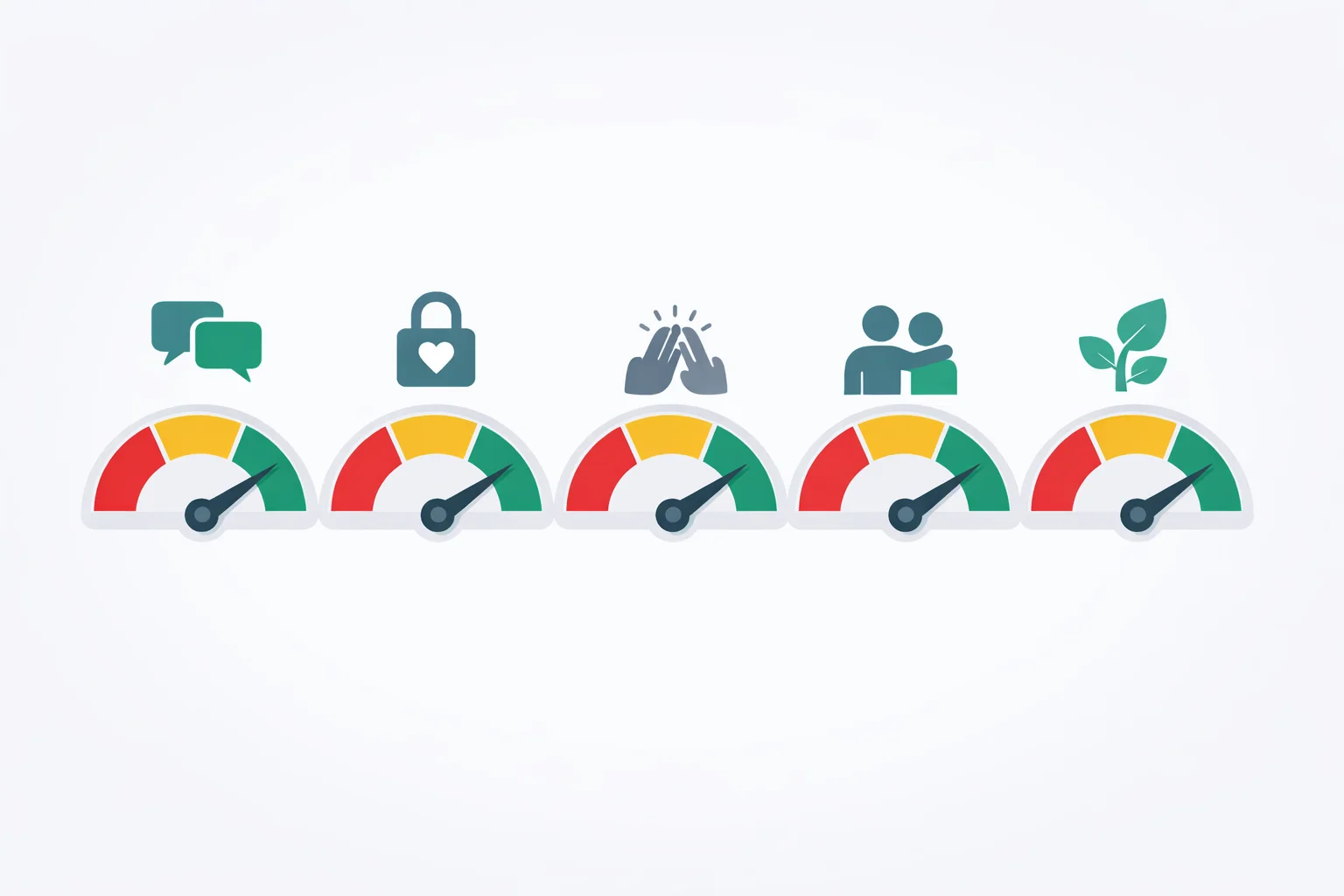
The Five Pillars This Quiz Actually Measures
Instead of spitting out a single vague number, this quiz scores five separate pillars and shows each one on a green-yellow-red dashboard. That design is deliberate: a couple can be a 9 out of 10 on communication and a 3 on trust, and a single blended score would hide that completely. The five pillars are communication (can you raise hard things and resolve them?), trust (do you feel secure when apart and rely on each other's word?), respect (are you treated kindly even mid-fight, and free to be yourself?), support (does your partner show up on the bad days and cheer your goals?), and growth (are you building something, or drifting?).
Each pillar is scored from three scenario questions rather than abstract "rate your agreement" statements, because people answer concrete situations far more honestly than they answer "Do you trust your partner?" Your weakest pillar isn't a verdict — it's a map. It tells you where one honest conversation will move your overall score more than anything else.
Four Myths About Healthy Relationships That Quietly Do Damage
A lot of relationship "common sense" is wrong, and believing it can make a fine relationship feel broken — or make a struggling one feel normal. Here are four of the most stubborn myths, and what the evidence actually says.
Myth 1: Healthy couples don't fight. Reality: they fight, they just fight clean. Researcher John Gottman found that the difference isn't conflict frequency — it's the ratio of positive to negative moments. His lab clocked a roughly 5-to-1 ratio of warm interactions to negative ones in stable couples, even during arguments.
Myth 2: If it's real love, it should be effortless. Reality: the "effortless" feeling is mostly the chemistry of a new relationship. Lasting health comes from effort that becomes a habit — checking in, repairing after a snap, choosing each other on the dull Tuesdays. The growth pillar exists to catch this.
Myth 3: Jealousy proves they care. Reality: occasional insecurity is human, but routine jealousy, phone-checking, or needing to know where your partner is at all times is a trust deficit wearing a romantic costume. It scores low here for a reason.
Myth 4: A high score means you've "made it." Reality: relationship health is a current reading, not a trophy. Couples who score in the thriving range and then coast often slide within a year or two. The point of measuring is to keep measuring.
Why the Healthiest Couples Argue More, Not Less
Here's the counterintuitive part. Couples who never argue often aren't conflict-free — they're conflict-avoidant. One or both partners has decided that raising problems isn't worth the discomfort, so resentment quietly accumulates instead. That's why questions 1 and 6 on this quiz probe how you handle friction, not whether you have it. "We talk it through" scores full marks; "I keep it in to avoid rocking the boat" scores zero, even though the second couple looks calmer from the outside.
Gottman's lab also flagged four behaviors that genuinely predict breakups — criticism, contempt, defensiveness, and stonewalling. Contempt (eye-rolling, mockery, sarcasm) is the single strongest predictor of divorce. Notice that none of those is "arguing." They're ways of arguing badly. If your respect pillar came back low, contempt is usually the culprit hiding underneath. Understanding your own conflict wiring helps here — many people discover their default reaction traces back to their attachment style, which shapes whether you lean toward pursuing or withdrawing under stress.
What Your Wellness Score Is Really Telling You
Your overall percentage is the average of all five pillars, but the headline number is the least interesting part of your result. The shape of your dashboard matters more. A couple at 68% with five even pillars has a very different relationship from a couple at 68% with four greens and one deep red — the first is generally healthy and a little tired, the second has a specific wound that needs naming.
| Score range | Result | What it usually reflects |
|---|---|---|
| 85–100% | Thriving Partnership | Strong across every pillar; the task is protecting it, not fixing it |
| 70–84% | Healthy & Grounded | Genuinely healthy with one or two soft spots |
| 55–69% | Stable but Strained | Real love, but one or two pillars are draining the tank |
| 40–54% | Running on Reserves | Coasting on history; several pillars low at once |
| 0–39% | Waving a Red Flag | The current pattern isn't sustainable without change |
One important caveat: this is a self-report from one person's perspective on one day. If you took it after a fight, your numbers are skewed low. For a fairer picture, have your partner take it separately and compare — or pair it with a lighter, two-player check-in like our couples quiz to see how well you actually know each other beneath the day-to-day. If you'd rather check your own side privately first, the quiz to ask your boyfriend measures how well you really know his inner world.
Where's the Line Between a Rough Patch and a Red Flag?
This is the question the quiz takes most seriously. A rough patch is temporary and mutual — you're both stressed, distant, or stuck, and you both want it to get better. A red flag is a pattern that makes you smaller, scared, or unsafe. The difference isn't the intensity of a single bad night; it's the direction over time and whether respect survives the conflict.
That's why the respect pillar gets special treatment in your results. If it scores in the red — repeated insults, walking on eggshells, threats, or controlling behavior — that's not a "work on your communication" situation. It's a safety situation, and no amount of effort on the other four pillars cancels it out. If that's your reality, the most useful thing this quiz can do is point you toward real support, like the resources at The Hotline. For everything short of that, a low pillar is simply information you can act on.
All 5 Relationship Health Results Explained
🌳 Thriving Partnership (85–100%). All five pillars are strong. You argue without cruelty, trust each other by default, and still feel like teammates. The risk at this level isn't conflict — it's complacency, so keep doing the small things that got you here.
💚 Healthy & Grounded (70–84%). A solid, healthy relationship with one or two soft spots. The good clearly outweighs the friction. Your lowest pillar is where a little attention pays off most — it's rarely a crisis, just an invitation.
💛 Stable but Strained (55–69%). There's real love and stability, but something is quietly draining you. Usually it's one or two pillars dragging the score down rather than trouble everywhere. Name the strained pillar and you've found this month's most important conversation.
🧡 Running on Reserves (40–54%). You're getting by on habit and shared history more than daily connection. It's exhausting, but very fixable when both people decide to reinvest. Start with the single weakest pillar instead of trying to overhaul everything at once.
🚩 Waving a Red Flag (0–39%). Something needs to change for this to feel healthy again. That doesn't mean it's over — but the current pattern won't hold. Look hard at your lowest pillar, and if respect or safety is involved, treat that as the priority over everything else.
Turn One Weak Pillar Into Your Next Conversation
Don't try to fix all five pillars this week — that's how good intentions die. Take your single lowest pillar and turn it into one specific, low-pressure conversation. If trust is low, that might be: "I've noticed I get anxious when you're out late, and I want to understand why so it stops running the show." If support is low, it might be naming one concrete thing you need more of. Small, specific, and owned beats big, vague, and blaming every time.
Then retake the quiz in a month. Relationship health isn't a fixed trait you discover once — it's a moving number you can nudge. The couples who keep checking in are, almost by definition, the ones still paying attention. And if your results made you curious about what you each need to feel cared for in the first place, the love language quiz is a natural next step. And for couples whose strong score has them daydreaming about a wedding, the wedding dress style quiz is a fun way to picture the day ahead.