The 12 Female Archetypes: What Your Result Says About Your Drive, Shadow, and Energy
Most people take a female archetype quiz hoping to be handed one tidy label — the Queen, the Lover, the Wild Woman — as if every woman ships with a single factory setting. That's the most common misconception about archetypes, and it's worth dismantling before you read your result. You aren't one archetype. You're a shifting cast of all twelve, with one or two doing most of the talking right now. Carl Jung, who built this whole idea, was crystal clear about that — and it changes how you should read the quiz you just took.
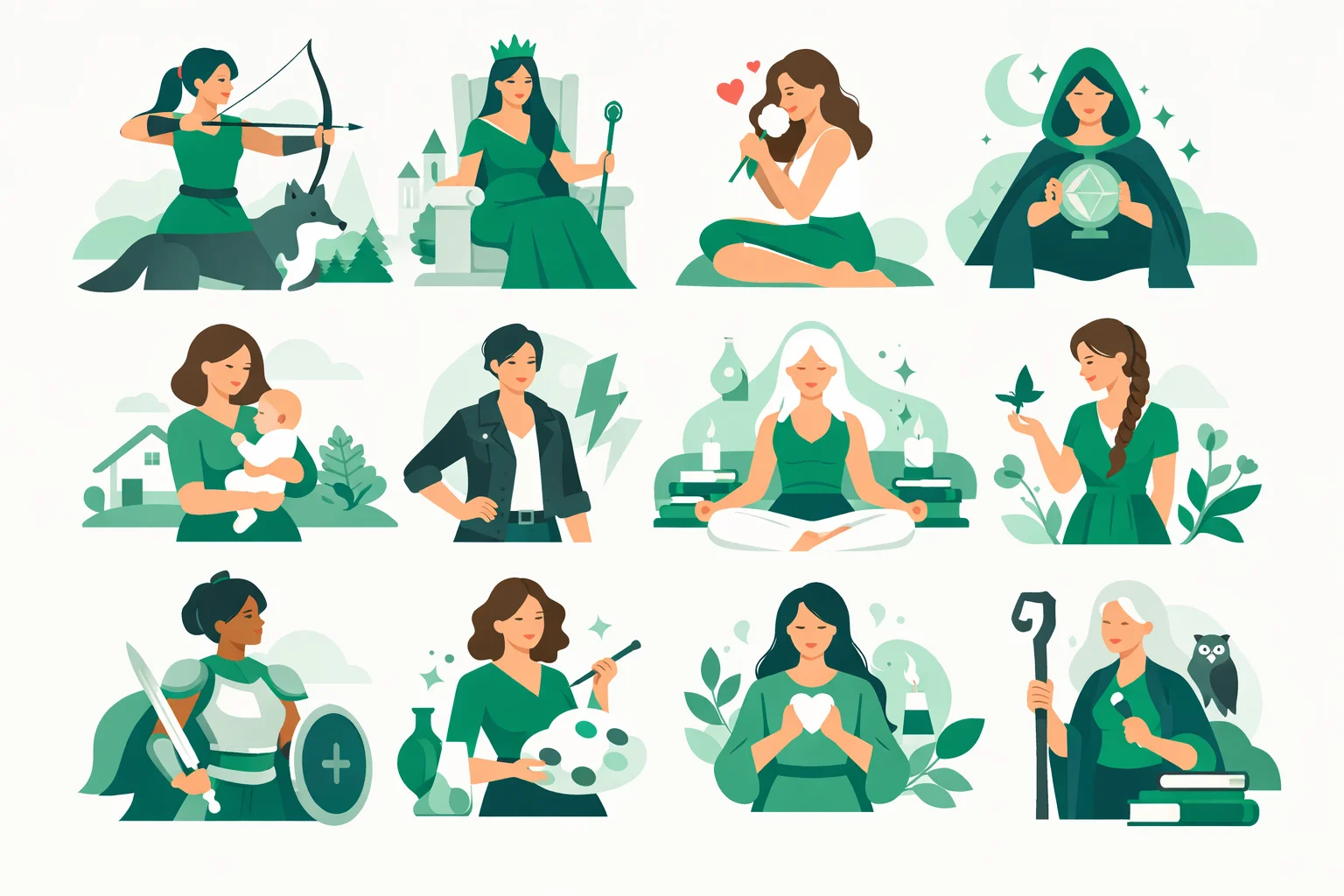
The Myth of Your One "True" Archetype
Here's the belief almost every quiz quietly reinforces: that there's a real you hiding underneath, and the right test will finally name it. It's a comforting idea. It's also wrong. Jung described archetypes as universal patterns living in what he called the collective unconscious — and he insisted we all contain every one of them. The Mother lives in the most ambitious Huntress. The Rebel sleeps inside the gentlest Healer.
What the quiz actually measures is which archetype is active in your life today — the energy you're leading with at this stage. That's why two questions matter more than your headline result: which archetype came in second (your blend), and which ones scored near zero. The bottom of your list is often more revealing than the top, because it shows the energy you've disowned. A woman with almost no Lover score isn't incapable of passion; she's probably buried it. More on that when we get to your shadow.
Where the 12 Female Archetypes Really Come From
The framework isn't internet folklore. It has a real lineage. Jung introduced archetypes in his work around 1919, but the feminine-specific version most quizzes borrow from traces to Jungian analyst Jean Shinoda Bolen, whose 1984 book Goddesses in Everywoman mapped seven Greek goddesses — Artemis, Athena, Hestia, Hera, Demeter, Persephone, and Aphrodite — onto recognizable patterns in women's lives. That's why the result you got names a goddess root: the Huntress is Artemis, the Sage is Athena, the Queen is Hera.
Two other sources fill out the modern twelve. Clarissa Pinkola Estés gave us the untamed instinctual self in her 1992 classic Women Who Run With the Wolves — the Wild Woman archetype directly. And Carol Pearson's work on the twelve archetypes (later popularized for branding in The Hero and the Outlaw) supplied the Creator, the Rebel, and the Sage as we use them. So when this quiz blends a Greek goddess with a Jungian pattern, it's stitching together three respected bodies of work, not making them up. You can read more on the underlying theory through Jung's original concept of archetypes.
It's worth noting how unusual that lineage is, because the male equivalent has nothing like it. The alpha/beta/sigma ladder people apply to men didn't come from Jung or from any depth-psychology tradition — the alpha half traces to a 1947 study of captive wolves that the field has since retracted, and sigma was invented in a blog post in 2010. The sigma male quiz covers that history and scores the two dimensions research actually supports underneath it. Same impulse to name a pattern; very different pedigree.
Why Does This Quiz Measure Drives, Not Traits?
A trait test asks what you're like — are you outgoing, are you organized. This quiz asks something sneakier: what are you reaching for? Look back at the questions. Almost none asked you to rate yourself. They asked what you fear, what you'd do with a free Saturday, what compliment lands deepest, what you'd tattoo on your heart. Those are drive questions, and they bypass your self-image.
That distinction is why the result sometimes startles people. You can think of yourself as a nurturing Mother and still score Huntress, because when the questions probed what you actually chase — freedom, the next horizon, your own path — the honest answers pointed somewhere your self-image didn't. This is also where archetypes diverge from a broad personality read. If you want the trait-based picture too, the Big Five personality quiz measures the five dimensions psychologists actually score, which pairs nicely with the mythic layer here.
Fire, Water, Earth, Air: The Four Feminine Energies
The twelve archetypes aren't a random grab bag. They sort cleanly into four elemental energies, three archetypes each — and your result told you which element you carry. It's the fastest way to understand why certain archetypes feel like cousins.
| Element | Archetypes | Leads with |
|---|---|---|
| 🔥 Fire | Huntress, Queen, Rebel | Will, action, courage |
| 🌊 Water | Lover, Mystic, Healer | Emotion, intuition, depth |
| 🌱 Earth | Mother, Wild Woman, Creator | Body, nurture, making things real |
| 🌬️ Air | Sage, Maiden, Muse | Mind, vision, inspiration |
If your top two archetypes share an element, you read as concentrated — a Fire woman who is both Queen and Rebel is a force, but may struggle to slow down and feel. If your top two span opposite elements (say a Fire Huntress with a strong Water Mystic underneath), you're more of a paradox: ambitious and intuitive, driven and dreamy. Neither is better. But knowing your mix explains the internal tug-of-war you've probably felt your whole life.
Here's What Your Shadow Archetype Is Telling You
Every archetype has a shadow — the same energy turned destructive, usually when you're stressed, scared, or running on empty. Your result named yours, and it deserves more attention than your gift. The Queen's shadow is control. The Healer's is self-erasure dressed up as love. The Rebel's is burning down good things just to prove she's free. The Lover's is disappearing into whoever she's with.
Jung argued that the parts of ourselves we refuse to look at don't vanish — they run the show from the basement. So the practical move isn't to fix your shadow; it's to recognize it in the moment. When the Mother catches herself martyring, when the Sage notices she's using analysis to avoid a feeling, that flash of recognition is the whole game. Your shadow only has power while it's unconscious. Name it and it shrinks.
Four Myths About Feminine Archetypes, Debunked
A few stubborn misconceptions trail this topic everywhere. Here's what they get wrong.
Myth 1: "My archetype is fixed for life." Reality: it moves in waves. Many women lead with Maiden energy in their twenties, shift to Mother or Queen in midlife, and grow into Mystic or Sage later. Bolen described the goddesses within us as rising and receding with circumstance. Retake the quiz in three years and you may meet a different leading lady.
Myth 2: "The Mother and Queen are for women with kids and power; the rest aren't for me." Reality: these are energies, not job descriptions. The Mother archetype shows up in the friend who feeds everyone; the Queen in the woman who quietly runs her department with grace. No marriage or crown required.
Myth 3: "Some archetypes are better than others." Reality: every culture just rewards different ones. Ours prizes the Huntress's independence, which can leave the Healer or Mother feeling undervalued — but that's a bias, not a ranking. Each archetype carries a gift the others lack.
Myth 4: "The quiz tells me who I am." Reality: it tells you which pattern is loudest right now. That's a mirror, not a verdict. The point isn't to be boxed — it's to recognize a pattern clearly enough to choose whether you want to keep leading with it.
Archetypes vs. MBTI vs. the Enneagram
People often ask how this differs from the other personality systems they've taken. Short version: they measure different layers of you, and they actually complement each other.
| System | What it measures | Best for |
|---|---|---|
| Female Archetypes | The mythic role and energy you bring | Story, symbolism, self-understanding |
| MBTI | How your mind takes in and processes information | Communication and work style |
| Enneagram | Your core fear and deepest motivation | Emotional patterns and growth |
Think of it as three lenses on the same person. Your archetype is the character you play; your Myers-Briggs type is the operating system running underneath; and your Enneagram number is the fear driving the whole thing. Stack all three and the picture gets genuinely specific. Archetypes win on emotional resonance — they just feel truer — even though they're the least clinically rigorous of the three. Archetypes also tend to leak into how you present yourself: if you want to see that connection on the surface, the style quiz maps your wardrobe instincts onto the same self-image these archetypes describe, and the hair type quiz does the same for how you wear your hair, while the body type quiz grounds all of it in the proportions you're actually dressing. Archetypes leak into the spaces you build as much as the clothes you wear, so the interior design style quiz is a revealing way to see the same self-image expressed in a room. And if you prefer archetypes distilled to three, the viral soldier, poet, king quiz sorts you into the sword, the word, or the crown. And for the anime-flavored version of the same idea, the dere type quiz reveals which love archetype — tsundere, kuudere, dandere, and more — you become when you catch feelings.
All 12 Female Archetypes at a Glance
🌸 The Maiden (Persephone) meets life wide open — curious, hopeful, energized by fresh starts. Her gift is renewal and contagious optimism. Her shadow is drifting into fantasy and refusing to grow up when life asks her to.
🌹 The Lover (Aphrodite) lives with the volume turned up on passion, beauty, and intimacy. She makes people feel chosen. Her shadow is losing herself in relationships and chasing intensity over stability.
🌿 The Mother (Demeter) notices the empty cup before anyone asks. She creates safety and belonging wherever she goes. Her shadow is smothering and tying her worth to being needed.
🏹 The Huntress (Artemis) answers to her own aim — independent, focused, a little untamable. Her gift is the courage to go first. Her shadow is isolation and refusing help she actually needs.
🦉 The Sage (Athena) analyzes where others react and keeps her head when everyone loses theirs. Her gift is clarity and calm. Her shadow is using intellect as a fortress against her own feelings.
🔮 The Mystic (Hecate) lives with one foot in the unseen. Intuition is her data. Her gift is depth and meaning. Her shadow is withdrawing so far inward that she ghosts her own life.
👑 The Queen (Hera) reorganizes a room just by entering it — loyal, dignified, built to lead. Her gift is commanding presence. Her shadow is control and an unwillingness to share the throne.
🎨 The Creator (Brigid) makes things real with her hands and sees possibility everywhere. Her gift is originality and vision. Her shadow is perfectionism and a graveyard of half-finished projects.
🐺 The Wild Woman (Estés' untamed self) trusts instinct over instruction and is magnetically herself. Her gift is fearless authenticity. Her shadow is mistaking every limit for a prison and torching stability to feel free.
🕊️ The Healer (Isis) feels others' pain like weather and helps them find the thread back to themselves. Her gift is deep empathy. Her shadow is self-erasure and rescuing instead of relating.
⚡ The Rebel (Lilith) feels an itch to break rules that shouldn't exist and says what others won't. Her gift is the courage that moves history. Her shadow is defiance for its own sake.
🌟 The Muse (the Muses) makes people more themselves — she sees the spark in someone and fans it. Her gift is contagious belief. Her shadow is needing the spotlight and feeling invisible without it.
What to Do Once You Know Your Archetype
Don't treat your result as a box to live inside. Treat it as a starting coordinate. Three moves make it useful. First, learn your shadow well enough to catch it in real time — that single skill is worth more than any list of strengths. Second, look at the archetype that scored lowest and ask whether you've disowned an energy you actually need; the buttoned-up Sage often needs a dose of Wild Woman, and the burned-out Healer usually needs the Queen's boundaries. Third, notice your blend — your top two together describe how your lead energy expresses itself far better than the headline alone.
If you'd rather meet these archetypes in the characters you actually grew up with, the Disney princess quiz maps the same energies onto eight familiar princesses — the Sage becomes Belle, the Huntress becomes Mulan or Moana, the Queen becomes Elsa. Seeing your archetype wearing a storybook face is often the fastest way to recognize it in yourself.
For a version where the archetypes are under real social pressure rather than fairy-tale pressure, the Bridgerton character quiz is unusually clarifying. It scores duty, passion, wit and candour — and watching which of those your archetype sacrifices first, when a whole society is grading you on reputation, tends to expose the shadow faster than any question about your strengths does.
And then retake it down the road. The most interesting thing this quiz can show you isn't today's result — it's the difference between today's and the one you'll get in five years. That gap is the story of how you're changing.