Hair Type Quiz: The 1A-4C System, What It Misses, and How to Read Your Real Hair
The hair type quiz you just took ranks your curls on the famous 1A-to-4C scale — but that scale wasn't built by a scientist in a lab. It was dreamed up by a celebrity hairstylist in the 1990s, partly to organize a line of products. Knowing where the system came from is the fastest way to understand both what it's good for and where it quietly falls apart.
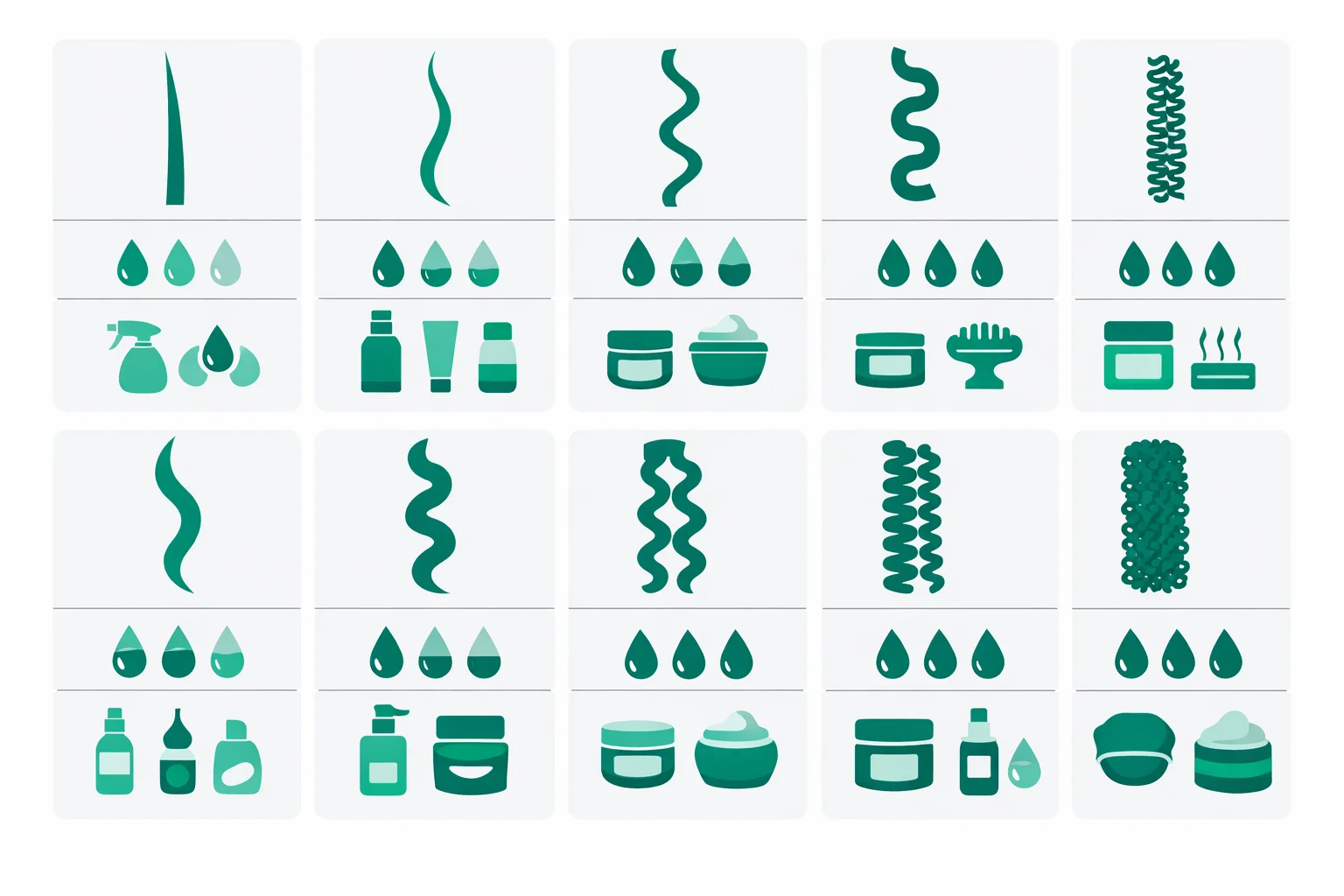
The Hair Chart You Know Was Invented to Sell Products
The 1A-4C numbering comes from Andre Walker, the stylist who spent decades doing Oprah Winfrey's hair and won multiple Daytime Emmys for it. He laid the system out in his 1997 book and attached it to his own line of haircare, which is why the categories were practical from day one: they existed to help someone pick the right product, not to satisfy a journal of biology. You can read the broad strokes of the framework on its Wikipedia entry, which also notes the criticism it has drawn over the years.
That commercial origin matters. Walker once said straight hair was the most manageable and described tighter textures in less flattering terms — a stance he later softened, but one baked into how the chart treats Type 1 as the tidy baseline and Type 4 as the outlier. Plenty of stylists who serve coily hair argue the scale was never really designed with their clients at the center. Keep that in mind when your result hands you a single neat label.
From One Stylist's Idea to a Global Standard
So how did one stylist's product chart become the language the entire internet uses? Timing. The system spread just as the natural hair movement was exploding online in the late 2000s and 2010s. Curly-hair forums, YouTube tutorials, and product brands all needed a shared vocabulary, and "I'm a 3B" was far easier to type into a search bar than a paragraph describing your ringlets. The shorthand won because it was searchable.
The number tells you the broad family — 1 straight, 2 wavy, 3 curly, 4 coily — and the letter tells you how tight the pattern runs within that family, from the loosest A to the tightest C. It's elegant, it's memorable, and it gave a generation of people a starting point for figuring out their hair. That's a real achievement. The trouble only starts when people treat the label as the finish line instead.
What the Numbers and Letters Actually Mean
The cleanest way to find your number is the curl-width test, and it's exactly what question two on the quiz is doing. Wash your hair, add nothing, let it dry, and see what object your tightest curl wraps around. Here's the rough map stylists use:
| Type | Pattern | Curl width benchmark |
|---|---|---|
| 1A-1C | Straight | No curl; 1C may wave in humidity |
| 2A-2C | Wavy | Loose S-waves, no measurable loop |
| 3A | Loose curls | Sidewalk chalk / wine cork |
| 3B | Springy ringlets | Sharpie marker |
| 3C | Tight corkscrews | Pencil or drinking straw |
| 4A | Soft coils | Crochet needle |
| 4B-4C | Z-pattern coils | Tight zigzag, little visible loop |
One thing the chart hides: nobody is a single type. Your crown is often tighter than your nape, your hairline finer than the back. That's why the quiz asks you to answer for the pattern that covers most of your head, then nudges you toward treating your tightest sections with a little extra moisture.
Why Curl Pattern Is the Least Useful Part of Your Hair
Here's the claim that gets curly-hair veterans nodding: once you're past the broad category, your curl pattern is the least helpful thing to know when you're standing in a store aisle. What actually decides whether a product works is porosity, density, and strand width — and the 1A-4C system measures none of them. Two people can both type as 3B and need opposite routines because one has low-porosity hair that repels moisture and one has high-porosity hair that drinks it and dries out by lunch.
Porosity is how easily water and product move in and out of your strands, set largely by how the outer cuticle lies. Low porosity means a tight cuticle that resists moisture, so heavy creams just sit on top; high porosity means a raised cuticle that soaks everything up and loses it fast, so sealing matters. Density is how many strands you have packed onto your scalp, and strand width is how thick each individual hair is — fine, medium, or coarse. Those three dials, not the curl letter, are what tell you how heavy to go and how often to deep-condition.
How This Quiz Reads Four Things at Once
Most online hair quizzes ask a few questions, tally them into four buckets, and stop. This one runs four readings in parallel. The pattern questions — air-dry behavior, curl width, shrinkage, frizz, and heat response — feed a single weighted score that slides along a spectrum from bone-straight to tight coil, then snaps to the nearest of the twelve types. The curl-width question carries the most weight because it's the most reliable signal a stylist uses.
Running quietly alongside it are three more measurements. The float test (does a shed strand sink or float in a glass of water) and the dry-time question estimate your porosity. The ponytail question gauges density. The thread-comparison question reads strand width. That's why your result screen shows three extra bars under the type code instead of a single label — the same "measure several dimensions, don't flatten to one" logic that powers our color analysis quiz, which reads undertone, depth, and chroma rather than just "warm or cool." If you like the way that result feeds straight into a wardrobe, our style personality quiz is a natural companion once you've sorted out your hair.
Did Scientists Ever Try to Fix the System?
They did. In 2007 a team of L'Oréal researchers led by Roland de la Mettrie published a study that ditched ethnicity-based labels and instead measured hair geometry directly — curve diameter, curl index, number of waves, and more — across hundreds of people worldwide. The result was an eight-group classification built on numbers a machine could read, not on a stylist's eye. You can find the published study indexed in the medical literature.
And yet salons and product labels still run on Andre Walker's 1A-4C. Why? Because a system you can say out loud beats a system you need calipers to apply. The scientific version is more accurate and almost nobody uses it day to day. That tension — precise but impractical versus rough but memorable — is the real story of hair typing, and it's why the smartest move is to use the familiar label for conversation and your porosity and density for actual decisions.
All 12 Hair Types, From 1A to 4C
1A (pin-straight, fine) is the rarest type — sleek, shiny, and so smooth that oil races down it, so it reads flat and greasy fast. 1B (straight with body) adds medium weight and a little bend at the ends, holding a style better. 1C (straight and coarse) is thick and resilient, can throw a slight wave in humidity, and resists the curling iron.
2A (loose waves) brings subtle, fine S-waves that start around eye level and flatten if you weigh them down. 2B (defined waves) is the classic beachy texture, well-shaped from mid-length but frizz-prone at the crown. 2C (strong waves) is thick and voluminous, waving right from the root and bordering on curly — treat it like loose curls and it behaves.
3A (loose curls) forms big, springy chalk-width curls with natural shine that vanish if you brush them dry. 3B (springy ringlets) are bouncy, marker-width, and full of volume but prone to mid-shaft dryness. 3C (tight corkscrews) packs dense, pencil-width spirals with serious shrinkage and the most thirst of the curly family.
4A (soft coils) shows defined, springy S-coils about a crochet needle wide, holding moisture better than its tighter cousins. 4B (Z-pattern coils) bends in sharp zigzags with a fluffy, cottony feel and less obvious definition. 4C (tightest coils) is the densest, most fragile, most moisture-hungry type, with up to 75% shrinkage and a pattern that only reveals itself once you clump it with water and cream.
What to Do Once You Know Your Type
Start by writing down four things, not one: your type code, your porosity, your density, and your strand width. The code tells you how to style — diffuse and scrunch a 2B, finger-coil a 3C, protective-style a 4C. The other three tell you how to care — low porosity wants lighter products and occasional gentle heat to open the cuticle, high porosity wants richer creams and a sealing step, fine strands flatten under heavy butters, coarse strands shrug them off.
Then resist the urge to chase someone else's routine just because you share a type code. A fine, low-density 3B and a coarse, high-density 3B will never thrive on the same products, no matter how identical their curls look in a photo. The same trap catches skincare, which is why it's worth running our skin type quiz too — it separates oil from hydration so you don't treat a dehydrated face like a dry one. Knowing your hair this precisely is really just one slice of knowing yourself — the same instinct behind our personality quiz. Your curls were never the whole story; they were the headline. The care plan is in the fine print you just measured.