Skin Type Quiz: How to Read Your Oil, Hydration, and Sensitivity — and Fix Your Routine
The skin type quiz you just took starts from a confession: for years I bought the wrong products with total confidence. My nose was shiny by lunch, so I called my skin oily and reached for the strongest foaming cleanser and a clay mask twice a week. It only got worse. The grease came back faster, my cheeks started flaking, and my face somehow felt tight and greasy at the same time. I was treating a problem I'd diagnosed wrong from the start.
The Bathroom Shelf That Told Me I Had It Backwards
Here's what a dermatologist eventually pointed out, and what changed how I read every result since: my skin wasn't just oily. It was oily and dehydrated, and the harsh routine was driving both. Every time I stripped the oil away, my skin panicked and made more, while the water underneath quietly drained out. The shelf full of "for oily skin" products was half right and half sabotage. That's the trap most people fall into, and it's exactly why a good skin type quiz has to measure more than surface shine.
If any of that sounds familiar — a face that's slick in the middle and parched at the edges, or one that reacts the second you try something new — you're in good company. Most of us were handed a five-word menu (oily, dry, combination, normal, sensitive) and told to pick one. The menu isn't wrong. It's just incomplete, and using it well means understanding what actually sits underneath those labels.
Your Skin Type Is Set Mostly by One Gland
Almost everything the classic skin types describe comes down to a single structure: the sebaceous gland. These tiny glands, attached to your hair follicles, secrete sebum — the waxy, oily film that waterproofs your skin and keeps it supple. How many you have, and how hard they work, is largely genetic and hormonally driven, and it's the master dial behind whether you read as oily, dry, or somewhere between. You can see the basic biology on the sebaceous gland entry, which explains why these glands cluster most densely on the forehead, nose, and chin.
That clustering is the reason combination skin exists at all. Your T-zone is simply carrying more oil factories per square inch than your cheeks, so it shines first. Oily skin means those glands run hot across the whole face; dry skin means they under-produce and your barrier loses water it can't easily replace; normal skin is the lucky middle. Sensitivity is a different axis entirely — it's about how reactive your nerves and blood vessels are, which is why you can have oily and sensitive skin, or dry and sensitive. Understanding the gland is what turns five vague labels into something you can actually act on.
Dry or Just Thirsty? The Mix-Up Behind Most Wrong Routines
This is the distinction that quietly ruins more routines than any other, and it's the one I got wrong for years. Dry skin lacks oil. Dehydrated skin lacks water. They feel similar — tight, dull, uncomfortable — but they're not the same thing, and they don't take the same fix. Dryness is a skin type, set by those under-active glands. Dehydration is a temporary condition that can land on absolutely any type, including oily.
Picture oily skin that's been over-washed all summer: the glands keep pumping, so the surface still looks greasy, but the deeper layers are parched, so the face also feels tight and looks strangely flat. Slather on more oil-control products and it gets worse. What it actually needs is water — a humectant like hyaluronic acid or glycerin that pulls moisture into the skin — plus a gentler hand. That's why this quiz scores hydration on its own bar, separate from your type. If your result flags dehydration, that's the fastest, highest-impact thing you can change this week.
How This Quiz Separates Oil, Sensitivity, and Water
Most online skin quizzes ask a handful of questions and drop you into one of five buckets. This one runs four readings in parallel and keeps a fifth off to the side. The oil questions — afternoon shine, pore size, how your face feels after a hot shower — build a single oil score. A dryness score tracks tightness, flaking, and how products cling. A sensitivity score watches for stinging, redness, and reactions to fragrance and actives. And a dedicated "combination" signal compares what your T-zone does against what your cheeks do, because that gap is the whole definition of combination skin.
The fifth reading, hydration, is scored separately and shown as its own bar on purpose — it's a condition, not a type, so it doesn't decide your result but it does change your routine. This "measure several dimensions, don't flatten to one" approach is the same logic behind our hair type quiz, which reads porosity and density alongside curl pattern rather than stopping at a single 1A-4C label. If you like results that feed straight into how you present yourself, our color analysis quiz picks up where skincare leaves off, matching your undertone to the makeup and colors that flatter it. And if you've ever wondered why your skin defaults to dry, sensitive, or oily in the first place, our dosha quiz traces those exact tendencies back to your Ayurvedic constitution. Your skin type does more than shape a routine, too — its oil level and pH quietly decide how long a fragrance lasts and how it projects, which is why the perfume quiz is a smart next step for choosing a scent that actually holds on your skin.
Why Does My Skin Type Keep Changing?
Because it genuinely does. Your underlying tendency is fairly stable, but the oil and water balance on the surface shifts with the seasons, the climate, your hormones, and your age. Cold, dry winter air and indoor heating pull water out, so summer-combination skin can read dry by January. Humidity does the opposite. Hormonal swings during puberty, your monthly cycle, pregnancy, and menopause all move the oil dial — which is why so many people who were oily at nineteen find themselves dry at fifty.
Age is the big one. Sebaceous glands are busiest in your teens and twenties and slow down over time, especially as estrogen falls. The practical takeaway: your skin type isn't a tattoo. Reassess it a couple of times a year, answer based on the last two weeks rather than one weird day, and let your routine drift with it instead of clinging to the type you had in high school.
The Bare-Face Test Dermatologists Actually Use
Want to confirm your result the way a professional would? Do the bare-face test, which is exactly what question three in the quiz is modeled on. Wash your face with a mild cleanser, pat it dry, and then apply nothing at all — no serum, no moisturizer, no makeup. Wait 30 minutes and read what your skin does. Tight and flaky points to dry. Shiny all over points to oily. Shine only in the T-zone with comfortable cheeks is textbook combination. Comfortable everywhere is normal. The American Academy of Dermatology outlines the same basic skin-type approach in its everyday-care guidance.
One tip that makes the test far more reliable: use two blotting sheets. Press one against your forehead and nose, and a fresh one against a cheek, then hold both to the light. If the T-zone sheet is soaked and the cheek sheet is nearly clean, you've just proven combination skin to yourself in ten seconds. If both are saturated, you're oily; if both stay dry, you're dry or normal. It's the cheapest diagnostic in skincare, and it settles most arguments.
All 5 Skin Types, Read Honestly
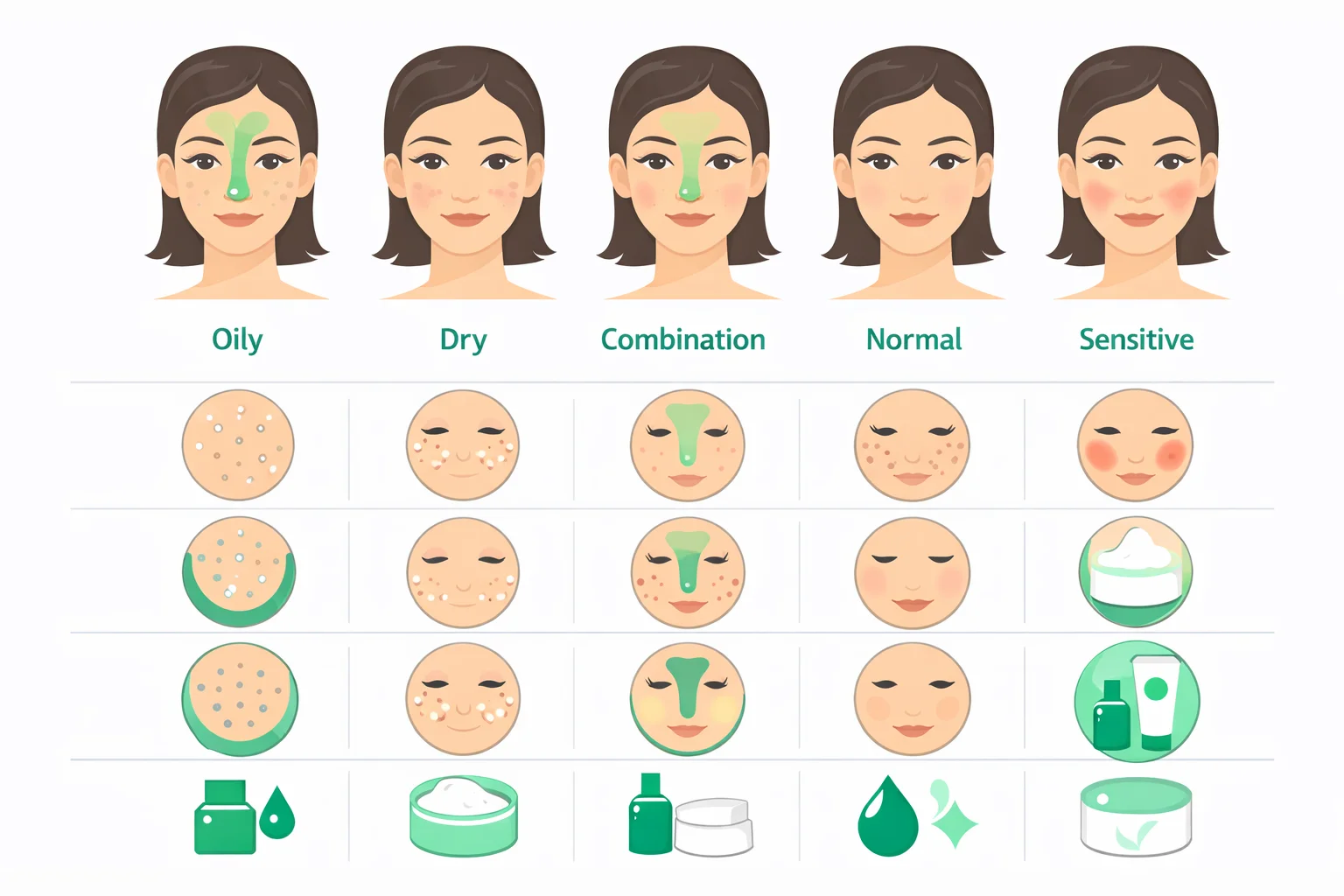
✨ Oily skin comes from hard-working glands that keep the whole face shiny, with visible pores and a tendency toward blackheads. The overlooked upside is that all that sebum keeps skin supple and tends to age more slowly — the goal is balance, not a war on oil. Over-stripping only provokes more grease.
🍂 Dry skin under-produces oil, so it feels tight, looks matte, and flakes when the air turns cold. Pores are small and rarely an issue, but the barrier loses water quickly and shows fine lines sooner. Rich creams, ceramides, and sealing moisture in matter far more than any cleanser.
🌗 Combination skin is the most common result and the most misread: an oily T-zone sitting over the densest patch of oil glands on your face, paired with cheeks that behave normally or lean dry. Treating the whole face like the greasy middle is the classic mistake — the fix is zoning your care.
🌸 Normal skin keeps oil and moisture in near-perfect balance, with even texture and few surprises. It's rarer in adulthood than people assume. The main risk is over-treating it with too many actives until it stops being normal — protection beats correction here.
🌡️ Sensitive skin reacts easily to fragrance, heat, weather, and strong ingredients, flushing or stinging where other types shrug things off. It can ride on top of any of the other four, so the oil and hydration readings still apply. Fewer products, gentler ingredients, and a protected barrier are the whole strategy.
What to Do the Moment You Know Your Type
Write down two things, not one: your type and your hydration reading. The type tells you the shape of your routine — lightweight and pore-clearing for oily, rich and sealing for dry, zoned for combination, minimal and soothing for sensitive, protective for normal. The hydration reading tells you whether to bolt a humectant onto whatever you're already doing. Get those two right and you've solved most of what a shelf of products was promising to fix.
Then resist copying someone else's routine just because you share a label. Two people can both read "oily" and need opposite things if one is dehydrated and one isn't. Skin, like everything else about you, rewards being understood in specifics rather than stereotypes — the same instinct behind our personality quiz. Your shine was never the whole story. It was just the first clue, and now you've read the rest.