Dosha Quiz: What Vata, Pitta, and Kapha Really Say About Your Body
Search “dosha quiz” and you walk straight into a fight. On one side, millions of people who'll tell you that learning their Ayurvedic body type — Vata, Pitta, or Kapha — finally explained why they run cold, sleep badly, or can't sit still. On the other, doctors and scientists who'll tell you that doshas are unmeasurable, unproven, and no substitute for actual medicine. Both are right about something. And the interesting part — the part that makes your quiz result worth reading — lives in the gap between them.
Two Camps, One 5,000-Year-Old Question
Ayurveda is one of the oldest continuously practiced systems of medicine on earth, with roots going back thousands of years in the Indian subcontinent. Its central claim is bold: every person is born with a unique proportion of three biological energies, and most of what ails you comes from that proportion drifting out of balance. To the traditional camp, that's not mysticism — it's an early, sophisticated attempt at personalized medicine, centuries before the phrase existed. Two people with the same cough get different treatment because they have different constitutions.
The skeptical camp answers with a shrug and a stack of studies. You can't point a scanner at someone and read their Vata level. Randomized trials don't show dosha typing predicting disease. And the U.S. National Center for Complementary and Integrative Health openly warns that some Ayurvedic products have contained unsafe levels of heavy metals like lead and mercury. Both things are true at once: the framework is ancient and thoughtful, and it hasn't been validated the way modern medicine demands. Holding both ideas at the same time is the honest way to read your result.
What a Dosha Actually Is (Past the Instagram Version)
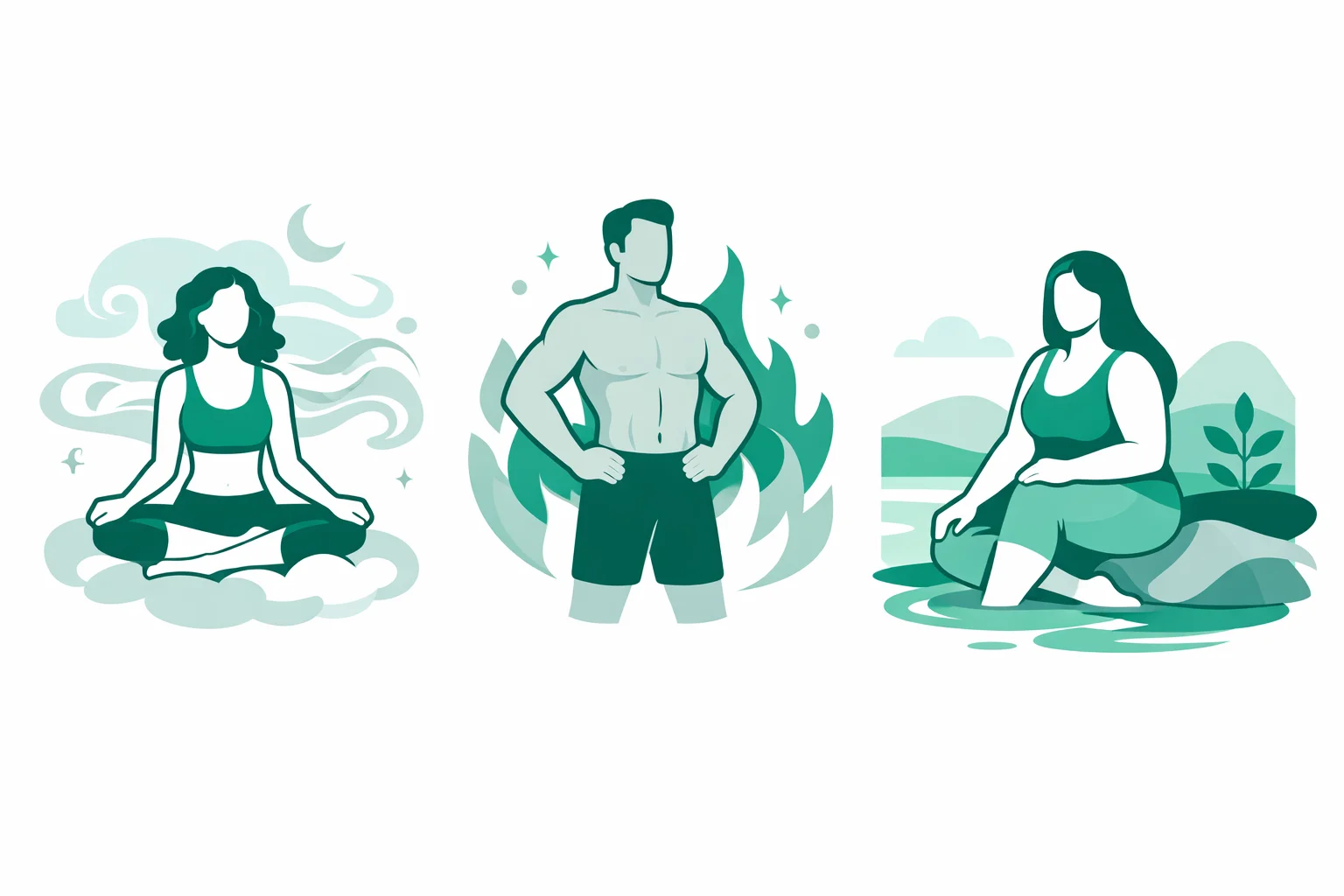
Strip away the wellness-brand gloss and a dosha is a simple, almost elegant idea. Ayurveda says everything in nature — including you — is made from five elements: space, air, fire, water, and earth. Those elements pair up into three functional forces. Vata (air and space) governs movement: breath, circulation, nerve impulses, thought. Pitta (fire and water) governs transformation: digestion, metabolism, body heat, the sharpness of your focus. Kapha (earth and water) governs structure: your build, your fluids, your stability and stamina.
You have all three. What makes you you is the ratio — and that ratio expresses itself in startlingly physical ways. It's why the same quiz that asks whether your mind races under stress also asks about your skin, your appetite, and which weather you hate. A Vata-dominant person tends to run dry, cold, and light; a Pitta runs hot, sharp, and intense; a Kapha runs cool, heavy, and steady. If your frame and temperament seem to track together, that's not a coincidence the model invented — it's the pattern it was built to describe. The same mind-body link shows up when you take our body type quiz, which reaches similar conclusions through a completely modern lens.
Ayurveda isn't the only system that builds people out of elements, and the comparison is genuinely useful. Greek astrology does the same job with four elements instead of five, then crosses them against a second axis — whether you start things, hold them, or keep changing them — to reach twelve types rather than three. Our zodiac sign quiz scores that grid from behaviour alone and never asks your birthday, so it's worth taking alongside this one: fire-dominant results there and Pitta results here overlap far more often than coincidence would predict.
Vata, Pitta, and Kapha at a Glance
The fastest way to see yourself in the system is side by side. Notice how the physical column and the mental column rhyme — that consistency is the whole reason people find their type so uncannily accurate.
| Dosha | Elements | Body Signs | Mind & Mood | Tips Into |
|---|---|---|---|---|
| 🌬️ Vata | Air & Ether | Lean, dry skin, cold hands | Creative, quick, restless | Anxiety, insomnia |
| 🔥 Pitta | Fire & Water | Medium, warm, sharp appetite | Driven, focused, intense | Irritability, inflammation |
| 🌿 Kapha | Earth & Water | Solid, oily skin, deep sleep | Calm, loyal, patient | Sluggishness, weight gain |
Read across your dominant row and you get the logic of the whole system in one line: what you are when balanced, and what you become when that quality piles up too high. Ayurveda treats the second column as the early-warning system for the fourth.
Where the Skeptics Have a Real Point
Let's be fair to the doubters, because a good self-assessment tells you its own limits. A dosha quiz is a self-report questionnaire. It can't detect a thyroid problem, a nutrient deficiency, or a mood disorder — and every one of those can masquerade as “too much Vata.” If you're exhausted, anxious, or gaining weight in a way that worries you, the answer isn't more cumin and an earlier bedtime; it's a doctor. Ayurveda at its best sits alongside medicine, not in place of it.
There's a subtler trap, too. Because the descriptions are broad and mostly flattering, they invite a bit of the Barnum effect — the same reason horoscopes feel personal. “You're creative but sometimes anxious” describes a huge slice of humanity. The way to use the quiz honestly is to treat it as a lens for noticing real, specific patterns in your body — how you actually respond to cold, to spicy food, to a missed meal — rather than as a horoscope that hands you an identity. The value isn't in the label. It's in what the label makes you pay attention to.
The Surprising Research Almost Nobody Mentions
Here's the twist most articles skip. A handful of Indian research groups have started testing whether Prakriti — your dosha constitution — actually maps onto measurable biology, and the early results are more interesting than the skeptics expect. A widely cited 2015 study by Bhavana Prasher and colleagues at the CSIR Institute of Genomics and Integrative Biology found that people independently classified as Vata, Pitta, or Kapha showed differences in the expression of specific genes, including one (EGLN1) linked to how the body handles oxygen. Other work has reported differences in biochemistry and even gut microbiome between Prakriti groups.
Now the caveats, because they matter. These are small studies, some not widely replicated, from a field with an obvious stake in the outcome. This is not proof that doshas are “real” in the way blood type is real. But it's enough to make a blanket “it's all nonsense” look lazy. The most reasonable reading is that dosha typing is a rough, pre-scientific attempt to sort people by constitution — and that modern tools are only now testing how well that sorting holds up. You can read more of the historical background on the Ayurvedic concept of dosha if the origins pull you in.
Why Almost No One Is a Pure Dosha
If your quiz result came back as a blend — Vata-Pitta, Pitta-Kapha — that isn't the quiz hedging. It's the quiz being accurate. Ayurveda holds that single-dosha (eka-doshic) constitutions are genuinely uncommon; the majority of people are dual, or dvi-doshic, carrying two doshas that run close together. That's exactly why this quiz shows you the full percentage split of all three instead of slapping one label on you and calling it a day. Your real constitution is a recipe, not a single ingredient.
This is also where dosha work gets genuinely practical. A Vata-Pitta person balances differently in winter (calm the Vata) than in summer (cool the Pitta). Knowing your blend — and which half tends to act up when — is far more useful than memorizing a one-word type. It's the same reason a nuanced result beats a flat one on our chronotype quiz: the interesting information is in the mix, not the headline.
Vata, Pitta, and Kapha: Your Full Constitution Decoded
🌬️ Vata — Air & Ether (The Visionary). Vata is the energy of motion, so Vata-dominant people tend to be lean, quick, and creative, with dry skin and a mind that rarely sits still. At their best they're imaginative, adaptable, and endlessly curious. When Vata climbs too high, the same lightness turns into anxiety, insomnia, bloating, and cold hands. Their medicine is warmth and rhythm: cooked food, steady routines, and slowing down on purpose. Vata is also the dosha that naturally rises with age.
🔥 Pitta — Fire & Water (The Achiever). Pitta governs transformation and heat, which shows up as a medium, athletic build, a strong appetite, and a sharp, driven mind. Balanced Pittas are natural leaders — focused, courageous, and warm. Push it too far and the fire scorches: irritability, heartburn, inflammation, and burnout. Pittas cool themselves with moderation, downtime, sweet and bitter foods, and a hard limit on how much they take on. Their skin tends to run sensitive, which is why many Pittas recognize themselves in a skin type quiz before they ever hear the word dosha.
🌿 Kapha — Earth & Water (The Nurturer). Kapha is structure and stability, so Kapha types are typically solid, strong, and calm, with thick hair, smooth skin, and deep sleep. At their best they're the loyal, patient, unshakeable anchor of any group. Out of balance, Kapha gets heavy in every sense — weight gain, congestion, lethargy, and a real resistance to change. Their cure is stimulation: vigorous exercise, lighter and spicier food, novelty, and an early alarm. Where Vata needs to slow down, Kapha needs to speed up.
How to Actually Use Your Result This Week
Forget the idea of “fixing” your type — you can't, and you wouldn't want to. The one principle worth remembering is Ayurveda's oldest: like increases like, and opposites balance. If you came out Vata (cold, dry, moving), you steady yourself with warmth, moisture, and stillness. If you're Pitta (hot, sharp), you cool down and ease off. If you're Kapha (heavy, slow), you lighten up and get moving. That's the entire operating system in one sentence.
Start with a single experiment this week, not a lifestyle overhaul. A Vata might add a warm cooked breakfast and a fixed bedtime and watch what happens to their sleep. A Pitta might cut the afternoon coffee and protect one real break. A Kapha might take a brisk walk before the day swallows them. Pay attention to whether you feel more like yourself — steadier, clearer, more at home in your own body. That felt sense, not the label on the quiz, is the only measure of a constitution that actually matters.