Body Type Quiz: What Body-Scan Data Reveals About Your Real Shape
The body type quiz you just finished sorts you into one of five silhouettes — hourglass, pear, apple, rectangle, or inverted triangle — and the first surprise is usually the shape itself. When researchers at North Carolina State University scanned the measurements of more than 6,000 women for the SizeUSA body-shape project, only about 8% turned out to be true hourglasses. Nearly half — roughly 46% — measured as rectangles. So if you were braced to be told you're "supposed" to be an hourglass, the data has good news: almost nobody is.
Five Body-Shape Myths That Refuse to Die
Almost everything people "know" about body shape is a mix of tailoring folklore and magazine shorthand. Before you do anything with your result, it helps to clear away the five myths that trip up the most people.
- Myth: You can diet your way into a different shape. Reality: losing or gaining weight changes your size, not the skeleton underneath. The width of your shoulders and hip bones — the framework that decides whether you read as pear, rectangle, or inverted triangle — doesn't move. A pear who loses twenty pounds becomes a smaller pear, not an hourglass.
- Myth: The hourglass is the normal, default body. Reality: it's the rarest of the classic shapes. The SizeUSA scans put true hourglasses under 10%, while the plain, straight rectangle was the runaway most common result. The shape culture treats as the baseline is actually the exception.
- Myth: Everyone fits neatly into one of five boxes. Reality: the categories are points on a spectrum, and most people land between two of them. That's exactly why this quiz reports a percentage match rather than a single verdict — "70% rectangle, 25% hourglass" describes a real body far better than one forced label.
- Myth: Ectomorph, mesomorph, and endomorph are the scientific version. Reality: those somatotypes describe build and composition, not silhouette, and they come from a 1940s theory that tried to link body type to personality — an idea that was later discarded. They answer a completely different question than "what's my shape."
- Myth: Your BMI or dress size tells you your body type. Reality: two people at an identical BMI can be a rectangle and an hourglass. Shape is about how your measurements are distributed — waist versus hips, shoulders versus seat — not about your total mass or the number on a label.
The Five Shapes, and Why the Lines Between Them Blur
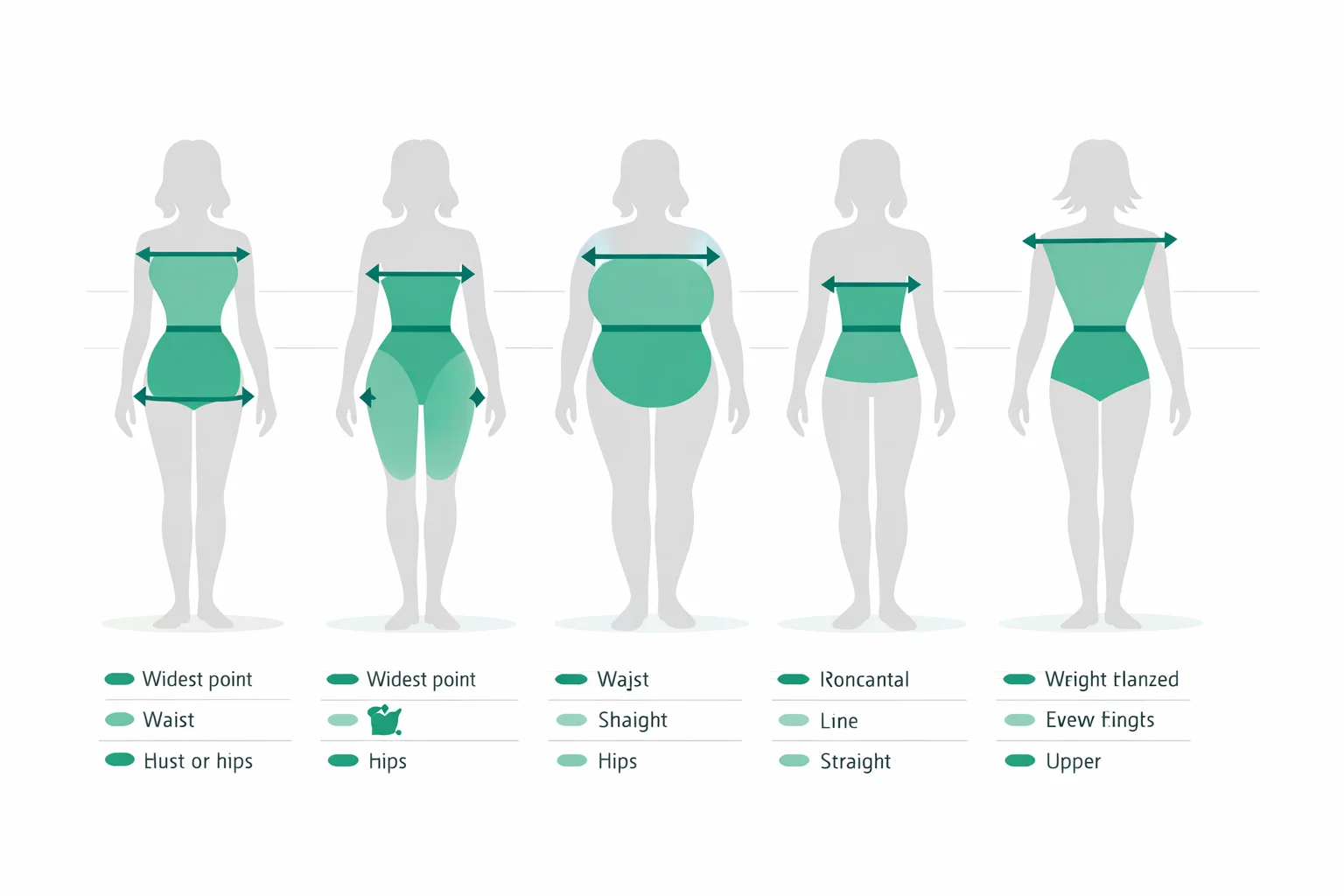
Each shape is really just shorthand for a relationship between four widths: shoulders, bust, waist, and hips. Once you can see those relationships, the labels stop feeling arbitrary and start feeling like a map. Here's the quick version of what separates them.
| Shape | Widest point | Waist | Weight lands |
|---|---|---|---|
| Hourglass | Bust and hips (even) | Clearly defined | Bust and hips together |
| Pear | Hips | Defined | Hips, thighs, seat |
| Apple | Midsection | Soft / undefined | Belly, upper body |
| Rectangle | Even all around | Slight or none | Evenly, then the middle |
| Inverted triangle | Shoulders / bust | Moderate | Upper back, chest, arms |
The lines blur because bodies aren't drawn with a ruler. A woman with an athletic frame and a slight waist can read as rectangle from the front and hourglass in a fitted dress. Someone who was a textbook pear at 25 may drift toward apple after menopause. This is why one answer to "pick your shape" is a bad way to run a body shape quiz — you learn far more by reading several signals and watching which pattern wins, which is how the twelve questions above are built.
Measure Yourself in Four Numbers
Want to check the quiz against cold numbers? Grab a soft tape and take four measurements: your bust at the fullest point, your waist at its narrowest (usually just above the navel), your full hip at the widest part of your seat, and — with a friend's help — the width across your shoulders. Then compare them instead of judging any single number on its own.
The logic is simple once the tape is out. If your hips clearly beat your bust, you lean pear. If your bust and shoulders beat your hips, inverted triangle. If bust and hips come out close and your waist is roughly a quarter smaller than both, that's the hourglass ratio. If bust and hips are close but the waist is only a little smaller, you're a rectangle. And if the waist or midsection is your largest reading, that's the apple. Measure over a thin layer rather than baggy clothing, and the results usually line up with your quiz percentage. Once you know your proportions, our style personality quiz helps translate them into an aesthetic that actually feels like you.
Body Shape or Somatotype — Which Are You Even Asking About?
Here's a distinction that causes endless confusion online. "Body type" gets used for two totally different systems. One is body shape — the proportion story we've been telling, all about where your width sits. The other is the somatotype system: ectomorph (naturally lean and narrow), mesomorph (naturally muscular), and endomorph (naturally softer and rounder). Those describe build and how easily you gain muscle or fat, not the outline of your figure.
The somatotypes carry more baggage than most people realize. Psychologist William Sheldon introduced them in the 1940s as part of "constitutional psychology," a theory that claimed your body build predicted your temperament and even your likelihood of criminal behavior. The personality claims were thoroughly discredited, and the framework survives today mostly as loose fitness shorthand. The practical takeaway: a lean ectomorph and a soft endomorph can both be rectangles, and a muscular mesomorph can be an hourglass. Shape answers "what's my silhouette," somatotype answers "how does my body build." This quiz is squarely about the first.
Can You Actually Change Your Body Shape?
Partly, and it's worth being honest about which parts. Your bone structure is fixed — no workout narrows your hip bones or broadens your ribcage on demand — so your fundamental shape category is remarkably stable. Whatcan move is the soft tissue draped over that frame, and it moves in patterns set largely by hormones and genetics. A rectangle who builds glutes and shoulders in the gym can create real visual curve; an apple who lowers overall body fat changes their midsection more than their hips.
Life stages shift the picture too. Pregnancy can permanently widen the ribcage, and both pregnancy and menopause redistribute fat — as estrogen drops, storage tends to migrate from hips and thighs toward the abdomen, nudging pears and hourglasses toward apple over time. None of that rewrites your skeleton, but it's a good reason to retake a body shape test every few years instead of trusting the shape you had in high school.
What Your Shape Says About Your Health (and What It Doesn't)
For four of the five shapes, your silhouette is a styling fact and nothing more. The apple is the one exception worth taking seriously — not because of how it looks, but because of where the weight sits. Fat carried around the midsection is more likely to be visceral fat, packed around the organs, and that's the type most strongly linked to heart disease and type 2 diabetes. Fat carried on the hips and thighs, the pear's signature, is largely subcutaneous and carries far less metabolic risk.
The number that captures this is your waist-to-hip ratio — waist measurement divided by hip measurement. The World Health Organization flags a ratio above roughly 0.85 for women (and 0.90 for men) as a marker of elevated health risk. That's useful information, but keep it in proportion: a body shape quiz is a mirror-and-tape tool, not a diagnosis. If your waist ratio concerns you, that's a conversation for a doctor, not a styling article.
All Five Body Shape Results, Explained
⌛ Hourglass means your bust and hips are close in width with a waist that clearly nips in between them. It's the rarest classic result, and its whole styling story is about honoring the waist you already have — fitted and belted beats boxy and shapeless every time. The trap is hiding those proportions under fabric that hangs straight.
🍐 Pear puts your widest point at the hips, with narrower shoulders and weight that settles in the thighs and seat. One of the most common shapes, it flatters best when you add a little interest up top — a statement neckline or shoulder — to balance a naturally strong lower half. Your defined waist is an asset worth showing.
🍎 Apple carries fullness through the middle over comparatively slim hips and legs. Vertical lines, open necklines, and hemlines that show off those legs do the most for the shape. It's also the only result with a genuine health footnote, thanks to where midsection weight tends to sit — worth knowing, not worth worrying over.
📏 Rectangle runs in a fairly straight line from shoulders to hips with little waist indent — and it's the single most common body in real scan data, not the afterthought it's often treated as. Straight frames wear tailoring beautifully, and curve, when you want it, gets built with belts, peplums, and layers rather than wished into existence.
🔻 Inverted triangle is the mirror image of the pear: broad shoulders or bust tapering to narrower hips and slim legs, the classic athletic build. The move is to add visual weight below — fuller skirts, wide-leg trousers — so your strong shoulders read as balanced rather than dominant. It's a powerful, low-effort shape to dress.
Dress the Shape You Have, Not the One You Wish For
Every styling guideline in this article is really one idea wearing five costumes: balance the frame and define a waist, so clothes read as proportional. That's it. Once you stop dressing for the shape you wish you had and start working with the one in the mirror, getting dressed gets dramatically easier — you already know what to reach for and what to skip. Pair that with the colors that suit you from our color analysis quiz, and most of your outfit decisions are already made before you open the closet.
Just remember the guidelines are a tool, not a sentence. Plenty of people know their shape cold and cheerfully ignore every rule because they love how something feels — and that's a perfectly good reason. Your body shape is a starting point for understanding your proportions, the same way our female archetype quiz is a starting point for understanding how you present yourself. If you're curious how an ancient system reads the very same frame, our dosha quiz treats your build as a clue to your Ayurvedic constitution. That same frame even decides how firm your bed should feel — our mattress quiz turns your build and sleep position into an ideal firmness number. Knowing the map just means you get to decide, on purpose, where you actually want to go.