Mattress Quiz: How to Match a Mattress to Your Sleep Position, Body, and Temperature
Roughly a third of your life happens on a mattress, which is why this mattress quiz asks about your body before it ever mentions a brand. The average person keeps a bed for seven to ten years and sleeps on it around 25,000 times — yet most people choose one by lying on a showroom model for ninety seconds, or by buying whatever a "best mattress" list ranked first. Both methods ignore the only thing that actually decides comfort: how your sleep position, weight, and body temperature interact with a mattress's firmness and materials. Nail that match and back pain, overheating, and 3 a.m. tossing often fix themselves.
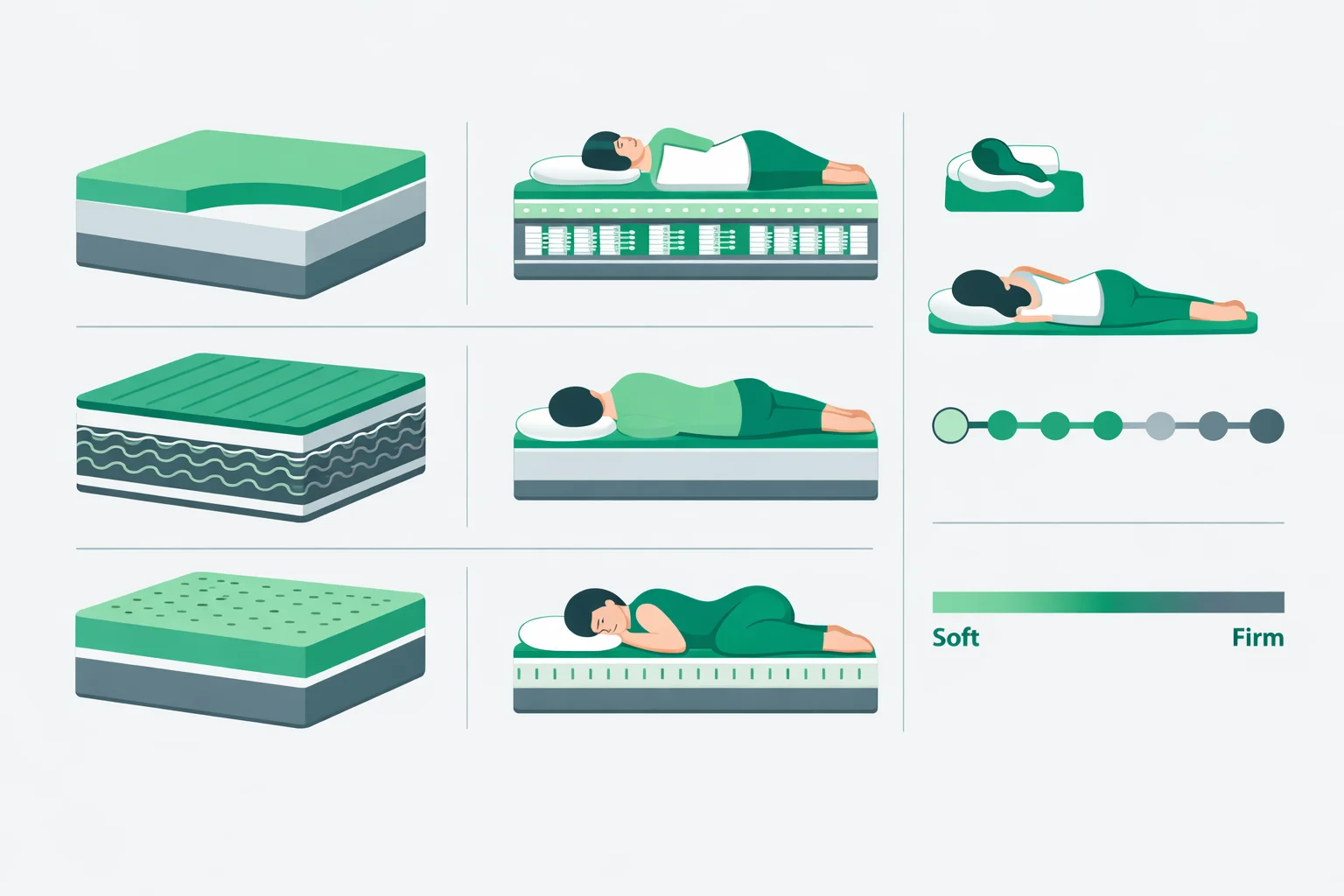
Firmer Is Not Better for Your Back
Here's the belief that sells the wrong mattress to more people than any other: if your back hurts, buy something firm. It sounds logical — bad back, need support, get the hard one. The research says the opposite. A landmark 2003 trial published in The Lancet by Kovacs and colleagues put 313 people with chronic low-back pain on either firm or medium-firm mattresses for 90 days. The medium-firm group reported less pain in bed, less pain on rising, and less disability. "Firmest available" was the losing choice.
The reason is spinal alignment. A too-firm bed holds your hips and shoulders up but leaves gaps at the lower back and waist, so your spine bows. A too-soft bed lets your hips sag below your shoulders, bending the spine the other way. The sweet spot — for most sleepers, a medium-firm feel around 6 out of 10 — keeps the spine roughly neutral, the same gentle S-curve you have standing up. That's the target the quiz calibrates for, then nudges it softer or firmer based on the rest of your answers.
Match the Mattress to How You Actually Sleep
Your sleep position is the single biggest lever on firmness, because each position puts a different part of your body under load. Side sleepers press their entire weight through one shoulder and one hip, so they need a surface that lets those points sink in — go too firm and you wake with a numb arm or an aching hip. Stomach sleepers have the opposite problem: any sink at the hips arches the lower back, so they need a firm surface that keeps the pelvis level. Back sleepers sit in the middle, and combination sleepers who move all night want something responsive enough to reposition on without fighting the foam.
| Sleep position | Ideal firmness | Why | Best-fit types |
|---|---|---|---|
| Side | Soft–Medium (3–6) | Shoulder and hip need to sink to relieve pressure | Memory foam, hybrid |
| Back | Medium–Med-Firm (5–7) | Balance of contour at the waist and support at the hips | Hybrid, latex |
| Stomach | Firm (7–9) | Keeps hips from sinking and arching the spine | Innerspring, firm latex |
| Combination | Medium (5–6) | Responsive enough to move without feeling stuck | Hybrid, latex |
This is also why timing and rhythm matter alongside the bed itself. If you struggle to fall asleep no matter how good the mattress is, the culprit may be your body clock rather than your comfort — our chronotype quiz pins down whether you're wired to sleep early or late, which changes when you should be climbing into that perfectly matched bed.
Why Your Body Weight Changes the Right Answer
Two people can lie on the identical mattress and honestly disagree about whether it's soft or firm — and neither is wrong. Firmness is really a measure of how far you sink, and a heavier body pushes deeper into the same foam or coils. A mattress rated "medium" by the manufacturer feels medium to a 160-pound sleeper, noticeably softer to a 240-pound one, and almost hard to someone who weighs 115.
That has real consequences. A lighter person — under roughly 130 pounds — often can't press far enough into a "medium-firm" bed to reach its pressure-relieving comfort layer, so it feels like sleeping on a board; they usually need to size down a notch in firmness. A heavier person needs the reverse: firmer support and often thicker or higher-count coils, or they bottom out and lose spinal support by morning. It's the same reason a body type quiz is a useful companion here — your frame shapes not just what clothes fit, but how a mattress carries you. The quiz above weighs your build right alongside your position so the firmness number it returns is calibrated to your actual body, not an average one.
Sleep Hot? The Material Matters More Than a Fan
If you kick the covers off and flip to the cool side of the pillow, no amount of bedroom AC fully fixes the problem — because the heat is coming from the mattress itself. Solid memory foam is the worst offender: it wraps around your body, shrinking airflow and holding warmth against your skin. Surveys of sleepers consistently put "sleeping too hot" near the top of mattress complaints, and it's almost always a materials issue.
The fix is airflow and heat-drawing materials. Innerspring and hybrid beds breathe because their coils leave open channels for air to circulate. Natural latex has an open cell structure that runs far cooler than memory foam while still offering some contour. And gel- or graphite-infused foams genuinely help by pulling heat away from the surface — the technology behind the Cooling Gel Hybrid result. If overheating is your main nighttime enemy, that single answer can override everything else and steer you away from a thick all-foam bed no matter how much you love the hug.
The Two-Body Problem: Sharing a Bed
Sharing a mattress doubles the constraints, and the most common conflict isn't snoring — it's firmness. One partner wants plush, the other wants a plank, and a single "compromise" firmness leaves them both a little miserable. There are two real solutions. An adjustable air bed gives each side an independent air chamber, so you each set your own firmness on the same bed. A split king does the same with two separate mattresses under one headboard.
The other shared-bed issue is motion. If your partner gets up at 6 a.m. and you feel the whole bed heave, you want motion isolation — the ability of a mattress to absorb movement on one side without transmitting it to the other. Memory foam is the champion here; traditional connected-coil innersprings are the worst, because a coil that compresses on one side tugs its neighbors. Pocketed coils in a good hybrid land in between. The quiz asks specifically whether you feel every toss and turn, because that answer can be the deciding vote between a foam bed and a springy one.
How the Quiz Turns Your Answers Into a Firmness Number
Most mattress quizzes just spit out a product name. This one does two things at once. First, it scores every answer across the six mattress types — memory foam, hybrid, innerspring, latex, cooling gel hybrid, and adjustable air — and the highest total becomes your primary match, with the runner-up shown as a close second so you can see the trade-off. A restless-partner answer pushes points toward foam; a runs-hot answer pushes them toward coils and latex; a can't-agree-on-firmness answer lifts the adjustable option.
Second, and more useful, three of the questions — your sleep position, your body frame, and your ideal feel — each cast a vote on a 1-to-10 firmness scale. The quiz averages those votes into a single personalized number and a label from Soft to Firm. That number is the thing to actually carry into a store or a product page: nearly every mattress lists a firmness rating, and anything within a point of your result should feel right. It turns a vague "I think I like it medium" into a spec you can check.
All 6 Mattress Matches Explained
Here's a closer look at every result the quiz can land on, so you can see where you fit and what your close-second option would trade off.
🛏️ Contouring Memory Foam — The pressure-relief specialist. Slow-sinking foam molds to shoulders and hips and isolates motion beautifully, making it the go-to for side sleepers and light-to-average builds sharing a bed with a restless partner. Its weaknesses are heat retention and a slightly stuck feel, so hot sleepers should look for gel-infused versions or skip it entirely.
⚖️ Balanced Hybrid — The versatile all-rounder. A contouring comfort layer over pocketed coils cushions pressure points while still supporting the spine, and the coils keep it breathing cooler than all-foam. It forgives combination sleepers, undecided shoppers, and couples with similar needs. The only real reason to skip it is a tight budget paired with a strict side-sleeping style.
🌀 Supportive Innerspring — The breathable, budget-friendly classic. Firm coils with a thin comfort layer give a bouncy, on-top feel and excellent airflow, ideal for back and stomach sleepers, heavier bodies, and hot sleepers who want value. It doesn't cushion joints well, so anyone with shoulder or hip pressure pain should add a topper or move up to a hybrid.
🌿 Natural Latex — The durable, eco-friendly investment. Buoyant and responsive, it supports without the quicksand sink of memory foam, sleeps cool, and often lasts 10 to 15 years. It suits eco-minded buyers and people who dislike feeling swallowed by their bed. The catch is price and a springy feel that won't satisfy anyone craving a deep hug.
❄️ Cooling Gel Hybrid — Built for the hot sleeper. Gel- or graphite-infused foam over breathable coils delivers contour without the heat trap, making it the answer for night-sweaters, warm climates, and hormone-driven overheating. If you actually sleep cold, though, you'll miss the cozy warmth a plush foam bed provides.
🎛️ Adjustable Air Bed — The customizable fix. Independent air chambers let each side of the bed dial in its own firmness, solving the mismatched-couple problem and adapting as your body changes over time. It pairs naturally with an adjustable base. You pay a premium, and the pump and electronics add long-term failure points a simpler mattress doesn't have.
What to Do Before You Buy
Take your result — a mattress type, a close second, and a firmness number — and use it as a filter, not a verdict. Shortlist two or three beds in your category that sit within a point of your firmness target, then insist on a real sleep trial. A showroom test tells you almost nothing; your body needs a couple of weeks to adjust and the mattress needs that long to break in, which is exactly why bed-in-a-box brands offer 100-night trials. Sleep on it at least 30 nights before you judge. One honest caveat: this quiz sorts comfort and support preferences, not medical conditions — if you have chronic or severe back pain, sciatica, or a sleep disorder, talk to a doctor or physical therapist before you spend, because the right mattress is a supporting actor, not a cure. And once the bed is settled, the rest of the room follows: our interior design style quiz helps you build the calm, sleep-friendly bedroom that makes a great mattress even easier to fall asleep on.
For deeper reference on materials, firmness testing, and sleep hygiene, the Sleep Foundation's mattress guides and the overview of mattress construction on Wikipedia are solid, non-commercial starting points once you know the category you're shopping for.