Chronotype Quiz: How Your Sleep Animal Decides When You Should Wake, Work, and Rest
Most people think the chronotype quiz you just took is measuring a habit — whether you've trained yourself to be a “morning person” or a “night owl.” It isn't. Your chronotype is closer to your eye color than your gym routine: a biological trait you were largely born with, running quietly in the background of every day whether you notice it or not. That's why the person who bounces out of bed at 5:30 and the one who can't form a sentence before 10 aren't showing discipline or laziness. They're showing genetics.
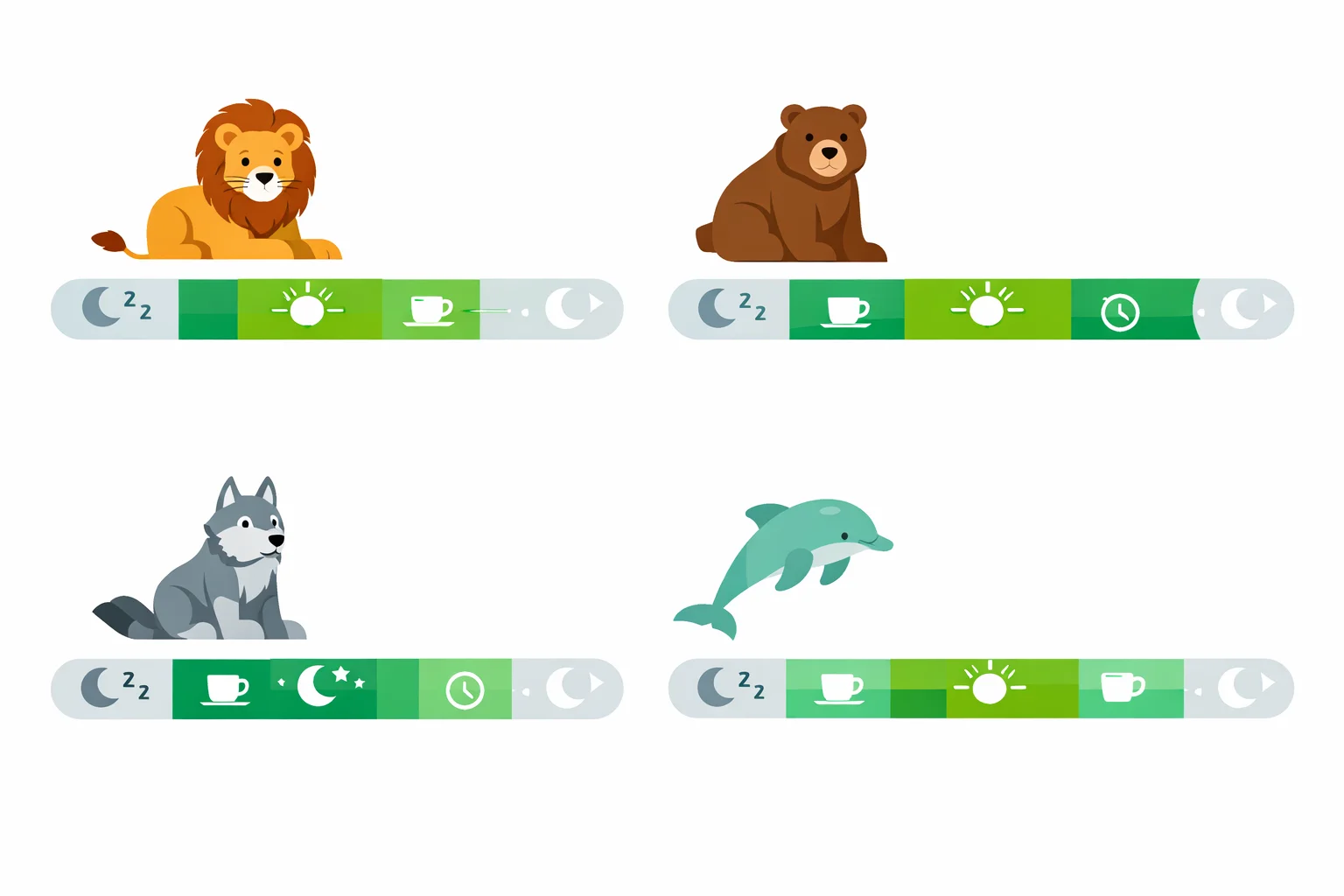
Your Chronotype Is Wired Into Your DNA, Not Your Willpower
The clearest evidence comes from a gene called PER3. Researchers have found that a specific variation in its length is strongly associated with extreme morning or evening preference — people with the longer version tend to be larks, while the shorter version skews toward owls. There are at least a dozen more “clock genes” feeding into the same system, which is why your natural wake time is far more inherited than most self-help advice admits. A 2019 genome-wide study of nearly 700,000 people published in Nature Communications pinned down 351 genetic locations linked to being a morning person. That's not a rounding error — that's biology writing your schedule for you.
The four-animal framework — Lion, Bear, Wolf, and Dolphin — was popularized by clinical psychologist and sleep specialist Dr. Michael Breus in his 2016 book The Power of When. He built it partly on decades of circadian research and partly on a simple clinical observation: his patients' problems rarely came from bad habits. They came from living on a schedule their bodies never agreed to.
Why “Just Go to Bed Earlier” Almost Never Works
If you matched with the Wolf, you've probably heard this advice a hundred times — and watched it fail every time. Here's the reason. Telling a true evening type to fall asleep at 10 p.m. is like telling someone in one time zone to feel sleepy on another zone's clock. Their melatonin — the hormone that signals “time for bed” — simply isn't released yet. They lie there wide awake, then get blamed for “poor sleep hygiene” when the real issue is a mismatch between the alarm clock and the body clock.
This matters because forcing the wrong schedule doesn't just make mornings unpleasant. It quietly shortens sleep. A Wolf who has to be at a desk by 9 a.m. loses sleep on the front end (can't fall asleep early) and the back end (has to wake up early), night after night. If you're curious whether your temperament tilts you toward the quieter, more internal Wolf pattern, our introvert or extrovert quiz pairs surprisingly well with your chronotype result.
Worth separating out, though: a rigid daily structure is not the same thing as a Lion chronotype. Plenty of Wolves run tightly scheduled lives precisely because their body clock fights them, and plenty of Lions are chaotic once the morning is over. Our Stardew Valley character quiz scores that distinction directly — it measures how much of your day is decided before it starts as a separate axis from everything else, which is a useful cross-check on whether your schedule is biology or discipline.
The Hidden Second Dimension Most Quizzes Miss
Here's where it gets interesting — and where cheaper chronotype quizzes fall flat. The old standard, the Horne-Östberg Morningness-Eveningness Questionnaire from 1976, scores you on a single line: strong morning type on one end, strong evening type on the other. Useful, but flat. The Lion-Bear-Wolf-Dolphin model adds a second axis that the single line can't see: sleep drive, or how deeply and easily you sleep.
That second dimension is the entire reason the Dolphin exists. A Dolphin isn't defined by when they peak; they're defined by light, anxious, easily-broken sleep. Two people can both hate their 6 a.m. alarm for completely different reasons — one is a Wolf whose clock runs late, the other a Dolphin whose sleep is just fragile. Measure only timing and you'd lump them together and give them the same (wrong) advice. That's the information most one-question “are you a lark or an owl” tests throw away.
The Four Sleep Animals at a Glance
The quickest way to see the framework is side by side. Notice how the population percentages aren't even close to equal — this is why so many people feel out of step with the world around them.
| Chronotype | Population | Natural Peak | Signature Trait |
|---|---|---|---|
| 🦁 Lion | ~15% | Early morning | Wakes before the alarm, fades by evening |
| 🐻 Bear | ~55% | Late morning | Follows the sun, sleeps deeply |
| 🐺 Wolf | ~15% | Evening & night | Creative, dreads mornings |
| 🐬 Dolphin | ~10% | Mid-morning | Light sleeper, sharp and anxious |
If Bears make up more than half of everyone, that's the group standard office hours, school bells, and TV schedules were built around. The other 45% — the Lions who've been up for hours and the Wolves who are barely functional — are quietly running on a borrowed timetable.
Social Jetlag: The Real Cost of Fighting Your Clock
German chronobiologist Till Roenneberg coined a term for what happens when your biological clock and your social clock disagree: social jetlag. It's the gap between the sleep your body wants and the sleep your calendar allows, and you can measure it in your own life — just compare your natural weekend sleep to your dragged-out-of-bed weekday sleep. A three-hour gap means you're essentially flying from New York to Los Angeles and back every single week, without ever leaving home.
Roenneberg's large-scale surveys found that a majority of people carry at least an hour of social jetlag, and that larger gaps track with worse mood, more caffeine and nicotine use, and higher body weight. The takeaway isn't that Wolves are doomed — it's that the fix is usually structural, not moral. Shift the schedule, not the person. It's the same logic behind our core personality quiz: you get further working with your wiring than pretending you can rewrite it.
One caveat before you blame the calendar for everything. Social jetlag has a signature: your sleep works when you're allowed to take it on your own schedule. If you sleep nine unbroken hours on a Saturday with no alarm and still wake up wrecked, that is a different problem — unrefreshing sleep regardless of timing is the pattern our sleep apnea risk quiz screens for. Fixing your schedule won't touch an airway that closes forty times an hour.
All Four Chronotypes, Decoded
🦁 The Lion (Dawn Achiever). Roughly 15% of people, and the closest thing to a “natural” early riser. Lions wake before dawn with a clear head, do their best thinking before noon, and burn out in the evening. They tend to be driven, optimistic planners. The weakness is stamina after dark — Lions often bow out of nightlife not from disinterest but from a genuinely empty tank.
🐻 The Bear (Steady Rhythm). The majority type at about 55%. Bears rise and set with the sun, peak in the late morning, and hit a famous slump around 2 to 3 p.m. They sleep soundly and keep a dependable rhythm, which makes them the steady anchors of most teams. Their one real vulnerability is the weekend: a couple of late nights can throw their whole week off far more than they expect.
🐺 The Wolf (Night Creative). Around 15% of people and the group the modern workday punishes hardest. Wolves are foggy until mid-morning and genuinely alive in the evening, often doing their most creative, focused work after everyone else logs off. The trade-off is chronic morning misery and a standing risk of sleep debt on a 9-to-5. Many Wolves only discover they're not “lazy” when they finally get a flexible schedule.
🐬 The Dolphin (Restless Mind). The rarest type at roughly 10%, named after an animal that sleeps with half its brain alert. Dolphins are intelligent, detail-obsessed, and prone to lying awake replaying the day. Their sleep is light and easily wrecked, and their energy runs uneven — but they carry a razor-sharp mid-morning focus window when the anxiety quiets down. Structure and a hard shutdown routine are their best friends.
How to Sync Your Day to Your Biology
The whole point of finding your sleep animal is to stop swimming against your own current. A few moves work for everyone, tuned to your type. Get bright light early if you're a Bear or Lion, and be strategic with it if you're a Wolf — morning sun nudges a late clock earlier over time. Set a firm caffeine cutoff (Lions by 10 a.m., Wolves by 2 p.m.) so it isn't quietly stealing your sleep. Guard your peak window for the work that actually matters instead of spending it on email. And if you're a Dolphin, treat wind-down as a non-negotiable ritual, not an afterthought.
One last, freeing thought: your chronotype isn't a life sentence, but it also isn't something to “fix.” It shifts naturally as you age — most of us drift earlier past 50 — and it responds to light and routine. The goal isn't to become a Lion. It's to stop losing the argument with your own body, and start building a day it's actually willing to show up for — starting with a sleep setup that fits your body, right down to the mattress you sleep on. If that mind-body angle grabs you, our dosha quiz reads the same tendencies — your sleep, your energy, your temperature — through the lens of Ayurvedic constitution.