Your Spirit Animal, Explained: Symbolism, Psychology, and What Your Result Really Means
A spirit animal quiz promises to name the creature that mirrors your inner nature — but the phrase itself hides a small mystery most people never think about. A spirit animal isn't a personality label, it isn't a zodiac sign, and it isn't the same thing as a totem, even though the words get used as if they were interchangeable. Before you read too much into whether you got the Wolf or the Owl, it's worth understanding what this result actually is — a symbol your mind reaches for to make sense of itself.
Spirit Animal, Totem, or Power Animal? They're Not the Same
These three terms get blended together online constantly, but they come from completely different places. A totem traditionally belongs to a clan or family — it's inherited, not chosen, and in many Indigenous cultures it carries ceremonial weight. A power animal is a concept popularized by anthropologist Michael Harner in his 1980 book The Way of the Shaman, describing a protective animal spirit a person connects with through a kind of guided inner journey. A spirit animal, as most people use it today, is something looser: a symbolic animal you feel reflects who you are.
This quiz lives firmly in that third, modern category. It isn't assigning you a sacred guardian or a clan symbol. It's reflecting your instincts back to you through an animal image — which, as it turns out, is something the human brain is unusually good at doing.
Why Do We See Ourselves in a Wolf or an Owl?
Here's the strange part: you already had an emotional reaction to the eight animals before you read a single description. The wolf felt free, the owl felt wise, the butterfly felt hopeful. That instant association is the engine the whole quiz runs on, and psychologists have a name for the broader tendency behind it — anthropomorphism, the projection of human minds and traits onto non-human things.
University of Chicago psychologist Nicholas Epley argues we do this most when we're trying to understand something — including, sometimes, ourselves. An animal is a perfect mirror for this because it gives a fuzzy inner feeling a sharp, memorable shape. "I value freedom and loyalty but I struggle to trust outsiders" is abstract and easy to forget. "I'm a wolf" sticks. Research on memory consistently shows that vivid, concrete images are recalled far better than abstract descriptions, which is exactly why an animal symbol outlasts a list of adjectives. If you want to compare that gut-level symbolism against a more behavioral read on yourself, the What Animal Am I Quiz maps your day-to-day actions rather than your inner instincts — the contrast between the two results is often revealing.
The Four Energies Behind Your Result
This quiz doesn't pick your animal at random or by which one you clicked first. Each of the 15 questions quietly measures where you sit on four inner currents, and your spirit animal is the one whose blend of those currents matches yours most closely:
- Intuition — how much you trust inner knowing over hard logic. The Owl and Raven sit highest here.
- Free Spirit — your hunger for independence and the open road. The Wolf and Hawk lead this dimension.
- Heart — how openly and deeply you feel, and feel for others. The Deer and Butterfly carry the most.
- Inner Strength — your grounded resilience under pressure. The Bear stands tallest here.
Two people can both land on Fox while having very different second-strongest energies, which is why the quiz also reveals a secondary spirit animal. A Fox-Owl is clever and deeply perceptive; a Fox-Wolf is clever and fiercely independent. That pairing is usually a more honest portrait than either animal on its own. This is the same logic behind core-and-wing systems in other frameworks — if that idea intrigues you, the Enneagram Quiz uses a primary type plus a neighboring "wing" in much the same way, and the Soldier, Poet, King quiz reports a blend across its three archetypes for the same reason, and the character quiz hands you a dominant fictional archetype plus the secondary one running underneath, and the Pokémon quiz gives you a headline Pokémon plus the two teammates your answers lean toward.
What Carl Jung Understood About Animal Symbols
The reason animal symbols feel so universal isn't an accident — it's something Swiss psychiatrist Carl Jung wrote about nearly a century ago. In his 1921 work Psychological Types and later writing on the collective unconscious, Jung proposed that humans everywhere share a deep reservoir of recurring symbols he called archetypes. Animals show up constantly in this layer of the mind — in myths, dreams, and folklore across cultures that never met. The wise old owl, the trickster fox, the transformative butterfly: these aren't random. They recur because they map onto patterns of human experience.
Jung believed the animals that appear in our dreams often represent the instinctual, less-conscious parts of ourselves — the drives we don't always put into words. From that angle, the animal you got isn't a costume. It's a pointer toward an instinct you may already live by without naming it. When people say a result "feels right" in a way they can't quite explain, this is usually what they're brushing up against.
A quick, honest caveat: this is a self-reflection tool grounded in symbolism and personality psychology, not a clinical assessment. It's built to make you think, not to diagnose anything. For a more structured, research-based read on your traits, our personality quiz leans on established trait models rather than symbolism.
The Uncomfortable Truth About 'Spirit Animals'
There's a part of this conversation that most spirit animal quizzes skip entirely, and it deserves a moment. The phrase "spirit animal" has genuine sacred meaning in a number of Indigenous North American cultures, where it's tied to real spiritual practice, ceremony, and lineage — not a casual quiz. Over the last decade, many Indigenous voices have pointed out that tossing the term around to mean "my favorite thing" flattens something that holds deep significance for them.
So how should you hold your result? Lightly, and honestly. Treat it as what it is: a piece of symbolic self-reflection drawn from Jungian psychology, world folklore, and your own instincts — a mirror, not a borrowed religion. Some people prefer the terms animal archetype or kindred animal for exactly this reason, and that's a perfectly good way to think about it. Naming where an idea comes from isn't a buzzkill; it's part of taking it seriously.
If a system with a documented lineage appeals more than free association, there's an obvious alternative. The Chinese zodiac quiz uses a fixed set of twelve animals attached to a calendar that shows up on Shang oracle bones three thousand years ago, with defined traits, defined groupings and defined clashes. Nothing is being freely associated. It's a useful contrast precisely because it can't give you the animal you were hoping for.
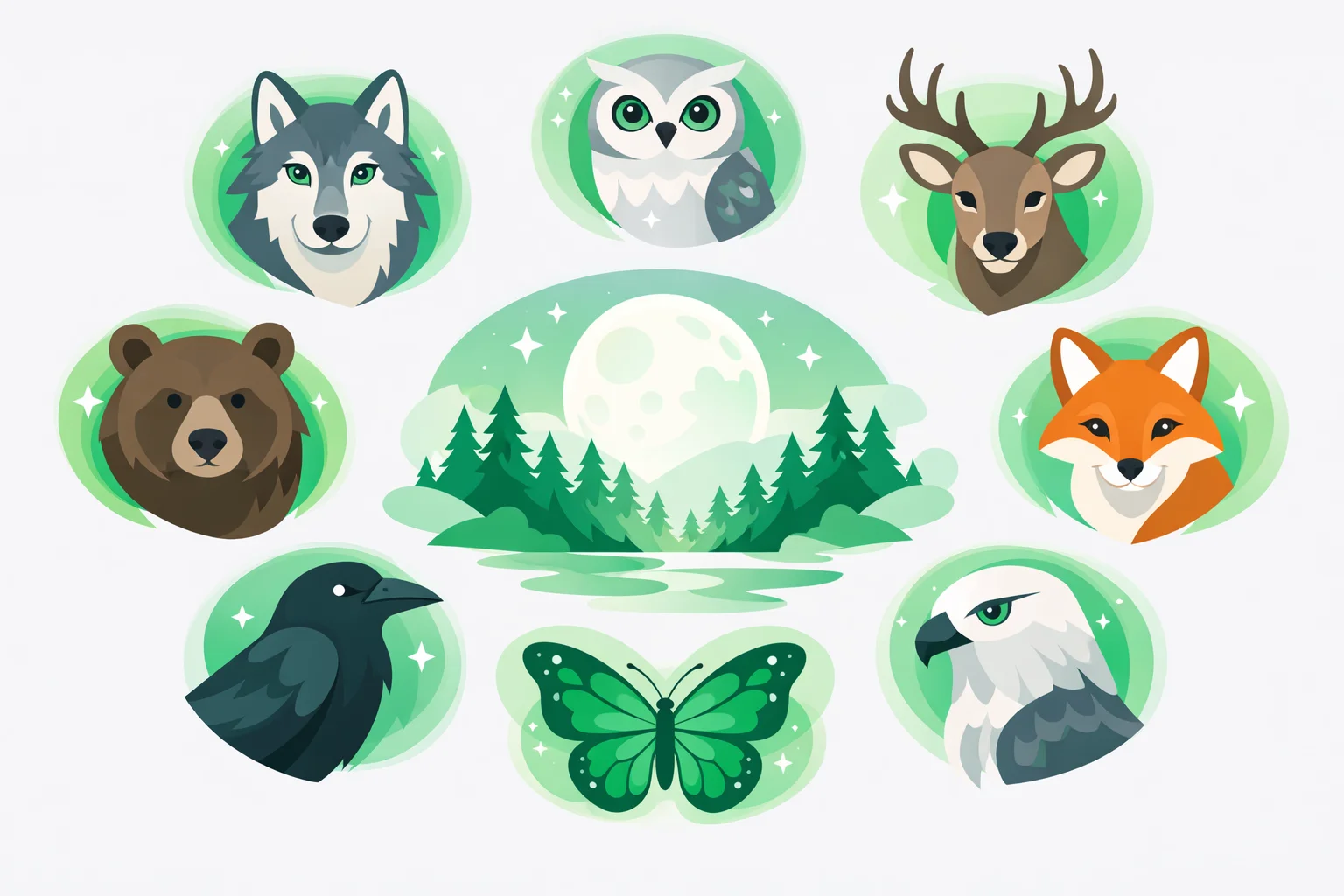
All 8 Spirit Animals, Decoded
Curious about the animals you didn't get, or comparing results with a friend? Here's a full guide to every spirit animal in this quiz and what each one represents.
🐺 The Wolf — The Free Spirit. The wolf belongs to people who need freedom the way others need air, yet pour fierce loyalty into a small, trusted circle. Wolves lead by instinct and protect what's theirs without being asked. Their gift is that rare mix of independence and devotion; their shadow is a guarded heart that struggles to let new people in.
🦉 The Owl — The Old Soul. Owls see what others miss — the unspoken feeling, the truth under the story. Patient, perceptive, and at home in silence, they're the ones people come to for clear-eyed counsel. Their weakness is overthinking: they can wait so long for perfect certainty that they hesitate to act at all.
🦌 The Deer — The Gentle Heart. Deer move through life with grace and feel everything deeply, sensing moods most people miss. Their tenderness is frequently mistaken for weakness, but staying soft in a hard world takes real courage. Their challenge is learning to protect their own heart instead of absorbing everyone else's pain.
🐻 The Bear — The Quiet Healer. Bears are steady, grounded strength — calm in chaos and the person everyone instinctively leans on. Crucially, they understand that retreat isn't weakness; like the bear in winter, they know when to withdraw and heal. Their shadow is bottling things up and being slow to ask for help they freely give to others.
🦊 The Fox — The Shapeshifter. Foxes are quick, clever, and endlessly adaptable, always spotting the angle no one else saw. They thrive on change and can charm a room or vanish to do their own thing with equal ease. Their risk is hiding behind the cleverness — staying so strategic that few people ever see the real them.
🐦⬛ The Raven — The Dreamweaver. The rarest result at roughly 9%, the raven belongs to those drawn to mystery and unafraid of the dark or the strange. Imaginative and often a step ahead of their time, ravens find meaning where others see only shadow. Their shadow side is drifting into isolation and dwelling too long in the depths.
🦋 The Butterfly — The Reborn Soul. Butterflies have come through something — a loss, a hard season, an old self they had to shed — and emerged lighter. They bring hope into rooms effortlessly and treat change as the point rather than the enemy. Their challenge is avoiding pain by fluttering on before they've fully felt it.
🦅 The Hawk — The Skywatcher. Hawks rise above the noise to see the whole landscape — the goal on the horizon, the thing that actually matters. Focused, independent, and a little fearless, they cut through fog and give others clarity. Their weakness is impatience with details and a tendency to fly too solo. Hawks make up only about 10% of results.
How to Actually Live With Your Spirit Animal
A result like this is only worth as much as what you do with it, so here's the practical part. First, sit with the gap between the animal you wanted and the one you got — that gap is often where the real insight hides. If you hoped for the bold Hawk but landed on the gentle Deer, your work probably isn't becoming more fearless; it's honoring a sensitivity you've been told to apologize for.
Second, take your animal's shadow side seriously, not just its gifts. The Wolf's guarded heart, the Owl's overthinking, the Butterfly's habit of skipping past pain — naming the shadow is how the symbol earns its keep. And finally, remember that your animal can change. Retake the quiz after a real life shift and notice if a different creature steps forward. That movement isn't the quiz being inconsistent; it's a small, honest record of how you're growing — which, in the end, is the only reason any of this is worth doing. And if you enjoy seeing yourself through an animal lens, the chronotype quiz matches you with a sleep animal — Lion, Bear, Wolf, or Dolphin — based on your natural body clock.
It's worth knowing that symbolic matching has a measurable cousin. Victorian floriography assigned flowers fixed meanings the same way older traditions assigned animals theirs, and it collapsed for a specific reason: no two dictionaries agreed, and marigold was printed as grief, cruelty and devotion in the same decade. The what flower am I quiz was built as the deliberate opposite — it drops the symbolism entirely and scores you on four things a botanist can actually measure in a plant. Reading the two side by side is the clearest way to see what a symbolic result gives you that a measured one can't, and vice versa.