The Character Quiz, Explained: Why One Fictional Person Feels Like You
A good character quiz doesn't really ask which show you like — it asks who you'd be inside the story. Picture the last series that kept you up well past “just one more episode.” The credits roll, and the character stuck in your head isn't necessarily the fan favorite everyone quotes. It's the one who, for a few uncomfortable seconds, moved through a scene exactly the way you would have. That flicker of recognition — oh, that's me — is the thing this quiz is built to catch and name.
You Root for the Character Who Feels Like You
There's a specific kind of loyalty we develop toward fictional people. It isn't about who's the strongest or the funniest. Ask a room full of friends who their favorite character is and you'll get a scatter of wildly different answers — and if you dig into why, the reason is almost never “they're the coolest.” It's “they get it” or “they'd have done what I would've done.” We bond hardest with the character who mirrors our own instincts back at us, even when that character is a supporting player nobody else remembers.
That's the quiet premise underneath every “which character are you” test. You're not really browsing a cast list. You're looking for your own reflection in a hall of very well-drawn mirrors — and the one that finally fits tells you something the mirror in your bathroom can't.
Why Your Brain Treats Fictional People Like Real Ones
Here's the genuinely strange part: your brain barely distinguishes a compelling fictional person from a real one. When a story pulls you in — psychologists call this narrative transportation — the same networks that model the minds of real people light up to model the characters. You predict their choices, flinch at their mistakes, and feel the sting of their losses because, neurologically, you're running them on the same hardware you use for your actual friends.
This is also why a character can teach you something about yourself that a personality test delivered flat. Watching someone make a choice under pressure — and realizing you'd have made the same one — is a far stickier form of self-knowledge than reading a bullet point that says “you value loyalty.” A character shows you the trait in motion. That's the whole reason we've been telling stories about heroes, tricksters, and mentors for a few thousand years: they're self-diagnosis tools wearing costumes.
The Eight Archetypes Almost Every Story Runs On
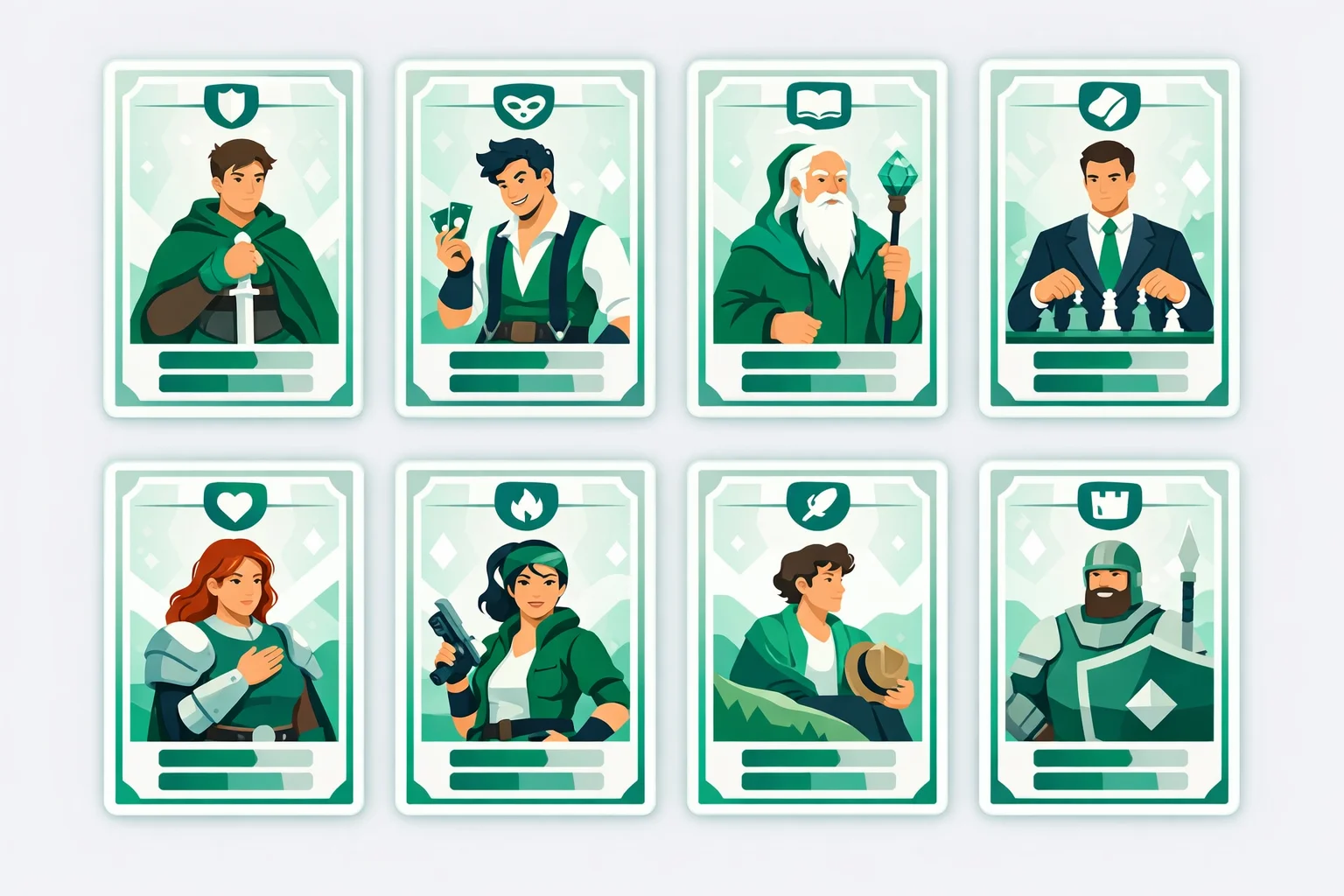
Sort enough fictional characters and the sheer variety collapses into a surprisingly short list of blueprints. This isn't a modern marketing trick — it goes back to Carl Jung's work on archetypes and, before him, to the stock roles of ancient myth and theatre. The specific eight this quiz sorts you into show up again and again because they map onto the handful of ways a person can relate to a story's central problem: run from it, guard against it, out-think it, burn it down, and so on.
| Archetype | Drives them | Familiar faces |
|---|---|---|
| Reluctant Hero 🗡️ | Duty they never asked for | Frodo, Katniss, Peter Parker |
| Loyal Heart 💛 | Devotion to the people they love | Samwise, Ron Weasley, Watson |
| Steadfast Guardian 🛡️ | A code worth protecting | Aragorn, Wonder Woman, Mulan |
| Free-Spirited Dreamer 🌙 | Wonder and the unseen door | Luna Lovegood, Moana, Belle |
| Charming Rogue 🃏 | Freedom, wit, a secret soft spot | Han Solo, Jack Sparrow, Loki |
| Fierce Rebel 🔥 | Tearing down what's unjust | Zuko, Daenerys, Furiosa |
| Wise Mentor 🧙 | Guiding the next one through | Gandalf, Iroh, Yoda |
| Brilliant Mastermind 🧠 | Winning with the mind | Tyrion, Sherlock, Hermione |
How the Quiz Reads Your Choices, Not Your Favorites
Most “which character are you” quizzes cheat. They ask what your favorite color is, or which movie you'd rewatch, and then reverse-engineer a flattering result from your taste. This one works differently on purpose. Every question drops you into a story beat — a call to adventure, a villain's offer, the moment the plan collapses, the climax — and asks what you'd actually do. Your archetype is assembled from those fifteen instincts, not from what you enjoy watching.
That distinction matters more than it sounds. Question 7, the villain's deal, quietly separates the Mastermind (who hears the offer out because information is leverage) from the Guardian (who won't even sit at the table). Question 12, your relationship with the rules, teases the Rogue apart from the Rebel — one bends rules for themselves, the other breaks them for a cause. By the end, the pattern isn't about a single dramatic answer; it's the direction you keep leaning when the stakes rise. If you're curious how that instinct maps onto formal psychology, the personality quiz measures the same tendencies as traits rather than roles.
Here's Where People Get Their Result Wrong
The single most common reaction to a character result is a small, disappointed “huh.” Someone was sure they'd be the dashing Rogue or the world-changing Rebel, and instead they got the Loyal Heart. Here's the thing worth sitting with: that gap is the most useful reading on the whole page. We aspire to the characters we find exciting, but we answer honestly as the character we actually are — and those are rarely the same person.
Loving a character and resembling one are two completely different measurements. Plenty of gentle people are obsessed with chaotic anti-heroes precisely because that energy is nothing like their own. So if your result surprised you, resist the urge to retake it while “fixing” your answers toward the cooler archetype. The version that came out when you weren't managing the outcome is the honest one. The Guardian who wishes they were the Rebel is still, reliably, the person everyone runs to when the roof caves in. Single-cast quizzes make that gap even starker — on the Persona 5 character quiz nearly everyone expects Joker, and about one run in eight actually lands there.
An entire subculture is built on the opposite measurement. Kinning means claiming a character as you rather than noting a resemblance, and it counts the unflattering parts as the point — which is why the kinnie quiz returns a ranked kin list plus a separately scored comfort character instead of one name. If your archetype above surprised you, that split is usually where the surprise was hiding.
What Your Archetype Reveals Off the Page
Strip away the swords and spaceships and your archetype is basically a snapshot of how you handle three things: responsibility, risk, and other people. A Mastermind's cool distance often tracks with high introversion and a strong need for control. A Loyal Heart or Guardian usually scores high on the trait psychologists call agreeableness. A Dreamer or Rogue leans into openness and a comfort with uncertainty that a Guardian would find genuinely stressful. It's not astrology — it's the same behavioral tendencies you'd surface in a proper assessment, just wearing a story's clothes.
That's why these results tend to rhyme with your other type-quiz outcomes rather than contradict them. If you want the motivation sitting underneath the role — the “why” that decides how your arc actually resolves — the Enneagram quiz digs there, and the spirit animal quiz comes at the same core instinct from an entirely different mythology. Read together, they triangulate something a single quiz never could. And if you want the same sorting run inside a single medium, the anime character quiz matches you to a named lead — Naruto, Levi, Gojo — instead of a broad archetype, and the Gilmore Girls character quiz does the same sorting across eight Stars Hollow residents.
All 8 Fictional Character Archetypes, Explained
🗡️ The Reluctant Hero — The ordinary person the story keeps choosing. They don't want the spotlight, but when duty lands on them they carry it anyway, driven by love and obligation rather than glory. Humble and quietly unbreakable, their real challenge is believing they were enough before anyone forced them to prove it.
💛 The Loyal Heart — The devoted companion who often turns out to be the true center of the story. Warm, dependable, and generous to a fault, they hold the group together and never ask for the credit. Their growth is learning to let themselves be carried, too, before the well runs dry.
🛡️ The Steadfast Guardian — Built around a code and unwilling to bend it, the Guardian is the one everyone lines up behind in a crisis. They'll take the hit so someone weaker doesn't have to. The lesson waiting for them is that integrity sometimes means knowing when the rule itself needs to flex.
🌙 The Free-Spirited Dreamer — Curious, imaginative, and cheerfully immune to “that's impossible,” the Dreamer finds the door nobody else spotted. They wander off the map and return with the answer. Their arc is about following through — turning all that vision into something they actually finish and build.
🃏 The Charming Rogue — Witty, independent, and allergic to rules, the Rogue plays it cool and self-interested. But underneath the swagger is someone who shows up for their people at the worst possible cost to themselves. Their bravest move is dropping the act and admitting they care on purpose.
🔥 The Fierce Rebel — Low tolerance for “because those are the rules,” especially when the rules hurt people. Magnetic, courageous, and a little dangerous, the Rebel lights the match everyone else was afraid to strike. Their challenge is answering the question that comes after the fire: and then what?
🧙 The Wise Mentor — Been through their own war and come out still. The Mentor sees the whole board, asks the right question instead of handing over the answer, and exists to make sure the next person makes it. Their hardest wisdom is stepping back and letting others stumble on their own.
🧠 The Brilliant Mastermind — Already several moves ahead while everyone else reacts. Calm, resourceful, and occasionally mistaken for cold, they flip losing situations by spotting the one variable nobody noticed. The rarest result here, their growth is remembering that people aren't chess pieces to be solved.
So, Which Character Are You Really?
The honest answer is that you're a blend — almost every memorable character is. The quiz hands you a dominant archetype and a secondary one, and that pairing is where the interesting version of you lives: a Guardian with a Dreamer streak, a Mastermind hiding a Loyal Heart. Pay attention to the combination, not just the headline. And here's the move that actually matters once the confetti settles: look at your character arc — the flaw your archetype has to outgrow — and treat it as a prompt, not a verdict. Frodo had to believe he mattered. Your arc is just as writable. If you enjoyed decoding yourself through fiction, the soldier, poet, or king quiz asks a sharper three-way version of the same question, the dere type quiz zooms all the way in on the romantic side of your character, and the Disney princess quiz runs the same instinct-reading approach across the eight princesses, and the Pokémon quiz does it across eight iconic creatures, and the Stranger Things quiz matches you to a Hawkins hero if you'd rather be sorted straight into the Upside Down.