Soldier, Poet, King: The Three Archetypes and What Your Result Really Means
It's late 2021, you're scrolling TikTok, and the same eerie refrain keeps looping past you — "oh lei, oh lai, oh Lord" — under video after video sorting friends, fictional characters, and total strangers into three buckets: Soldier, Poet, or King. That's the moment most people met the Soldier Poet King quiz, even if they never took a formal one. The song did the sorting for them. Within months, "which one are you" had quietly become one of the most-asked personality questions online, and it all traces back to a four-minute folk ballad by a sibling duo from Texas.
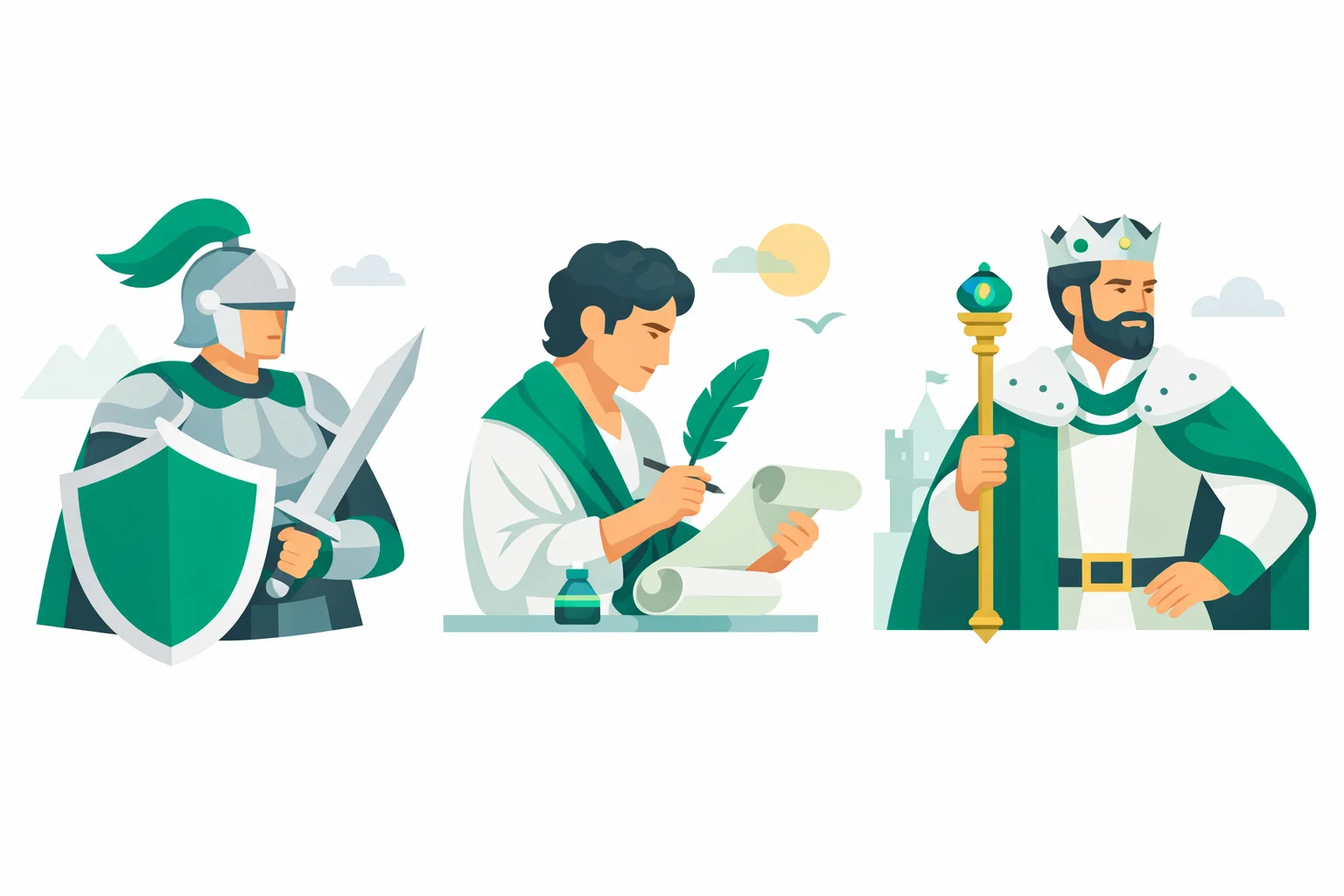
How a Folk Song Became the Internet's Favorite Personality Test
The song is "Soldier, Poet, King," released in 2017 by The Oh Hellos, a band built around siblings Maggie and Tyler Heath. It sat quietly on their Notos EP for four years — a folky, building, almost hymn-like track — before TikTok's algorithm decided it was destiny. What made it spread wasn't a dance. It was the structure. Three verses, three characters, each described in a single vivid image: a soldier with a mighty sword, a poet whose weapon is his word, and a ruler crowned in thorn. That's a personality test hiding inside a lyric sheet, and the internet noticed.
Here's the part that's easy to miss: the song was never written as a quiz. It reads more like prophecy — three figures who "will come." But because each one is drawn so cleanly, people instinctively saw themselves in one of them. That instinct is the whole engine behind why archetype quizzes work, and it's why a track with no chorus about "you" became a mirror millions held up to their own personality.
The Three Weapons: Sword, Word, and Crown
Strip the song down and you get three ways of changing the world, each tied to a weapon. The Soldier carries a sword — direct force. He acts, he protects, he "tears the city down." The Poet's weapon is his word — influence. He doesn't overpower you; he "slays you with his tongue," changing how you see things. The King's weapon is the crown itself — authority, and the sacrifice underneath it. His brow is "laid in thorn," a deliberate echo of a crown of thorns, and he's "smeared with oil like David's boy," a nod to the shepherd boy David being anointed king in the Hebrew Bible. Three weapons, three kinds of power: the hand, the mouth, the head.
The quiz above scores exactly these three drives across twelve questions. It doesn't ask whether you're a good person or a strong one — all three archetypes are. It asks how you tend to move: do you act on a problem, reframe it, or take responsibility for it? Question 6 makes this literal by handing you the three weapons and asking which fits your hand. Most people hesitate there, and the hesitation is the point.
| Archetype | Weapon | Mode of power | At their best |
|---|---|---|---|
| 🗡️ Soldier | The sword | Force & action | Courage, loyalty, decisiveness |
| ✒️ Poet | The word | Insight & influence | Empathy, perception, persuasion |
| 👑 King | The crown | Authority & sacrifice | Vision, responsibility, composure |
Why Does a Three-Way Quiz Feel So Accurate?
Three options should feel too simple to say anything real about you. So why does the result so often land? The answer is archetypes. An archetype is a pattern of personality so old and so common that it shows up in myths, religions, and stories across cultures that never met — the warrior, the sage, the ruler. The psychiatrist Carl Jung argued these patterns live in a shared layer of the human mind, which is why the Soldier, the Poet, and the King feel familiar the instant you read them. You're not learning something new; you're recognizing something you already carry.
There's a catch worth naming, and any honest quiz should. Part of the "wow, that's so me" feeling is the Barnum effect — our tendency to accept broad, flattering descriptions as uniquely personal. A well-built archetype quiz fights that by forcing trade-offs: every question here makes you pick one drive over two others you probably also like. When you have to choose between acting, understanding, and carrying — over and over — a genuine pattern emerges instead of a horoscope. If you want a read that goes wider than three types, the deeper personality quiz measures core traits on a spectrum rather than sorting you into a single figure.
The Older Framework Hiding Behind the Trend
Long before TikTok, two authors named Robert Moore and Douglas Gillette published King, Warrior, Magician, Lover (1990), a book mapping four mature archetypes of the psyche. Line them up next to the song and the overlap is almost eerie. The Warrior is the Soldier — disciplined, protective, action-oriented. The Magician and Lover together make the Poet — the one who sees beneath the surface and moves people through insight and feeling. And the King is, well, the King: the part of us that orders our inner world and takes responsibility for others. The song didn't cite the book. It didn't need to. Both are drawing from the same ancient well of Jungian archetypes.
This is where the trend quietly becomes useful instead of just fun. Moore and Gillette argued that each archetype has a "full" expression and an immature, shadow expression — a distinction most three-second TikToks skip entirely. A King in his fullness serves the realm; a King in shadow becomes a tyrant or a weakling. That framework is exactly why the quiz above reports a shadow side for every result, not just a highlight reel. If you like this kind of layered typing, the Enneagram quiz builds an entire system around the core fear and desire underneath each type.
Here's the Part the Trend Gets Wrong
The viral version treats this as a hard sort: you're a Soldier, full stop, and your friend is a Poet. Real people don't work that way, and neither does the quiz above — it gives you a percentage across all three. That blend is usually the most revealing part of your result. A Soldier-King acts decisively and carries the group; think of the captain who charges in but never forgets who's behind them. A Poet-King leads through vision and words rather than force. A Soldier-Poet fights hard and feels everything, which is a beautiful and exhausting combination to be. If you like seeing that fighter-feeler-leader instinct spread across a whole cast of story roles, the character quiz sorts you into one of eight fictional archetypes built on the same idea.
Watch what happens if you scored, say, 50% King, 33% Soldier, 17% Poet. Your dominant drive is responsibility, but the Soldier underneath means you don't just plan — you'll pick up the sword when the plan needs someone to. The thin slice of Poet is your quiet reader of people, the part that occasionally surprises everyone with how much you noticed. Two people can both "get King" and lead nothing alike, because the second and third archetypes change the whole flavor. That's why comparing your full breakdown with a friend's is more interesting than comparing headline results — and it's the same reason a broad archetype quiz reports a primary and a secondary rather than a single label.
There's one thing the soldier-poet-king split deliberately leaves out, and it's the axis a lot of men actually want measured: how much you want to be inside the group at all. All three of these archetypes assume you're in the room and playing a role in it — the King leads it, the Soldier defends it, the Poet reads it. None of them covers the man who simply doesn't attend. The sigma male quiz adds that second dimension, plotting you on detachment as well as status strategy, which is why it can distinguish a genuine loner from someone who's just avoiding the room.
The Shadow of Each Archetype (and Why It Matters Most)
The most useful thing any personality result can hand you isn't the compliment — it's the warning. Each of these archetypes has a failure mode that only kicks in under stress, and knowing yours is worth more than knowing your strengths. The Soldier's shadow is turning everything into a battle: staying armored, burying feelings, mistaking a wall for a spine. When a Soldier is hurt (question 9 quietly tests this), the instinct is to bury it and march on — which works right up until it doesn't.
The Poet's shadow is the opposite trap: sinking so deep into feeling and analysis that nothing gets done, or turning that razor gift for words into something cruel when wounded. The Poet who "slays with his tongue" can slay the wrong people. And the King's shadow is the quietest and most dangerous — silent martyrdom. Kings hide their own pain so the people counting on them won't worry, carry weight they should be sharing, and isolate at the top until they crack. If your result was King, the single most important sentence in it is the one about asking for help. That's not a footnote; for a King, it's the whole growth edge.
All Three Results, Decoded
🗡️ The Soldier — the Unbreakable Protector. You act while others deliberate. Loyalty and courage define you, and the people you love know you'd stand between them and anything. Soldiers are the most reliable people in any group and the ones you want in a genuine crisis. The weakness to watch: seeing conflict everywhere and armoring up so completely that no one — including you — can reach what you actually feel. Roughly a third of people lead as Soldier, making it one of the two most common results.
✒️ The Poet — the Truth-Teller. You notice what everyone else walks past and can name it in a way that comforts or cuts. Your power is perception and language; you change people by making them feel and understand, not by force. Poets are the most emotionally intelligent of the three and the most likely to be told "you just get me." The shadow is living in your head, sliding into melancholy, and weaponizing your words when you're hurt. Poet is the most common single result — the archetype most people quietly recognize themselves in.
👑 The King — the Sacrificial Leader. You end up carrying things whether you asked to or not, because people trust you with the hard calls and you make them without needing the credit. You think in terms of the whole and the long game, and you absorb weight so others don't have to. King is the rarest result — only about one in five — precisely because the archetype is built on shouldering responsibility most people avoid. Its shadow, silent martyrdom and control, is the price of the crown "laid in thorn."
What to Actually Do With Your Result
Don't frame it as a fixed identity — frame it as a starting move. If you're a Soldier, your growth this month is to sit with one hard feeling instead of burying it. If you're a Poet, it's to finish one thing you've been endlessly analyzing. If you're a King, it's to hand one piece of your load to someone else and let them carry it imperfectly. Archetypes aren't cages; they're maps of your default setting, and the whole point of seeing your default is being able to choose against it when it stops serving you. Then send the quiz to three friends and compare breakdowns — you'll learn more about your circle from that one conversation than from any headline result, and it's a genuinely fun way to see who reaches for the sword, the word, or the crown.