Which Anime Character Are You? Why Your Match Is Rarely the Character You'd Pick
The first time Mira took an anime character quiz, she wanted Levi Ackerman so badly that she answered half the questions as him — and still got Tanjiro Kamado. She was, in her words, "quietly offended." Mira is a composite of a very real pattern we see in the result data, and her story is worth telling because it captures the strange, slightly uncomfortable thing this kind of quiz does: it ignores the character you'd cosplay and finds the one you actually behave like on a Tuesday.
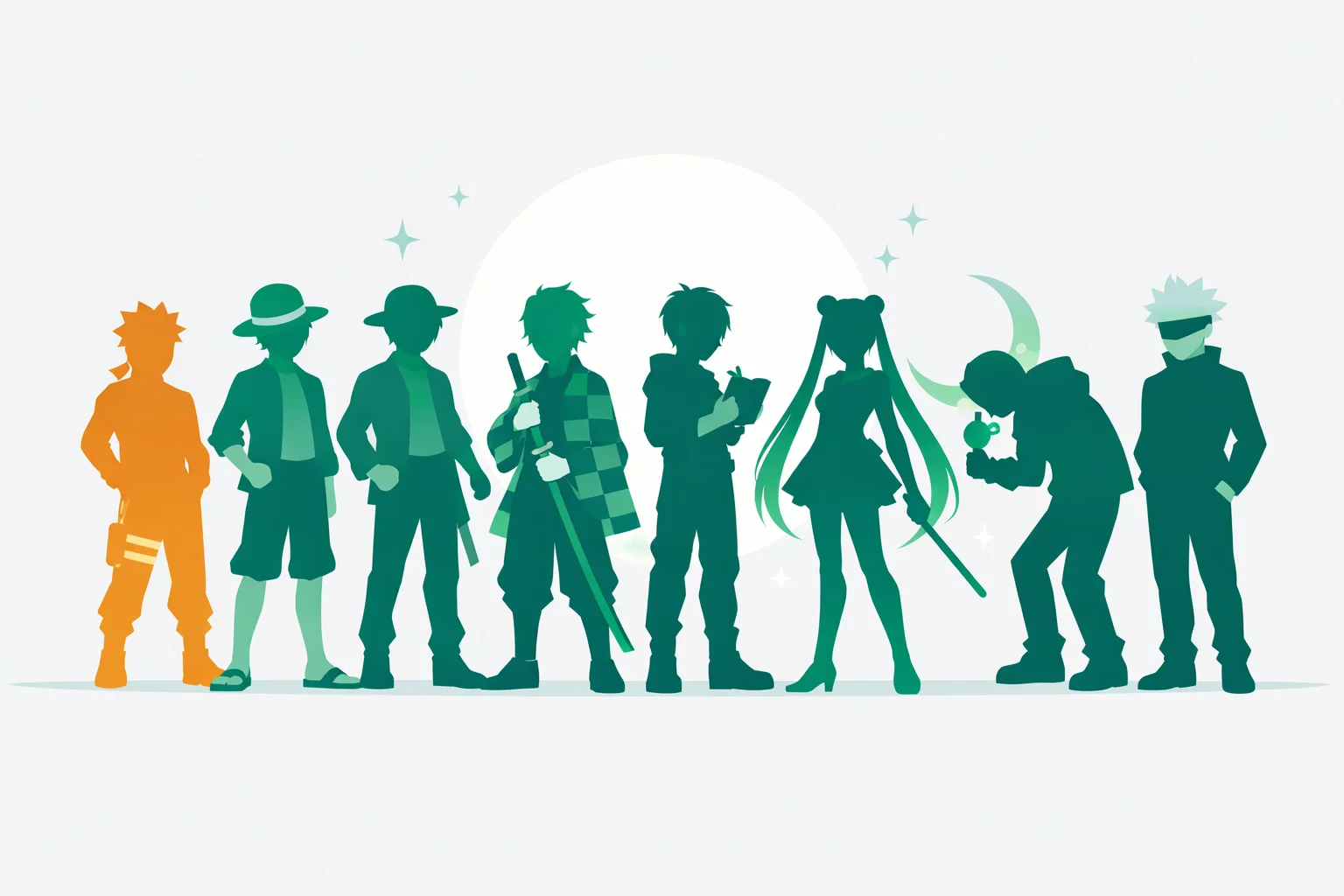
The Character You Love Isn't the Character You Are
Six months after her "wrong" result, Mira's roommate delivered the verdict. Mira had spent that weekend cooking for a heartbroken friend, talked a feuding group chat back from the brink, and apologized to a spider before relocating it to the balcony. "You know that's just Tanjiro with a MetroCard, right?" The quiz had her from question three; it just took two seasons of real life for her to admit it.
Media psychology has a name for the gap Mira fell into. Identification — actually feeling like a character, adopting their perspective while you watch — is a different process from admiration, where you watch a character precisely because they're everything you're not. Jonathan Cohen's widely cited 2001 paper on identification with media characters drew exactly this line: we merge with some characters and idolize others, and the two lists rarely overlap. Levi was Mira's idol. Tanjiro was her mirror. A good character quiz is built to find the mirror, which is why the result sometimes lands like a gentle insult before it lands like the truth.
Why Do Anime Characters Feel Like Personality Tests?
Here's the thing that makes an anime quiz work better than, say, a sitcom character quiz: anime externalizes personality. The medium's whole visual grammar — sweat drops, power auras, the dramatic wind that only blows for stoic characters — turns inner states into things you can see. Shonen series in particular are built around clearly legible drives. Naruto wants acknowledgment. Deku wants to be worthy of the power he was given. Luffy wants freedom so purely that the show treats it as his superpower. When motivations are drawn that boldly, mapping your own instincts onto them stops being fuzzy vibes and becomes something closer to a sorting exercise.
There's also a scale effect nobody had to plan. With roughly three hundred new anime productions airing every year and archetypes refined across seven decades, the medium has produced an unusually complete taxonomy of human temperament — the gentle protector, the eccentric genius, the effortless ace, the big-hearted crybaby. Western fiction has these people too, but anime names them, ranks them, and gives them signature moves. That taxonomy is exactly what makes questions like "which anime character am I" answerable in a way that feels precise instead of arbitrary.
How the Sync Rate Scoring Actually Works
This quiz doesn't use simple "each answer equals one character" counting, because real personalities don't sort that cleanly. Every answer you pick awards two points to a primary character and one point to a secondary character whose pattern overlaps. Choosing "I cook for people — it's how I say I care" is classic Tanjiro, but it's also a little bit Usagi, and the scoring respects that overlap. After 15 questions, your point spread across all eight characters gets ranked, and three things come out of it: your match (highest score), your rival (second), and your crewmate (third).
The sync rate percentage measures consistency, not quality. Someone who answers as the same underlying pattern all fifteen times can push toward the 98% cap; someone whose answers split across three characters will land in the 70s — and that lower number is genuinely informative. It means you're a blend, and your rival result deserves almost as much attention as your match. The everyday framing of the questions is also deliberate: group projects and lunch breaks instead of demon attacks, because your real instincts answer everyday questions while your aspirational self answers the heroic ones. That design choice is the difference between measuring you and measuring your favorite season finale.
Eight Series, One Personality Map
The eight results deliberately come from eight different series spanning three demographics — shonen (Naruto, One Piece, Demon Slayer, My Hero Academia), seinen-adjacent darkness (Attack on Titan, Death Note, Jujutsu Kaisen), and classic shojo (Sailor Moon). That spread matters. An all-shonen lineup would collapse into four flavors of "determined fighter," and the quiz would lose the people whose core trait is warmth or analysis rather than willpower. Here's the full map:
| Character | Series | Archetype | Core drive | Blind spot |
|---|---|---|---|---|
| Tanjiro Kamado | Demon Slayer | Gentle Protector | Protecting what's left | Absorbing everyone's pain |
| Naruto Uzumaki | Naruto | Unbreakable Underdog | Acknowledgment | Recklessness |
| Monkey D. Luffy | One Piece | Free-Spirit Captain | Freedom | Allergic to plans |
| Izuku Midoriya | My Hero Academia | Analytical Striver | Being worthy | Chronic overwork |
| Usagi Tsukino | Sailor Moon | Big-Hearted Crybaby | Everyone she loves, safe | Feelings outrun follow-through |
| Levi Ackerman | Attack on Titan | Stoic Perfectionist | Control amid chaos | Bluntness that bruises |
| L Lawliet | Death Note | Eccentric Genius | Solving the unsolvable | People aren't puzzles |
| Satoru Gojo | Jujutsu Kaisen | Effortless Ace | Protecting the next generation | Strength that isolates |
If the archetype layer interests you more than the specific character, two neighboring quizzes go deeper on it: the fictional character archetype quiz maps you across all of fiction rather than one medium, and the dere type quiz zooms into a single anime-specific layer — how you express affection — that this quiz deliberately doesn't score.
Your Rival Result Says the Quiet Part Out Loud
Back to Mira. Her match was Tanjiro, but her rival — the second-highest score — was Levi. And that's the detail that reframed the whole result for her. She hadn't been answering "wrong" when she reached for his answers; she'd been describing the discipline and composure she was actively building. Anime itself runs on this dynamic: Naruto and Sasuke, Deku and Bakugo, Gon and Killua. The rival isn't the opposite of the hero. The rival is the trait the hero is missing, walking around with better hair. That Naruto-and-Sasuke pairing is a clan argument as much as a personal one, which the Naruto clan quiz takes apart properly — Uzumaki and Uchiha score on opposite ends of what a bloodline is supposed to cost you.
Read your own results the same way. Your match is your default setting — the pattern your answers kept returning to when the question was ordinary. Your rival is usually your growth direction or your stress mode, the character you become when the defaults stop working. A Deku with a Gojo rival is an anxious analyst learning to trust their own competence. A Levi with an Usagi rival is a fortress with a garden growing inside it. If your rival annoys you a little? That's worth sitting with. We're rarely neutral about the traits we're halfway to owning.
All 8 Anime Character Results
🌊 Tanjiro Kamado (Demon Slayer) is the quiz's most common match at about 16%. Tanjiro types lead with empathy that never tips into weakness — they check on the quiet person, hold their ground in a crisis, and carry grief as a promise. Their trap is absorbing everyone else's pain and calling exhaustion "duty."
🍜 Naruto Uzumaki (Naruto) matches land around 15%. These are the stubborn optimists who convert rejection into fuel and skeptics into family, winning through persistence rather than raw talent. The cost of all that forward momentum is a long history of charging in before thinking.
👒 Monkey D. Luffy (One Piece) takers, roughly 14%, run on pure freedom. They ignore hierarchies rather than fight them, decide with their gut in half a second, and accumulate loyal friends almost by accident. Planning, paperwork, and pacing remain lifelong optional side quests.
📓 Izuku Midoriya (My Hero Academia) comes up for about 13% of takers. Deku types out-prepare everyone, turning obsessive observation and honest anxiety into courage that arrives exactly on time. Their growth edge is brutal: they price their own worth at whatever they produced today.
🌙 Usagi Tsukino (Sailor Moon) matches about 11% — people who feel everything at full volume and turn that emotional gravity into the glue of their friend group. They can befriend a rival mid-argument. Their calendar, however, is usually a crime scene of overcommitted yeses.
⚔️ Levi Ackerman (Attack on Titan) lands on roughly 10% of takers: the composed perfectionists who feel everything and show nothing, whose reliability in a crisis rewrites how people saw their coldness. Their bluntness can cut people who needed softness, and delegation physically pains them.
🍰 L Lawliet (Death Note) is the second-rarest result at about 9%. L types notice the detail everyone missed, treat social convention as an optional setting, and would rather be right than liked. Care, for them, is remembering exactly what you said six weeks ago — not saying anything about it.
🕶️ Satoru Gojo (Jujutsu Kaisen) is the rarest match at 8%. Gojo types pair genuine top-tier competence with a refusal to take life seriously, and take quiet, fierce responsibility for the people coming up behind them. Being the strongest in the room is also the loneliest seat in it.
What to Do With Your Result (Besides Arguing About It)
First, the argument is allowed — Mira spent half a year in it. But try this instead of retaking the quiz immediately: read your match's growth edge and ask whether anyone in your life has said that exact sentence to you. That's usually where the match proves itself. Second, take the watch-next suggestion seriously. Your match's series tends to hit differently when you recognize yourself in the lead, and your rival's series shows you the trait you're building, fully grown. Third, make it social — this quiz gets dramatically better when your group chat compares supporting casts, because the person who got Levi will absolutely be told they're actually an Usagi, and that conversation is the real result. If that Usagi accusation lands, the Sailor Moon character quiz settles it properly across all nine guardians, and it tells you something this one can't — whether your instincts match the 1992 anime or the manga, which genuinely disagree about who Rei is. And if you want to keep the streak going once the dust settles, the Pokémon personality quiz asks a related question with a completely different scoring model: not who you are in the story, but what you'd be in the world. And if your group chat's other shared language is idol pop, the K-pop quiz trades personality matching for a survival-show debut evaluation — knowledge, not vibes, decides who takes the center spot. For a fandom that argues about character motives even harder than this one does, the FNAF character quiz matches you to an animatronic using the movement rules the 2014 game gave each one. If your match came out gentler than you expected, the Studio Ghibli character quiz is the one worth running next — it ignores fighting spirit entirely and sorts you on whether you go or stay, work or feel, and whose side you take when the town and the forest cannot both win. And if you drew Tanjiro or Zenitsu above, the Demon Slayer breathing style quiz goes a level deeper into that series, sorting you onto the lineage tree the fourteen styles actually branch from rather than matching you to a face. And if the One Piece questions were the ones you cleared fastest, the Devil Fruit quiz hands you one of twelve fruits, a Paramecia-Zoan-Logia reading and a bounty scored from how far you said you would actually go.