Perfume Quiz: How to Find Your Signature Scent by Fragrance Family
This perfume quiz sorts you into one of five fragrance families, but that neat system of families is barely 40 years old — while the craft it organizes is nearly 4,000. The oldest chemist whose name survives in recorded history wasn't a man in a Renaissance lab. She was a Babylonian woman named Tapputi-Belatekallim, and around 1200 BCE she was distilling flowers, oil, and resins into scent and writing down her methods on a clay tablet. Every result this quiz can give you — floral, woody, amber, fresh, gourmand — is a distant descendant of what she was doing over three millennia ago. Knowing that history actually changes how you read your result.
The First Perfumer Was a Woman Named Tapputi
Perfume didn't start as vanity — it started as devotion. The word itself comes from the Latin per fumum, "through smoke," because the earliest scents were incense burned for the gods. Tapputi, referenced on a Mesopotamian cuneiform tablet, used a still and a filtration process to extract fragrance from botanicals, which makes her the first recorded person to do chemistry of any kind. You can read the surviving account of Tapputi's perfume-making for the full story.
From there the craft traveled. The ancient Egyptians perfected scented oils and gave us kyphi, a legendary temple incense. The Romans bathed in fragrance so heavily that emperors passed laws against overspending on it. By the 1500s, the town of Grasse in southern France had turned scented leather gloves into an industry and became the perfume capital of the world — a title it still holds. So the five-way choice this quiz just handed you sits at the end of a very long line. What changed recently is only how we organize all that history.
How Five Families Came to Organize Every Scent
For most of perfume's history there was no map. You either knew a perfumer or you guessed. That changed in 1983, when a fragrance expert named Michael Edwards built the Fragrance Wheel — a circular chart that groups scents into families and sub-families, arranged so neighboring groups smell related. It's the single most useful tool in fragrance, and it's why a quiz like this one can exist at all. Before the wheel, "what kind of perfume are you" didn't have a vocabulary.
Here's a detail almost no perfume quiz will tell you: one of these families recently changed its name. The warm, spicy, resin-heavy family was called "oriental" for decades. In roughly 2021, Fragrances of the World — the database Edwards maintains — officially retired that term and renamed the family Amber, because "oriental" had come to feel like a lazy, exoticizing catch-all. If your result was Amber, that's the family older guides still label oriental. Same scents, more honest name. Getting that right is exactly the kind of thing a knowledgeable friend, not a template, would mention.
Why Does a Smell Drag You Back Twenty Years?
You've felt it: a stranger walks by, you catch a whiff of something, and suddenly you're nine years old in your grandmother's kitchen. Scent does this more violently than any other sense, and there's a specific reason. Smell is the only sense that skips the brain's central relay station. Sight, sound, and touch all route through the thalamus first; scent signals travel straight from the nose into the limbic system — the ancient region that runs emotion and memory, including the amygdala and hippocampus.
That wiring is why a fragrance can feel like a person, a season, or a version of yourself. It's also why choosing a signature scent matters more than people think. You're not just picking a smell; you're handing everyone who gets close to you a memory anchor. This is the real reason the quiz asked what a scent should do for you and which memory stops you cold, rather than simply "do you like vanilla." Your emotional pull toward a family is more predictive than your opinion of any single note.
The Five Fragrance Families, Side by Side
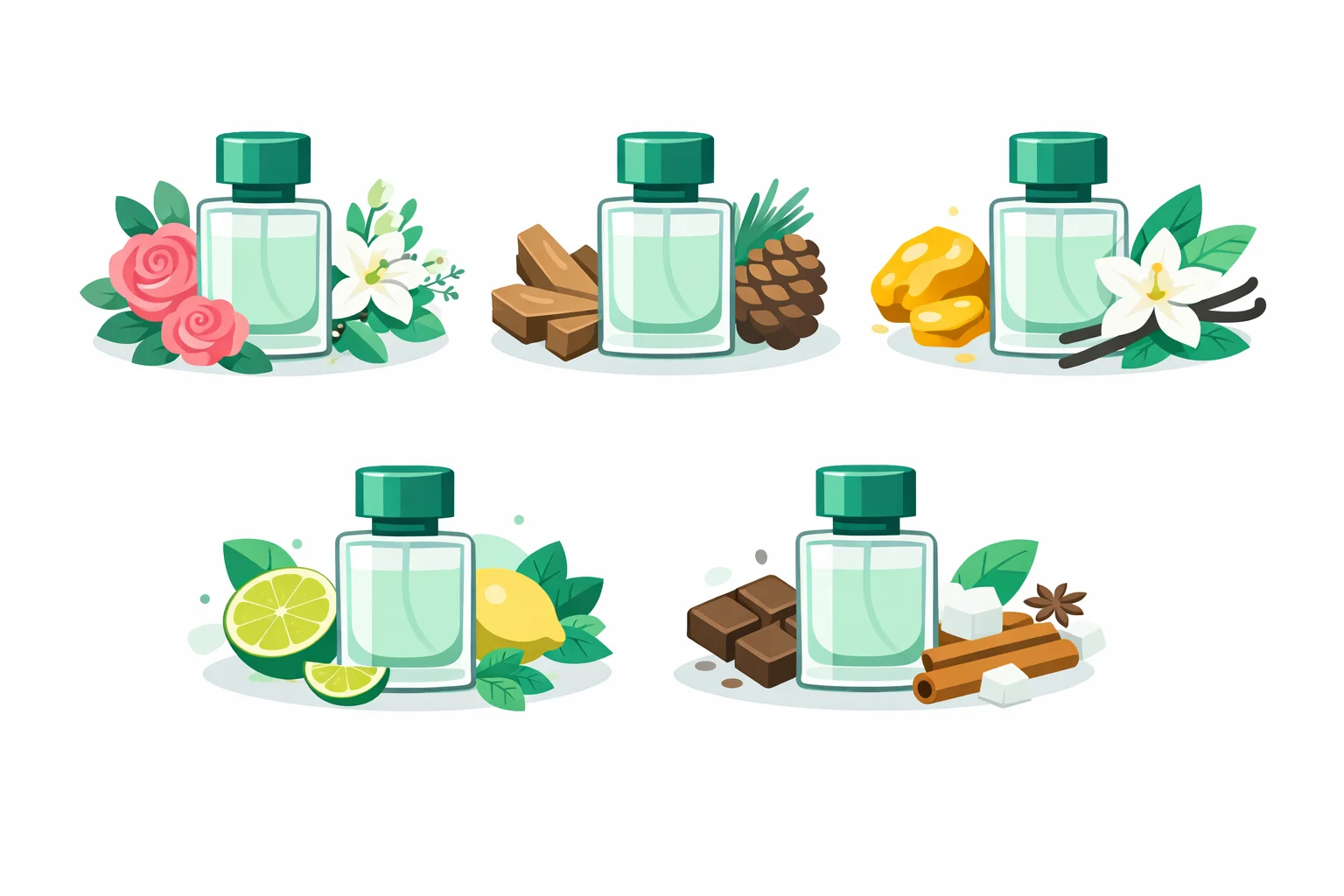
Each family has a personality, a home season, and a projection style. Here's the cheat sheet — find your result and note the family sitting next to it, because that's usually your best "blend" direction.
| Family | Signature notes | Mood | Best season |
|---|---|---|---|
| 🌸 Floral | Rose, jasmine, peony | Romantic, timeless | Spring |
| 🌊 Fresh | Citrus, sea salt, mint | Clean, energetic | Summer |
| 🍰 Gourmand | Vanilla, caramel, tonka | Cozy, comforting | Autumn / winter |
| 🌲 Woody | Sandalwood, cedar, vetiver | Grounded, confident | Autumn / winter |
| 🔥 Amber | Amber, resins, warm spice | Sensual, bold | Winter |
Notice the seasons cluster. Fresh and floral are "cool" families that shine in heat because their light molecules lift off the skin; amber, woody, and gourmand are "warm" families that bloom in the cold, which is why your quiz result also told you whether your palette leans warm or fresh overall. If your wardrobe already runs to a distinct look, your scent should rhyme with it — the style quiz maps that visual side of your signature, and the color analysis quiz finds the seasonal palette that pairs with it.
Top Notes Are Lying to You
The single most expensive mistake in perfume shopping: buying based on the first sniff. When you spray a fragrance, you smell it in three descending acts, a structure perfumers call the pyramid. The top notes — usually citrus and light herbs — are the loudest and the most fleeting, gone within 15 minutes. The heart notes take over for a few hours and carry the fragrance's theme. The base notes — woods, resins, vanilla, musk — are the heavy molecules that cling to skin for hours and define what the scent actually becomes.
So the version you smell at the counter is basically the trailer, not the film. The scent that greets you in the bottle has mostly evaporated by the time you reach the parking lot. This is also why smelling a perfume off a paper strip tells you almost nothing — paper has no warmth, no oil, no chemistry. It can't produce a dry-down. The only honest test is skin: one spray, then wait. Which brings us to reading your result properly.
Reading Your Result Like a Perfumer
Your quiz result isn't a single bottle — it's a starting coordinate, and a good one. Treat the headline family as your aisle in the store and your second-place family as the twist. A Woody result with Amber close behind means you'll likely love a sandalwood scent with a spicy, resinous warmth; a Fresh result with Floral underneath points you toward a citrus scent with a soft petal heart. That two-family blend is far more precise than the family name alone, and it's why the quiz shows your full ranking rather than just the winner.
Then factor in your own skin, because it does half the work. Warmer, oilier skin amplifies and holds fragrance, so a little amber goes a long way; drier skin burns through the light top notes fast and may need a richer base to hang on. If you have no idea which camp you're in, the skin type quiz is worth two minutes before you spend money on a bottle — the exact same perfume can last eight hours on one person and ninety minutes on another. Concentration matters too: an eau de parfum will always outlast an eau de toilette of the identical scent, because it simply contains more of the aromatic oils.
All Five Fragrance Family Results
🌸 Floral — The Romantic. The oldest and most popular family, built on rose, jasmine, peony, and other blossoms. Floral wearers read as expressive, warm, and timeless, and the family flatters almost everyone, which is both its strength and its trap. Its weakness is blandness when it plays it too safe; the best florals sharpen the sweetness with green, pepper, or musk. Best in spring, and endlessly versatile.
🌊 Fresh — The Free Spirit. Citrus, aquatic, green, and herbal scents that smell like clean air and cold water. Fresh is the most crowd-pleasing and office-safe family, perfect for heat and movement, and it suits people who value ease over drama. The downside is longevity — those light molecules evaporate fast — so fresh fans should anchor their scent with a woody or musky base to make it last past noon.
🍰 Gourmand — The Comfort Keeper. The youngest family, born in the 1990s and built on edible notes: vanilla, caramel, coffee, almond, and warm sugar. Gourmand wearers come across as cozy, approachable, and instantly likable, because the scent is a literal comfort trigger. Its risk is tipping into cloying sweetness, so the best gourmands cut the sugar with something bitter or dry. It peaks in cold weather.
🌲 Woody — The Grounded Soul. Sandalwood, cedar, vetiver, and patchouli give this family its warm, earthy backbone. Woody wearers project calm authority and quiet confidence, and the scents last a long time thanks to their heavy base notes. The one weakness is severity — a woody scent can read as stern — which a hint of citrus or vanilla softens beautifully. It comes alive in autumn and winter.
🔥 Amber — The Enigma. Formerly called "oriental," this is the boldest, most sensual family, built on amber, resins, incense, vanilla, and spice. Amber wearers are magnetic and memorable, the people whose scent lingers in a room after they've gone. Its weakness is sheer power — amber is easy to overapply — so restraint is the whole skill. It's a cold-weather, evening, statement family through and through.
What to Actually Do With Your Scent Match
Take your family to a store — or a sampling website — and try three or four scents from it on actual skin, one per wrist and forearm so they don't clash. Spray, then walk away for at least half an hour and live your life; judge the fragrance by what it becomes, not what it opens with. Never buy on the first sniff, and never trust a paper strip. If you can, order a sample vial before committing to a full bottle, because a scent you love for a day can wear thin over a week.
And don't treat your result as a life sentence. Most people who love fragrance keep a small wardrobe — a fresh scent for hot days, something warm for winter, a bolder one for nights out — which is really just leaning into your top two or three families instead of only the winner. Your signature isn't one bottle you wear until it's discontinued; it's a direction. If you enjoyed decoding the self behind your scent, the aesthetic quiz and the female archetype quiz read the same person from two other angles — the vibe you build around you and the energy you lead with.