History Quiz: What Your Era Chart Reveals About How You Learned History
Two Camps Have Been Arguing About History Tests Since 1987
Every history quiz on the internet quietly takes a side in an argument that has been running since 1987, and almost none of them know it. One camp formed around E. D. Hirsch's Cultural Literacy, published that year, which argued that a shared stock of names and dates is the load-bearing wall of an educated public — you cannot read a newspaper properly if 1066 and 1929 mean nothing to you. The other camp formed around Sam Wineburg's Historical Thinking and Other Unnatural Acts in 2001, whose position was blunter: reciting dates tells you nothing about whether a person can read a source, weigh a motive, or notice when a document is lying.
The scoreboard is bleak for both camps. On the 2022 National Assessment of Educational Progress, 13% of American eighth-graders reached Proficient in US history — down from 15% in 2018, and the lowest since the assessment started in 1994. Whichever thing you think history class should be producing, it is not producing much of it.
This quiz sits, without apology, in the first camp — with one change that I think mostly settles the fight. It tests recall. But instead of handing back a bare number out of 25, it sorts every answer by when in time the thing happened and returns a chart. The number tells you how much you know. The chart tells you how you learned it, and that second thing turns out to be far more useful.
Why Does Everyone's Knowledge Collapse in the Middle?
Here is the finding that made me build the era chart in the first place. In 2014 the psychologists Henry Roediger and Andrew DeSoto asked hundreds of Americans to write down every US president they could name. The results did not look like a knowledge test. They looked like a serial position curve — the first few presidents came back almost universally, the most recent ones came back almost universally, and the men in the middle fell off a cliff. Franklin Pierce, Chester Arthur and their Gilded Age neighbours came back from only a small minority of people.
The follow-up study is better. When the same researchers gave people a list of names and asked which had been president, 71% picked Alexander Hamilton — a higher recognition rate than several men who actually held the job. Hamilton is on the money and, by then, in a musical. Proximity to a story beats proximity to the office.
None of this is really about presidents. Primacy and recency are how any long list gets remembered, and collective memory obeys the same law as an individual memorising a word list. Which is why your era chart will usually show two tall bars with a trench between them. Ancient history survives because five thousand years got compressed into a dozen iconic set pieces — pyramids, Caesar, Rome falls. Recent history survives because you or your parents were nearby when it happened. The stretch from roughly 1500 to 1850 is too far back to be news and too recent to have been boiled down into legend, so it thins out. Taking the US track is essentially running the Roediger and DeSoto experiment on yourself; our Presidents Quiz runs it on the original list.
What the Era Chart Is Actually Measuring
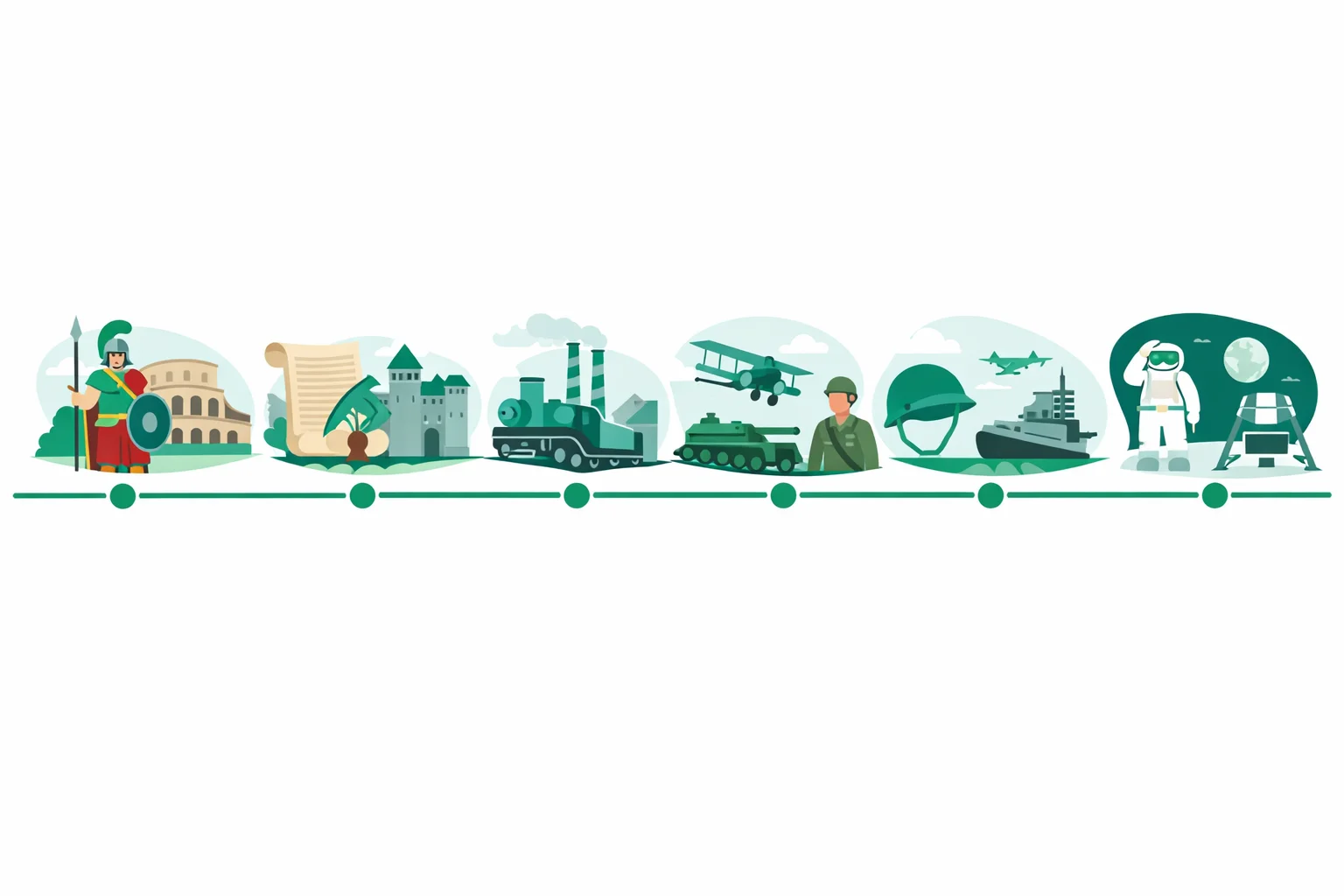
Five bands, drawn where the historiography actually breaks rather than at round numbers. Every question carries a signed year, the set is served in strict chronological order, and your accuracy is reported per band rather than as one average that hides everything interesting.
| Era band | Years | What sits in it | Where scores usually drop |
|---|---|---|---|
| 🏛️ Ancient World | before 500 CE | Sumer, Marathon, the Qin unification, Caesar, 476 | Anything non-Western — the China question is the usual casualty |
| 🛡️ Medieval | 500 – 1500 | The Hijra, Hastings, Magna Carta, the Black Death, Constantinople | Anything that is not English |
| ⚓ Early Modern | 1500 – 1800 | Luther, Magellan, Copernicus, 1776, the Bastille | Causes rather than dates — the Tea Act question is brutal here |
| ⚙️ Industry & World Wars | 1800 – 1945 | Waterloo, Fort Sumter, 1914, Pearl Harbor | The gap between 1815 and 1861, which nobody teaches slowly |
| 🚀 Postwar & Modern | 1945 – today | Partition, Cuba 1962, Brown v. Board, 1991 | Decolonisation outside the US and Europe |
The chart then does one more calculation. It takes your oldest band and your newest band, adds them together, and compares that against everything in between. A gap of 15 points or more in favour of the bookends is the textbook curve and is where most people land. A gap under 15 either way is a flat curve, which fewer than one player in five produces and which almost always means someone has read history rather than merely sat through it. A middle that beats the bookends is an inverted curve, and it usually belongs to someone who went deep on one period and let the ends fend for themselves.
World, US, or Both — Which Track Should You Take?
The three tracks are not difficulty settings, they are different samples of time, and they produce genuinely different charts.
World History runs 25 questions from roughly 3100 BCE to 1991, split 5 / 5 / 5 / 6 / 4 across the bands. It is the widest spread available and the gentlest on the middle, because the medieval and early modern questions are the famous ones. If your goal is one number that reflects general historical literacy, this is the honest version of "general."
US History starts at Jamestown in 1607, which means the Ancient and Medieval bands are empty and the chart shows three bars instead of five. That is not a bug worth hiding — a US-only timeline covering 400 years in 25 questions is roughly twelve times denser than the world track covering 5,000. The split is 8 colonial and founding, 9 across 1800–1945, and 8 postwar. Most people, Americans included, lose the middle here: 1877 to 1941 is a stretch that school curricula sprint through on the way to something else. If the colonial band is where yours falls apart, the 13 Colonies Quiz covers that stretch at far higher resolution.
The Full Sweep draws 13 world questions and 12 US ones, sorted into a single chronological line from Sumer to 2008, and adds a world-versus-US split to the result screen. That split is the one number the other two tracks cannot give you, and it is frequently uncomfortable. Plenty of American players clear 80% on their own history and land under 50% on everyone else's.
The Four Questions That Catch Nearly Everyone
Four items on this quiz have something in common: the date is easy and the fact underneath it is counterintuitive, so knowing the date confidently is exactly what makes people pick wrong.
The Boston Tea Party, 1773. The Tea Act made tea cheaper. It let the East India Company ship directly to the colonies and undercut everyone, including the smugglers. The protest was never about price — paying a lower duty still conceded Parliament's right to levy it, and the same act handed one company a monopoly that put colonial merchants out of the trade.
The Emancipation Proclamation, 1863. It applied only to territory then in rebellion. The loyal border states and Union-occupied areas were deliberately exempt — which is to say it freed almost nobody Lincoln could actually reach on the day it took effect. Slavery ended nationwide with the 13th Amendment in December 1865, two and a half years later.
The Bastille, 1789. Seven prisoners were inside: four forgers, two men declared insane, and one aristocrat. It was not a prison break. The crowd wanted the gunpowder in the vaults, and the fortress mattered as a symbol precisely because it was so nearly empty. That same autumn produced a quieter export: deputies in the National Assembly took to sitting on opposite sides of the chamber, which is where the words left and right come from and why our political typology quiz has to add a second axis to say anything the 1789 seating plan could not.
The fall of Rome, 476. Nobody alive in 476 believed an empire had ended. Odoacer deposed a teenage emperor and simply did not appoint a successor; the eastern half carried on for another 977 years until Constantinople fell in 1453. The date is a convenience invented by later historians, which is why the honest version of that question uses the word "traditionally."
Here's the Trick That Actually Moves Your Score
It is not flashcards. Flashcards store dates as isolated facts, and isolated facts are exactly what a serial position curve eats first. What works is anchoring: memorise eight dates properly, then place everything else by its distance from the nearest anchor.
The eight worth having are 476, 1066, 1492, 1517, 1776, 1815, 1914 and 1945. Try it on the French Revolution. It is thirteen years after 1776 and twenty-six years before Waterloo — which is not just a location on a line, it is the causal story arriving with the date. The American war drained the French treasury; the revolution that followed produced the general who lost at Waterloo. Anchoring gives you the sequence and the argument in the same move, which is the thing Hirsch and Wineburg were arguing about and, quietly, the thing they were both half right about.
The second half of the trick is timing. Retaking this quiz ten minutes after your first go measures your memory of the feedback screens, nothing more. Leave it ten to fourteen days and the same 25 questions become a real test of what stuck — the interval where spaced retrieval does its actual work. Come back on a different track and you get a second, independent sample of the same timeline.
All Six History Quiz Ranks, Explained
🏆 Historiographer (24–25). A near-perfect run on a set built to punish narrow expertise, and it does not happen by accident. Scoring here means you cleared at least one of the counterintuitive items, so you are holding causes rather than reciting dates. Roughly 3% of players finish here, and their remaining gaps are almost always geographic rather than chronological.
📜 Archivist (21–23). Fluent reading across every era band, which is harder than a high score in any single one. What keeps this band out of the top is consistently the same small set of trap questions where the easy date hides the awkward fact. About 9% of players land here and most of them lose exactly two or three points to the same four items.
🕰️ Chronicler (17–20). Four of the five bands cleared, with losses that form a pattern rather than scatter. The pattern is worth more than the score: one band is dragging the average, and it is nearly always a stretch of time that got taught quickly and never revisited. Around 21% of players finish in this band.
🗿 Enthusiast (13–16). The most common landing zone, and it usually means strong bookends with a soft middle. The ancient set pieces and the recent decades are there; the centuries between them are where answers stopped arriving. That is a shape rather than a deficit, and it is the most fixable shape on this chart.
🧭 Wanderer (9–12). The timeline outran you somewhere and the era chart names the spot. Players in this band typically answer their weakest era's questions faster than the rest, which is the reliable tell of a guess rather than a recall attempt. Slowing down in that one band is worth three or four points on the retake.
🌱 Time Traveller in Training (0–8). A score here almost always means the set is sampling centuries you were never taught, not centuries you forgot — a completely different problem with a much easier fix. Reading the fact under each answer instead of tapping through moves most players in this band up a full rank within a fortnight.
What to Do With the Chart
Take the trough, not the whole timeline. The instinct after a middling score is to go and revise history in general, which is a project nobody finishes. Your weakest band is a window of a few hundred years with maybe six or eight events that matter — one decent long-form article or one documentary covers it, and the band moves.
Then come back in a fortnight on a different track. If the trough sits in the same place on a fresh sample of questions, it is real and worth reading about. If it moves, the first result was noise, and you have just learned something about your own guessing rather than about the past. There is also a cheaper diagnostic worth running: history is one of six subjects in our General Knowledge Quiz, and comparing the two scores tells you whether you have a history problem or a recall problem. Those need opposite fixes. And if the era that sagged was the most recent one, that is worth taking seriously rather than shrugging off — the last twenty years are the stretch people assume they know because they lived through it. Our weekly news quiz tests exactly that band, and it is the rare quiz where living through the events turns out to be almost no advantage at all. And once the trough is patched, history becomes trivia's most bankable subject: it anchors a full column on our Jeopardy-style quiz, where sweeping History's Headlines is worth $3,000 of board money before the wagers even start.
One last thought, since the era chart tends to provoke it. The curve is not a verdict on your education. It is a description of how memory prices information — beginnings and endings are cheap to store, middles are expensive, and nothing about that is going to change. What can change is which middle you decide is worth the price.