Jeopardy Quiz: The Scandal That Invented Answer-First Trivia
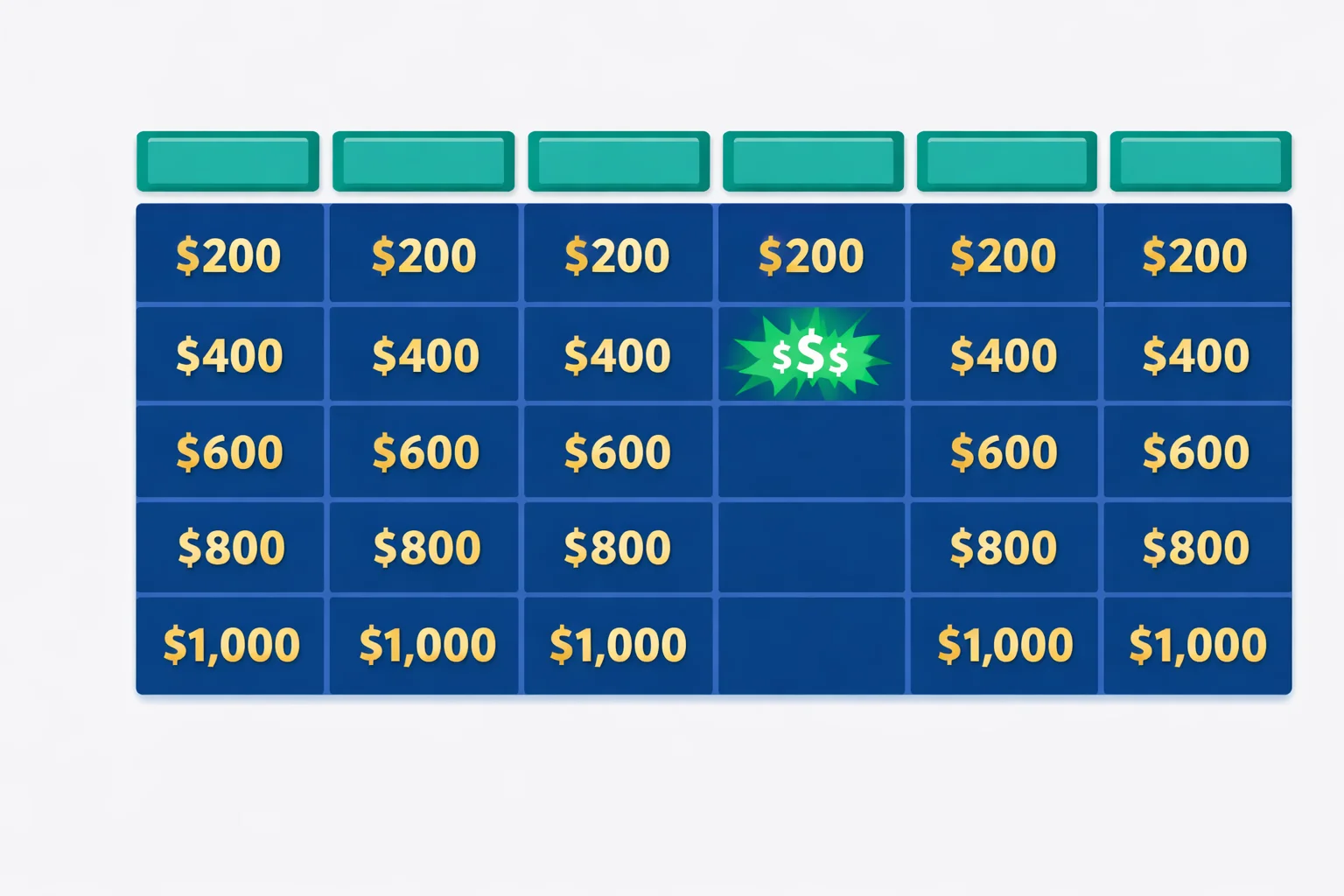
A Jeopardy quiz has a strange birth certificate: the answer-first format was invented at 30,000 feet in 1963, specifically to make cheating impossible. That detail changes how you should think about the game you just played. The board above — six categories, thirty clues, two hidden Daily Doubles, one final wager — isn't a trivia gimmick. It's a piece of anti-fraud engineering that accidentally became the best knowledge test on television, and its history explains almost every rule that just cost you (or won you) money.
The Scandal That Invented Answer-First Trivia
In the late 1950s, American quiz shows were caught rigging games on a massive scale. Producers of Twenty-One fed champion Charles Van Doren answers in advance, coached his dramatic pauses, and scripted his losses — and when he confessed before Congress in 1959, the fallout took down an entire genre. Ratings collapsed, sponsors fled, and in 1960 Congress amended the Communications Act to make fixing a game show a federal crime.
Four years later, Merv Griffin was on a flight to New York, complaining to his wife Julann that networks wouldn't touch quiz formats anymore. Her reply became broadcasting legend: why not just give the contestants the answers? She tossed one out — "5,280" — and Griffin responded, "How many feet in a mile?" That inversion was the whole trick. If the answer is displayed to everyone at once, there's nothing secret left to leak. The scandal-proof quiz was born mid-flight, and NBC put it on the air in March 1964.
From $50 Clues to $131,127: Six Decades of the Board
The game you just played is recognizably the 1964 game — but the money and the strategy have transformed. Art Fleming hosted the original daytime run, where a top-row clue paid a whopping $10 and the best clue on the board was worth $50. The show died in 1975, then came back for good in 1984 with Alex Trebek and syndication money: $100 to $500 in the first round. On November 26, 2001, all clue values doubled to the $200–$1,000 range our board uses — a change with consequences nobody predicted, because bigger stakes made aggressive wagering mathematically worthwhile.
| Era | Top single-round clue | Signature moment |
|---|---|---|
| 1964–1975 (Art Fleming) | $50 | The scandal-proof format proves itself as a daytime staple |
| 1984–2001 (Alex Trebek) | $500 | Syndicated revival becomes an American evening ritual |
| 2001–2018 (values doubled) | $1,000 | Ken Jennings wins 74 straight games and $2.52 million in 2004 |
| 2019–present (the wagering era) | $1,000 | James Holzhauer sets the single-game record: $131,127 |
Two more milestones round out the timeline. In 2011, IBM's Watson beat Jennings and Brad Rutter in a televised exhibition — a moment computer scientists still cite as a turning point for language AI. And in 2021, Jennings crossed the podium to become the show's host, which has to be the best promotion in trivia history.
Why Does the Board Punish Wrong Answers?
Losing money on a miss feels cruel the first time it happens. It's actually the smartest rule in the game. Deducting the clue's value turns every buzz into a calibration test: the board isn't asking "do you know this?" so much as "do you know whether you know this?" Psychologists call that metacognition, and it's the skill that separates people who merely know facts from people who win with them.
Here's the math our quiz inherits. With four options, a blind guess wins 25% of the time and loses 75% of the time — an expected loss of half the clue's value on every random click. Guess blindly on a $1,000 clue and you're handing the board an average of $500. The break-even point is exactly 50% confidence, which gives you a rule you can actually use: answer when you're better than a coin flip, and let the clue expire in your head when you're not. Players who finish our board in the negative almost never lack knowledge — they lack a filter.
The Holzhauer Method: Bet Like a Bookmaker
In April 2019, a professional sports gambler from Las Vegas walked onto the set and broke the game's economy. James Holzhauer's innovation wasn't knowing more — plenty of champions knew as much — it was treating the board like a betting market. He started with the $1,000 row instead of the $200 row, building a bankroll early so that when he found a Daily Double, his "true Daily Double" all-in wager was worth thousands instead of hundreds. His single-game record of $131,127 still stands, and his 32-game total of $2,462,216 came in barely a third of the games Jennings needed for a similar sum.
The strategy transfers directly to this jeopardy quiz. Analyses of thousands of archived televised games show Daily Doubles hide overwhelmingly in the bottom three rows and almost never behind a top-row clue — which is why our two Daily Doubles only ever spawn in the $600 to $1,000 rows. If you want the Holzhauer experience, clear the high-value clues in your strongest categories first, then hunt the bottom rows with money already banked. An all-in wager when you're holding $4,000 is a different game than one when you're holding $600.
Here's What the Buzzer Never Tells You at Home
Every couch player believes they'd clean up in the studio, and the buzzer is why most of them are wrong. On the televised show, you can't ring in until the host finishes reading and a technician activates the signaling devices — buzz even a fraction early and you're locked out for about a quarter of a second, an eternity when three people know the answer. Champions consistently say the game is won on buzzer timing, not knowledge; contestants practice at home with pens and toilet-paper spools to groove the rhythm.
Our board deliberately has no buzzer and no shot clock, which means your score here is something the show can never measure: your knowledge ceiling. Think of it as lab conditions. A studio game would tax that score with reflexes, stage lights, and two opponents — so if you cleared $12,000 on this board, you have a champion's knowledge base and an untested thumb. There's one tax this board doesn't charge, though: every clue still hands you four options to recognize. To measure the ceiling with no scaffolding at all, our hard quiz makes you type 20 answers from cold memory.
Six Categories, Two Daily Doubles, One Final Wager
The six columns above weren't picked at random — they mirror the blend a real writers' room aims for: geography, hard science, wordplay, history, entertainment, and the show's beloved catch-all, Potpourri. Difficulty is calibrated by row, the way the show's writers do it: a $200 clue should be gettable by most adults at a dinner table, while a $1,000 clue should stump the whole table more often than not. If you want a version of this without categories or wagering, our general knowledge quiz runs 30 straight questions with instant scoring — and if History's Headlines was your strongest column, the history quiz digs five centuries deeper.
Wagering follows the show's actual rules: a Daily Double lets you risk up to $1,000 or your full total, whichever is greater. We diverge from television in exactly one place, and it's worth being honest about: the real show bars anyone with $0 or less from playing Final Jeopardy, while our board offers a $1,000 house stake instead. A solo game that ends on a lockout screen teaches nothing — a comeback wager at least teaches you how it feels to bet under pressure.
All 5 Jeopardy Quiz Results, from Couch to Champion
🏆 Tournament of Champions Material ($20,000+) is the rarest finish — roughly 2% of players. A perfect board with no wagers maxes out at $18,000, so this tier is mathematically impossible without winning Daily Doubles and betting boldly in the final. It signals broad knowledge plus champion-grade risk management.
📺 Returning Champion ($12,000–$19,999) represents a genuinely winning performance — a total in this range would take home the game on most televised nights. These players tend to miss only the $800–$1,000 rows and rarely go negative on guesses.
🎙️ Studio-Ready Contender ($6,000–$11,999) is where well-read players who haven't learned wager discipline usually land. The knowledge is there; the leaks are over-buzzing on half-known clues and timid Daily Double bets that waste strong categories.
📚 Promising Challenger ($1–$5,999) means you finished in the black, which most first-timers don't once deductions start stacking. The fastest fix isn't studying more facts — it's skipping clues below coin-flip confidence, which alone can double a total in this range.
🛋️ The Couch Commentator ($0 or below) is the tier that proves the format works. A negative score almost always reflects over-confidence, not ignorance — answering everything, the way you would shouting at the TV, where wrong answers cost nothing. One retake with a stricter filter usually jumps this player two tiers.
Turning Your Score Into a Study Plan
If you're serious, there's a real path from this board to the real one. The show's official Anytime Test is 50 fill-in questions at 15 seconds each, with a commonly cited passing bar around 35 — players who consistently clear $15,000 here should simply go take it. Below that, train your weakest column, not your strongest: your result screen names the category that cost you the most, and feeding it beats another lap of comfortable material. Fans have also archived hundreds of thousands of real clues from past episodes, which makes the show itself a free, bottomless practice bank — watch with a pen in hand and click it as your buzzer.
And when the answer-first format starts feeling natural, try its evil twin: the impossible quiz punishes exactly the quick, literal reading that Jeopardy rewards. Going back and forth between the two is the closest thing trivia has to cross-training.