Hard Quiz: The Toughest Trivia Questions and How to Expand Your Knowledge
Ask the internet for quiz questions hard enough to humble a table of know-it-alls and you'll walk straight into a fight. One camp insists difficulty means obscurity — deep-catalog facts, minor royals, capitals nobody visits. The other camp calls obscurity lazy. A truly hard quiz, they argue, is built almost entirely from facts you've already met; it just exploits the way your memory files them. The 20 questions above are our attempt to run that argument as an experiment on you personally. There's no multiple choice unless you spend a lifeline, and that one design decision — recall instead of recognition — does more damage to scores than any obscure fact ever could.
The Two Camps of Quiz Difficulty
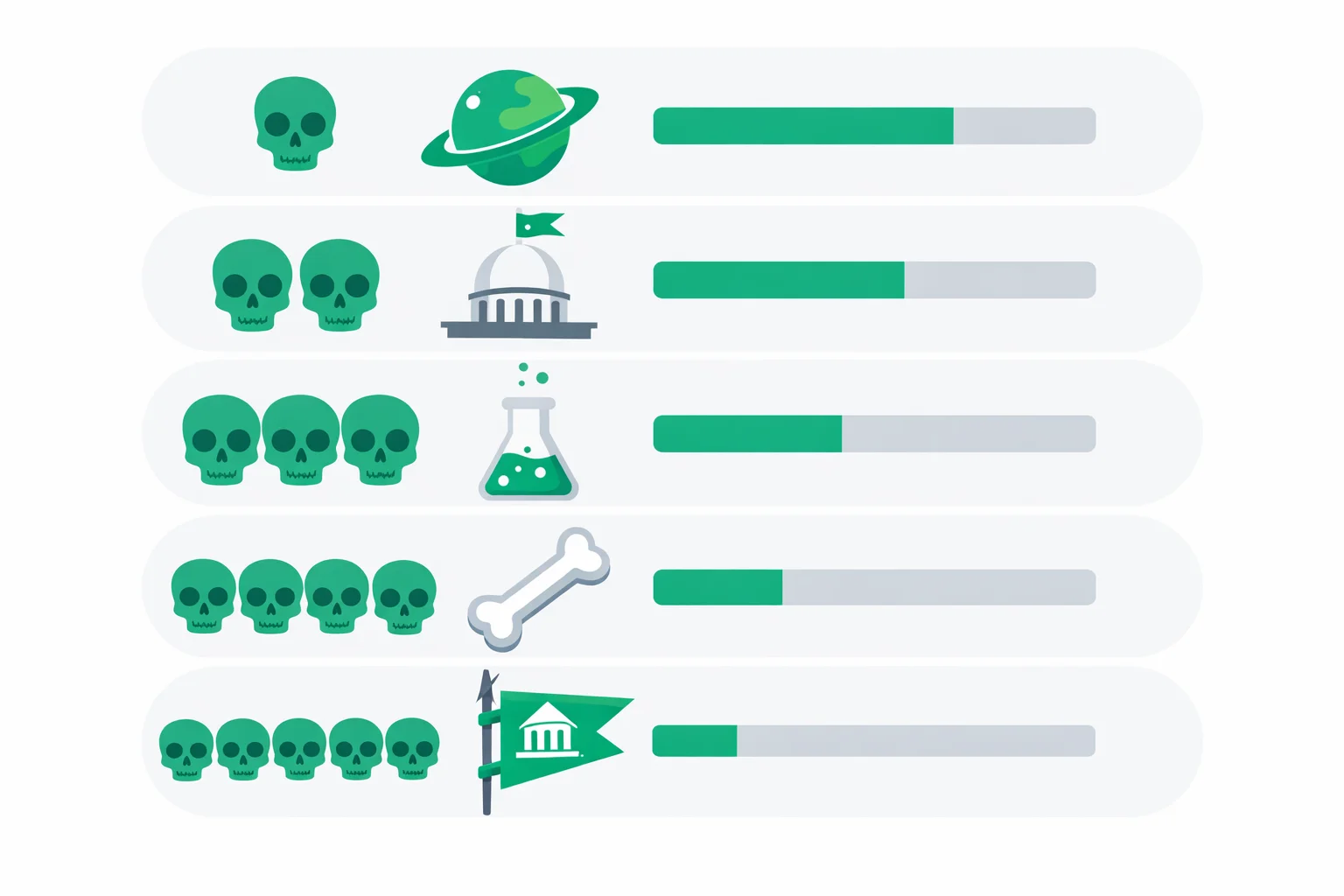
Camp Obscurity has real evidence on its side. At the top of competitive quizzing — think of the World Quizzing Championship's 240-question written paper — the only thing that separates elite players is coverage. Everyone at that level retrieves quickly; winners simply know more things. If you want a hard quiz to distinguish a 14-point player from an 18-point player, you need questions with single-digit answer rates, and those are obscure almost by definition. Our skull-five tier exists for exactly this reason: only around 7% of players can name the world's oldest continuously used national flag.
But Camp Design has the more interesting evidence: wrong answers cluster. When we ask for the capital of Australia, misses don't scatter randomly across Melbourne, Perth, and Brisbane — the overwhelming majority say Sydney. When wrong answers agree with each other, the question isn't probing rare knowledge; it's springing a trap that was built into how the fact was learned. The hottest-planet question goes further and baits the trap openly, mentioning that Mercury sits closest to the sun before asking the real question. Both camps are right, in other words — they're just describing different floors of the same building. (There's a third kind of difficulty neither camp claims: trick-reading quizzes where the wording itself is the puzzle. Different sport entirely.)
Your Brain Runs Two Retrieval Systems. We Used the Slower One.
In 1966, Endel Tulving and Zena Pearlstone had nearly a thousand students memorize categorized word lists, then split them for testing. Half had to recall the words cold; half were given the category names as cues. The cued group retrieved dramatically more — in some conditions close to double. Tulving's conclusion reshaped memory science: information can be available in memory yet not accessible without the right cue. The words weren't forgotten. They were filed where cold retrieval couldn't reach them.
A multiple-choice option is the most powerful retrieval cue ever put in front of a quiz player — the answer itself, sitting there, waiting to be recognized. That's why the same question can feel trivial with options and brutal without them, and it's why this hard quiz makes you type. Recognition measures what your brain stored. Recall measures what you can actually produce at a pub table, in an interview, mid-argument — which is the only version of knowledge anyone ever gets to use.
The Tip-of-the-Tongue State Has a Fingerprint
Somewhere in the gauntlet, you almost certainly hit it: the answer felt physically close, you could nearly taste the first syllable, and it would not come. Psychologists Roger Brown and David McNeill induced exactly this in a famous 1966 Harvard study by reading students definitions of rare words. When subjects fell into a tip-of-the-tongue state, they could still guess the word's first letter correctly about 57% of the time, and often its syllable count too. The memory wasn't gone — it was partially loaded, phonology first.
That fingerprint gives you a practical tool. Because partial sound information is live during tip-of-the-tongue, running through the alphabet works as self-cueing — players stuck on the smallest bone often unlock "stapes" the moment they hit S. It also explains the specific frustration this quiz produces: on reveal, you recognize the answer instantly. You did know it. You just couldn't reach it, which is precisely the gap between availability and accessibility that typing exposes.
Where Do the Stump Rates on Each Question Come From?
Every question in this hard quiz carries an estimated share of players who can produce the answer from memory, from 40% at the friendly end (Venus) down to 7% (Denmark's Dannebrog). Those rates are set for cue-free recall, which makes them far harsher than the numbers you may have seen on our general knowledge quiz, where 25 multiple-choice questions carry an expected score of 14.4 — about 58% correct. Here, the 20 rates sum to 474, so the expected score is roughly 4.7 out of 20. Same species of facts; the format alone cuts the expected result by more than half.
The lifeline math follows from that gap. Flipping a question open to four options moves it from recall to recognition, so a correct pick earns half a point rather than a full one — you solved an easier problem. And because three lifelines can add at most 1.5 points, they can't launder a middling run into the top tier. Reaching 14 means clearing nearly everything through skull tier three and landing several questions that fewer than 1 in 6 players get. That's what makes 14+ a genuine top-5% claim rather than marketing.
Everyone Misses the Same Way
Calibration research has a sobering track record on confidence: in a classic 1977 study, Baruch Fischhoff and colleagues found that answers people rated as absolute certainties still came back wrong roughly one time in five. Lure questions weaponize that. The miss doesn't feel like a gap in your knowledge — it feels like knowledge, right up until the reveal. Watch how the pattern repeats across this quiz:
| Question | The magnet wrong answer | Reality | Why memory serves the wrong fact |
|---|---|---|---|
| Capital of Australia | Sydney | Canberra | Fame substitutes for fact — the biggest city feels like the capital |
| Largest desert | The Sahara | Antarctica | "Desert" is stored next to sand, not precipitation |
| Tallest mountain, base to peak | Everest | Mauna Kea | The famous ranking overwrites the measurement in the question |
| Most abundant crust metal | Iron | Aluminium | A true fact about the core answers a question about the crust |
| Most time zones | Russia | France | Map size stands in for territory — overseas départements are invisible |
The largest-internal-organ question shows the mechanism at its cleanest. Most people have stored the headline "skin is the largest organ" — true! — but the qualifier internal never got filed with it. Memory keeps headlines and quietly drops fine print, and a well-designed hard question is simply one that asks about the fine print.
Rereading Feels Like Learning. Testing Is Learning.
If your recap list stung, the fix is counterintuitive. In 2006, Henry Roediger and Jeffrey Karpicke had students learn prose passages either by rereading them repeatedly or by repeatedly testing themselves. A week later, the self-testing group remembered substantially more — even though the rereaders had felt more confident and predicted better scores. This testing effect is one of the most replicated findings in learning science, and it means the quiz you just failed is a better teacher than the article you're now reading.
Two details make it work harder. First, errors followed by correction stick unusually well — which is why every miss above shows you the answer with a why, not just a red X. Second, spacing beats cramming: a retake next week strengthens retrieval far more than a retake in the next five minutes, because you'll be pulling the memory back across a genuine gap rather than echoing it.
All Five Hard Quiz Score Tiers
🪨 The Baseline (0–4). Where the arithmetic says most players land — about 55% of runs finish here, right around the expected 4.7. A Baseline score measures cue-free recall against questions built to resist it, not intelligence. The recap usually shows several answers that were recognized instantly on reveal, which is the most fixable kind of miss there is.
📈 Above the Curve (4.5–8). Clearing the expected score puts you ahead of the average player on the hardest format trivia offers. Players here typically sweep the first skull tier, trade blows through the second, and get stopped by the lure questions — the ones that feel easiest right before they miss.
🎯 Quiz-Night Closer (8.5–13.5). Roughly double expectation, reached by about 13% of players. Closers hold their recall through tier three, where stump rates fall below a quarter, and their misses shift from lures to genuine coverage gaps. If you landed here, the skull-five questions are what separate you from the tier the quiz is named for.
🏆 The Five Percent (14–17.5). The bragging-rights tier from the description above the quiz. Getting here requires surviving nearly the full gauntlet from memory, since lifelines can only contribute 1.5 points at most. Five Percent players tend to miss only among the single-digit questions — Grant's banknote, the Dannebrog, Richard's misquoted winter.
🧠 Recall Machine (18–20). Fewer than 1 in 100 runs end here, and a perfect 20 should be vanishingly rare — it means producing, unprompted, at least eighteen answers that most people can't retrieve with help. If this is you on a first attempt, competitive quizzing would genuinely like a word.
What to Do With Your Score
Treat your first run as the benchmark and your recap as a study list — the misses where you recognized the answer instantly are free points waiting a week out. When tip-of-the-tongue strikes on the retake, run the alphabet before spending a lifeline; letter cues resolve a surprising share of stalls. If the gauntlet bruised more than it flattered, recalibrate on our Are You Smarter Than a 5th Grader? quiz, where the floor is friendlier and the humbling is gentler. And if you cracked 14, send a friend your score with no further comment. The description at the top of this page promised bragging rights — consider them collected.