Are You Smarter Than a 5th Grader: Four Myths About Why Adults Fail Elementary Questions
Fail an are you smarter than a 5th grader quiz and the excuse writes itself: I knew this once, I just forgot it. A century of memory research says that is the wrong diagnosis — and the right one is far more interesting. Most of what vanished was never stored properly in the first place. You recognised it long enough to pass a Friday worksheet, and recognition and recall are not the same machine.
Below are the four explanations people reach for after a bad run, each one measured against what the evidence actually shows. Then the mechanics: how our 20-rung ladder is weighted, which five questions end the most runs, and what every grade band is really testing.
Myth 1: You Forgot It
Hermann Ebbinghaus mapped the forgetting curve in 1885 and it has been misquoted ever since. His nonsense syllables decayed brutally fast — but they were nonsense, learned once, with nothing attached. Real school knowledge behaves differently, and the person who proved it was Harry Bahrick.
In the early 1980s Bahrick tracked down more than seven hundred people who had studied Spanish in school anywhere from three to fifty years earlier and tested them. The decay was steep for the first three to six years — and then it simply stopped. People who had last seen a Spanish classroom in 1935 scored about the same as people who left in 1955. Bahrick called that flat residue the permastore: knowledge that crossed some threshold of over-learning and then stayed put for the rest of a life, without a single review.
That finding reframes the whole quiz. If you had genuinely learned that a mile is 5,280 feet, a chunk of it would still be there decades later. Nobody half-remembers 5,280. The number is either in the permastore or it never got in — and for most adults it never got in, because it was memorised for one test in 3rd grade and never used again. Question 12 is not measuring decay. It is measuring whether encoding ever happened.
Myth 2: Wasn't Fifth Grade Supposed to Be Easy?
It looks easy from the outside because you recognise every word in the question. The children sitting in the room disagree. On the 2022 National Assessment of Educational Progress, only about 36% of US fourth graders scored at or above Proficient in mathematics, and roughly a third did in reading. This material is not trivially easy for anyone. It is only easy for the small group actively rehearsing it that week.
And the curriculum turns abstract faster than adults remember. First grade counts sides on a hexagon. By fourth grade you are adding fractions with unlike denominators — our question 13 — which requires holding two conversions in working memory at once. By fifth you are separating a simile from a metaphor and knowing that potassium's symbol comes out of Latin rather than English. Those are not baby questions dressed up. They are the exact point where school stops being about naming things and starts being about operating on them.
Myth 3: Here's Where the TV Show Gets Blamed Unfairly
The complaint after every televised humiliation was the same: those were trick questions. They were not. Are You Smarter Than a 5th Grader? premiered on Fox on 27 February 2007 with Jeff Foxworthy hosting, and its questions were pulled straight from grade-level standards — ten of them, two subjects per grade, first through fifth. The cheats were Peek, Copy and Save, which is where the three on this page come from. Quit at any point and you had to look into the camera and say the line.
What broke contestants was never the difficulty. It was the format. A studio audience, a host waiting, and an answer you had to produce rather than pick off a page. Recall under social pressure is a different cognitive task from recognition in private, which is why people who blanked on air could recite the answer in the parking lot ten minutes later.
One person beat it. Kathy Cox, then Georgia's State Superintendent of Schools, took the full million in 2007 and gave away every dollar of it — split between the Georgia School for the Deaf, the Georgia Academy for the Blind and a school for children with disabilities. On a show built entirely around adults being publicly humbled by elementary curriculum, the one person who conquered it ran a state school system. That is either the most predictable outcome imaginable or the most damning one.
Myth 4: The One Nobody Wants to Hear
In 2002 two Yale researchers, Leonid Rozenblit and Frank Keil, asked people to rate how well they understood everyday objects — a zipper, a flush toilet, a bicycle. Ratings were confident. Then they asked those same people to write a step-by-step explanation of how the thing actually works. Ratings collapsed. They named it the illusion of explanatory depth: familiarity with a topic gets mistaken for knowledge of it.
That is the quiet engine behind almost every miss on this quiz. You have read the word "perimeter" ten thousand times. The fluency of the word feels like command of the concept, right up to the moment somebody hands you an 8-by-3 rectangle and 24 comes out of your mouth. The uncomfortable version of myth four is not that adults are out of practice. It is that adults are systematically overconfident about material they have never once been asked to retrieve since childhood. For a different practice format, try the reasoning quiz and read its worked answers; it reports a raw score for the question set.
Why the Safe Haven Sits at Question 12
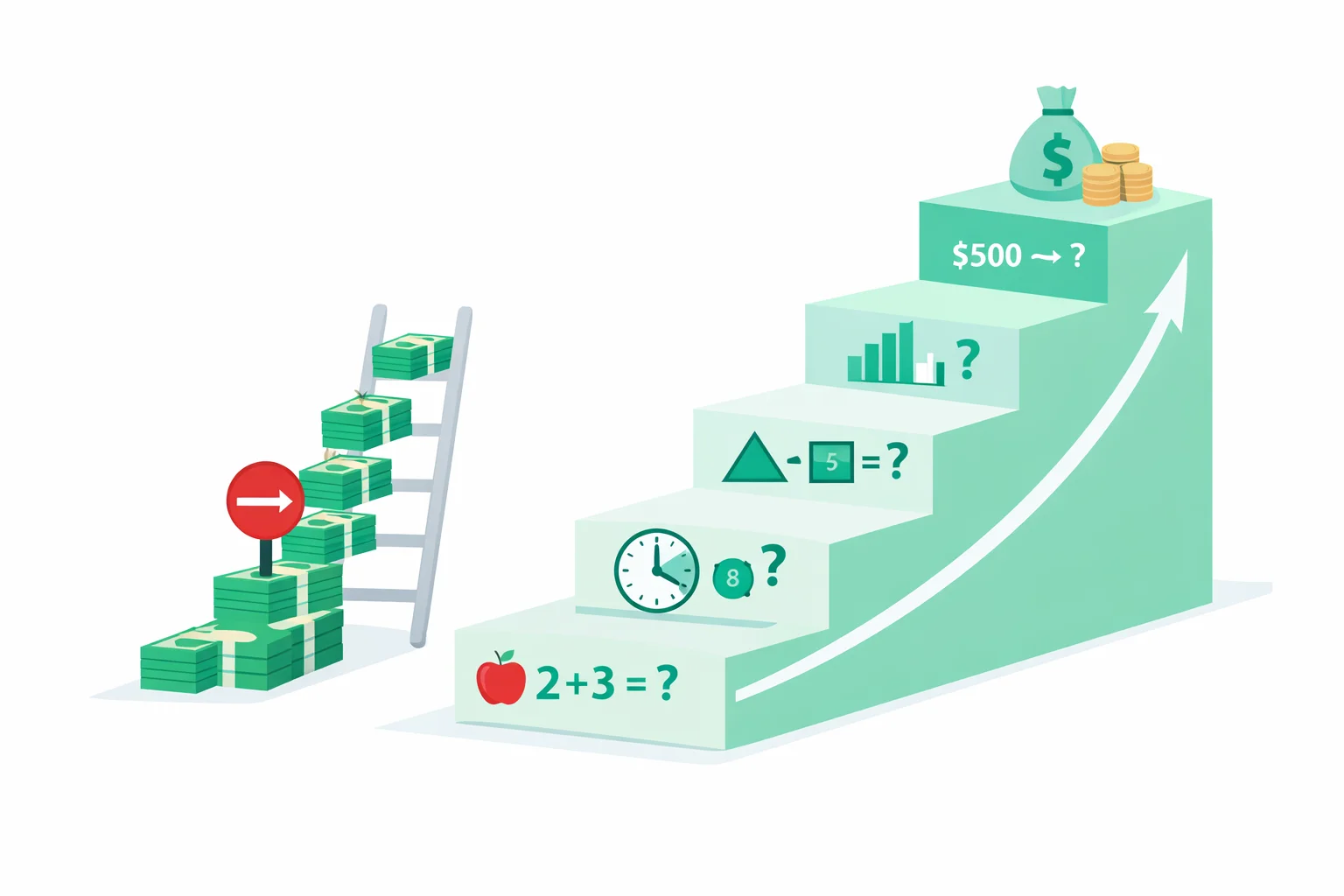
Twenty rungs, four per grade, climbing from $1,000 to $1,000,000. Every question is filed under a real grade band, and the money curve is deliberately gentle early and steep late so the decision to walk gets genuinely painful around the 4th grade band.
The safe haven sits at question 12 for a specific reason. Questions 9 through 12 are the last band that is pure recall — feet in a mile, the first resident of the White House, vertebrate versus invertebrate, perimeter. There is no reasoning path to any of them. You either kept the fact or you did not, so putting the haven at the top of that band rewards storage rather than cleverness. From question 13 onward every item becomes an operation you can work out: convert fractions to twelfths, apply the possessive rule, take 10% and halve it.
Maya, your 5th grade classmate, is right on 17 of the 20 questions. She is deliberately wrong on three of them — the perimeter question, the Australian capital and the potassium symbol — because a classmate who is always right turns Copy into a free pass and destroys the whole tension of the format. Peek shows you her answer and leaves the choice with you. Copy locks it in blind. Save is the honest one: it keeps your money alive after a miss, but the question still counts as missed, so a band containing a Save can never register as cleared. Your winnings and your grade level are measuring two different things, and only one of them is the real answer.
One rule is borrowed straight from the show: all three cheats sit out the final question. The million has to be earned alone, which means the 5th grade band is the only stretch of the ladder where a wrong answer has nothing standing behind it except the safe haven twelve rungs below.
What Each Grade Band Actually Covers
Every band on this ladder pulls four subjects, and each one decays for its own reason. The pattern is more consistent than you would expect:
| Band | Subjects on this quiz | The item adults miss most | Why it decays |
|---|---|---|---|
| 1st Grade | Math · Science · Social Studies · Spelling | Stripes on the US flag | The star count overwrites the stripe count — 50 is the number you see quoted |
| 2nd Grade | Math · Science · Geography · Grammar | Place value of the 4 in 3,472 | Adults perform place value constantly and never have to name it |
| 3rd Grade | Math · Science · US History · Measurement | First president to live in the White House | Washington is the default answer to every early-America question |
| 4th Grade | Math · Grammar · Anatomy · Geography | Adding 1/4 and 1/3 | Fraction arithmetic is the first skill a calculator fully replaces |
| 5th Grade | Math · Chemistry · Civics · Language Arts | Chemical symbol for potassium | K breaks the first-letter rule the rest of the periodic table taught you |
Notice what is missing from that table: nothing decays because it was hard. Every item on it fell out for a structural reason — an overwriting fact, a missing label, a default answer, a tool that took over, or a rule with an exception. That is also why the 3rd grade band statistically ends more runs than the 4th, despite being a full grade easier on paper.
The Five Questions That End Most Runs
These five are not the hardest questions on the ladder. They are the ones where the wrong answer is more attractive than the right one, which is a different and much more dangerous property.
Question 9 — perimeter versus area. An 8-by-3 rectangle has a perimeter of 22 and an area of 24, and 24 wins the popular vote. Both words were taught in the same week of 3rd grade and filed in the same drawer, so whichever surfaces first gets spoken.
Question 11 — the White House. George Washington is the availability heuristic in human form. He picked the site, he supervised the build, he died in 1799, and John Adams moved in during November 1800. Washington is the only president who never lived there — a fact that reliably surprises people who could name all forty-odd of his successors in our presidents quiz.
Question 12 — feet in a mile. The trap is 1,760, which is correct for yards. Two units, one memorised number, and no way to reason your way out. The 5,280 comes from a 1593 Act of Parliament forcing the Roman mile of a thousand paces to line up with eight English furlongs.
Question 16 — the capital of Australia. Sydney is the recency winner: bigger, more photographed, and the host of an Olympics. Canberra exists precisely because Sydney and Melbourne could not agree, so in 1908 the country picked farmland between them and built a capital. Capitals that lose out to a more famous city are a whole category, and our world capitals quiz is mostly made of them.
Question 18 — potassium. Every other symbol you learned rewarded the first-letter heuristic. K comes from the Latin kalium, and the three decoys are all genuine elements — phosphorus, polonium, platinum — so nothing about the option list feels wrong until it is too late.
All 6 Grade-Level Results Explained
Your grade level is not your score. It is the highest band you cleared with an unbroken run beneath it, so a single miss in 1st grade caps you no matter how well you handle 5th.
🧸 Kindergarten — the run ended inside the 1st grade band. This almost never means the material was too hard; it means a decoy worked. Hexagon and octagon, penguin and dolphin, thirteen stripes and fifty stars: each pair lives in the same mental neighbourhood, and under any pressure at all the wrong twin arrives first.
🖍️ 1st Grade — you cleared shapes and animals and stalled in 2nd, the band where questions stop asking what a thing is and start asking what it is called. Place value, adverbs, metamorphosis. You use all three concepts weekly and name none of them, so the deficit here is vocabulary rather than understanding — which our vocabulary quiz measures directly, in words rather than grade levels.
✏️ 2nd Grade — two bands banked and out in 3rd, which is the cruellest stretch on the ladder because it is pure storage with nothing to reason from. This is exactly why the safe haven sits at the top of it rather than the bottom.
📗 3rd Grade — you reached the safe haven, which puts you ahead of most adult runs and means recall did not beat you. Twelve straight includes the three questions that finish more runs than anything else here. Fourth grade is where it came apart, and 4th is where facts turn into operations.
🧪 4th Grade — sixteen questions is a genuinely strong result. You added unlike fractions without a calculator, applied the apostrophe rule English breaks on purpose, and knew the largest organ is the one you are wearing. Fifth grade got you, and it usually gets people on the two items adult life never refreshes: potassium's Latin symbol and the count of the Bill of Rights.
🎓 5th Grade — twenty for twenty, and you never have to say the line. What this actually demonstrates is rarer than it sounds. Elementary knowledge is the first thing to decay because nothing in adult life reinforces it, so a clean sheet means you either kept using this material or you over-learned it hard enough at ten years old that Bahrick's permastore took it and never gave it back.
Getting the Facts Back Is a Two-Week Job
The instinct after a bad run is to reread the answer key, nod, and feel restored. Henry Roediger and Jeffrey Karpicke demolished that instinct in 2006: students who were tested on material retained dramatically more a week later than students who simply restudied it, even though the restudy group felt more confident at the time. Rereading produces the feeling of learning without the thing itself.
So do the opposite. Take the five items you missed and write each one as a question, not a statement — "how many feet in a mile?" rather than "a mile is 5,280 feet." Then close the page for ten days and retake this quiz cold. The gap is the active ingredient; retaking it ten minutes later measures your short-term memory and nothing else. If you want a harder rematch in the meantime, the general knowledge quiz runs the same recall test on adult material, and the GED practice quiz is what this curriculum turns into once it grows up. If it was the Math band that ended your run, the math quiz has a Warm-Up level pitched at exactly this curriculum, and it tells you which of seven specific errors you keep making. And if the Social Studies band was where you came apart, the Bible quiz tests the same childhood-taught material that decays the same way — most adults still have the Sunday school layer intact and almost nothing above it.
And there is a version of this quiz worth playing that has nothing to do with the score. Hand it to a 10-year-old, take it beside them, and watch which bands each of you owns. They will beat you through 3rd grade on raw freshness. You will take 5th on general knowledge you picked up long after school ended. Neither of you is smarter. You are just storing different decades.