Bible Quiz: The Long Road From 66 Scrolls to the Book You Were Just Tested On
Every bible quiz carries a hidden assumption that almost nobody examines: that the Bible is a book. It isn't, and the name says so. The word comes through Latin from the Greek ta biblia — "the books," plural — and that plural does an enormous amount of work. Sixty-six separate documents. Three languages. Law codes, war chronicles, love poetry, courtroom speeches, personal mail, and one very strange piece of apocalyptic vision. By traditional reckoning, about fifteen centuries of writing separate the first line of Genesis from the last line of Revelation.
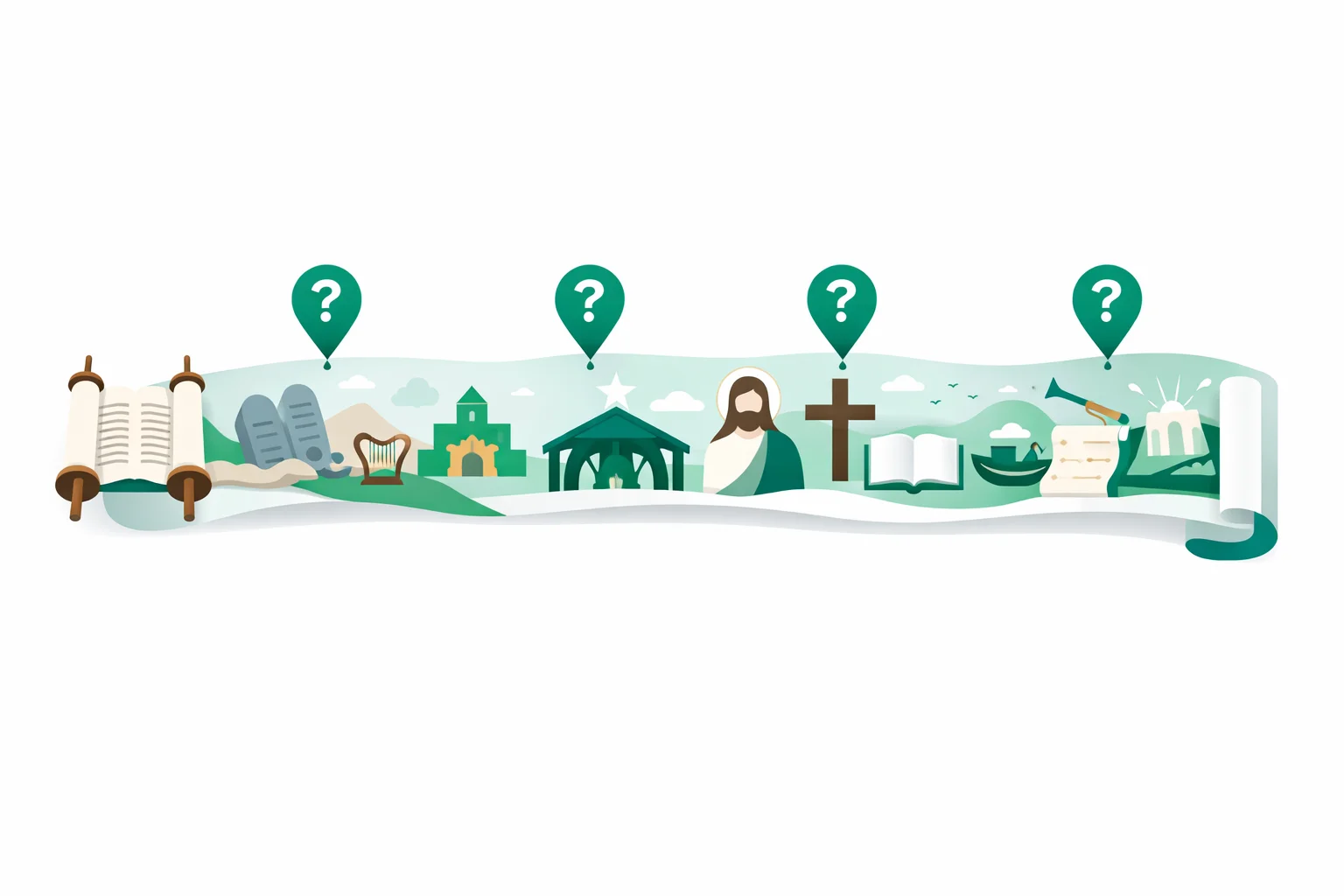
That is the actual shape of the thing you just walked through, one section at a time. And it explains the single most predictable pattern in the results: hardly anyone scores evenly across it. The canon strip on your result screen almost always shows bright blocks at the start and around the Gospels, with a grey trough somewhere in the prophets and another in the letters. That isn't a knowledge failure. It's a history lesson about how the collection was assembled and which parts of it the last two thousand years chose to repeat.
Nobody Sat Down and Wrote the Bible
There was no editorial meeting. No founding committee picked sixty-six manuscripts off a shelf and stamped them. What happened instead was slower and much messier: communities used certain scrolls, argued about others, and gradually stopped arguing.
For the Hebrew Scriptures, the Torah settled first, the Prophets next, and the Writings — the section holding Psalms, Job, Esther and Daniel — stayed contested longest. You may have read that a Council of Jamnia closed the Jewish canon around AD 90. That idea was popular for most of the twentieth century and has since been largely abandoned; the evidence for a formal canon-closing council there is thin to nonexistent. The Dead Sea Scrolls, found at Qumran in 1947, complicated the picture further by showing multiple text versions circulating side by side, including a copy of Isaiah roughly a thousand years older than anything previously known.
The New Testament took even longer to settle, and the first surviving list that names exactly the twenty-seven books we now have — no more, no fewer — is a festal letter written by Athanasius of Alexandria in AD 367. Regional councils at Hippo in 393 and Carthage in 397 endorsed the same list. That is more than three centuries after the events the Gospels describe. Question 23 above, on how many letters bear Paul's name, is really a question about that process, which is exactly why so few people get it.
It is worth sitting with how normal this is for ancient literature. The Greek myths went through something similar — centuries of oral circulation before anyone fixed them in writing, then centuries more of editing and selection. If you enjoyed the canon-history side of this quiz, the Greek mythology quiz tests the other great body of ancient stories that shaped Western vocabulary and art.
Why Does Your Bible Have 66 Books and Your Neighbour's 73?
Walk into three churches and you can find three different Bibles, and none of them is wrong. The differences are entirely in the Old Testament, and they trace back to whether a tradition followed the Hebrew collection or the Greek Septuagint, which carried extra books.
| Tradition | Books | What's different |
|---|---|---|
| Protestant | 66 | Follows the Hebrew Old Testament; the extra Greek books are set aside as Apocrypha |
| Roman Catholic | 73 | Adds seven deuterocanonical books — Tobit, Judith, Wisdom, Sirach, Baruch, 1 and 2 Maccabees — plus additions to Esther and Daniel |
| Eastern Orthodox | Around 76–79 | Includes the Catholic additions plus texts such as 3 Maccabees and Psalm 151 |
| Ethiopian Orthodox Tewahedo | 81 | The broadest canon in use, including Enoch and Jubilees |
The Protestant boundary hardened during the Reformation, and Rome responded formally at the Council of Trent in 1546 by affirming the longer list. Note the direction of travel: the shorter canon is the newer decision, not the older one. That surprises people who assume 66 is the original number.
The quiz above deliberately stays inside the 66 books shared by every one of those traditions. Not a single question depends on Tobit or Maccabees. If you would like a deeper reading of how these lists were formed, the overview of the biblical canon is a reasonable starting point.
Chapter and Verse Are Younger Than the Printing Press
Here is a fact that reliably startles people who have quoted "John 3:16" their entire lives: for most of its existence, the Bible had no chapter numbers and no verse numbers. The text ran on. Finding a passage meant knowing roughly where it lived.
The chapter divisions almost everyone now uses are credited to Stephen Langton, Archbishop of Canterbury, working around 1227. Verses came much later still. Robert Estienne, a Paris printer, numbered the verses of the Greek New Testament in 1551 and finished the whole Bible in the following years. His son claimed he did the work while travelling on horseback, which — if you have ever wondered why a verse break occasionally lands mid-sentence — is at least an entertaining explanation.
Gutenberg printed his Bible around 1455, nearly a century before Estienne's verses. So the printing press predates the reference system that makes the printed Bible searchable. That ordering matters for a quiz. Every feedback panel above gave you a citation because the citation is the useful part — a score tells you a number, but "Exodus 10:21" tells you where to go and read.
The Whale That Was Never a Whale
Question 10 catches almost nobody out, but it catches out a surprising number of the people who think they know it best. Jonah 1:17 says a great fish — dag gadol in Hebrew. There is no whale. The whale arrives via the Greek ketos in Matthew 12:40, a word meaning any large sea creature, and then via a thousand years of artists picking the biggest animal in the ocean.
Once you start looking, the Bible most people carry in their heads is full of these.
- The apple in Eden. Genesis says fruit and never specifies which. The apple is widely traced to a Latin pun — malum meaning both apple and evil.
- Lucifer as a name for Satan. In Isaiah 14:12 the Latin lucifer, "light-bringer," translates a Hebrew phrase in a taunt addressed to the king of Babylon.
- Three wise men. Matthew 2 names three gifts and never counts the visitors.
- Money is the root of all evil. 1 Timothy 6:10 says the love of money, which is a different claim entirely.
None of these are translator errors exactly. They are compression — the way a long text gets summarised, illustrated and retold until the summary becomes the memory. That process is worth understanding, because it is the same one that shapes what you scored above.
Here's Where Almost Every Score Splits
The testament balance meter on the result screen exists because the gap it measures is so consistent. The Old Testament is roughly three quarters of the Bible by length and gets a fraction of the airtime. Most people meet it through a handful of narrative highlights — creation, Noah, Abraham, Moses, David, Jonah, Daniel — and never touch the prophetic books that make up a huge share of its actual pages.
Survey data backs this up in a way that is genuinely humbling. Pew Research Center's U.S. Religious Knowledge Survey found that fewer than half of American adults could name all four Gospels, and that respondents frequently misattributed core teachings to the wrong testament altogether. If you scored well above the middle bands here, you are already unusual.
The uneven-knowledge pattern isn't unique to Scripture, incidentally. It shows up any time a large body of facts gets taught in fragments — the same effect that makes people strong on geography and weak on the arts in our general knowledge quiz, where every question carries its own difficulty rating.
The Five Questions That Wreck the Most Scores
These five account for the majority of the gap between a mid-teens score and a twenty-plus one. Every one of them is structural — about how the Bible was made, not what it says.
- Question 25 — the shortest New Testament book. Most people answer 2 John. By verse count they're right; by word count in the Greek, 3 John is shorter at roughly 219 words to 245. The question specifies word count.
- Question 23 — how many letters name Paul. Thirteen. Fourteen if you count Hebrews, which is anonymous. Seven are undisputed by scholars. Three plausible numbers, one correct one.
- Question 13 — the most-quoted prophet. Isaiah, comfortably. Jeremiah is longer and Daniel is more dramatic, which is why they draw the wrong votes.
- Question 5 — which Torah book is named for a census. Numbers. The Hebrew title, Bemidbar, means "in the wilderness," and readers who know the content rather than the naming convention often talk themselves out of it.
- Question 17 — the earliest Gospel. Mark. Matthew comes first in the printed order, which is the entire reason this question works.
Why the Stories Stick and the Letters Don't
There is a solid reason your Genesis blocks are lit up and your Romans blocks probably aren't, and it has nothing to do with piety. Narrative is simply easier to remember than argument.
Frederic Bartlett demonstrated the mechanism in his 1932 book Remembering, where he had British participants recall a Native American folk tale called "The War of the Ghosts" over increasing intervals. They didn't just forget parts — they reconstructed the story, smoothing unfamiliar details into shapes that matched their own expectations. Memory turned out to be reconstructive rather than a recording. Narrative survives that process well because it has causal structure to hang on: this happened, therefore that happened.
Paul's letters have almost none of that scaffolding. They are arguments, addressed to specific disputes in specific towns, often responding to letters we no longer possess. Take away the causal chain and you take away the handholds. It is the same reason people can retell the plot of a film years later but not summarise an essay they read last month.
The practical implication is encouraging: the sections you scored worst on aren't harder, they're just less story-shaped. Read them once with the context in place — who wrote it, to whom, about what fight — and retention improves sharply.
All 6 Score Bands Explained
Scores are grouped into six bands, and the boundaries sit where the question difficulty actually steps up rather than at round numbers.
📜 Scripture Scholar (23–25). The rarest result, at roughly 2% of players. Clearing 23 means answering questions about authorship, canon order and book length, which no amount of Sunday school covers. This band belongs to people who have read the whole collection, including the minor prophets, and who have looked into how it was assembled.
🕯️ Bible Study Leader (20–22). About 7% land here. You moved through the easier two thirds without stumbling and took at least a couple of the hardest items. The misses are almost always technical — a date, a word count, a scholarly consensus — rather than anything about the text itself.
📖 Faithful Reader (16–19). Around 18% of players. Stories are secure, famous chapters are correctly placed, and both testaments show real coverage. What caps this band is structural knowledge: which book came first, who wrote what, how the pieces were joined. That gap closes faster than any other.
⛪ Sunday School Graduate (12–15). The most common outcome at roughly 31%. The childhood layer is fully intact — Jericho, Bethlehem, the ark, the plagues — which says something remarkable about how durable narrative teaching is. What's missing is everything usually taught after about age twelve.
🌿 Familiar With the Stories (8–11). About 27%. This is the Bible as most of the Western world knows it: absorbed through film, art, idiom and half-remembered assemblies rather than through reading. Knowledge clusters tightly in Genesis, Exodus and the Gospels, and the canon strip shows that clustering with unsettling precision.
🌅 Starting the Journey (0–7). Roughly 15%. The set climbs quickly, so a low score reflects exposure far more than ability. It is also, oddly, the most useful score to get here — every miss came with a chapter and verse attached, so you leave with a specific reading list instead of a vague intention.
Read the Section You Scored Worst On — It's Shorter Than You Think
The "read this next" panel on your result isn't decoration. It picks the weakest of your six sections and names the shortest realistic entry point into it, because the biggest obstacle to filling a canon gap is the assumption that it takes months.
Weak on the letters? Philemon is one chapter — a single page about a runaway slave, and the fastest possible proof that these documents are real mail to real people. Weak on the prophets? Jonah is four chapters of pure narrative and about ten minutes, which teaches you how prophetic writing argues before you meet Ezekiel. Weak on the Gospels? Mark is sixteen chapters, roughly ninety minutes, and reading it in one sitting is the single most effective way to stop the four Gospels blurring into one composite story.
One more thing worth saying plainly, since bible quizzes rarely do. A score here measures recall of names, numbers and book order. It is not a measure of faith, practice or understanding, and anyone claiming otherwise is selling something. What it is good for is diagnosis — a map showing which quarter of a very large library you have never actually opened. Then, at four chapters or one, going and opening it.