Greek Mythology Quiz: Gods, Heroes, and Legends You Should Know
A Greek mythology quiz does something no textbook can — it forces you to actually recall what you know, not just nod along while reading. And that gap between "I think I know this" and "I definitely know this" is where the interesting stuff lives. Most people can name Zeus and Athena, maybe Poseidon if they've seen a Percy Jackson movie. But ask about Ouranos, the Judgement of Paris, or why Tantalus is stuck in a pool he can't drink from, and suddenly the confidence evaporates.
Why Greek Mythology Still Matters
These myths are over 2,700 years old, and they're still everywhere. The word "narcissist" comes from Narcissus, who drowned staring at his own reflection. "Tantalize" comes from Tantalus, punished with food and water he could never reach. "Odyssey" means any long, difficult journey — straight from Odysseus's ten-year trip home from Troy.
But it goes deeper than vocabulary. The 2019 study by classicist Emily Katz Anhalt at Sarah Lawrence College argued that Greek myths functioned as ancient Greece's "thought experiments" — fictional scenarios designed to test moral and political ideas. When Homer wrote about Achilles choosing a short, glorious life over a long, quiet one, he wasn't just telling a story. He was asking the audience: what would you choose? That's why these myths feel relevant — they aren't answers, they're questions.
Greek myth also isn't the only ancient story collection doing that job in Western culture. The other one travelled the same road — centuries of oral retelling, then gradual written fixing, then arguments about which texts belonged. Our Bible quiz walks that canon from Genesis to Revelation and shows exactly where most people's knowledge of it runs out.
There's a third branch worth knowing about, and it's the reason a lot of readers arrive at Greek myth in the first place. Tolkien was a professional philologist who found the Greek and Norse material second-hand and decided England needed its own — so he built one, languages first. If you want to see how a modern mythology borrows the machinery of an ancient one, the Lord of the Rings race quiz breaks down how he assembled the peoples of Middle-earth and which bits he lifted wholesale.
The Twelve Olympians and Their Domains
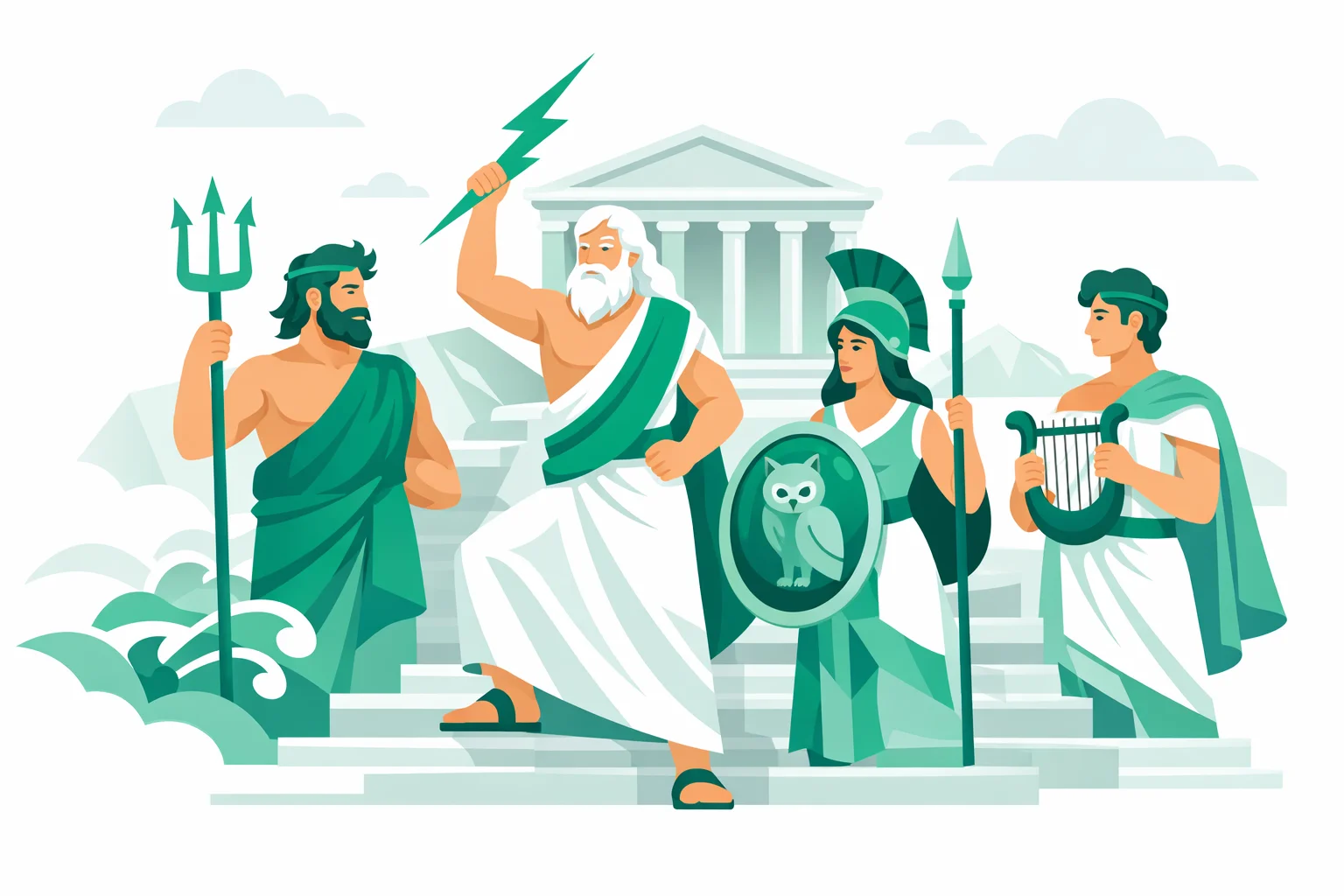
The Olympians weren't just powerful — they were specialized. Each god controlled a specific domain of human experience, and the Greeks assigned virtually every aspect of life to one deity or another.
| God/Goddess | Domain | Symbol |
|---|---|---|
| Zeus | Sky, thunder, kingship | Lightning bolt, eagle |
| Hera | Marriage, family, women | Peacock, cow |
| Poseidon | Sea, earthquakes, horses | Trident, dolphin |
| Athena | Wisdom, warfare, crafts | Owl, olive tree |
| Apollo | Sun, music, prophecy | Lyre, laurel wreath |
| Artemis | Moon, hunting, wilderness | Bow and arrow, deer |
| Ares | War, violence, bloodshed | Spear, boar |
| Aphrodite | Love, beauty, desire | Dove, mirror |
| Hephaestus | Fire, forge, metalwork | Hammer, anvil |
| Hermes | Travel, thieves, commerce | Caduceus, winged sandals |
| Demeter | Harvest, agriculture, seasons | Wheat sheaf, torch |
| Dionysus | Wine, theater, ecstasy | Grapevine, thyrsus |
Notice anything? Hades isn't on the list. Despite being one of the three most powerful gods (alongside Zeus and Poseidon), Hades ruled the Underworld and wasn't technically an Olympian. It's one of the details our quiz tests — and one of the most commonly missed facts. If you're fascinated by how these gods map to personality archetypes, our Percy Jackson Cabin Quiz lets you discover which Olympian's personality you actually share.
One more thing worth knowing about Zeus, because it reaches much further back than Greece. His name descends from Proto-Indo-European *Dyēus, a sky-father term that also produced Latin Jupiter and — this is the surprising one — the Norse god Týr. Same root, wildly different fates: Zeus stayed king of his pantheon for a thousand years while Týr was demoted so thoroughly that only one of his myths survives. If you want to see how the northern branch of that family turned out, our Norse god quiz sorts you across twelve deities from the Eddas rather than testing recall.
Heroes, Quests, and the Monomyth
Greek heroes weren't superheroes — they were deeply flawed people placed in impossible situations. Heracles murdered his own family in a divinely-induced madness, and the twelve labors were his penance. Odysseus spent ten years trying to get home, losing every one of his men along the way. Perseus was sent to kill Medusa because a king wanted him dead.
Joseph Campbell identified these patterns in his 1949 book The Hero with a Thousand Faces, calling it the "monomyth" — a universal story structure where a hero departs, faces trials, and returns transformed. Greek mythology is the original template. George Lucas explicitly used Campbell's framework when writing Star Wars. So did Rick Riordan with Percy Jackson — right down to hamartia, the Aristotelian "missing of the mark" that becomes every demigod's fatal flaw, which our Percy Jackson character quiz uses to sort you rather than the usual personality vibes. If you enjoyed our Star Wars Character Quiz, you've already felt the monomyth at work — Luke Skywalker's journey mirrors Odysseus's almost beat for beat.
What makes Greek heroes unique is their vulnerability. Achilles was invincible everywhere except his heel. Jason couldn't have retrieved the Golden Fleece without Medea's magic (and later betrayed her, which destroyed him). The Greeks didn't want perfect heroes — they wanted warnings about what power, pride, and unchecked ambition actually cost.
Monsters and Creatures That Guard the Myths
Every great myth needs something terrifying standing between the hero and their goal. Greek mythology delivered some of the most creative monsters in any tradition:
- The Minotaur — half man, half bull, imprisoned in a labyrinth. Born from Queen Pasiphaë's union with a bull sent by Poseidon. The labyrinth was designed by Daedalus to be inescapable.
- Medusa — one of three Gorgon sisters. Originally beautiful, Athena cursed her after Poseidon violated her in Athena's temple. Her gaze turned anyone to stone.
- The Hydra — a serpent with nine heads. Cut one off, and two more grew back. Heracles defeated it during his second labor by cauterizing the stumps.
- Cerberus — the three-headed dog guarding the entrance to the Underworld. The only beings who passed him alive were Heracles, Orpheus, and Psyche.
- The Sphinx — a creature with a woman's head, lion's body, and eagle's wings. She asked every traveler a riddle and devoured those who answered wrong.
What most people miss is that Greek monsters almost always have tragic backstories. They're not evil by nature — they're products of divine punishment, curse, or cosmic injustice. Medusa was a victim before she was a villain.
How This Quiz Scores Your Knowledge
Our Greek mythology quiz uses a tiered difficulty system. The first seven questions are marked "Easy" and test foundational knowledge — the major gods, the most famous myths, the stories everyone should recognize. Questions 8 through 14 are "Medium," covering heroes, creatures, and myths that require more than surface knowledge. The final six questions are "Hard" — obscure details, lesser-known characters, and trick questions designed to separate casual fans from genuine scholars.
After each question, you'll see whether you were right or wrong, plus a brief explanation. This isn't just a test — it's designed to teach. Even if you miss a question, you'll walk away knowing something you didn't before.
How Ancient Greeks Lived Their Myths
Modern people treat mythology as entertainment. Ancient Greeks treated it as infrastructure. Every city had a patron god — Athens for Athena, Corinth for Poseidon, Delphi for Apollo. Military campaigns began with animal sacrifices and oracle consultations. Marriage rituals honored Hera. Sailors prayed to Poseidon before every voyage. The myths weren't bedtime stories — they were law, religion, psychology, and science all in one.
The Oracle at Delphi, where the Pythia delivered Apollo's prophecies, was the most powerful institution in Greece for nearly a thousand years. Cities and kings paid fortunes for her guidance. A 2001 geological study by Jelle de Boer and John Hale found that ethylene gas seeped through faults beneath the temple, which may have induced the Pythia's trance states. Science and myth, it turns out, aren't always on opposite sides.
All 5 Quiz Results Explained
Your score places you into one of five ranked tiers, each named after a figure or concept from Greek mythology. Here's what each one means:
🏺 Lost Mortal (0-4 correct) — You're still finding your way through the myths. The major gods might sound familiar, but the deeper stories haven't clicked yet. Think of it as standing outside the labyrinth — the adventure is just beginning. Many quiz takers in this range discover they knew less than they assumed, which is actually the most valuable outcome.
🛡️ Spartan Soldier (5-9 correct) — You charge in with confidence and handle the basics well. Zeus, Athena, the Minotaur, Pandora's box — you've got the essentials. But the medium and hard questions revealed gaps, especially around the Titans, the Underworld punishments, and the trickier myths. You know enough to hold your own in any mythology conversation.
⚔️ Demigod Hero (10-14 correct) — This is the most common tier, and it's genuinely impressive. You nailed the easy questions and held strong through the medium tier. A few hard questions tripped you up, but your overall knowledge base is solid. You understand the gods, the heroes, the creatures, and most of the major storylines. About 32% of quiz takers land here.
📜 Olympian Scholar (15-16 correct) — You know Greek mythology at an academic level. The hard questions didn't scare you — you recognized Ouranos, understood the Judgement of Paris, and probably knew the difference between Tantalus and Sisyphus without hesitating. Athena would be proud to have you in her library. Only 18% of quiz takers reach this rank.
🏛️ Oracle of Delphi (17-20 correct) — The highest rank, earned by roughly 8% of quiz takers. You didn't just learn these myths — you internalized them. From the primordial gods to the most obscure Underworld punishments, you navigated every tier with near-perfect accuracy. Apollo himself would ask for your opinion.
What to Do With Your Score
If you scored lower than you expected, don't treat it as a failure — treat it as a map. The questions you missed tell you exactly which areas of Greek mythology to explore next. Missed the Titans? Start with Hesiod's Theogony. Confused about Underworld punishments? Look up Tantalus, Sisyphus, and Ixion. Couldn't place the Judgement of Paris? Read the backstory of the Trojan War — it starts with a single golden apple.
If you want to keep testing yourself, try our IQ Quiz to test a completely different kind of knowledge — logical reasoning and pattern recognition instead of mythology recall. For something completely different, our US map quiz tests whether you can click every state on a blank map — spatial recognition instead of recall. Or if you're a fan of mythology-inspired fiction, head to the Percy Jackson Cabin Quiz to see which Olympian's personality matches yours.
The best thing about Greek mythology? It rewards repeat visits. Every time you revisit a myth, you notice something new — a detail you missed, a connection between stories, a parallel to something in your own life. That's why these stories have survived for nearly three millennia. They were built to last.