The Impossible Quiz: The Bedroom Flash Game That Trained a Generation to Distrust Questions
The Impossible Quiz is the only game most people have ever rage-quit and then immediately recommended to a friend. That is a genuinely strange achievement. It was made by a single teenager in a bedroom, it looks like it was drawn in Microsoft Paint because largely it was, and nearly two decades later it still pulls six-figure monthly searches from people who were not born when it launched. Nothing about its production values explains that. The design does.
A Teenager, a Bedroom and 110 Questions
In February 2007, a British animator posting under the name Splapp-Me-Do uploaded a Flash file to Newgrounds. They were still a teenager. The game had 110 questions, three lives, seven skips, and a bomb that showed up whenever it felt like ruining your afternoon. It had no tutorial, no difficulty curve worth the name, and a first question that most players failed.
Newgrounds at the time was the closest thing the web had to an open submissions desk for games. Thousands of Flash files landed there every month and almost all of them vanished. The ones that stuck did so because they were passed around school computer labs and office break rooms by people who had just been humiliated and wanted company. That is precisely the mechanism The Impossible Quiz was accidentally optimised for. You cannot brag about beating it, because nobody believes you. You can only make somebody else try.
A sequel followed in 2008 with 120 questions, then The Impossible Quiz Book across three chapters, then mobile ports. The originals were free, unsigned, hosted on someone else's servers, and copied onto hundreds of mirror sites without permission — which turned out to be the reason they survived at all.
The Question That Made Everyone Furious
Question one of the 2007 game asks how many holes are in a Polo, the British ring-shaped mint. The options are 1, 2, 3 and 4. The answer is 4, because the packet contains four mints. Anyone who has eaten a Polo answers 1 immediately, and loses a life before they have understood that a game is happening.
That single question does an enormous amount of work. It tells you the rules are not what you assumed, it costs you a third of your resources, and it makes you re-read question two four times. The rest of the game trades on that suspicion. An early question asks "can a match box?" and wants the answer "no, but a tin can". Others hide the target somewhere in the interface rather than among the options. And the final question, number 110, demands seven skips that you were supposed to hoard across the previous hundred — the cruellest design decision in Flash history and also the most memorable.
Our version does not reuse any of these. The answer key to the 2007 game has been public for eighteen years, and a quiz whose solutions you can already recite is not a quiz. What carried over is the grammar: read the literal words, distrust the obvious, and expect the interface itself to lie to you occasionally.
Why Does Being Cheated Feel So Good?
Losing at most games feels like failure. Losing at a trick question feels like a magic trick, and the difference is prediction error. Your brain builds a confident model of what a sentence means, commits to it, and then watches it collapse in a single beat. That collapse registers as surprise, and surprise is one of the most reliable triggers for dopamine release we know of — the same mechanism that makes slot machines and plot twists work.
There is a second effect stacked on top. The Zeigarnik effect describes our tendency to remember unfinished tasks far better than completed ones, and a run that ends at question 22 out of 50 is the definition of unfinished. You do not close the tab. You close the tab and then reopen it. Anyone who has spent an hour on the pi memorisation quiz because they stalled two digits short of a round number knows this feeling from the inside.
The third ingredient is the cheapest and the most powerful: the failure is never your fault, and it is always your fault. The question was unfair. The question was also perfectly answerable, and you can see that the moment you read the explanation. That combination — deniable failure with visible competence — is close to the ideal recipe for a retry.
Here's What Happened When Flash Died
Adobe stopped supporting Flash on 31 December 2020 and browsers began actively blocking the plugin in the weeks after. This was the right call for web security and it deleted an entire era of internet culture overnight. Somewhere between 100,000 and several hundred thousand games — the majority of them never archived, many with no surviving source files — simply stopped running.
The Impossible Quiz survived because enough people cared to rebuild the runtime. Ruffle is an open-source Flash emulator written in Rust that runs inside a normal browser tab, and the Internet Archive's Flash software library uses it to serve thousands of preserved titles. The separate Flashpoint project has archived well over 100,000 games and animations for offline play.
This is the whole reason "impossible quiz unblocked" is still one of the most searched phrases attached to the game. Part of that traffic is students getting around school network filters, which is the original meaning. But a growing share is simply people discovering that the game they remember does not load anymore, and searching for any version that will. The cycle itself has only accelerated: absurd internet culture that took years to peak and fade in the Flash era now burns through the same arc in weeks — our brainrot quiz measures how much of the current wave you absorbed before it, too, becomes archaeology.
Why Our Version Gives You Bombs but No Fusestoppers
The 2007 game had a power-up called a Fusestopper that froze a bomb permanently. It sounds generous. In practice it made the timed questions feel arbitrary, because whether a bomb was survivable depended on an item you had picked up ninety questions earlier. We dropped it.
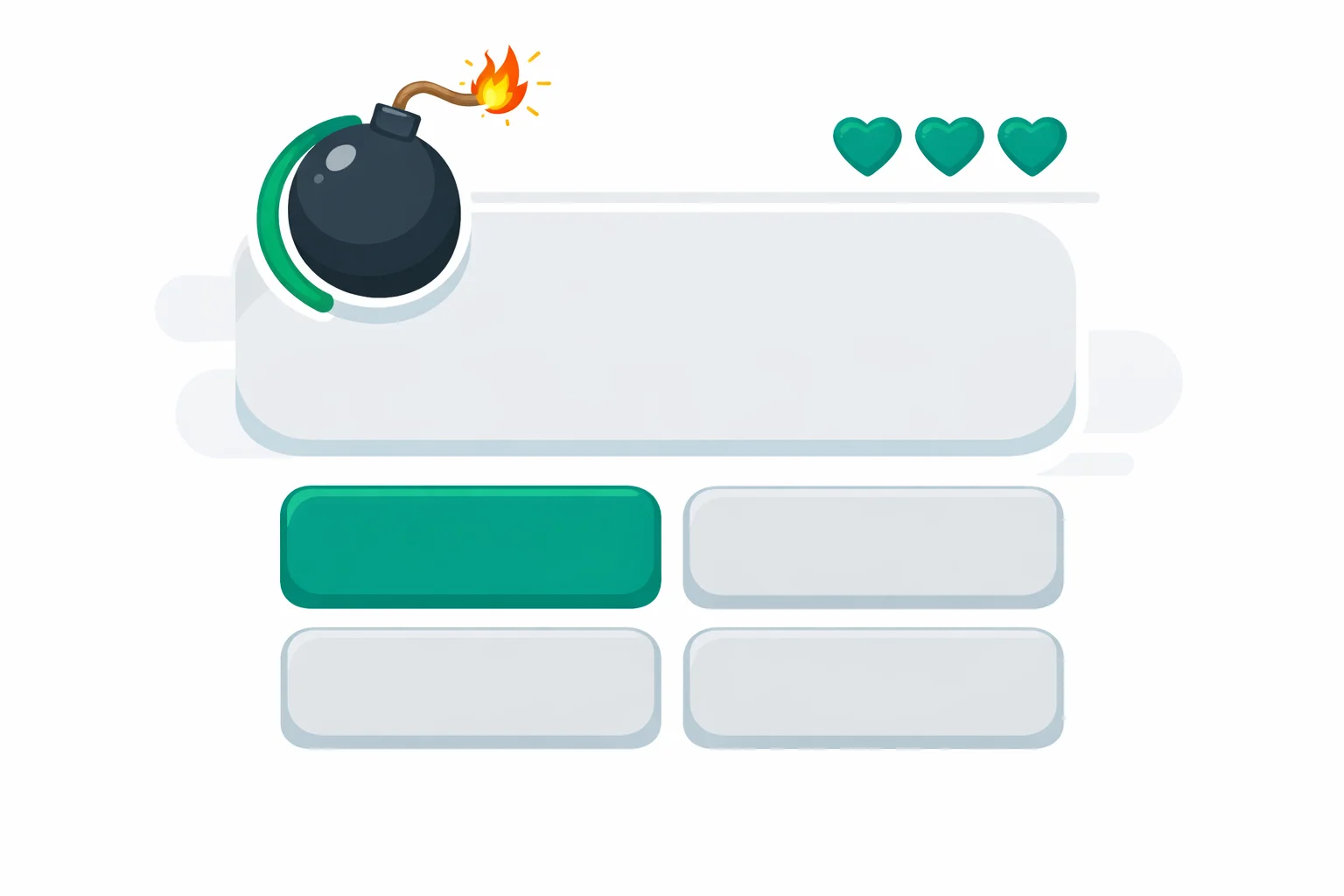
What we kept, and what the numbers below describe, is a deliberately tuned pressure curve across 50 questions:
| Mechanic | Count | What it is actually testing |
|---|---|---|
| Standard trick questions | 30 | Whether you read the sentence or recognised its shape |
| Bombs (timed) | 8 | Whether your answer survives without a second pass |
| Typed answers | 4 | Recall with no options to eliminate — the hardest format here |
| Sequencing questions | 3 | Real chronology, where partial credit does not exist |
| Do-nothing questions | 2 | Whether you can leave a button unpressed |
| Interface tricks (dodging, sizing, self-reference) | 3 | Whether you trust what the screen shows you |
Two design choices matter more than the rest. First, every wrong answer opens an explanation before you move on, and wrong answers do not auto-advance — you have to click past them. That converts a life lost into something you actually learned, which is the difference between a frustrating quiz and a replayable one. Second, question 46 asks how many lives you have left, and its correct answer is different for every player. It is the only question here that cannot be spoiled.
The Four Trap Types and the Bug Each One Exploits
Trick questions are not random cruelty. Each one targets a specific, documented shortcut in human cognition, and once you can name the shortcut you stop falling for that family of question. Here is the mapping for this quiz.
| Trap | Example here | The cognitive shortcut |
|---|---|---|
| Literal reading | Q18 — how many months have 28 days | Your brain silently inserts "only". Adding words that were never written is standard comprehension behaviour, and it is what makes the Moses illusion work |
| False premise | Q40 — which way does the rooster's egg roll | Once a scenario is detailed enough to picture, we start solving it instead of checking it |
| Action bias | Q9 and Q32 — do nothing | Faced with pressure we prefer doing something to doing nothing. Penalty-kick research found goalkeepers jump left or right on 93.7% of shots, even though standing still saves more of them |
| Perceptual blindness | Q34 — counting the letter F | You process the word "of" by sound rather than by letters, so its F disappears. Knowing this in advance barely improves your count |
The action bias row is worth sitting with. Bar-Eli and colleagues analysed 286 penalty kicks from top leagues and championships and found that the optimal goalkeeper strategy was to stay in the centre of the goal — yet keepers jumped left or right on 93.7% of them. The 2007 analysis in the Journal of Economic Psychology pins the gap on how much worse it feels to concede while standing still than to concede having dived. Our do-nothing questions are that experiment in miniature, and the pass rate suggests professional goalkeepers are not unusual.
Looking Up the Answers Costs More Than the Score
"Impossible quiz answers" has been a high-volume search since 2007, and there is no judgement in that — a game with a hundred-plus unfair questions and no save file invites it. But it is worth knowing what the shortcut actually buys you. It buys a completion screen. It removes the collapse-and-rebuild moment, which was the only thing the game had to offer.
Memory research on desirable difficulties has been consistent on this for decades: material you tried to retrieve and failed at is retained substantially better than material you were simply shown, even though the failed attempt feels like wasted effort at the time. That finding is why this quiz shows you the reasoning after a wrong answer rather than before it. A second run after reading the explanations reliably gets people ten to fifteen questions further, and it feels earned in a way a copied answer key never does.
For practice with a defined answer key, the reasoning quiz counts correct answers and explains each solution, and the logo quiz exploits the same perceptual blind spots as question 34 without ever lying to you.
All Six Endings and What Each One Says
Where your run stops is the score, and there are six places it can stop. Roughly a third of players never leave the first band.
🪦 Question One Casualty (reached 1–6). The opening six questions are pure literal-reading tests, and this ending means all three lives went to them. It is not a knowledge problem — it is reading speed. You answered the question you expected instead of the one printed on screen, three times in a row. Nearly every player who eventually reaches the forties has an ending like this in their history.
🌀 The Overthinker (reached 7–14). You cleared the literal traps and then got caught by the reverse: searching for a trick in a straightforward question. Question 20 is a plain arithmetic question under a five-second fuse and it eats a surprising number of otherwise-sharp players. Suspicion is the correct instinct at the wrong intensity, and the fix is simply asking whether a sentence has any second meaning at all before hunting one.
🧐 Getting Suspicious (reached 15–24). The biggest single jump in the quiz is learning to distrust phrasing by default, and this ending means you made it. What ends most runs here is a bomb rather than a riddle. Time pressure removes your ability to double-check, and double-checking is the entire skill you just acquired. Players in this band typically lose two lives to timers and one to a typed answer.
🧠 Trick-Question Literate (reached 25–36). Past the halfway mark the quiz stops being pure wordplay and starts demanding facts: troy versus avoirdupois pounds, botanical berries, the birthday paradox, the founding year of Nintendo. Reaching this band means you are switching between both modes without getting stuck in either. The weakness that shows up here is almost always the typed questions, where there are no options to eliminate.
😤 So Close It Hurts (reached 37–49). Roughly one player in twelve gets this far. Questions 41 to 49 stack the tightest fuses onto the heaviest arithmetic, and question 50 quietly asks whether you remember the first thing you ever saw on the screen. People in this band usually have an unspent skip they were saving for a rainy day that never came.
👑 The Impossible Made Possible (all 50, lives remaining). The rarest ending by a wide margin. It requires reading literally when the wording is the puzzle, reading factually when it is not, holding your nerve through eight bombs and two questions where the correct move is to touch nothing at all, and remembering question 1 fifty questions later. Almost nobody does it on a first attempt.
Five Habits That Get You Past Question 30
None of these are answer keys. They are the actual behaviours that separate a run ending in the teens from one ending in the forties.
- Read the question twice before looking at the options. The options are written to make one interpretation feel obvious. Forming your own answer first is the single highest-value habit in the whole quiz.
- Hunt for the word doing the damage. "Only", "single", "survivors", "here", "left" — one word is usually carrying the entire trick, and it is rarely the loudest one in the sentence.
- On a bomb, commit early and stop revising. Timers punish reconsideration far more than they punish ignorance. Your first read of a five-second question is almost always your best one.
- Spend skips on typed questions, never on multiple choice. Four options with two absurd ones is a coin flip worth taking. A blank text box with no hint is not. Skips arrive after questions 13, 27 and 42.
- Read every explanation, including the ones for questions you got right. Several later questions reuse the logic of earlier ones, and question 50 is a direct callback to question 1. The quiz rewards attention retroactively.
Then take it again. Not to memorise the answers — the second run works because you have rebuilt how you read a question, and that transfers to every trick question you meet afterwards. Which, if you have ever sat through a daily general knowledge quiz and been caught by a wording technicality, is more often than you would like. And when fifty questions of deliberate deception leave you craving a test that plays fair, our pop quiz is the exact opposite contract: 15 questions drawn at random from a 60-question vault, every single one of them played completely straight. Or keep the fairness and add stakes — the Jeopardy-style quiz never tricks you, but it bills you the clue's full value for every wrong answer. Deception-free, consequence-heavy. And for difficulty with no tricks at all — no options, no wordplay, just a blank box and whatever your memory can produce — our hard quiz makes you type all 20 answers cold.