Brainrot Quiz: A Guide to Internet Culture, Memes, and What Your Score Means
Before you dismiss a brainrot quiz built around Skibidi Toilet and three-legged sharks in Nike sneakers, consider this: the phrase "brain rot" is 170 years older than TikTok. It wasn't coined by a frustrated teacher in 2024 or a Gen Alpha kid on a Discord server. It was Henry David Thoreau — yes, the pond guy — grumbling about shallow thinking in 1854. The quiz above measures how much of the modern version lives in your head: 20 questions spanning three eras of internet culture, scored as a rot percentage from Touch Grass Certified to Maximum Skibidi.
Thoreau Complained About Brain Rot in 1854
In Walden, Thoreau asked: "While England endeavours to cure the potato rot, will not any endeavour to cure the brain-rot — which prevails so much more widely and fatally?" He was annoyed that society kept rewarding simple ideas over complex ones. Swap "England" for "the algorithm" and the sentence still works, which is probably why brain rot beat five other finalists to become Oxford's 2024 Word of the Year, chosen with input from more than 37,000 public voters. Oxford's language monitors recorded a 230% jump in usage between 2023 and 2024.
Oxford defines it as the supposed deterioration of a person's mental state from overconsuming trivial online content. Note the word "supposed" — it's doing a lot of work, and we'll come back to it. The immediate irony is better: the moment "brain rot" won, it went viral, got memed, and became brainrot itself. Thoreau would've logged off.
What the Research Says About Your Scrolling Brain
There's real science underneath the joke. Gloria Mark, a professor of informatics at UC Irvine who has tracked screen attention for over two decades, found that the average time a person spends focused on any single screen before switching dropped from about 2.5 minutes in 2004 to 75 seconds around 2012 — and to roughly 47 seconds in her recent studies. That's not a TikTok statistic. That's measured behavior, logged with tracking software, across thousands of observation hours.
Then there's the 2017 "Brain Drain" study from the University of Texas at Austin, which tested nearly 800 people and found that the mere presence of your phone — face down, powered off, on the desk — measurably reduced available working memory compared to leaving it in another room. Your brain spends resources not checking it. So when your result page says your rot is "fresh off the algorithm," there's a genuine cognitive-load story hiding behind the joke. What the research does not show is that knowing memes damages anything — which brings us to the distinction most brainrot content skips entirely.
Knowing Every Meme Isn't the Same as Being Addicted
Here's the thing this brainrot quiz actually measures: cultural fluency. Not addiction, not attention damage, not screen time. You can score 90% without ever installing TikTok, because memes travel through group chats, YouTube Shorts, younger siblings, and that one coworker who says "delulu" in meetings. Researchers who study problematic phone use look for completely different markers — sleep displacement, failed attempts to cut back, hours disappearing without awareness. A trivia score can't detect any of that.
The reverse is also true. Question 7 — the NPC streaming one — trips up plenty of heavy scrollers because Pinkydoll's "ice cream so good" era burned bright and died fast in mid-2023. Missing it doesn't mean you were offline; it means you were on a different corner of the internet that month. If you want to test knowledge with a longer shelf life, our general knowledge quiz asks 25 questions that will still be true in five years. Skibidi Toilet cannot make that promise.
The Three Eras Your Score Breaks Down
The 20 questions aren't distributed evenly, and that's deliberate. Four cover Elder Memes from the 2010s, six cover the TikTok era of 2020–23, and ten cover Peak Brainrot from 2024–25. The weighting reflects how rot works: it decays. Knowing Doge proves you were online a decade ago; knowing Tung Tung Tung Sahur proves your feed is current right now. A brainrot quiz weighted toward 2013 would measure internet history, not rot level.
| Era | Years | Native format | Meme lifespan | Example |
|---|---|---|---|---|
| Elder Memes | 2010–2019 | Image macros, YouTube | Months to years | Doge, Harambe |
| TikTok Era | 2020–2023 | Short video + sounds | Weeks | Grimace Shake, NPC streams |
| Peak Brainrot | 2024–2025 | AI-generated characters | Days | Bombardiro Crocodilo, 6-7 |
Read that lifespan column again. A meme in 2012 could stay funny for three years; by 2025, a character can be born, peak, and become cringe inside a single week. That acceleration is the single most measurable thing about brainrot culture — and it's why your era breakdown on the results screen says more about you than the total percentage does.
Is Italian Brainrot the Weirdest Meme Genre Yet?
Probably, and it's not close. Italian brainrot exploded in early 2025: AI-generated images of impossible hybrid creatures — a three-legged shark in Nike sneakers (Tralalero Tralala), a crocodile fused with a bomber plane (Bombardiro Crocodilo), a wooden log clutching a baseball bat (Tung Tung Tung Sahur, borrowed from Indonesia's pre-dawn Ramadan drum tradition) — narrated by an exaggerated text-to-speech Italian voice saying almost nothing coherent.
Why did pure nonsense conquer the internet? Because nonsense has no entry fee. Older memes required context — you had to know the movie, the game, the drama. Italian brainrot requires nothing. A kid in Jakarta, a teen in Ohio, and a confused dad in Zagreb all experience the shark identically — the same borderless quality that let a set of emoji puzzles become a party game in every language at once. It's also the first meme canon Gen Alpha built entirely for themselves, with AI tools, without borrowing from millennial culture. That's genuinely new. Absurd, but new — and if you enjoy content engineered to defy logic, The Impossible Quiz has been running that experiment since before the shark had sneakers.
The Score You Don't Want Isn't 100%
Everyone assumes Maximum Skibidi is the alarming result. Let me push back. A 100% scorer who sleeps fine, reads books, and simply also knows why the crocodile is a plane has a hobby. A 40% scorer who loses three hours a night to a feed they don't even enjoy has a problem the quiz can't see. The relationship with the feed matters more than the vocabulary.
And a 0% score isn't automatically the healthy flex it appears to be. Meme literacy is functional social currency now — teachers use it to decode classroom chaos, parents use it to keep a channel open with their kids, and marketers who ignored "6-7" in 2025 aged their brands a decade in a month. The genuinely enviable position is the middle of the meter: fluent enough to translate, detached enough not to care when the shark becomes cringe.
All 6 Brainrot Quiz Results Explained
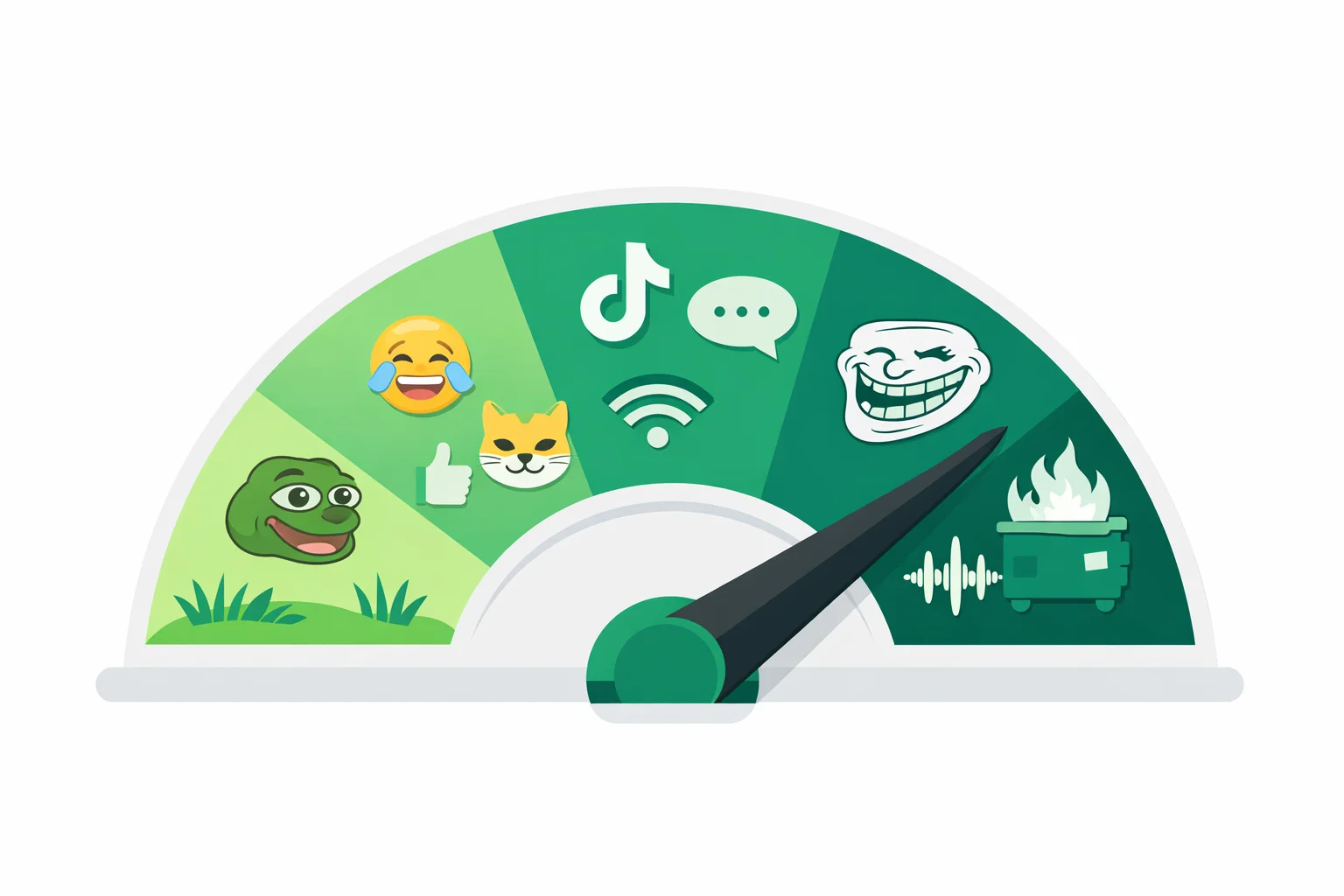
Every result on this brainrot quiz maps to a tier on the rot meter, based on how many of the 20 questions you answered correctly. Here's the full spectrum, from untouched to fully consumed.
🌱 Touch Grass Certified (0–15%) — The rarest low score, held by about 9% of takers. You've either curated your life beautifully or you're a grandparent someone handed a phone. Either way, algorithms have no power here. The internet finds you fascinating, like a nature documentary in reverse.
📱 Casually Scrolling (20–35%) — You know rickrolling and maybe rizz, but the 2024–25 wave washed past you. Memes reach you weeks late through secondhand channels, pre-filtered by people who scroll so you don't have to. Your attention span is likely in excellent shape; your group chat references may occasionally expire.
😵💫 Chronically Online (40–55%) — The most common result, covering roughly a third of takers. You're fluent in headline memes but hazy on deep cuts — you know Ohio is cursed without being able to say why the wooden log carries a bat. Balanced, functional, still capable of finishing a paragraph.
🧠 Certified Brainrotted (60–75%) — The rot has taken hold. You caught most of the AI shark lore and the slang, missing only a handful of era-specific details. You likely send memes faster than you receive them. Your screen-time report is a horror document you've chosen not to open.
💀 Terminally Online (80–90%) — You witnessed every era firsthand, from image macros to AI absurdism, and can date a meme's death within a week. Around 13% of takers reach this tier. You're the person friends screenshot things to with the message "explain." It's a burden. You love it.
👑 Maximum Skibidi (95–100%) — Fewer than one in twenty takers get here. Perfect or near-perfect fluency across thirteen years of internet culture is genuinely hard — most Terminally Online scorers still fumble an Elder Meme or one Italian brainrot deep cut. You dropped nothing. Seek sunlight, champion.
What to Actually Do With Your Brainrot Score
If your score worried you, skip the dramatic phone detox — Mark's research suggests cold-turkey approaches mostly produce anxiety, not focus. Two smaller moves have actual evidence behind them. First, put the phone in a different room during focused work; the Texas study showed proximity alone taxes working memory. Second, protect one daily block of long-form attention — a chapter, a full album, a 40-minute video without a second screen. Attention is trainable in both directions.
If your score delighted you, congratulations — now diversify the portfolio. Your brain clearly memorizes absurd information at industrial scale, so point that skill somewhere with compound interest: our vocabulary quiz tests whether you know as many real English words as brainrot terms. And one last thought to sit with: Thoreau never cured the brain-rot of 1854. Nobody cured the television rot of 1994, or the internet rot of 2014. Every generation names its rot, panics, and then raises a generation that finds the panic funnier than the rot. The shark with three legs is just your turn.