The Three-Step Method That Cracks Almost Any Emoji Puzzle
Here is a claim worth testing: you can beat most of an emoji quiz without recognising a single one of the pictures on sight. Not because the puzzles are soft — a few of the twenty above are genuinely nasty — but because emoji rebuses are built out of a grammar, and the grammar is small enough to learn in one sitting. What follows is that method, three puzzles taken apart in slow motion, and the reason your score probably says more about which categories you read than about how clever you are.
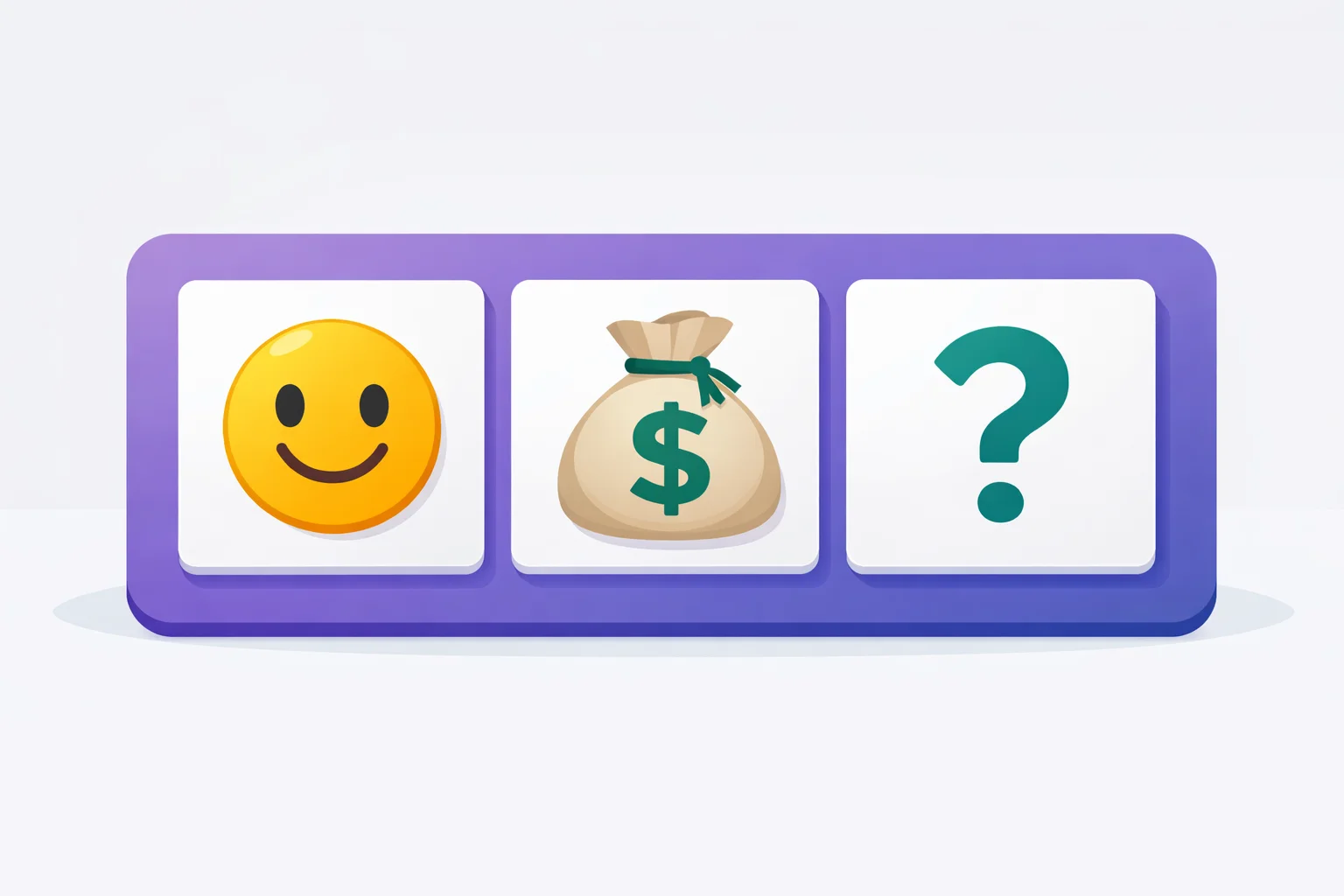
Every Emoji in a Rebus Is Doing One of Three Jobs
Pick any puzzle from the quiz above and you will find the same three roles, in some order. There is an anchor — the concrete thing the answer is about. There is a modifier that narrows the anchor down from a category to a specific answer. And there is a connector, which is the one people miss, because it stands in for a word that has no picture at all.
Reading a sequence of images as language is a real skill and not a party trick, which is easiest to see in a writing system that does it for a living. Fingerspelling arrives as a stream of hand pictures at five or six a second, and fluent readers stop decoding individual letters exactly the way you stop decoding individual emoji here — they recognise the shape of the whole word. The ASL alphabet quiz tests that transition directly.
| Job | What it looks like | In the quiz above |
|---|---|---|
| Anchor | A noun you can photograph. Usually shown first. | 🦁 in The Lion King, 🐳 in Moby-Dick, 🚢 in Titanic |
| Modifier | Narrows the anchor: a title, a place, a possession. | 👑 (king), 🏭 (factory), 🕸️ (whose web) |
| Connector | Carries an adjective, a duration, or an outcome. | ♾️ (forever), ⏰ (early), 💔 (and it ends badly) |
That table is the whole trick, and it has a direct consequence for scoring. The anchor is almost always the emoji you see first — and the anchor is almost always the one that tells you least. In the foggy-city puzzle, every option on screen is a city where it gets foggy. Committing on tile one there is not confidence, it is a coin flip that happens to be worth five points.
Watch a Puzzle Fall Apart in Slow Motion
Take 🥐 🗼 🥖, which you have already met. Tile one is a croissant, and your instinct says France. Look at what is actually on offer, though: Belgium, Switzerland and Italy all have a defensible pastry claim, and one of them invented the thing you are looking at. Tile one is a category, not an answer. It has told you "somewhere in Western Europe with a bakery culture" and nothing else.
Tile two is a tower. Now three of the four options are dead, and you are at four points instead of five. That single point is the entire economics of the format: buying one extra tile costs 20% of the puzzle's value and often eliminates 75% of the options. On a puzzle where you are genuinely torn, revealing is not the timid choice. It is the correct one.
Now take 🐝 👑 🎤, which breaks the rule the first example just taught you. The bee is not an anchor. It is not an animal at all — it is a syllable, and the answer is Beyoncé. And 🐦 ⏰ 🪱 breaks a second rule: the phrase is the early bird catches the worm, so "early" comes first in the words and second in the pictures. Rebuses are not obliged to run left to right, and that puzzle is in the set specifically to prove it.
When the Picture Is a Sound, Not a Thing
The moment a rebus stops meaning what it depicts and starts meaning what it sounds like, most people's scores fall off a cliff. A bee is the syllable bee. An eye is the word I. A wave can be a sea or the letter C. Nothing about the picture announces which mode you are in, and the switch has to be made deliberately.
This is not a modern invention. Using a picture for the sound of a word rather than its meaning is called the rebus principle, and it is one of the ways early writing systems escaped the trap of needing a new symbol for every idea. Egyptian scribes used it to write names that had no picture of their own. When you decode a bee into a syllable, you are doing something a scribe did four thousand years ago, on a phone. If you enjoy that particular flavour of decoding, the vocabulary quiz runs the same skill on Latin and Greek word parts instead of pictographs.
Why Does the Same Emoji Mean Different Things on Different Phones?
Because Unicode standardises the meaning of a character, not the artwork. Apple, Google, Samsung, Microsoft and every other vendor draw their own version of the same code point, and those drawings do not always agree with each other.
Researchers at the University of Minnesota put a number on it in 2016. In a study titled Blissfully Happy or Ready to Fight, they showed people the same emoji as rendered by five different vendors and asked them to rate its sentiment. A single character could come back rated clearly positive in one rendering and clearly negative in another — before anyone had even sent a message. The most public example arrived that same year, when Apple redrew the pistol emoji as a bright green water pistol and every other major vendor followed within about two years, which means a message sent in 2015 can read completely differently on a phone bought in 2020.
That instability is exactly why every puzzle above leans on objects rather than faces. A croissant is a croissant on any platform. A grinning face is an argument. If you want the full standards-body version of this, the Unicode Consortium's emoji documentation is surprisingly readable.
176 Icons, a Pager War, and a Museum
The set that started all of this was 176 designs drawn on a 12x12 pixel grid by Shigetaka Kurita for NTT DoCoMo's i-mode service in 1999. At that resolution there is no room for detail — a face is a handful of pixels — which forced a discipline that survives in every puzzle you just solved: an emoji has to be readable as a concept, not as an illustration.
They were not quite the first pictographs on a phone. Japanese pagers had carried a heart symbol a few years earlier, and when a newer model dropped it, teenage users left for a competitor in numbers large enough for the industry to notice. That is the actual origin story of emoji: not a design breakthrough, but a company discovering that people would switch networks over a picture of a heart. Unicode absorbed the concept properly in 2010, the set has grown into the low thousands depending on how you count skin tones and flag sequences, and MoMA acquired Kurita's original 176 for its permanent collection in 2016. The full lineage is well documented on Wikipedia's emoji entry.
Four Ways People Talk Themselves Out of the Right Answer
Watching people play this, the same four mistakes account for most of the lost points, and each one has a specific puzzle above that punishes it.
- Reading the anchor as the answer. 🐘 appears and the brain reaches for the elephant idiom it already knows. Three of the four options are elephant idioms. The anchor was never the discriminator.
- Refusing to switch into sound mode. If 🐝 stays an insect, Beyoncé is unreachable no matter how long you stare at it.
- Assuming left-to-right. The bird-clock-worm puzzle is deliberately out of order, and people who read strictly in sequence produce "bird early worm" and give up.
- Committing on tile one when all four options share it. This is the expensive one. On the fog puzzle a lot of players lock in Seattle for five points and score zero, when four points were sitting one click away.
Notice that three of the four are reading errors and only one is a knowledge gap. That ratio is the reason retake scores jump so sharply — you are not learning twenty new facts, you are learning to read four sequences differently.
Movies Are Easy. Idioms Are Where People Fall Apart.
The category bars in your results are not decoration. They separate two genuinely different tasks, and the gap between them is consistent enough to predict.
| Category | What the anchor gives you | Where it goes wrong |
|---|---|---|
| 🎬 Screen | A proper noun with an iconic visual — a shark, a tornado, a ship. | Rarely. This is the category people clear. |
| 📚 Books | A character or object from the cover art you grew up with. | Two books by the same author sharing a motif. |
| 🎵 Songs | A title that is often literal word-for-word. | When the artist, not the song, is the answer. |
| 🌍 Places | Stereotype shorthand — food, landmark, animal. | Depends entirely on where you grew up. |
| 💬 Idioms | Almost nothing. The key word is usually abstract. | Constantly. This is the most expensive category here. |
Idioms cost the most because the load falls on the connector slot, and connectors are where emoji are weakest. There is no picture of "early", so the puzzle borrows an alarm clock and hopes. Places are the sleeper problem: a Dutch player clears the tulip puzzle instantly and may never have heard of Karl the fog, while a San Franciscan has the reverse experience. That is not a knowledge gap, it is a geography-of-childhood gap — the same effect that makes some brands unrecognisable in the logo quiz depending on which country you grew up in. If you want the version with no pictures at all to lean on, the movie trivia quiz is pure recall.
All 6 Emoji Quiz Score Bands Explained
👑 Emoji Cryptographer (85–100). The rarest finish on the board, and it is not achievable by knowledge alone — you have to be committing on single tiles and being right. Cryptographers read the slot before the picture, which is why the brutal final five do not slow them down. The characteristic weakness is impatience: the occasional five-point gamble on a puzzle that deserved a reveal.
🧠 Rebus Fluent (70–84). Near-total accuracy with good early commitment. Fluent readers handle the connector slot comfortably, so idioms stop being a graveyard. What separates them from the top band is almost always the sound puzzles — the bee, and anything where a picture stands for a syllable rather than an object.
🔍 Sharp Decoder (55–69). Strong accuracy funded by extra tiles. Decoders usually know the answers and simply buy more information than they need, which converts fives into threes and quietly costs around thirty points across twenty puzzles. A clean sweep where you always waited for the third tile lands at exactly 60 — this is the band with the largest gap between what you know and what you scored.
📖 Solid Reader (40–54). Where most players land. Proper nouns are secure and abstractions are not, so screen and song bars run high while idioms run low. Readers in this band tend to treat every emoji as a picture of itself, which works for four categories out of five.
🤔 Literal Thinker (25–39). Every emoji got read as the thing it depicts, so any sequence needing a sound or an adjective slipped straight past. This is the most fixable score here by a wide margin — the entire fix is the three-slot framework at the top of this article, and it works on the very next attempt.
🌫️ Lost in Translation (0–24). Rebus reading is a learned skill and a first attempt measures exposure, not ability. Anyone who has never had to decode a picture sequence lands here, and twenty-point jumps on a second run are ordinary rather than impressive.
Build a Puzzle Your Friends Cannot Solve
The fastest way to get good at reading these is to write one. Four rules make the difference between a puzzle people enjoy and a puzzle people resent.
Make the first emoji ambiguous on purpose — if tile one gives the answer away, there is no puzzle, only a lookup. Use exactly one connector, because two abstract slots in a single sequence turns solving into guessing. Avoid faces entirely, since they render differently on your friend's phone than on yours. And test it on someone who did not grow up where you did; if the puzzle depends on a snack sold in three countries, you have written a geography test rather than a rebus.
Then send it cold, with no category label. That is the version of this game that has been spreading through group chats for a decade, and it is a close cousin of the shorthand tested in the brainrot quiz — a private compression layer that only works if everyone reading it shares the same references. Get one past a friend who reads the internet as fluently as you do and it is worth more than a perfect score up there.