Movie Trivia Quiz: 25 Questions Across Five Eras of Film History
Every movie quiz is secretly a memory experiment, and the baseline was measured in 2011: Columbia psychologist Betsy Sparrow published four experiments in Science demonstrating what's now called the Google effect: when people believe a fact is stored somewhere else — a hard drive, a search engine, a friend who "knows movies" — their brains quietly stop bothering to remember it. Film knowledge lives in exactly that danger zone. Why memorize who directed The Godfather when your phone knows? The 25 questions above are a check on what actually survived: five acts, five eras of film history, and a final breakdown showing which decades your memory really kept.
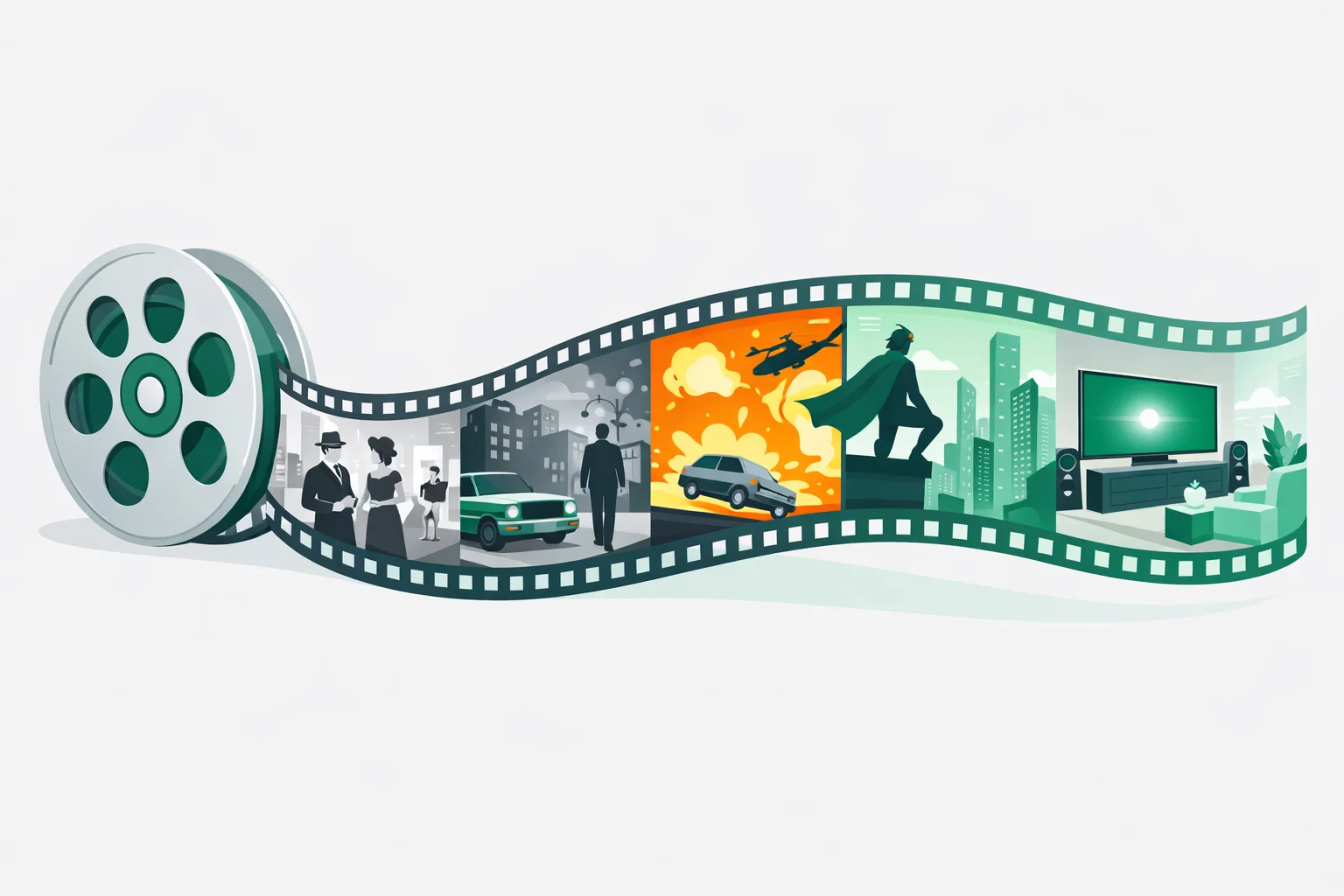
Your Brain Quietly Deletes Movies You Loved
Think of a film you adored five years ago. You can probably recall how it made you feel, one or two images, maybe a single line. Director? Year? Who won the Oscar it was nominated for? Gone. Memory researchers distinguish between gist memory (the emotional shape of an experience) and verbatim memory (the precise details), and gist wins nearly every time. That's why you aced the questions about films you've rewatched and guessed on ones you've merely seen.
There's a fix, and it's the reason trivia works. In a 2006 Washington University study, students who actively tested themselves on material retained dramatically more of it a week later than students who re-read it — psychologists call this the testing effect, and it's one of the most replicated findings in learning science. Getting the Jaws question wrong and then reading that the broken mechanical shark created the film's style is a stronger memory event than watching Jaws again. Failure plus correction encodes; passive exposure doesn't.
The Reminiscence Bump Decides Your Strongest Era
Your era breakdown at the end of the quiz isn't random. Decades of autobiographical memory research — starting with David Rubin's work at Duke in the 1980s — show that adults disproportionately remember music, books, and films they encountered between roughly ages 10 and 30. The phenomenon is called the reminiscence bump, and it's so reliable that you can often guess someone's birth year from their trivia profile alone.
Run the math on yourself. If you were born in 1985, your bump covers 1995–2015 — which predicts a towering Blockbuster Age bar, a strong 2000s showing, and a Golden Age score that's mostly guesswork. Born in 2000? Expect the Streaming Era act to carry you. The interesting cases are the outliers: people whose strongest era predates their birth usually had a parent who programmed their childhood viewing, or went through a deliberate classics phase. Either way, the bar chart is a little biography. The same effect rules songs even more strongly than films, by the way — our name that song quiz spreads 14 tracks across seven decades for exactly this reason.
The bump narrows to almost nothing inside a single artist's catalogue, which is where it gets genuinely useful. Our Taylor Swift trivia quiz walks five eras in order and hands back one score per era, and the strongest bar almost always marks the album cycle someone joined during — a twenty-question quiz that dates your fandom to within about three years.
Why the Quiz Splits Film History at 1960, 1980, 2000, and 2010
The five acts aren't arbitrary decade buckets — each boundary marks a moment the industry itself broke and reformed. Film historians argue about exact years, but these four fault lines are the ones most of them accept:
| Act | Years | What broke | What it means for your score |
|---|---|---|---|
| 🎩 The Golden Age | 1927–1959 | Sound arrived with The Jazz Singer; the studio system ruled until antitrust rulings and television cracked it open | High marks here almost always mean deliberate study, not luck |
| 🎞️ New Hollywood | 1960–1979 | The Production Code collapsed in 1968; directors like Coppola, Kubrick, and Spielberg seized creative control | The era film schools live in — cinephiles peak here |
| 🦖 The Blockbuster Age | 1980–1999 | The Jaws/Star Wars playbook matured into event cinema; VHS put rewatches in every living room | The most commonly won act — these films saturate pop culture |
| 💿 The 2000s | 2000–2009 | Digital effects matured and the franchise became the business model, capped by the MCU's 2008 launch | Strong here suggests your teens overlapped the DVD boom |
| 📱 The Streaming Era | 2010–today | Streaming rewrote distribution; international films like Parasite rewrote Oscar history | Recency helps everyone — a weak score here is the rarest result |
Each act mixes difficulty levels on purpose. A question everyone gets (the DeLorean's 88 mph) sits next to one almost nobody does (Midnight Cowboy's X rating), so a 4/5 in an act reflects genuine era knowledge rather than one lucky guess.
What Makes a Movie Question Genuinely Hard?
Difficulty in a movie trivia quiz has surprisingly little to do with how obscure the film is — every movie in this quiz is famous. It comes from the gap between recognition and recall, and from how plausible the wrong answers are. Ask someone "did Titanic win a lot of Oscars?" and everyone says yes. Ask "9, 10, 11, or 13?" and the room splits, because nobody encoded the number — they encoded "a lot."
The distractors do the rest of the work. Every wrong option in this quiz is drawn from the same era and genre neighborhood as the right one: Easy Rider sits next to Midnight Cowboy because both are 1969 counterculture films, and SAL 8000 is a real computer from the 2001 sequel, not an invention. When a wrong answer is something you've genuinely heard of, your familiarity signal fires — and familiarity is exactly what a good trivia question weaponizes against you.
Here's Where Your Memory Betrays You
Two questions in this quiz are traps built from collective false memories, and they catch a remarkable share of confident quiz takers. The Casablanca question offers "Play it again, Sam" — a line that is never spoken in the film. And the most famous line in the Star Wars saga is misquoted by nearly everyone: Vader says "No, I am your father," not "Luke, I am your father." If you know the saga's characters better than its exact dialogue, our Star Wars character quiz measures the other half of that fandom.
These misquotes persist for the same gist-over-verbatim reason as before: your brain stores the meaning of the scene, then reconstructs the wording on demand — and reconstruction quietly optimizes for clarity. "Luke, I am your father" identifies the speaker and listener; the real line only makes sense in context. Millions of brains made the same edit independently. It's not a glitch, it's compression — but a trivia scoreboard doesn't grade on compression.
Visual memory compresses in exactly the same way, and there's a neat demonstration of it: in one UCLA study, only one student out of 85 could draw the Apple logo correctly from memory. Our logo quiz is built on that finding — 30 brand marks, all blurred — and it tends to humble the same people who breeze through movie quotes. Memory does something similar with time: our WWE quiz spans five decades on purpose, and almost everyone who takes it sweeps whichever era they actually watched and goes blank on both sides of it.
All 5 Movie Trivia Ranks Explained
Your score out of 25 maps to one of five ranks. Here's the full ladder, so you can see what you're climbing toward — or gloating from.
🏆 Head Projectionist (23–25). The top of the marquee, reached by roughly 3% of quiz takers. This rank requires knowing production stories and award records across all five eras — not just recognizing films, but knowing how they were made and what they won. Its one hazard: insufferable behavior at watch parties.
🎞️ Certified Cinephile (18–22). Deep knowledge with a visible edge in two or three eras. Cinephiles usually miss questions clustered in a single act — the era just outside their reminiscence bump — which makes their retake path obvious. About 11% of quiz takers land here.
🎬 Film Buff (13–17). Above average and genuinely well-watched, with strong instincts on famous facts but gaps on numbers and names. Buffs typically nail the Blockbuster Age and stumble in the Golden Age. Just over a quarter of quiz takers earn this rank.
🍿 Matinee Regular (7–12). The most common result at 41%. Regulars watch plenty of movies but encode stories, not credits — they know the shark is scary without knowing why it stays offscreen. Every reel fact in the quiz is new information, which ironically makes this rank the fastest one to improve from.
📺 Casual Streamer (0–6). Movies as comfort noise rather than subject matter, and usually a knowledge base confined to the last fifteen years. About 18% of quiz takers land here — often people who clicked in from a personality quiz and got ambushed by Katharine Hepburn.
How to Actually Raise Your Score
Skip the listicles of "100 movie facts" — passive reading is the re-study condition that lost in every testing-effect experiment. What works is embarrassingly simple: retake this quiz in three or four days. Spaced retrieval is the single most efficient memory technique ever documented, and the facts you missed today are precisely the ones a spaced retake will lock in. Your second score isn't inflated — it's evidence of real learning.
Then attack your weakest act, because that's where the cheap points are. One deliberately chosen film per week from your worst era — with a five-minute read about its production afterward — will move that bar faster than a month of algorithm-fed rewatches. And if you want to test how this era-based format transfers to a single deep fandom, the Harry Potter trivia quiz runs 30 questions across three difficulty tiers, the K-pop quiz restages it as a survival-show debut evaluation, and the Stranger Things quiz flips the lens from what you know to which character you are. Your strongest era already told you where your movie memory lives — the only question left is whether you'll furnish the other four rooms.