K-Pop Quiz: Group Profiles, Fan Culture, and What Every K-Pop Fan Should Know
Score 14 or higher on this K-pop quiz and you know the industry better than most people who stream it every single day — and that's not a throwaway compliment, it's the design. The 20 questions above deliberately skip "name this song" territory and test the machinery instead: who built the trainee system, why contracts snap at seven years, what a Perfect All-Kill actually requires. Daily listening teaches you none of that. Reading about the industry does, which is why the four position rounds get harder as they shift from fandom slang to chart law — and why this article walks through every system the quiz just graded you on.
The Trainee System Is the Answer Key to Half This Quiz
Almost every fact you were tested on flows from one 1996 decision. SM Entertainment founder Lee Soo-man didn't just debut H.O.T. that year — he industrialized the process: scout teenagers through auditions (or literally on the street, which is where this quiz's lowest rank gets its name), train them for years in singing, dance, languages, and media handling, grade them in monthly evaluations, and debut only the survivors. Seo Taiji and Boys had already invented K-pop's sound in 1992 by welding American hip-hop onto Korean pop, but they were a self-managed band. H.O.T. was a manufactured product of a repeatable system — and the system, not the sound, is what made K-pop an industry.
The numbers behind that system explain why fans treat debuts like graduations. Training averages two to five years; TWICE's Jihyo trained for ten, and G-Dragon spent eleven years as a trainee before BIGBANG debuted. Survival shows like Sixteen and the Stray Kids program simply televised the final evaluation that agencies were already running behind closed doors — which is exactly the format this quiz borrows. When SEVENTEEN named themselves with arithmetic (13 members + 3 units + 1 team = 17), they were describing the structure the training system had sorted them into: vocal, hip-hop, and performance units, each with its own internal hierarchy.
Why Do So Many Groups Hit a Wall at Year Seven?
The expert round's final question is the most-missed in the whole quiz, and the wrong answers are revealing: most people pick military enlistment, because it's the famous constraint. The real answer is drier and more interesting. In 2009, after TVXQ members sued over a 13-year contract, the Korea Fair Trade Commission capped standard exclusive entertainment contracts at seven years. From that moment, every group debuted with a countdown clock attached.
Run the dates and the "seven-year curse" stops looking like a curse at all. 2NE1 debuted in 2009 and disbanded in 2016. 4Minute: 2009 to 2016. Sistar: 2010 to 2017. These aren't mystical patterns — they're contract expirations, the moment when every member simultaneously becomes a free agent and the agency has to re-sign all of them or lose the group. The groups that survive year seven tell you something too: BTS renewed with Big Hit in 2018, a full year early, at a point when the company's valuation depended almost entirely on them. A renewal like that is the industry's strongest possible signal of mutual trust — which is why fans track contract anniversaries the way sports fans track free agency.
Fandom Names Aren't Cute — They're Infrastructure
Here's the thing outsiders miss about questions like "what's BLACKPINK's fandom called?" — the names aren't branding afterthoughts, they're membership cards in organized institutions. ARMY stands for Adorable Representative M.C. for Youth. ONCE carries a promise: love TWICE once, get twice the love back. STAY exists because Stray Kids would be lost without someone staying beside them. TVXQ's fan club Cassiopeia entered Guinness World Records with roughly 800,000 registered members — a fandom the size of a city, with the coordination to match.
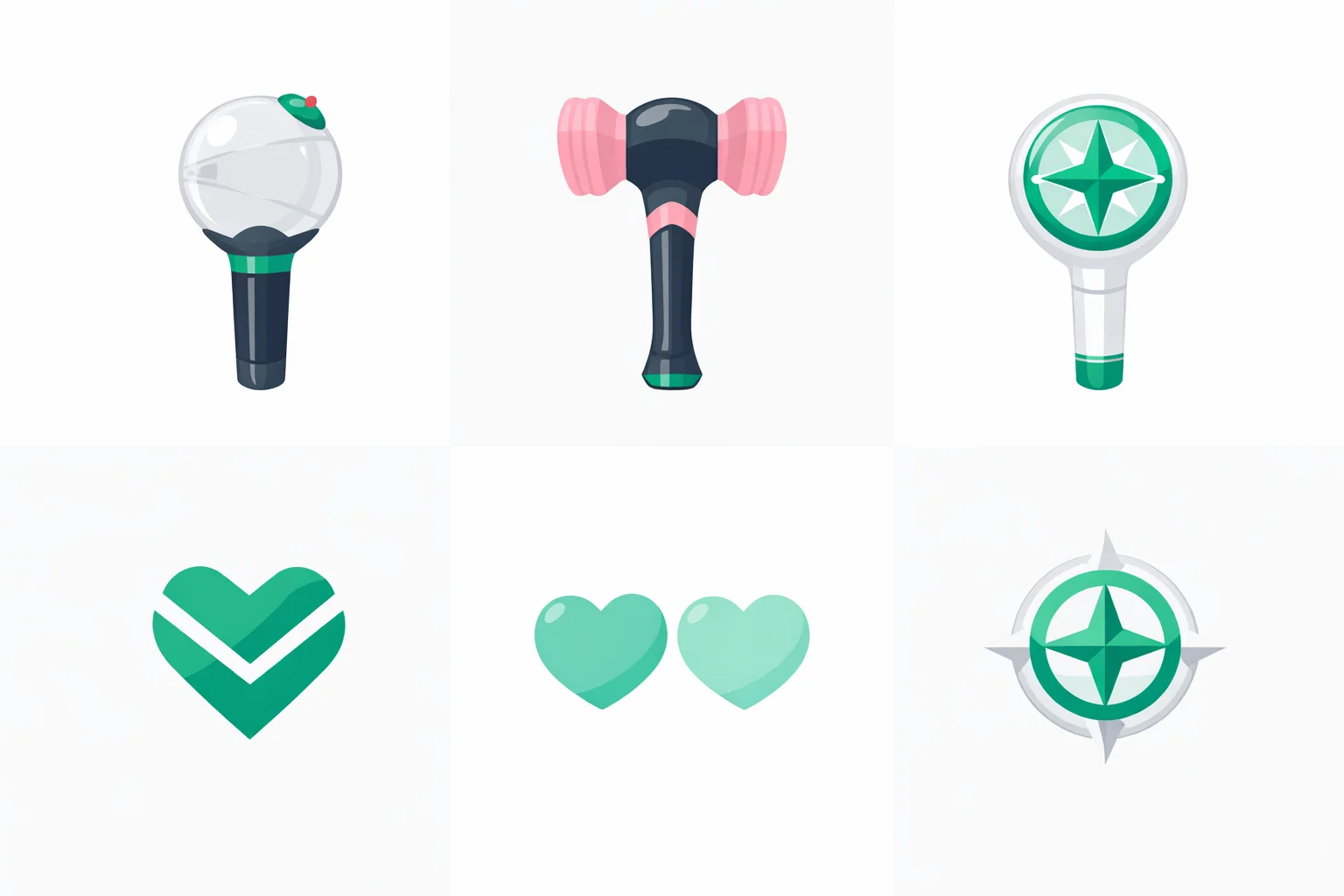
That coordination is physical, too. BIGBANG started the official lightstick tradition in 2006 with the crown-shaped Bang Bong, and the idea spread until every fandom had its own — the BTS ARMY Bomb, the BLACKPINK hammer, Stray Kids' compass. Modern versions pair over Bluetooth with the venue's control system, turning 50,000 fans into a synchronized pixel display. And the same infrastructure runs invisibly online: fan cafes organize streaming parties, voting campaigns for music shows, and birthday billboard rentals in Seoul subway stations. If you've ever wondered how K-pop songs win those shows, the answer is that fandoms operate like volunteer marketing departments. Fandom devotion isn't unique to K-pop, of course — our anime quiz explores the character archetypes that power the other great East Asian fan culture.
Western pop arrived at the same idea from the opposite direction. The friendship bracelets fans traded at Eras Tour shows were never official merchandise — they emerged bottom-up and became a currency anyway, which is why our Taylor Swift quiz uses them as its scoring mechanic instead of a plain points total. Lightsticks are top-down infrastructure; bracelets are bottom-up. Both end up doing the same job of making a fandom visible to itself.
The Records Round Is Built to Catch Confident Fans
Two questions in this quiz look like contradictions until you know which chart is which — and they're worth decoding, because chart confusion is the single biggest source of wrong answers among people who actually follow K-pop. Worked example one: BTS's Love Yourself: Tear made history in May 2018, and "Dynamite" made history in September 2020. Both facts are true because they're different charts. The Billboard 200 ranks albums; the Hot 100 ranks songs. The album barrier fell two years before the single barrier did — Korean-language albums could sell to committed fans, but a #1 song needed US radio play, which is why "Dynamite" was written entirely in English.
Worked example two: the billion-view question specifies the first K-pop group MV to get there, because PSY — a soloist — beat every group by seven years. "Gangnam Style" passed a billion views back in 2012 and eventually overflowed YouTube's 32-bit view counter, forcing an upgrade to 64-bit. BLACKPINK's "DDU-DU DDU-DU" didn't cross the same line until 2019. And the Perfect All-Kill question hides a third distinction: winning a music show only requires beating that week's competition, but a PAK requires simultaneous #1s on every major Korean chart — realtime, daily, and weekly — tracked by the aggregator iChart. A group can collect a shelf of music-show trophies without ever scoring one. If decoding opening bars sounds more fun than decoding chart rules, the name that song quiz tests pure recognition speed across seven decades instead.
Four Generations, Four Different Industries
Fans date K-pop in generations the way historians date dynasties, and the quiz pulls questions from all four on purpose — it's why single-group experts rarely take the center spot. Each generation isn't just a new wave of groups; it's a different business model, shaped by whatever technology carried the Korean Wave at the time.
| Generation | Years | Defining acts | What changed |
|---|---|---|---|
| 1st | 1996–2002 | H.O.T., S.E.S., g.o.d | The idol system is born; success means Korean TV music shows and physical CD sales |
| 2nd | 2003–2011 | TVXQ, BIGBANG, Girls' Generation, Wonder Girls | Expansion into Japan and China; YouTube arrives and "Gee" becomes a regional phenomenon |
| 3rd | 2012–2017 | EXO, BTS, TWICE, BLACKPINK, SEVENTEEN | Global streaming and social media make Western charts reachable; fandoms go worldwide |
| 4th | 2018–today | Stray Kids, ITZY, aespa, NewJeans | Global-first debuts, TikTok virality, self-production, and concept experiments like aespa's AI avatars |
Read the table bottom-up and the 4th-generation questions in this quiz start making sense as a set. Stray Kids writing their own title tracks through 3RACHA, aespa debuting with virtual counterparts, NewJeans skipping the teaser cycle entirely — these aren't quirks, they're competitive answers to the same problem. By 2018, the 3rd generation had saturated the traditional playbook, so new groups had to differentiate on process: own your music, own a fictional universe, or own the element of surprise. Your Dance Position grade quietly measured how well you've kept up with that shift.
All 5 K-Pop Quiz Ranks Explained
Your final ranking maps your score onto the trainee-to-debut ladder. Here's the full lineup, from the practice room to the center spot.
👑 Center of the Lineup (18–20). The top rank, reached by about 4% of quiz takers. Centers combine generational range with industry mechanics — they know H.O.T. and 3RACHA, chart law and contract law. It's the profile of someone who reads about K-pop, not just listens to it, and it's nearly impossible to reach as a single-group fan.
💎 Debut Line (14–17). A confident pass into the final lineup, earned by 14% of takers. Debut Liners typically ace the group and member questions but drop points on chart mechanics — the Perfect All-Kill and seven-year questions are the usual gap. One focused read of an industry explainer usually promotes them.
🎤 A-Class Trainee (9–13). The most common rank at 37%. A-Class scores show genuine fan knowledge with a history-shaped hole: strong on 3rd and 4th generation groups, thin on everything before 2012. Their Rap Position grade — the history round — is almost always the lowest of the four.
🎧 Rookie Trainee (5–8). Playlist listeners land here, about 29% of everyone who takes the quiz. The giants are familiar — BTS, BLACKPINK, a NewJeans hook from TikTok — but fandom names, agencies, and records haven't stuck yet. Rookies gain more points per retake than any other rank because every feedback fact is new.
🌱 Street Cast (0–4). The scout-spotted beginner, around 16% of takers. Street Casts usually know K-pop through its crossover moments — "Gangnam Style," maybe "Dynamite" — and guessed the rest. The rank is a starting line, not a verdict: every fan chanting in an arena once knew exactly this much.
How to Train Your Way Up the Rankings
The fastest route up isn't more streaming — it's watching the system work once. Pick a single comeback cycle from any group you like and follow it end to end: the teaser schedule, the music-show promotions, the chart tracking that fans do in real time. One cycle teaches you more industry mechanics than a year of passive listening, because you'll see the Perfect All-Kill race, the fandom voting drives, and the first-week sales counts play out live. Survival shows work as a crash course too — they're literally the trainee system with cameras on.
Then come back and re-audition. The facts you missed today are the ones a spaced retake locks in, and your position grades tell you exactly which round to study — a D in Rap Position means the pre-2012 generations, a C in Center Position means industry mechanics. And once you've claimed your spot in the lineup, take the evaluation format somewhere else: the movie trivia quiz runs the same rank-and-round structure across a century of film. The center position is open in both. Somebody's going to take it.