Sports Trivia Quiz: The Records, Moments, and Facts Every Sports Fan Should Know
Can a sports quiz tell you something you didn't already know about yourself? This one tries. Twenty-five questions travel through eight sports in a fixed order, the hard ones count triple, and the scoreboard at the end doesn't just hand you a number — it breaks your knowledge apart sport by sport and names the one you've been quietly avoiding.
That structure isn't decoration. It's the whole argument of the page: almost every "sports quiz" you'll find is really a league quiz wearing a broader label, and those two things measure completely different kinds of fan.
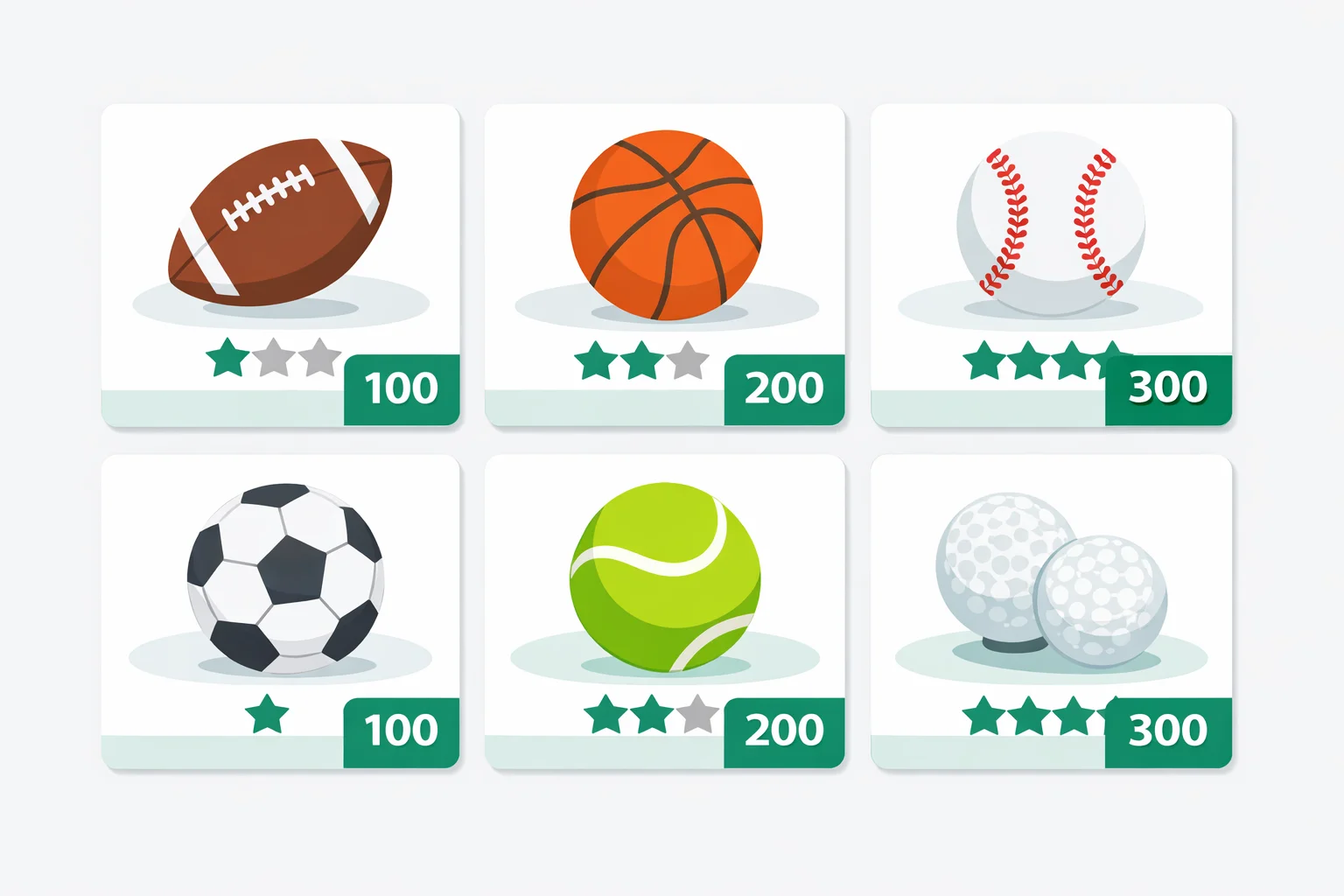
Breadth Is the Rarest Thing in Sports Fandom
Depth is easy to find. Any bar in Pittsburgh holds three people who can recite Steelers draft classes back to 1974. Span is the scarce thing — the person who can do that and tell you how many clubs a golfer is allowed to carry, and knows what happens at 40-40.
Sports fandom silos hard, and it silos along predictable lines: geography, family, and whatever was on television when you were eleven. An American fan raised on Sunday football usually has a soccer gap. A fan raised on the Premier League usually has a baseball gap shaped exactly like a diamond they've never had explained to them. Neither is a knowledge failure. It's an exposure difference, and this quiz is built to make it visible rather than to punish it.
So the point totals are rigged against specialists on purpose. Seven of the eight events are worth 6 points and the Olympics is worth 8 — meaning a single sport tops out at 16% of the board even if you answer every question in it perfectly. Nobody clears 50 on one league. The math simply won't allow it.
Why 14 Right Answers Can Beat 20
Every question carries a weight: 1 point for a warm-up, 2 for a starter, 3 for a Hall of Fame question. Eight warm-ups, nine starters, eight Hall of Famers, and the board totals exactly 50. That weighting produces the result people find hardest to believe, so here it is worked out with real numbers.
Player A answers every warm-up and every starter correctly and misses all eight of the hard ones. That's 17 right out of 25 — a 68% hit rate — and it scores 8 + 18 = 26 points.
Player B gets 14 right: all eight Hall of Fame questions, four starters, two warm-ups. That's a 56% hit rate, three fewer correct answers than Player A, and it scores 24 + 8 + 2 = 34 points. Player B lands a full band higher.
This isn't a gimmick — it mirrors how sports knowledge actually distributes. Knowing that a touchdown is worth six is not evidence of anything. Knowing that France Football, not FIFA, awards the Ballon d'Or is evidence of a genuine reading habit. The scoring is designed so the second kind of knowledge is what moves your number.
The Eight Events, and What Each One Is Testing
The running order never changes, which means you can see your weak event coming. Here's what each block of questions is actually probing:
| Event | Qs | Pts | What it tests | Hardest question hinges on |
|---|---|---|---|---|
| 🏈 Football | 3 | 6 | Down system, a fixed tradition, championship history | Perfection — and who never quite had it |
| 🏀 Basketball | 3 | 6 | Court geometry and award voting | Unanimity |
| ⚾ Baseball | 3 | 6 | Diamond measurements and integration history | April 1947 |
| ⚽ Soccer | 3 | 6 | Laws of the game and award governance | A French magazine |
| 🏒 Ice Hockey | 3 | 6 | Rink numbers, dynasties, rink slang | A fight |
| 🎾 Tennis | 3 | 6 | Scoring language, surfaces, one legendary season | Olympic gold |
| ⛳ Golf | 3 | 6 | Scoring terms, venues, equipment rules | The number 14 |
| 🏅 Olympics | 4 | 8 | Origins, symbolism, all-time medal records | Five continents |
The Olympics gets a fourth question because it's the only event on the board that contains all the others. Tennis, golf, football, basketball and hockey have all appeared at Games in some form, which makes Olympic questions the closest thing to a genuine crossover category.
Five Questions That Quietly Wreck Scores
Some questions fail people for interesting reasons rather than obscure ones. These five do the most damage, and each one fails in a different way.
The 14-club limit. Most guesses land on "no limit" or 12. The real answer is 14, capped in 1938 after players started hauling twenty-plus clubs around and turning caddies into pack animals. Carry a fifteenth today and you lose two strokes per hole, up to a maximum of four. It's the most testable rule in golf and almost nobody who doesn't play knows it.
The Gordie Howe hat trick. A goal, an assist and a fight in one game. The reason it makes such a good question is the punchline underneath it: Howe is credited with only two of them in a twenty-six-season career. The thing named after him is something he barely did.
Who awards the Ballon d'Or. France Football, a French magazine, since 1956. The confusion is entirely rational — FIFA co-branded the trophy as the FIFA Ballon d'Or from 2010 to 2015, so a whole cohort of fans learned it as a FIFA award. Anyone who came to the sport in that window gets this wrong for a completely understandable reason.
The unanimous MVP. One player, once: Stephen Curry in 2015-16. Not Jordan, not LeBron, not Kareem. Shaquille O'Neal came within a single first-place vote in 2000, when one writer picked Allen Iverson. If you followed the reasoning "it must be the most dominant player ever," you got it wrong for the right reason.
The five Olympic rings. They represent the five inhabited continents united by the Games — not five founding nations, not five original sports. The International Olympic Committee is explicit that no individual ring is assigned to a specific continent, despite how often you'll hear otherwise at a pub table.
Everyone Has a Blind Spot. Here's Where Yours Is.
The blind-spot panel at the end of the quiz is the part people screenshot, and its answers are boringly predictable once you've seen enough of them. Blind spots cluster by passport and by birth year.
North American fans typically drop soccer and tennis — specifically the penalty-spot distance and anything involving surfaces. Fans outside North America drop baseball first and American football second, usually on measurements rather than history. Younger fans lose points on anything before 2000; older fans lose them on the 2015-16 records that rewrote three sports at once. And golf catches nearly everyone who has never carried a bag.
Once you know the shape of your gap, the fix is specific rather than general. If football sank you, the NFL quiz runs 25 questions as a single drive down the field and covers rules, helmets and Super Bowl history in one sitting. If basketball was the weak bar, the NBA quiz goes deep on dynasties and the record book. Baseball gaps close fastest with the MLB baseball quiz, which walks through nine innings of history, and if the soccer bar embarrassed you, the soccer quiz is structured as a full World Cup bracket you have to survive round by round.
Hockey, tennis, golf and the Olympics don't have dedicated quizzes here yet, which is precisely why they're the four events where a couple of hours of reading buys the most points on a retake.
What Sports Recall Actually Measures
Here's the uncomfortable finding for anyone who thinks trivia measures intelligence. In 1988, Donna Recht and Lauren Leslie ran a study with 64 junior-high students, sorting them on two axes: reading ability and baseball knowledge. Everyone read a passage describing half an inning and then reenacted it on a model field. The students who were poor readers but knew baseball outperformed the strong readers who didn't. Prior knowledge beat general ability outright.
That fits the older and more famous result from chess. Chase and Simon showed in 1973 that masters recall real board positions dramatically better than novices — but hand them a board with pieces scattered at random and the advantage evaporates almost entirely. Experts aren't remembering more; they're remembering in meaningful chunks that novices can't see.
Apply that to this quiz and the eight bars on the results screen stop being a scorecard and start being a map. Each one shows whether you've built a schema for that sport. You can't transfer the football schema to hockey — that's why breadth is genuinely harder than depth, and why the True Generalist profile is the rarest outcome on the board. Every new sport is a structure you have to build from nothing.
All Five Results and Four Fan Profiles
Every score lands in one of five bands, and separately in one of four fan profiles based on how many of the eight events you cleared at 60% or better. Two people can score identically and get very different profiles — that's the point.
🏆 First-Ballot Hall of Famer (43-50). You converted the 3-point questions, which is the only route into this band. Golf's bag limit, the Ballon d'Or's publisher, a unanimous MVP — these aren't facts that arrive by having a TV on in the background. This is the score of someone who reads about sport.
🥇 Franchise Player (34-42). Wide and deep, a couple of deep cuts short of the top. Scores here almost always mean six or more events cleared, with the gap to the top band sitting in two hard questions rather than a missing sport.
🎯 Starting Lineup (25-33). The honest well-rounded fan. You took the rules, you took the sports you follow, you gave points back on the two or three you never watch. Half the board is still available and almost all of it sits in the events you already know you skipped.
📻 Bench Player (15-24). Sport as social knowledge rather than subject knowledge — usually one strong event carrying seven weak ones. It's also the cheapest band to climb out of, since all eight warm-up questions are pure rules.
🍿 Casual Spectator (under 15). Background noise rather than a subject. Scores down here come mostly from guessing on measurements and slang, both of which are learnable in an afternoon.
The profiles run alongside those bands. True Generalist means seven or eight events cleared, the rarest shape here because it requires knowing sports you have no personal reason to follow. Broad-Spectrum Fan is five or six — you follow past your home league and the bars prove it. Two-League Fan is three or four and the most common shape of all: two sports you love, a couple you tolerate, the rest blank. Single-Sport Specialist is two or fewer, which is depth without span, and exactly what this board is designed to expose.
How to Move Up a Tier Before Your Next Watch Party
Rules first, records later. Every event's 1-point question is a rule or a measurement — 10 yards, 5 skaters, 11 players, 9 innings, deuce, birdie, four years. That's 8 points sitting on the board for anyone willing to spend twenty minutes on eight rulebooks, and it alone lifts a Casual Spectator into Bench Player territory.
After that, work the blind spot rather than the strength. There's a real temptation to go and read more about the sport you already scored 100% in, because it feels good. It buys you nothing — that event is capped. The 6 points sitting untouched in golf or tennis are the only points genuinely available to you.
The highest-yield move is watching one championship event in your weakest sport with the rules open on your phone. A single Stanley Cup Final, one Sunday at Augusta, one final at Roland-Garros — three hours of attention builds more usable structure than an hour of flashcards, because you're watching the schema assemble itself in real time. Then leave it a few days before retaking. Coming straight back tests your memory of this page; coming back on Thursday tests whether you actually learned anything.
Worth knowing where sport sits in the wider picture, too. Our General Knowledge Quiz runs the same breadth-over-depth logic across six subjects instead of eight sports, and it rates every question by how many people get it right — so you find out whether the breadth you just demonstrated here is a sports habit or a general one.
And if you find yourself defending your blind spot with "that sport is boring" — that's the schema talking. Nothing is boring once you can see the structure.