Soccer Quiz: Where Football's Rules, Records and Even Its Name Came From
Before you argue with a single answer on this soccer quiz, settle a smaller argument first: the word soccer is English. Not American — English. It was coined by Englishmen, in England, about a game Englishmen had just finished writing the rules for, and Britain used it happily for roughly a hundred years before deciding it sounded like something the Americans had done to them.
That is the pattern behind most of the questions above. Almost everything people think they know about football's origins is off by a decade, a country, or an entire rule. The offside law you grew up with is not the one the sport started with. The first World Cup nearly happened without Europe. And the most famous trophy in the game was once recovered from under a hedge by a dog.
The Word "Soccer" Was Invented in England
In 1863 the newly formed Football Association had a naming problem. Several codes of football existed side by side, and the one the FA had just codified was formally called association football to distinguish it from rugby football. That is a mouthful, and at the time Oxford undergraduates had a fashionable habit of clipping long words and bolting -er onto the stump. Breakfast became brekker. Rugby football became rugger. Association became assoc, then soccer.
The word stuck in Britain for generations. Matt Busby, who managed the club in question three, called his 1973 autobiography Soccer at the Top. British newspapers and the FA's own publications used it without a flicker of embarrassment well into the 1970s. What changed was American usage: as the word became the standard term in a country where football already meant something else, Britain quietly stopped using it to avoid sounding like a foreigner talking about the domestic game. Economist Stefan Szymanski tracked this in a 2014 paper and found the British drop-off is startlingly sudden — the term collapses in British print right as it climbs in American print. If you want the full etymology, the record of what the sport has been called is unusually well documented for a word people fight about this much.
Eleven Clubs, Six Meetings, One London Pub
On 26 October 1863, representatives of eleven London clubs and schools met at the Freemasons' Tavern on Great Queen Street to agree a single set of rules. It took six meetings across about six weeks, and it did not end in agreement — it ended in a split.
The fight was over two things: running with the ball in your hands, and hacking, which meant kicking an opponent in the shins. Blackheath wanted both retained and argued, memorably, that banning hacking would produce a game of "Frenchmen" who lacked the pluck for it. They lost the vote, withdrew, and went on to help found the Rugby Football Union in 1871. Football and rugby are not distant cousins; they are the two halves of one argument in one room.
What the FA actually produced that winter was thirteen laws, and the omissions are the interesting part. There was no crossbar — a tape was strung between the posts until 1875. There was no goalkeeper as a defined role until 1871. And there was no penalty kick until 1891, when an Irish goalkeeper named William McCrum proposed one and was met with genuine outrage; opponents called it the "death penalty" and insisted that no gentleman would deliberately foul in the first place. The modern Laws of the Game still run to seventeen laws, only four more than that first draft.
Why Has One Law Been Rewritten More Than Any Other?
Offside is the only law in the sport that has been fundamentally rebuilt three separate times, and each rebuild changed how football looks. In the 1863 laws, offside was effectively a rugby rule: any forward pass was illegal. In 1866 it loosened to allow forward passing provided three opponents stood between the attacker and the goal line. And in 1925 that three became two.
The effect was immediate and measurable. Goals in England's Football League jumped by roughly a third in the first season under the new law — from around 4,700 to over 6,300 — which remains the single largest scoring shift ever produced by a rule change. Defences had no answer until Arsenal's Herbert Chapman pulled his centre-half back into defence and invented the WM formation, the ancestor of every back line since.
The rewrites did not stop. In 1990 the law changed so that a player level with the second-last defender is onside, deliberately tilting the balance toward attackers. In 2005 the meaning of "interfering with play" was tightened. And in 2018, VAR made offside a question of millimetres, which is why the semi-final question about video review sits in the same round as the one about 1925 — both are moments the sport decided that precision mattered more than flow.
The First World Cup Almost Had No Europeans in It
Thirteen teams entered the 1930 tournament, and only four of them were European: France, Belgium, Romania and Yugoslavia. The rest of Europe declined, because reaching Montevideo meant a sea crossing of two to three weeks each way and clubs were not enthusiastic about losing players for two months. Romania reportedly went because King Carol II personally selected the squad and negotiated leave from the players' employers.
Uruguay had earned the tournament twice over. They had won Olympic gold in 1924 and 1928, the closest thing to a world championship at the time, and 1930 was the centenary of their constitution. They built the Estadio Centenario for it, and won it, and then skipped the next two World Cups in protest at how few Europeans had bothered to show up. Twenty years later they returned to win the strangest edition of all: the 1950 tournament had no final, just a four-team final group whose last fixture happened to decide everything. Brazil needed a draw at the Maracana and lost 2-1, in front of a crowd usually given as somewhere between 173,000 and 200,000 — still the largest attendance in the sport's history. Plotting that entry list is half a geography lesson in itself; if Yugoslavia and Romania gave you pause, the countries of the world quiz covers the same ground on a much larger map.
Here's the Bit Where a Dog Saves the World Cup
In March 1966, four months before England hosted the tournament, the Jules Rimet trophy was on public display at Westminster Central Hall and someone walked off with it. The theft was a national embarrassment. The FA quietly commissioned a replica in case it was never seen again.
A week later, a man named David Corbett took his collie for a walk in Beulah Hill, South London. The dog, Pickles, went for a parcel wrapped in newspaper under a hedge. Inside was the World Cup. Pickles got a medal from the Canine Defence League, a year of free dog food and a role in a feature film; Corbett got a reward reportedly larger than the win bonus paid to the England players who lifted the thing four months later. The dog died the following year, chasing a cat while still attached to his lead.
The trophy's luck ran out eventually. Brazil won it outright in 1970 by taking a third title, and in 1983 it was stolen again from the Brazilian federation's headquarters in Rio. It has never been recovered, and is widely believed to have been melted down. Every winner since 1974 lifts a trophy that goes back to FIFA after the celebrations — what teams keep is a gold-plated replica. Nobody wins the actual cup anymore, and Pickles is the reason the policy exists.
The Records the Format Itself Has Made Unbreakable
Some records survive because nobody has been good enough. Others survive because the tournament has changed shape around them, and the quarter-final and final rounds of this quiz are built almost entirely out of the second kind.
| Record | Holder | Why it is effectively frozen |
|---|---|---|
| 13 goals at one World Cup | Just Fontaine, 1958 | Six matches, 2.2 goals a game. A modern winner plays seven and no one has passed nine since. |
| 3 winners' medals | Pele, 1958–1970 | Requires a country good enough to win across a twelve-year span, and a career long enough to see it. |
| 16 career World Cup goals | Miroslav Klose | Four tournaments of scoring. Most strikers get two, and the second is usually the wrong side of 30. |
| 4 lost finals | Germany | You have to be permanently excellent to lose that many, which is a harder ask than winning one. |
| 17 Women's World Cup goals | Marta | Scored across five different tournaments — a span no men's player has matched. |
There is a related quirk worth knowing, because it wins arguments: Brazil have never officially lost a World Cup final. Not because they always win them, but because the one they famously lost, in 1950, was not technically a final. That is the sort of fact the semi-final round of this quiz is made of.
Why This Quiz Eliminates You Instead of Scoring You
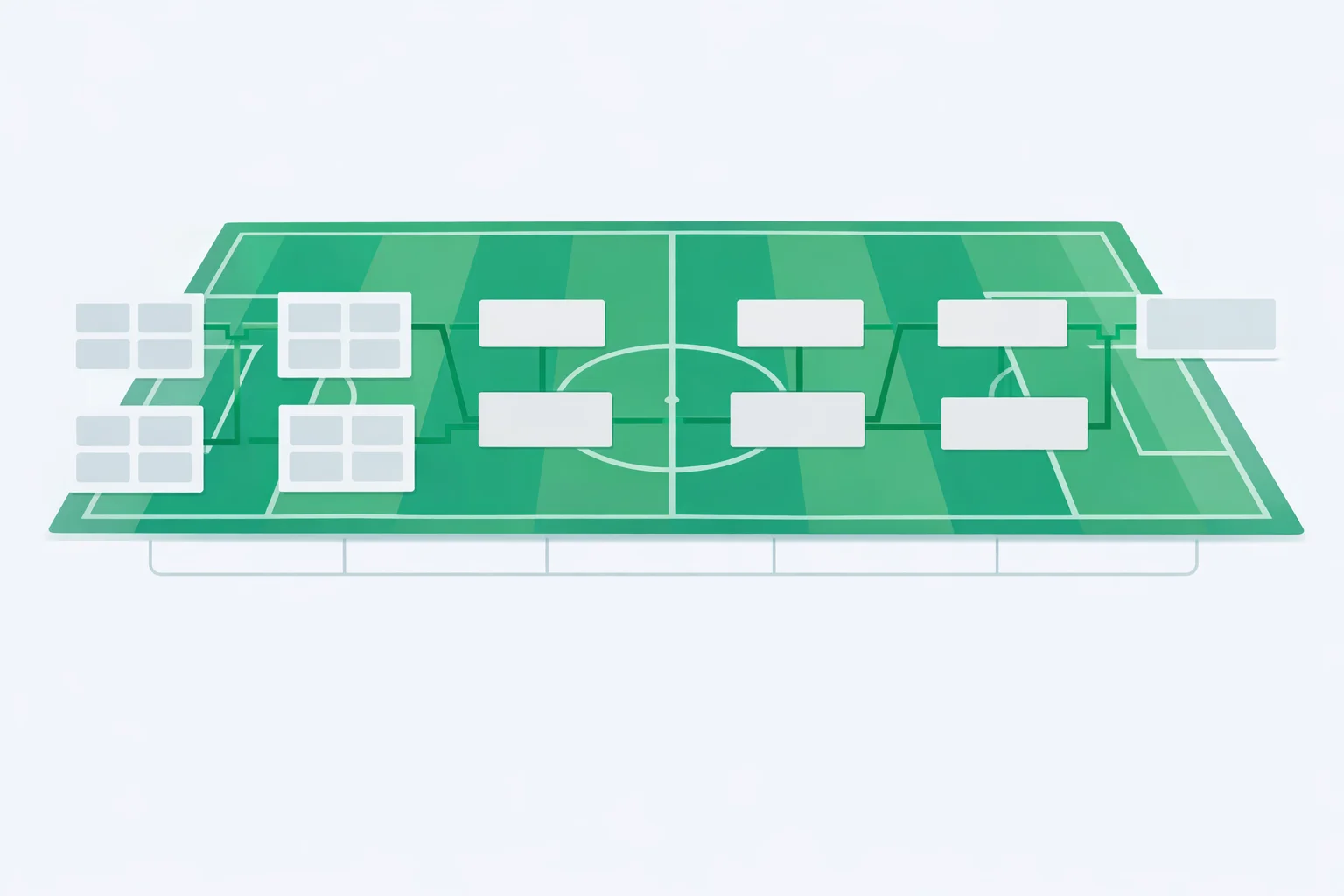
A flat score out of 25 hides the shape of what you know. Two people can both finish on 17 and have completely different football brains — one strong on tournaments and hopeless on the rulebook, the other the reverse. So this quiz is run as a tournament instead. Five rounds, each with a threshold you either clear or don't: five of nine in the group, two of four in the last 16 and the quarters, then three of four in both the semi-final and the final.
The thresholds tighten deliberately. A group stage is meant to be survivable — you can drop four questions and still go through, exactly as a real team can lose a match and qualify. The semi-final and final allow one mistake between four questions, which is roughly the margin a knockout tie actually gives you. And because the questions keep coming after you go out, the results screen can tell you something a score cannot: whether you would have gone deeper had one early answer landed. A surprising number of people are carrying a semi-final run and lose it in the group stage on a rules question.
The four-topic breakdown at the end exists for the same reason. World Cup history is ten of the 25 questions, players and records six, laws of the game five, club football four. That weighting is intentional — a quiz that leaned on this season's league tables would be wrong within months, while a rule change from 1925 will be true forever. Sibling quizzes in this category use different models for the same reason: the NFL quiz scores you as drives and touchdowns, the NBA quiz weights every question as a 1, 2 or 3-point shot and hands you a shot chart, and the MLB quiz refuses to weight anything at all — every answer is one hit, and the result is printed as a batting average. The sports trivia quiz goes the other way entirely and refuses to specialize: eight sports, 25 questions, and a per-sport percentage that shows exactly where football knowledge stops carrying you.
All Six Ways Your Run Can End
🧳 Group Stage Exit. Under five of nine in the opening round. The group questions are the ones a casual fan is expected to clear — Brazil's five titles, the 1930 hosts, ninety minutes, the second yellow card. Falling short here usually means a couple of near-misses rather than a blank, and it is the single easiest tier to climb out of on a second attempt.
🎟️ Out in the Last 16. You went through the group and met the first round that needs recall instead of recognition. Klose's 16 goals, Morocco's 2022 run, the only country never to miss a World Cup. This is where fans who watch tournaments but have never read about them tend to stop, and it is a gap of about four facts.
⚽ Quarter-Finalist. Top third of all players. Going out here nearly always means the laws questions did it — the minimum number of players, the 1992 breakaway, Fontaine's 13. Watching football teaches you almost nothing about the rulebook, which is precisely why this round works as a filter.
🥉 Semi-Finalist. Three of four required, and you got two. This round holds VAR's debut tournament, the 1950 edition with no final, the pre-1925 offside law and Marta's record. Reaching it means you carry both the history and most of the rule changes; whichever one you dropped is statistically likely to be offside.
🥈 Runner-Up. Four questions from the trophy and one short. The final is made of things that cannot move: 48 teams, Pele's three medals, Brazil winning in Sweden in 1958, and a stolen cup found by a dog. Roughly seven players in a hundred finish here, which is better company than it feels like in the moment.
🏆 World Champion. All five rounds cleared, which about three percent of players manage. It takes more than fandom — it takes having read about the sport, because the final round is deliberately built from 1925, 1958, 1966 and a format change most people only half-registered.
Eight Answers That End Arguments
If you take nothing else from this page, take these eight. Soccer is an English word, not an American one. The FA wrote the first laws in 1863, and rugby exists because that meeting split. Offside required three defenders until 1925, not two. The 1950 World Cup had no final, which is why Brazil have never lost one. Just Fontaine scored 13 in a single tournament and Klose holds the career record at 16. Pele is the only three-time winner. Morocco were the first African semi-finalists, in 2022. And the Jules Rimet trophy was found by a dog called Pickles.
Those eight cover fourteen of the 25 questions here, which is the difference between a group stage exit and a final. They are also, not coincidentally, the ones most confidently repeated wrong in pubs. If the 1930 entry list is where you enjoyed yourself most, the flags of the world quiz runs the same recognition instinct across every national side's home country — and it will tell you quickly whether you actually know Uruguay from Paraguay, or only know their shirts.
One tournament exit on that list started a manga. Japan led Belgium 2-0 in the 2018 round of 16 and lost 3-2 to a counter-attack from their own corner; weeks later, Blue Lock began serialising on the argument that the country produces beautiful teams and nobody selfish enough to finish. If you want the psychology rather than the trivia, the Blue Lock quiz sorts you onto the ego and devotion axes that sport psychologists have actually been measuring since 1984.