Flags of the World Quiz: The Trickiest Look-Alike Flags and How to Tell Them Apart
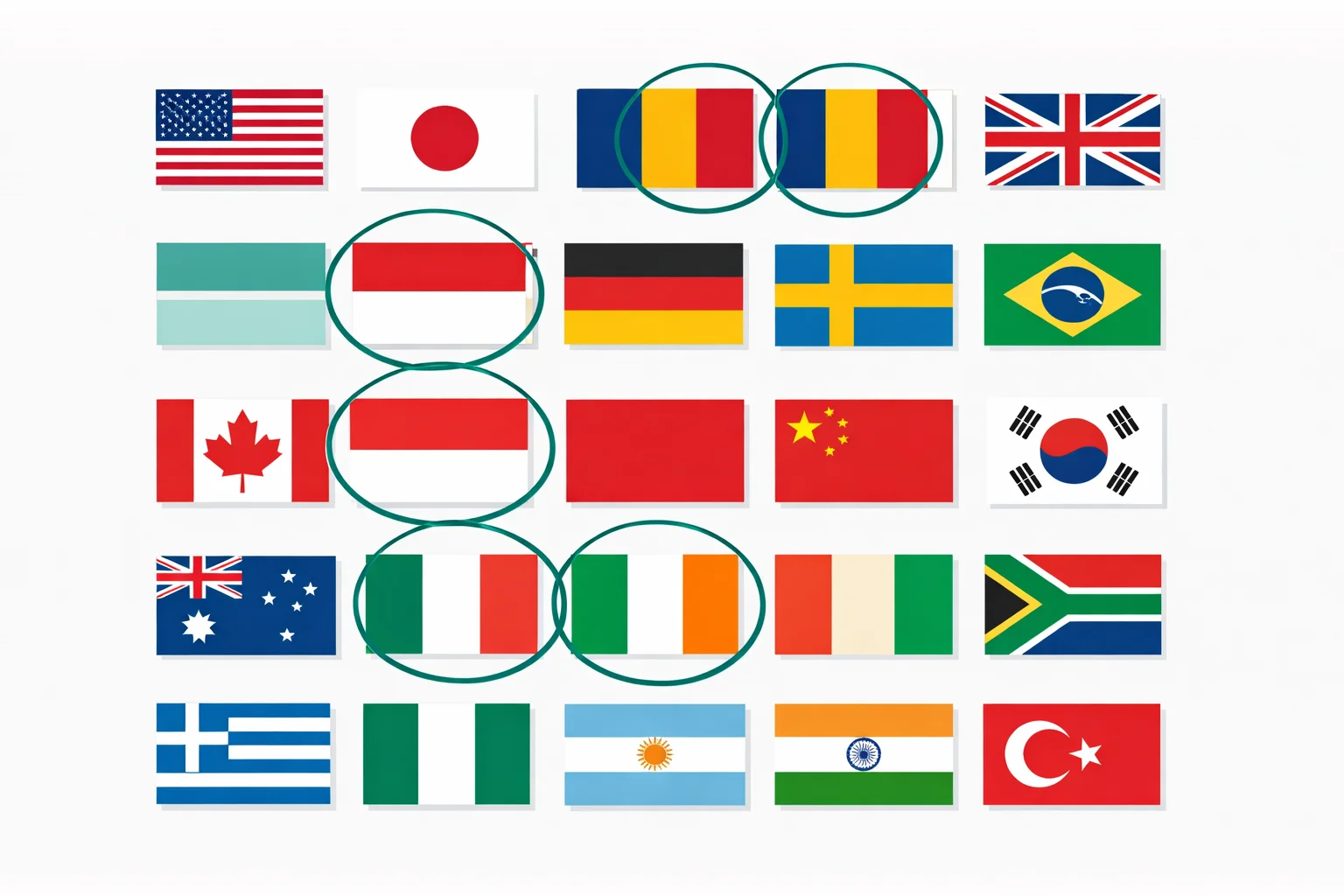
A flag quiz sounds simple until you're staring at two nearly identical blue-yellow-red tricolors and have to decide which is Chad and which is Romania. Most people can identify about 30 to 40 flags on sight — roughly 15% to 20% of the world's sovereign nations. The rest? They blur together in a sea of stripes, crosses, and crescents. This quiz tests 25 flags across four difficulty tiers, from universally recognized icons (the Stars and Stripes, Japan's red circle) to expert-level look-alikes that have caused actual diplomatic disputes.
Why Flag Quizzes Are Harder Than You Think
Here's the thing about flag recognition that catches people off guard: there are 195 sovereign nations and only a handful of distinct design elements to go around. Red, white, and blue appear on roughly 30% of all flags. Stars show up on over 60. Crescents appear on more than 20. Stripes — horizontal, vertical, diagonal — are everywhere. So when you see a horizontal red-white-blue tricolor, your brain has to pick from the Netherlands, Luxembourg, France (rotated), Paraguay, or half a dozen others.
A 2019 survey by Sporcle found the average person identified 22 out of 50 randomly selected flags. Geography teachers averaged 38. The pattern? People crush the flags they've seen on news broadcasts, sports jerseys, and product labels — then hit a wall once the quiz reaches Africa, Oceania, and Central Asia. If you scored well on our quiz, you're likely someone who consumes international media or has traveled widely. If you struggled, you're in the vast majority.
How This Flag Quiz Works
Each round shows you a flag and four country options. You get 25 questions drawn from a pool of 40, split into four tiers:
- Warm-Up (1 point) — Iconic flags like the US, Japan, Canada, and Brazil. If you watch the Olympics, you know these.
- Getting Harder (2 points) — Recognizable but confusable. Mexico vs Italy, Norway vs Iceland, Argentina vs El Salvador.
- Tricky (3 points) — This is where the look-alikes start. Ireland vs Ivory Coast. Romania vs Chad. Monaco vs Indonesia.
- Expert Only (4 points) — Obscure Pacific island nations, Pan-African tricolors, and the flag pairs that have literally caused international disputes.
Harder tiers earn more points, so correctly identifying Nauru is worth four times more than spotting the American flag. Your final percentage reflects not just how many you got right, but how difficult the ones you nailed were. This is also what makes it a solid companion to our Countries of the World Quiz, which tests whether you can name every country from memory rather than recognize its flag. For another angle on country knowledge, the World Capitals Quiz challenges you to match 30 countries to their capital cities.
The Look-Alike Problem: Flags That Fool Everyone
Some flag pairs are so similar they've caused real-world confusion. Telling near-twins apart by one small detail is a trainable skill — it's the exact same visual discrimination the hiragana quiz demands with Japanese characters like ぬ and め. Here are the most notorious offenders:
| Pair | What's Different | How to Remember |
|---|---|---|
| 🇹🇩 Chad vs 🇷🇴 Romania | Chad's blue is slightly darker (indigo vs cobalt) | Chad protested to the UN in 2004 — "C"had = darker (C comes before R) |
| 🇲🇨 Monaco vs 🇮🇩 Indonesia | Monaco's flag is 4:5 ratio (shorter), Indonesia's is 2:3 | Indonesia is bigger — bigger country, wider flag |
| 🇮🇪 Ireland vs 🇨🇮 Ivory Coast | Ireland: green-white-orange (L to R). Ivory Coast: orange-white-green | "I"reland = green "I"s on the left (hoist side) |
| 🇱🇺 Luxembourg vs 🇳🇱 Netherlands | Luxembourg uses light sky blue, Netherlands uses dark blue | "L"uxembourg = "L"ighter blue |
| 🇲🇱 Mali vs 🇸🇳 Senegal | Same colors, but Senegal has a green star in the center | "S"enegal has a "S"tar |
Chad and Romania have been arguing about their flags since 1989. Chad's president brought the issue to the UN, asking Romania to change its design. Romania refused, pointing out they'd used the design since 1848. As of 2026, neither country has budged.
Flag Design Patterns That Help You Cheat (Legally)
Flags aren't random. They follow regional design conventions that, once you spot them, make identification dramatically easier. If you can spot the pattern, you can narrow four options down to one without even recognizing the specific flag.
- Nordic Cross — An offset cross shifted toward the hoist (left). Denmark, Sweden, Norway, Finland, and Iceland all use it. If you see an asymmetric cross, it's Scandinavian. Period.
- Union Jack canton — Australia, New Zealand, Fiji, and Tuvalu include the British flag in their upper-left corner. Former British colonies — instant tell.
- Crescent and star — Turkey, Pakistan, Tunisia, Algeria, Malaysia, Mauritania. Islamic heritage is the common thread.
- Vertical tricolor — France popularized this. If you see vertical stripes, check for European origins first.
- Coat of arms on stripes — Central and South American nations love this: Mexico, El Salvador, Ecuador, Paraguay. Nineteen flags in the Americas belong to Spanish-speaking countries — if you can identify them all, our Spanish quiz will tell you whether you could actually order lunch under any of them.
These patterns work because flags are designed to communicate identity, and nations with shared history tend to signal that kinship through design. The Europe Map Quiz tests a related skill — recognizing borders instead of banners — and many players find that flag knowledge and map knowledge reinforce each other. The same recognition machinery works on any dense symbol set: the periodic table quiz swaps 190-odd flags for 118 element symbols and produces almost identical score curves, with the same cliff once the familiar ones run out.
Corporate designers reached the same conclusion decades ago, which is why a good logo and a good flag obey nearly identical rules: two or three colors, a silhouette you could cut from paper, no fine detail. The logo quiz makes that overlap unmistakable by blurring every mark before you answer — and the brands that survive the blur are exactly the ones built like flags. US states solve the identical design problem inside a six-by-twelve-inch rectangle: our license plate quiz blacks out the state name on 20 plates, and six of them carry no slogan and no picture at all — leaving colour and layout to do the whole job, exactly as a flag does.
Pan-African, Pan-Arab, and Pan-Slavic Colors Explained
Three color families dominate flag design across entire regions, and understanding them unlocks dozens of flags at once.
Pan-African colors (red, gold/yellow, green) — originating from the Ethiopian flag, these colors appear on the flags of Ghana, Senegal, Mali, Guinea, Cameroon, Burkina Faso, and many more. Ethiopia was never colonized, so its colors became a symbol of African independence. When you see green-yellow-red on a tricolor, think sub-Saharan Africa first. To build spatial memory alongside flag recognition, our Africa map quiz covers all 54 African countries on a click-the-map format.
Pan-Arab colors (red, white, black, green) — derived from the 1916 Arab Revolt flag, used by Jordan, Palestine, Iraq, Kuwait, UAE, Sudan, and Syria. The combination represents different Arab dynasties or Islamic ideals depending on the country. A flag with these four colors in any arrangement? Almost certainly Middle East or North Africa.
Pan-Slavic colors (red, white, blue in horizontal stripes) — Russia's flag popularized this, and you'll find variations in Slovakia, Slovenia, Croatia, Serbia, and the Czech Republic. Slavic identity drives the palette; what differs are the coats of arms, shields, or stripe arrangements each nation adds to distinguish itself.
The 5 Weirdest National Flags on Earth
Not every flag plays by the rules. These five break convention in ways that make them instantly memorable:
- Nepal 🇳🇵 — The only non-rectangular flag. Two stacked triangular pennants with a crimson background. Its exact construction is described by a 23-step geometric algorithm written into the constitution.
- Mozambique 🇲🇿 — Features an AK-47 with a bayonet crossed over a hoe. The only national flag with a modern assault rifle.
- Bhutan 🇧🇹 — A white thunder dragon (Druk) on a diagonally split orange and yellow background. "Druk Yul" means "Land of the Thunder Dragon."
- Kiribati 🇰🇮 — A golden frigate bird flying over a rising sun with red and white waves. One of the most pictorial and detailed national flags.
- Switzerland 🇨🇭 — One of only two square sovereign flags (Vatican City is the other). The white cross on red is also the basis for the Red Cross logo — just with inverted colors.
These outliers make great quiz anchors because once you've seen them, you never forget. Nepal's shape alone makes it a guaranteed correct answer for anyone who's taken a flag quiz before. If you enjoy geography trivia like this, the State Capitals Quiz scratches a similar itch — testing knowledge that feels like it should be easy but consistently stumps people. Or try our general world geography quiz for 25 questions covering everything from rivers and mountains to the world's weirdest borders. Flags also happen to be how most people first learn a country exists at all — the 1930 World Cup fielded thirteen nations and half of Europe stayed home, which the soccer quiz uses as its opening test.
All 5 Flag Quiz Result Tiers
Your weighted score places you into one of five tiers based on how well you did across all difficulty levels:
👑 Vexillology Master (96%+) — You nailed even the expert look-alikes: Chad vs Romania, Monaco vs Indonesia, Ivory Coast vs Ireland. Fewer than 2% of quiz takers reach this tier. You either study flags seriously or you've traveled extensively across multiple continents. The term "vexillology" — the study of flags — actually fits you.
🏆 Flag Expert (80-95%) — The easy and medium tiers were no challenge, and you caught most of the tricky ones. The expert tier is where you might have dropped a point or two on an obscure Pacific island flag. Top 10% of all players — genuinely impressive.
🌍 World Traveler (60-79%) — You know your major flags cold and caught some curve balls. The look-alike pairs and small-nation flags are where the points slipped away. This is where most geography enthusiasts land on their first attempt.
🗺️ Getting There (40-59%) — You crushed the iconic flags but the mid-range and expert tiers exposed blind spots. Totally normal — these are the flags that trip up most people. The look-alike cheat sheet above will help you jump a tier on your next attempt.
🧭 Beginner Explorer (under 40%) — Flags are harder than most people realize, and you've just taken the first step. Focus on one continent at a time, learn the design patterns (Nordic cross, Pan-African colors), and retake. Most people improve by 15-20% on their second try.
How to Actually Get Better at Flag Identification
Random repetition is slow. Deliberate practice — targeting your weak spots — is fast. Here's a concrete plan:
- Learn by region, not randomly. Start with Europe (Nordic crosses, EU blues) or the Americas (coat-of-arms striped flags). Master one group before moving on.
- Memorize the look-alike tells. Print the comparison table above or screenshot it. For each pair, drill the ONE difference until it's automatic.
- Use the "anchor flag" method. Pick one flag per region that you know cold (Japan for Asia, Brazil for South America). Then learn neighbors relative to that anchor.
- Watch international sports. The FIFA World Cup, Olympics, and UEFA Champions League are basically flag drills with commentary. Your brain encodes flags faster when they're attached to exciting moments.
- Retake this quiz. Seriously — the question pool rotates, so you'll get different flags each time. Spaced repetition (today, in 3 days, in a week) is the fastest path to permanent recall. Or try the Daily Geography Challenge — 10 fresh questions each day that mix flags, capitals, borders, and more. The daily streak mechanic makes it easy to build a consistent geography habit.
The single biggest shortcut? Learn the three pan-color families first. Pan-African (red-gold-green), Pan-Arab (red-white-black-green), and Pan-Slavic (red-white-blue) collectively cover over 40 flags. That alone can bump your score by 15-20 points on a full-pool quiz. If you want to pair flag knowledge with spatial placement, our country map quiz tests whether you can click 50 countries on a blank world map — recognizing a flag is one thing, knowing where the country actually sits is another.