What the Periodic Table Quiz Doesn't Tell You: Symbol Origins, Group 3, and the Hydrogen Problem
Almost every periodic table quiz you will ever take treats the layout as settled fact — and it isn't. Chemists have been split into two camps for decades over where hydrogen belongs, and there is an entire column of the table, group 3, where different textbooks print different elements and both are considered defensible. The quiz above quietly sits on top of those arguments, because it has to. Every quiz does.
That is worth knowing before you judge your score. The table looks like a finished object, the way a map of the world looks finished, but it is a model that people are still tuning — and the parts they are still arguing about are exactly the parts that make it hard to memorise.
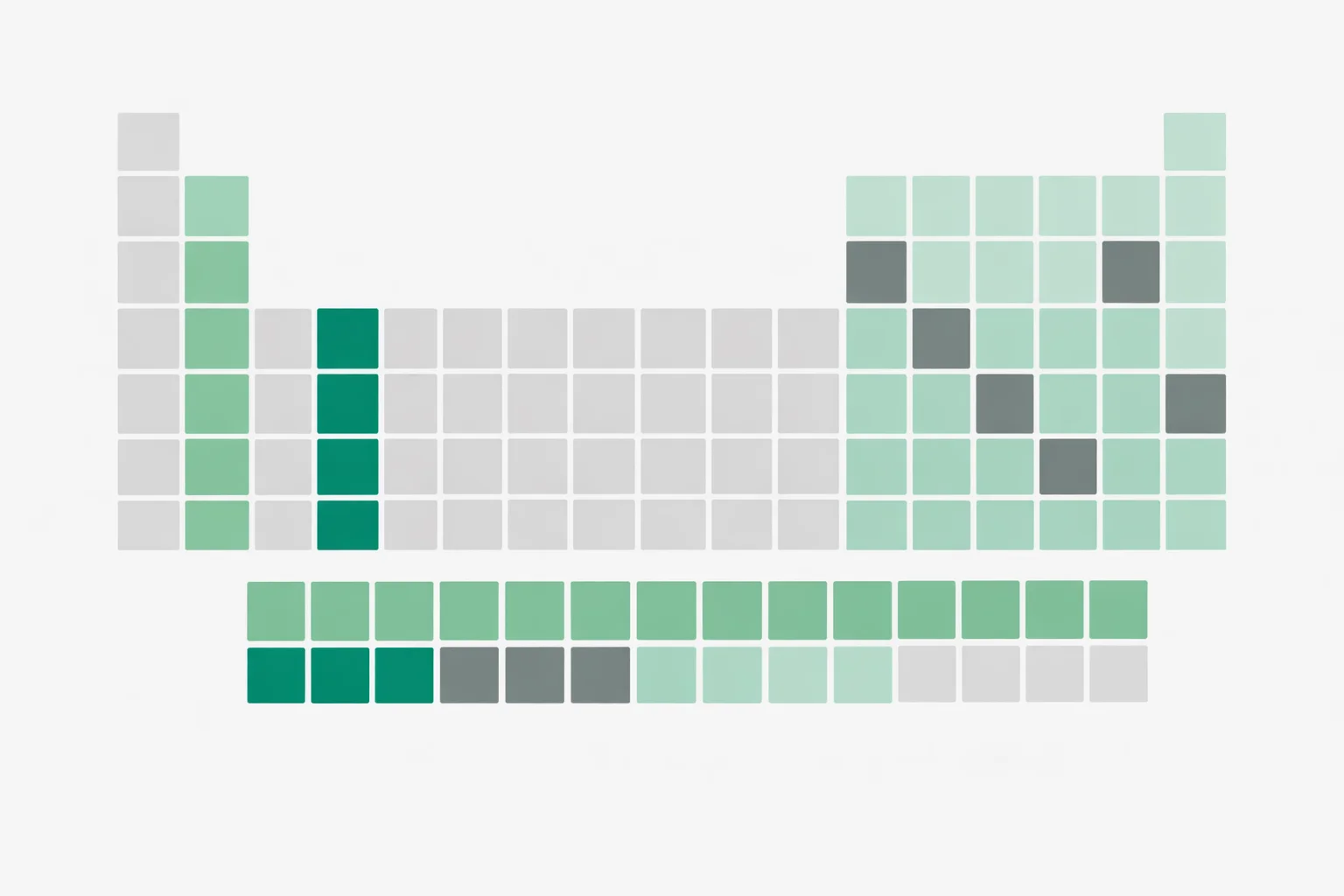
The Element Nobody Can Agree Where to Put
Hydrogen sits at the top of group 1, above lithium and sodium, on nearly every wall chart in nearly every classroom. It has one electron in its outer shell, which is what group 1 means, so the placement follows the rule.
Except hydrogen behaves nothing like the alkali metals. Lithium, sodium and potassium are soft silver metals that detonate in water. Hydrogen is a colourless gas that forms a diatomic molecule, and it needs just one more electron to fill its shell — which is exactly what fluorine and chlorine need, over in group 17. Some chemists argue it belongs there. Others put it in both places. A significant minority float it above the table entirely, unattached to any group, on the grounds that it is genuinely unique.
None of those camps is wrong, which is the point. The table organises elements by electron configuration, but it is used to predict chemical behaviour, and for hydrogen those two things point in different directions. When a quiz asks you for "the element in group 1, period 1" it is picking a side without telling you.
Two Camps, One Contested Column
The hydrogen argument is at least famous. The group 3 argument is stranger, because it affects a column most people never look at twice, and because you can spot which side a chart has picked in about two seconds.
Look at the third column, under scandium and yttrium. If it reads lanthanum and actinium, that chart follows the historical convention. If it reads lutetium and lawrencium, it follows atomic number order and ground-state electron configuration. In 2015 IUPAC formed a project specifically to resolve this, and the resulting report recommended the lutetium–lawrencium version. Most textbooks, most classroom posters and most of the periodic tables printed since then still show lanthanum and actinium — and the case each side makes runs to decades of back-and-forth in the chemistry journals.
| Layout | Group 3 shows | Argument for it | Where you'll see it |
|---|---|---|---|
| Historical | La and Ac | Matches how the f-block was first split off; familiar to every teacher | Most school textbooks and wall charts |
| Configuration-based | Lu and Lr | Keeps atomic numbers in unbroken order; matches ground-state electron filling | IUPAC's 2021 project recommendation, many university tables |
| Split / 15-wide f-block | Left blank or shows all 15 | Refuses to force a choice; shows the f-block as one unbroken series | Research papers, some specialist charts |
The quiz above avoids the question entirely — it never asks for a group 3 element — and the map draws the two f-block rows in the strip below, which is the arrangement everybody agrees is at least readable. If you want the official position, IUPAC publishes its own current periodic table and updates it when element names are approved.
Why 11 Elements Have Symbols That Look Wrong
Round 1 of the quiz is built almost entirely from these, and they are the reason a chemistry elements quiz feels unfair the first time you take one. Eleven elements carry symbols with no visible relationship to their English names, and the reason is a scheduling accident. Jöns Jacob Berzelius designed the one-and-two-letter symbol system in 1813 and drew the abbreviations from Latin, which was still the working language of science. The English common names for those same metals were centuries older and came from Germanic roots instead. Neither side gave way.
| Symbol | Element | Comes from | What the root means |
|---|---|---|---|
| Na | Sodium | natrium | Natron, the Egyptian mummification salt |
| K | Potassium | kalium | Arabic al-qalyah, "plant ashes" |
| Fe | Iron | ferrum | Latin for iron; gives us "ferrous" |
| Cu | Copper | cuprum | Aes cyprium — metal from Cyprus |
| Ag | Silver | argentum | Shining, white; Argentina is named for it |
| Sn | Tin | stannum | Originally a silver-lead alloy |
| Sb | Antimony | stibium | Kohl, the black eye cosmetic |
| Au | Gold | aurum | Glowing dawn |
| Hg | Mercury | hydrargyrum | Greek for "water-silver" |
| Pb | Lead | plumbum | Root of "plumbing" and "plumb line" |
| W | Tungsten | wolfram | Wolf's froth — it ate the tin during smelting |
Notice what they have in common: with the exception of tungsten, every one is a metal that was already in human hands before there was any such thing as chemistry. Gold, silver, copper, tin, lead, iron and mercury are the seven metals of antiquity. They had names in every European language long before anyone thought to abbreviate them. Learn that pattern and the eleven stop being eleven separate things to memorise — they become one rule with a couple of stragglers.
How the Four Rounds Score You
The four rounds are not four flavours of the same question. They test four different memory operations, and the score gap between them tells you something specific about where your knowledge is thin.
Round 1 gives you a symbol and asks for a name. That is recognition with a cue already on screen. Round 2 reverses it: you get the name and must produce the symbol from nothing, which is free recall. Cognitive psychologists have measured that asymmetry for over a century and it is large — the same material scores far higher when tested by recognition than by recall. If you cleared round 1 and stumbled in round 2, you have not forgotten the elements. You have stored them in a form that only activates when something prompts it.
Round 3 drops the label entirely and gives you a property. That requires you to have encoded the element as a thing that behaves, not a word that appears. Round 4 asks for coordinates — group, period, atomic number — which is the only round that tests whether you have the table as a spatial map rather than a list. People who studied chemistry recently tend to spike in round 4; people who studied it years ago tend to spike in round 3, because behaviour outlives position.
There is a practical upside to being tested this way rather than rereading a chart. The act of retrieving an answer strengthens memory more than restudying the same material for the same amount of time, an effect documented repeatedly since Roediger and Karpicke's 2006 experiments. If you want the elements to stick, taking this quiz three times across three days beats staring at a poster for an hour. How much it helps depends partly on how you process information in the first place — the learning style quiz is a reasonable way to work out whether diagrams, spoken repetition or physical practice does more for your retention.
Here's Where Mnemonics Actually Break Down
"Happy Henry Lives Beside Boron Cottage" and its many variants will get you through the first ten elements. Past about element twenty, every one of them collapses, and the reason is worth understanding rather than working around.
A mnemonic sentence encodes order. It is excellent for a list and useless for a structure, because it gives you no way to answer "what is below sulfur" without walking the whole sentence from the beginning. The periodic table is not a list. It is a grid where position carries meaning, and the entire value of it — the thing Mendeleev was actually doing in 1869 — is that elements in the same column behave alike.
Maths runs into the identical trap. Students memorise the unit circle as 32 separate coordinate values and then cannot answer "what is cos 225°" without reciting their way round from zero, when the circle is really three numbers reused in four quadrants. The unit circle quiz scores you by quadrant for exactly that reason — it separates people who learned the structure from people who learned the sentence.
The alternative is to learn the shape rather than the sequence. Rows 2 and 3 are the same eight-element pattern repeated one shell out: a reactive metal, a less reactive metal, a gap, then four nonmetals and a noble gas. Learn row 2 properly and row 3 costs you almost nothing. The transition metals in the middle are a block, not a line, and most people only ever need about a dozen of them. The f-block strip at the bottom can be treated as one object called "the rare earths" until you have a specific reason to care about neodymium. That reduces 118 items to roughly four chunks — which is exactly the number working memory handles comfortably. It is the same move that makes the anatomy quiz survivable, incidentally: nobody learns 206 bones as a list either, they learn five body systems and hang the names off those. Biochemistry does it too — the amino acid quiz asks for twenty structures, but only after sorting them into four side-chain families, because twenty separate molecules is unlearnable and four groups is not. Astronomy uses the same trick — the planet quiz flies the solar system in four legs rather than presenting twenty loose facts, so the outer planets arrive as a place you have travelled to instead of names at the end of a list. The Royal Society of Chemistry's interactive table is a good place to explore those blocks, since it lets you switch the whole table between properties and watch the trends move.
The Five Errors That Cost Students the Most Marks
These come up constantly, and four of the five are formatting rather than knowledge — which means they are cheap to fix.
- Mg versus Mn. Magnesium is Mg, manganese is Mn. Both are named after Magnesia in Greece, both are common in exam questions, and swapping them changes the formula you write. Question 7 in the quiz exists specifically to catch this.
- Writing CO when you mean Co. Capitalisation is not cosmetic in chemical notation. Co is cobalt, one element. CO is carbon monoxide, two elements bonded together. The first letter of a symbol is always capital, the second is always lowercase, with no exceptions anywhere on the table.
- Confusing group with period. Groups are the vertical columns and share outer-shell electron counts. Periods are the horizontal rows and share the number of occupied shells. Round 4 gives coordinates in that order — period first, then group — and reading them backwards will send you to entirely the wrong corner.
- Assuming the symbol matches the English name. Eleven times it does not, and those eleven include the most commonly used metals in the entire curriculum. Guessing "So" for sodium or "Ir" for iron is a predictable loss.
- Reading atomic mass as atomic number. The atomic number is the whole number that defines the element and never changes. The atomic mass is the decimal underneath, averaged across isotopes. Chlorine's 35.45 does not mean there are partial atoms — it means chlorine-35 and chlorine-37 exist in a roughly 3:1 mix.
All 6 Score Bands Explained
The quiz sorts twenty answers into six bands. They are deliberately uneven, because the difficulty is not spread evenly — the top band requires elements that fewer than a quarter of players can name.
🏆 Mendeleev's Heir (18–20). Roughly 3% of players finish here. You know the Latin-derived symbols without hesitating and you can identify an element from behaviour alone, which are separate skills that rarely appear together. The likely single miss is oganesson or antimony. Weakness: this band tends to over-trust memory on the synthetic elements, where the published properties are predictions rather than measurements.
⚗️ Research Chemist (15–17). About the top 12%. Fluent across the main groups with a couple of gaps in the deep transition metals or the noble gases. You almost certainly dropped points in round 1 on stibium or wolfram rather than anywhere in rounds 3 and 4. Weakness: strong on the elements you use and noticeably weaker on the ones you only ever read about.
🥼 Lab Technician (12–14). Around one in four players. Confident with everything that turns up in real materials — iron, copper, silver, lead, mercury — and hazier on the ones that only appear in textbooks. This is the classic shape for someone who studied chemistry years ago and has used it casually since. Weakness: property-based questions, because working knowledge tends to be about substances rather than elements.
📘 Chemistry Student (9–11). The most common outcome. You recognise the elements when they are written out but produce them slowly from a blank prompt, so round 2 costs you more than any other. Weakness: the recall-versus-recognition gap, which is also the most fixable thing on this list — it responds fast to repeated testing.
🔭 Weekend Curious (5–8). Around one in five. You have the famous elements and the first row or two, and everything past calcium blurs. That is completely reasonable for anyone without a working reason to know the transition metals. Weakness: no spatial model of the table yet, so coordinate questions are effectively guesses.
🔮 Alchemist (0–4). Fewer than 8% land here. The table currently reads as a wall of letters rather than a map. This is genuinely the score that improves fastest — learning only the first twenty elements would roughly double it, and those twenty follow a repeating pattern rather than being twenty unrelated facts. Weakness: none that matters yet, because everything is upside.
What to Do With Your Score
Look at the round breakdown rather than the total. A 12 made of 5/5, 2/5, 3/5, 2/5 is a completely different problem from a 12 made of 3/5, 3/5, 3/5, 3/5. The first is a recall problem and closes in about a week of two-minute daily retrieval. The second is a coverage problem and needs you to actually learn more elements.
If you are revising for an exam rather than playing, the elements to prioritise are not the ones you missed here — they are the first twenty in order, plus the eleven Latin symbols in the table above. That is 31 items covering the overwhelming majority of what school and college chemistry papers ask for, including the science section of the GED practice quiz. Everything past that is specialisation.
And if what you enjoyed was the symbol-decoding rather than the chemistry, that is its own distinct skill — the same one the flags of the world quiz tests, with 190-odd national flags standing in for 118 elements. Recognition memory does not care what it is recognising.