The Unit Circle Isn't 32 Values to Memorize — It's Three Numbers and a Sign Rule
A unit circle quiz looks like a memory test, and that framing is what makes it hard. The circle isn't a list of 32 coordinates you have to store. It's a coordinate system with a radius of exactly 1, which means the x-value of any point on it is the cosine of that angle and the y-value is the sine. That's the whole definition, and it's the reason the thing exists — sine and cosine stop being abstract ratios and become a position you can point at.
Once you see it that way, the memorisation load collapses. There are only three distinct magnitudes on the entire circle, four quadrants that recycle them, and one rule that decides the signs. Everything below is built around that, and around the specific places the quiz above shows people breaking down.
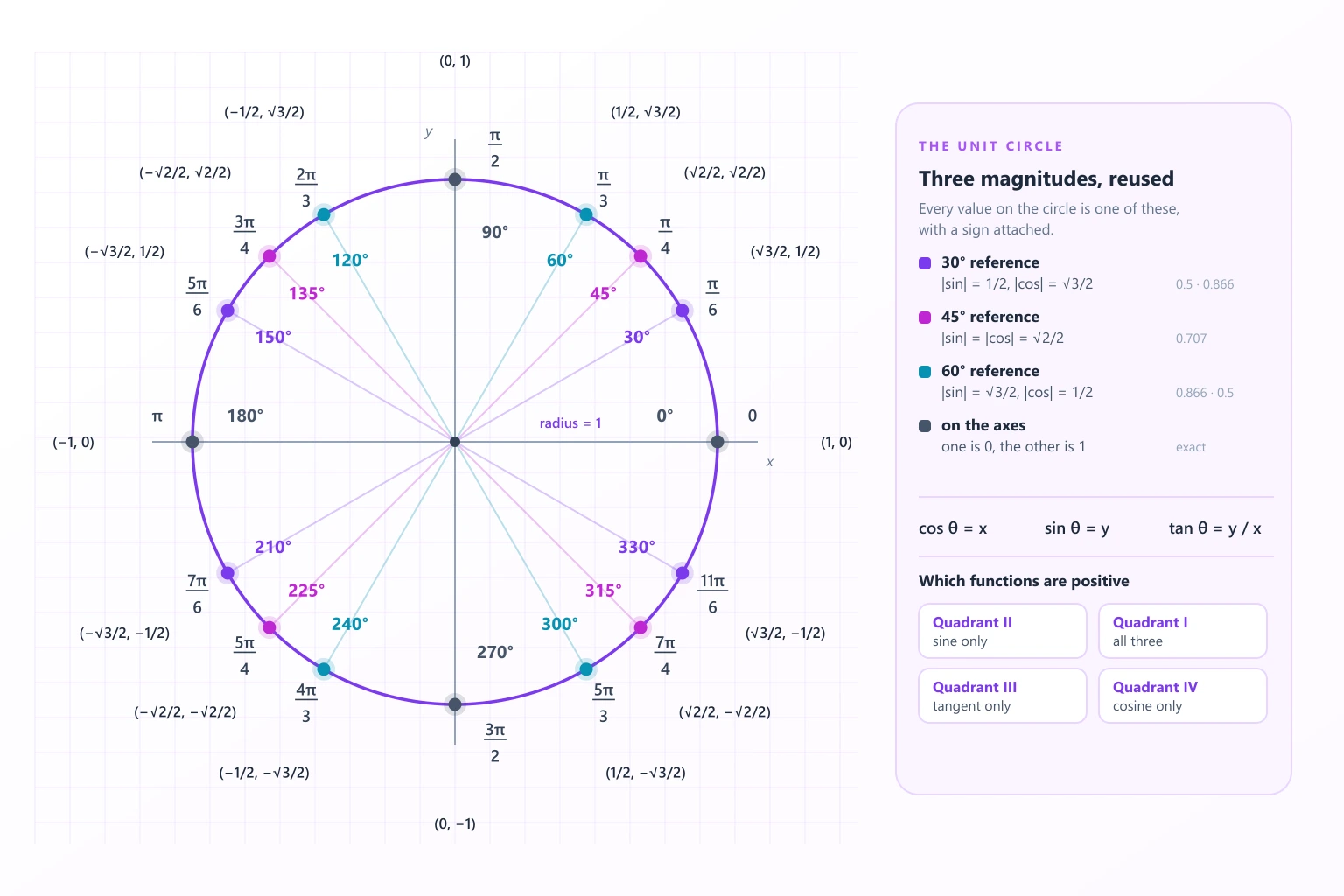
Every Value on the Circle Is One of Three Numbers
Write out the sine values for the first quadrant in order: 0, then 1/2, then √2/2, then √3/2, then 1. Look at what happens if you rewrite all five over a denominator of 2 with a square root on top:
√0/2, √1/2, √2/2, √3/2, √4/2.
The numerators count 0, 1, 2, 3, 4. That's it. That's the pattern, and once you've seen it you cannot unsee it. Sine climbs that ladder from 0° to 90°, cosine walks the exact same ladder backwards, and the two functions are just the same five numbers read in opposite directions. √0/2 simplifies to 0 and √4/2 simplifies to 1, which is why the pattern is usually hidden — textbooks print the simplified versions and the structure disappears.
So the working set is three numbers: 1/2 (which is 0.5), √2/2 (about 0.707) and √3/2 (about 0.866). Every non-trivial sine and cosine value on the circle is one of those three, with a sign attached. If you can rank them by size — and you can, because 0.5 is obviously smaller than 0.87 — you can sanity-check almost any answer without recalling anything. At 30° you have barely risen off the x-axis, so the height must be the small one, 1/2, and the horizontal reach must be the big one, √3/2. No table required.
Four Myths That Make This Harder Than It Is
Most of the difficulty students report with the unit circle comes from four beliefs that are either false or badly out of date. Here they are with what's actually true.
| What people believe | What's actually going on |
|---|---|
| "There are 32 coordinate values to memorise." | There are three magnitudes and a sign rule. The four quadrants reuse the same numbers — Quadrant III has nothing in it that Quadrant I doesn't. |
| "You need the tangent row too." | Tangent is sine divided by cosine and can be rebuilt in about two seconds. Memorising a third row triples your error surface for no gain. |
| "Radians are a separate system you learn afterwards." | A radian is defined by the circle itself — the angle that sweeps an arc equal to the radius. On a unit circle, the angle in radians is the arc length. |
| "A mnemonic sentence will get you through the exam." | Mnemonics survive about two weeks and collapse under time pressure, because you're recalling a sentence and then decoding it. Reconstruction from the triangles is slower on day one and far faster by day ten. |
The tangent myth is the expensive one. Students who memorise a tangent row tend to store it as isolated facts — tan 30° is √3/3, tan 150° is −√3/3 — and isolated facts decay fast. Students who divide sine by cosine on the spot get the sign for free, because a negative over a negative visibly produces a positive. That's why card 30 in the quiz above (tan 225°) trips up so many people who answered every sine and cosine question correctly: they reached for a stored value instead of doing the division.
Does the Left-Hand Trick Actually Work?
You've probably seen it. Hold up your left hand, assign the thumb to 0°, then 30°, 45°, 60° and the pinky to 90°. Fold down the finger for the angle you want. Count the fingers below the folded one, square-root that number, divide by 2 — that's the sine. Count the fingers above, do the same — that's the cosine.
It works, and it works for a real reason: it's a physical rendering of the √n/2 ladder from the section above. The finger count is n. So the trick isn't arbitrary, which is more than can be said for most maths mnemonics.
The honest limitation is that it covers Quadrant I and nothing else. Ask it for cos 225° and it has nothing to say. Every guide that presents it as a complete solution is quietly skipping the two steps that actually cause errors: finding the reference angle, and applying the sign. If the hand gets you the magnitude in half a second and you still have to reason through the quadrant, you've saved yourself the easy part of the problem. Useful, but keep it in proportion.
Where Everyone Actually Loses Marks
Quadrant III. It's the only region where both coordinates are negative, and that double flip is what breaks people. Sine is negative there. Cosine is negative there. Tangent, because it divides one by the other, comes out positive — the single exception that catches more students than anything else on the circle.
The standard tool is ASTC: in Quadrant I All are positive, in II only Sine, in III only Tangent, in IV only Cosine. Most classrooms teach it as "All Students Take Calculus". It's worth knowing, but it's worth knowing why more: moving anticlockwise from Quadrant I, you cross the y-axis and x goes negative, then you cross the x-axis and y goes negative too, then x comes back positive. The pattern is just the two axes taking turns. If you can picture that, you never need the sentence.
There's a second, quieter failure mode in Quadrant III worth flagging: reference angles of 30° versus 60°. At 210° the coordinates are (−√3/2, −1/2), and at 240° they flip to (−1/2, −√3/2). Both are negative, both use the same two numbers, and the only difference is which one is bigger. A 30° reference angle is always wide and flat, so the large number goes on x. A 60° reference is always tall and narrow, so the large number goes on y. Get that habit and two of the nastiest cards in the quiz stop being nasty.
Radians Aren't a Second System to Learn
Here's the definition that classrooms skip: one radian is the angle you get when the arc you've traced is exactly as long as the radius. On a unit circle, the radius is 1, so the angle in radians is literally the distance you've walked around the edge. A full lap is 2π because the circumference of a circle with radius 1 is 2π — and if you have never looked past the 3.14159 your calculator shows you, the pi quiz is a fast way to find out how many of those decimals you can actually produce from memory. Nothing is being converted — degrees are the arbitrary system here, an inheritance from Babylonian base-60 arithmetic that trigonometry carried forward for a few thousand years.
For conversion, stop dividing and start counting steps. The denominator tells you the family and the numerator tells you how many steps you've taken:
- Sixths — π/6 is 30°, so 5π/6 is five steps of 30° = 150°.
- Quarters — π/4 is 45°, so 3π/4 is 135° and 7π/4 is 315°.
- Thirds — π/3 is 60°, so 2π/3 is 120° and 4π/3 is 240°.
- Halves — π/2 is 90°, which is the quarter-turn everything else hangs off.
Four families, and the denominator names the family every time. That's a rule you can apply in under a second, versus multiplying by 180 and dividing by π under exam conditions and dropping a factor.
How This Quiz Finds Your Weak Spot
The 30 cards above aren't drawn at random. Every one of the 16 standard angles appears at least once, so by the end the diagram has filled itself in as a personal map — green where you were right at that position, red where you weren't. Each card is also tagged twice, once by skill and once by region, and those two tags are what turn a raw score into something you can act on.
The five skill buckets are degree-radian conversion, coordinates, sine, cosine, and tangent with signs. The five regions are the four quadrants plus the axis points. The reason for splitting both ways is that they diagnose different failures. A low sine score with high everything else means a values problem. A score that's fine in Quadrants I and II and collapses in III and IV means a sign problem — you know the numbers perfectly and you're losing marks on arithmetic you could fix in one sitting. Those two students need completely different study sessions, and a single percentage cannot tell them apart.
Timing is tracked for a specific reason too. Recall speed is a better predictor of exam performance than accuracy on an untimed run, because a trig identity problem asks you to retrieve four or five values while holding an algebraic manipulation in working memory. If each retrieval takes eight seconds of conscious reconstruction, you run out of working memory before you run out of question. Roughly four seconds per card is the point where recall has become automatic enough to stop competing with the rest of the problem.
One deliberate design choice: correct answers advance on their own, and wrong ones stop and wait. Getting something right doesn't need explaining. Getting something wrong is the only moment in the whole session where a correction will actually stick, so the card holds until you've read it. If you want a comparable diagnostic on a completely different kind of recall, the periodic table quiz scores you by element group using the same clustered-weakness idea, and the planet quiz holds every explanation on screen until you dismiss it, for exactly the reason described above.
Here's the Part That Feels Like Cheating
Staring at a completed unit circle chart feels productive and does almost nothing. Being asked for a value you don't quite have, struggling for two seconds, and then seeing the answer does far more — even when you get it wrong. This is the testing effect, and it's one of the most reliably reproduced findings in learning research. The act of retrieval is what strengthens the path to a memory. Rereading strengthens your feeling of knowing, which is why cramming feels so much better than it works.
Two things amplify it. The first is spacing: three short runs across three days beat ten runs in one evening, because the consolidation happens in the gaps. The second is interleaving — mixing radians, coordinates, sine, cosine and tangent in one shuffled stream instead of doing all the sine cards together. Blocked practice feels smoother and produces worse retention, because when every card is a sine card you stop deciding what kind of problem you're looking at. The deck above is interleaved on purpose, and yes, it makes the session feel harder. That's the point.
It also explains a result that confuses people: a second attempt that's slower but more accurate is usually real progress. Speed on run one often means guessing fast. If you're curious whether drilling suits how you learn at all, the learning style quiz is a reasonable place to check before you commit three evenings to it.
All 5 Score Bands and What Each Should Study Next
🎯 Unit Circle Locked In (28-30). Values arrive before you've finished reading the card, which is the state timed exams are built to reward. At this point you're reading a diagram rather than searching a table. Your remaining work is durability, not knowledge — one warm-up run the morning of the test and nothing else. Fewer than one first run in ten lands here.
✅ Test-Ready (23-27). The structure holds and your misses are clustered, not scattered. Almost always it's one quadrant or one function doing all the damage, which the breakdown will name for you. Fix that single cluster and you clear the top band without learning a genuinely new fact — most people in this range are two study sessions away.
🧭 The Shape Is There (17-22). The most common landing spot on a first attempt. You can navigate the easy half of the circle, but the reference-angle step isn't automatic yet, so anything past 90° becomes a guess with a plausible sign. Building that one habit — always ask what the equivalent first-quadrant angle is before anything else — is worth roughly eight points here.
🌓 Quadrant I Only (10-16). Everything up and to the right is solid; everything else is coin-flipping. This is a normal stage and the fastest one to escape, because the remaining three quadrants introduce no new numbers whatsoever — only new signs. Spend one session on ASTC and the reference-angle mirror, then come back.
📐 Start With Two Triangles (0-9). Put the circle down. Draw a 30-60-90 triangle and a 45-45-90 triangle, label every side including the hypotenuse of 1, and learn those two shapes until you can sketch them from nothing. The entire unit circle is those two triangles rotated into four positions. Build that and the other 28 values fall out of it rather than needing to be stored.
Your Next Three Study Sessions
Session one, tonight: take the run you just took and open the breakdown. Redraw only your weakest region on blank paper — not the whole circle, one quadrant — with angles in both degrees and radians and the coordinates filled in. Ten minutes, maximum.
Session two, tomorrow: blank circle, all 16 angles, degrees only, timed. Then the same circle again in radians. If a value takes more than four seconds, circle it and move on — the circled ones are your actual homework, and there will be fewer than you expect.
Session three, the day before your test: run the 30 cards again cold and compare the region bars, not the score. If Quadrant III has moved from red to green you've fixed the thing that was actually costing you marks. And if you're working towards a maths section rather than a trig unit specifically, the GED practice quiz covers the coordinate-geometry reasoning that sits underneath all of this, while the math quiz puts exact trig values back alongside algebra and geometry on its Challenge level — useful for checking whether the unit circle is your only weak region or just the one you noticed.