The Anatomy Terms Students Mix Up Most — and the Retrieval Method That Fixes Them
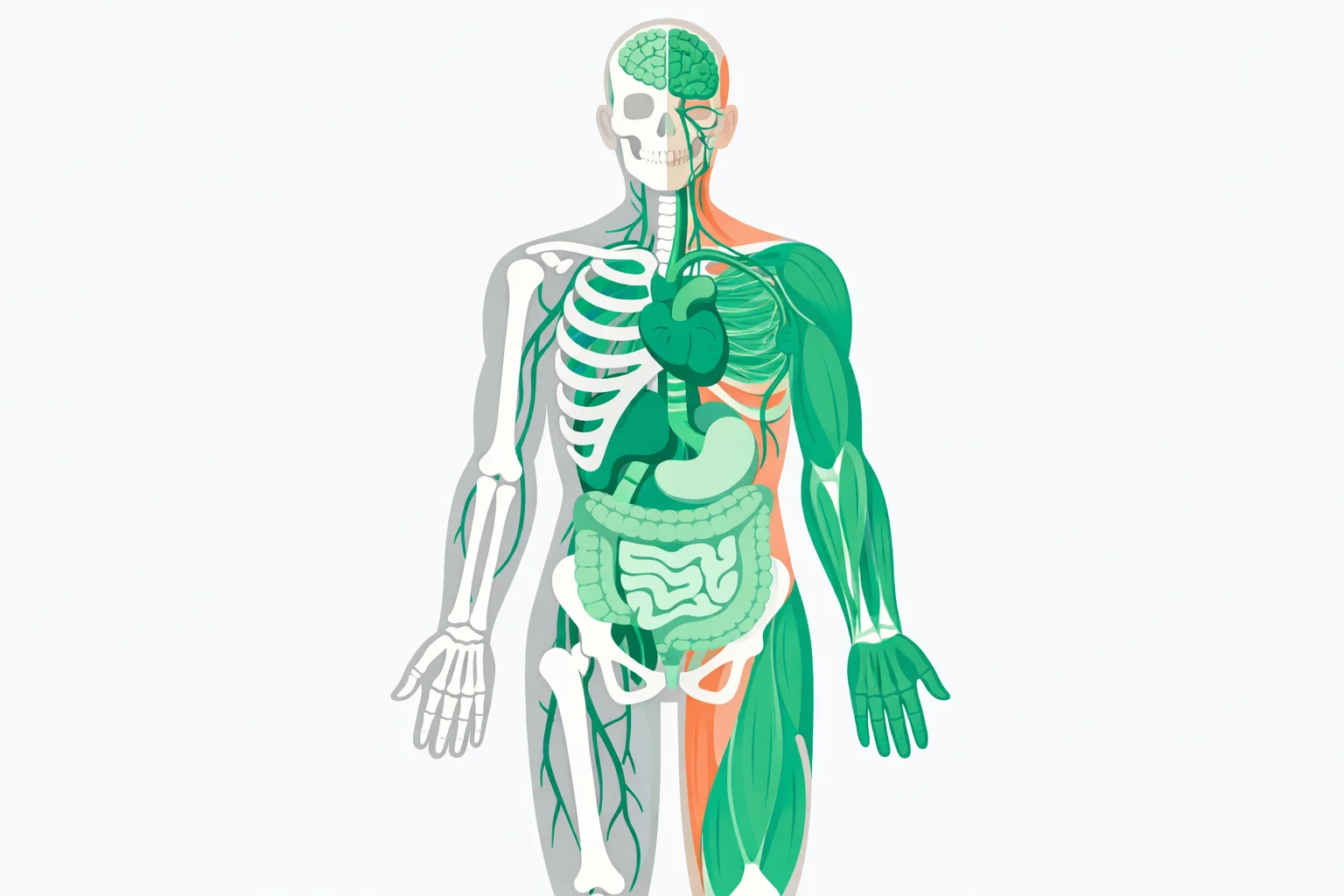
This anatomy quiz is built on a 2006 result that still annoys people who like highlighters: students who reread a passage four times recalled about 40% of it a week later, while students who read it once and were then tested three times recalled about 61%. Less exposure, better retention. Henry Roediger and Jeffrey Karpicke published that in Psychological Science, and it is the foundation of the testing effect. It matters more for anatomy than for almost any other subject, and the reason is structural rather than motivational.
Rereading Your Notes Is the Least Efficient Thing You Can Do
Most subjects give you a back door. Forget a formula in physics and you can often rebuild it from units. Forget a date in history and the surrounding events narrow it down. Anatomy gives you nothing. The ureter is called the ureter because a committee said so. There is no derivation to fall back on, which makes anatomy the closest thing an undergraduate curriculum has to pure paired-associate learning — a structure, a name, and a blank if the link is gone.
That is exactly the material the testing effect works hardest on. Rereading produces a feeling of fluency, because the words look familiar on the page. Retrieval produces the actual skill, because you have to generate the name with no cue in front of you. Those two feel almost identical while you are studying and diverge sharply a week later, which is why so many students walk into an anatomy practical convinced they knew the material.
The quiz above is built around that gap rather than around scoring. A correct answer moves on after a second — there is nothing to learn from being told you were right. A wrong answer stops and names the specific term you reached for instead, because the correction is the only part with any teaching value in it.
The Twelve Word Pairs That Cost Students the Most Marks
Here is the thing nobody tells first-year students: most lost marks in anatomy are not gaps. They are collisions. You have both terms stored, you have them stored next to each other because they sound alike or sit close together in the body, and under time pressure the wrong one surfaces first. Learning more material does nothing for this. Separating the pair does.
These twelve account for the large majority of wrong answers on the quiz above. The third column is the part most study guides skip — why the pair sticks together, which is what tells you how to prise it apart.
| The pair | What each one actually is | Why the swap survives |
|---|---|---|
| Ureter / urethra | Ureter: kidney to bladder, one per side. Urethra: bladder to outside, one only. | Near-homophones from the same Greek root. Count them: two ureters, one urethra. |
| Ilium / ileum | Ilium: the flared blade of the hip bone. Ileum: the final stretch of small intestine. | One vowel apart — and the ileum physically sits inside the iliac bowl. |
| Malleus / malleolus | Malleus: the hammer bone in the middle ear. Malleolus: the knob at the ankle. | Both come from Latin malleus, hammer, and both are hammer-shaped. |
| Mitral / tricuspid | Mitral: left AV valve, two cusps. Tricuspid: right AV valve, three cusps. | The prefix tells you the cusps but not the side. LAB and RAT fixes both at once. |
| Humerus / ulnar nerve | The funny bone bump is on the humerus. The nerve you compress is the ulnar nerve. | The nerve's name points at the wrong bone, and the ulna is right there. |
| Axon / dendrite | Axon: one output, carries signal away. Dendrites: many inputs, receive. | Both branch off the same cell body. Dendron means tree — branches gather. |
| Gastrocnemius / soleus | Gastrocnemius crosses knee and ankle. Soleus crosses the ankle only. | They share the Achilles tendon and look like one muscle from outside. |
| Radius / ulna | Radius: thumb side, rotates. Ulna: pinky side, forms the elbow hinge. | Similar length, same compartment. The radius sweeps a radius when you pronate. |
| Hippocampus / hypothalamus | Hippocampus: consolidates new memories. Hypothalamus: hormones, hunger, temperature. | Similar opening syllable, both small, both deep. Hippo for history, hypo for homeostasis. |
| Liver / gallbladder | Liver manufactures bile continuously. Gallbladder concentrates and stores it. | Shared duct system and adjacent position make them read as one unit. |
| Duodenum / jejunum | Duodenum first, about 25 cm. Jejunum second. Ileum third. | Only the order distinguishes them in most exam questions. |
| Artery / vein | Artery: away from the heart. Vein: toward it. Oxygen is not part of the definition. | School diagrams colour arteries red, so the exception feels like a contradiction. |
If you fell into any of these on the quiz, the report under your score named them individually. Work through those first. Six pairs cleared properly is worth more on an exam paper than a fortnight spent adding new terminology on top of an unstable base.
Which Questions Do People Actually Get Wrong?
The current hit rates on the 25 questions above are not evenly spread, and the pattern is informative. The five hardest are the hyoid (33% correct), the funny bone (41%), the vagus nerve (42%), the quadriceps odd-one-out (43%) and the mitral valve (44%). The five easiest are the aorta (87%), the diaphragm (81%), the triceps (76%), the gluteus maximus (74%) and the sciatic nerve (72%).
Notice what the hard ones have in common. Not one of them is obscure — every single term appears in a standard first-year syllabus. What they share is that each requires you to hold a second attribute alongside the name. The hyoid needs you to know it articulates with nothing. The mitral valve needs the side as well as the cusp count. The quadriceps question needs you to know biceps femoris belongs to a different muscle group entirely, despite the shared prefix.
The easy ones are all single-attribute recall. Largest artery, main breathing muscle, longest nerve. One fact, one word, no cross-reference. That distinction is the single most useful thing to take out of the score breakdown: if you scored well on the easy tier and collapsed on the hard tier, your problem is not the amount you have learned. It is that you have learned each term as one isolated fact rather than as a small cluster of attributes.
The occipital and temporal lobes are a good example that did not make the pair table. Roughly six in ten players who miss the vision question pick the temporal lobe — a reasonable error, because the temporal lobe does handle a sense. Just the wrong one. Hearing sits under your temples; vision sits at the very back of your skull, as far from your eyes as the anatomy allows.
Anatomy Isn't Memorization. It's a Vocabulary With Rules.
Before 1895, a single anatomical structure could carry a dozen different names depending on which school you trained at. The Basle Nomina Anatomica cut roughly 50,000 circulating terms down to about 5,528, and a century of revisions later the current standard — Terminologia Anatomica, first published in 1998 — holds roughly 7,500 approved terms. That standardisation is why anatomy vocabulary is learnable at all: the terms are built from a small set of roots according to consistent rules.
Learn about thirty roots and several thousand terms decode themselves. Brachi- is arm, so brachialis and brachiocephalic are both arm-related. Cardi- is heart, gastro- is stomach, my- is muscle, oste- is bone, neur- is nerve, hepat- is liver, nephr- and ren- are both kidney. Add the suffixes — -itis for inflammation, -ectomy for removal, -ostomy for a new opening, -plasty for repair — and myocarditis, nephrectomy and gastrostomy stop being words you have to memorise. Biochemistry rewards the same trick, incidentally: the twenty amino acids look like twenty unrelated structures until you learn the four side-chain families they sort into, which is how the amino acid quiz is built.
The directional terms are the other half of the system, and they are worth more than any individual structure name because every exam question uses them. Proximal means closer to the trunk, distal further away. Superior is up, inferior is down, but only in anatomical position — standing, palms forward. Medial is toward the midline, lateral away from it. Anterior is front, posterior is back. Once those are automatic, a phrase like "the medial malleolus is the distal projection of the tibia" describes a location you can point to rather than a sentence you have to decode. The US National Cancer Institute keeps a free, genuinely good anatomy and physiology training module that covers this vocabulary system properly if you want a reference beyond a quiz.
Why This Quiz Splits Into Five Blocks of Five
Twenty-five random anatomy questions would produce a single number that tells you almost nothing. Five blocks of five produce a profile, and a profile is diagnostic. The reason is that anatomy knowledge is not evenly distributed in anybody — it is built system by system, in the order a course happens to teach them, and it decays the same way.
Each block also tests a different kind of knowing. The skeletal block is nearly pure naming: a bone is a bone, and either the label is attached or it is not. The muscular block tests function as well as name, because muscles are defined by what they move — which is why the gastrocnemius question is really an action question wearing a name question's clothes. The nervous block tests localisation: not what a structure is, but where it lives and what it reaches. The circulatory block tests sequence, because everything in it depends on one unbroken loop running in one direction. And the digestive and urinary block tests the distinction between the tube itself and the accessory organs feeding into it.
So a 20/25 built from 5, 5, 5, 3, 2 is a completely different situation from a 20/25 built from 4, 4, 4, 4, 4. The first is a coverage problem in two systems and closes in about a week. The second means you are consistently losing the harder half of every block, which is a method problem — and no amount of additional reading fixes a method problem.
Here's What Two Weeks of Retrieval Practice Looks Like
Everyone nods at spaced repetition and then studies in a nine-hour block the night before. So here is the concrete version, sized for anatomy specifically and for two weeks, which is the realistic window before most exams.
Days 1–3: ten minutes a day, one system at a time, retrieval only. Close the book, write out every structure you can name in that system, then check. The list you produce on day one will be embarrassingly short. That is the point — you are measuring free recall, not recognition, and free recall is what the exam actually samples.
Days 4–7: start interleaving. Instead of one system per session, mix two or three. It feels worse and performs better; blocked practice inflates your sense of mastery because you always know which category the next item belongs to. Interleaving removes that crutch, which is precisely why it transfers to exam conditions. The effect is not limited to anatomy — the unit circle quiz shuffles radians, coordinates and tangent cards into one stream for the same reason, and scores you by region so you can see which slice the shuffle exposed.
Days 8–11: attack your confusion pairs directly. Take the six or seven the quiz report flagged and write each pair as a single card with both terms on it — never one term alone. Pairs learned separately re-collide. Pairs learned as a contrast stay separated.
Days 12–14: retake this quiz, then do a full blank-page pass of all five systems. Compare the score profile to your first attempt. What you are looking for is not a higher total — it is a flatter one.
If you are revising for a broader exam rather than an anatomy paper specifically, the science section of the GED practice quiz leans heavily on body systems and makes a reasonable mixed-topic warm-up. And if you want the same retrieval mechanics applied to a completely different vocabulary, the periodic table quiz is built on identical principles with 118 elements standing in for 206 bones, and the planet quiz runs the same feedback-after-every-answer format across the solar system.
All Six Score Bands Explained
🩺 Attending (23–25). Roughly 3% of players land here. This is not just breadth — it is stability under interference, which means you can hold two similar terms apart when both appear as options. Almost everyone scoring in this band has sat a practical exam, because that is the only format that trains this specific skill. The weakness at this level is usually depth in one system that was taught badly rather than any general gap.
🧑⚕️ Chief Resident (20–22). Top 11%. Fluent working knowledge with one or two live collisions still in play. The distinguishing feature of this band is that the wrong answers are almost never random — they cluster on the pair questions. Clear the three or four pairs your report names and this becomes a 24 without learning a single new structure.
📚 Third-Year Med Student (16–19). Top 28%. You have the map and most of the landmarks. What is missing is the second attribute — side, order, count, function — that turns a recognised name into a correct answer. This band improves fastest of all six, because the material is already there and only needs reorganising.
🔬 A&P Undergrad (12–15). The largest group, around a third of all players, and roughly where a student sits midway through a first anatomy and physiology course. Scores here are almost always lopsided rather than uniformly average — two systems strong, two barely started. The system breakdown is more useful than the total.
📖 First-Semester Footing (8–11). About 19% of players. The big landmarks are landing — aorta, diaphragm, sciatic nerve — and anything requiring a specific attached detail is not. This is the normal shape of early anatomy knowledge and it responds to ten minutes of daily retrieval far better than to weekend reading marathons.
🧭 Day One in the Lab (0–7). Around 7% of players start here, and it says nothing about aptitude. Anatomy is a vocabulary subject before it is a reasoning subject, and vocabulary is the one thing that yields reliably to repetition. Start with the twelve pairs above rather than a textbook chapter — they are worth more marks per minute than anything else on this page.
The Blank-Page Test Beats Any Quiz, Including This One
Multiple choice flatters you. Every correct answer is already on the screen and you only have to feel which one fits, so recognition scores run 20 to 30 points above free recall on identical material. That gap is why a comfortable quiz result can evaporate in a practical exam where structures are tagged on a specimen and nothing is written down for you.
So use the quiz for what it is good at — finding your collisions — and then close it. Take a blank sheet, pick one system, and draw it from memory with every structure labelled. Chambers and vessels for the heart. The full path from mouth to anus with the accessory organs branching off. Lobes, then the cranial nerves you can place. It will take four minutes and it will be humbling in a way no multiple-choice score ever is, because a blank page gives you no cues at all.
Then check it, note only what was missing, and do the same system again tomorrow. That single habit — draw, check, repeat once — closes the recognition-recall gap faster than any other technique in the education literature, and it costs less time per day than rereading one page of notes.