The Solar System Facts Your Planet Quiz Was Probably Still Getting Wrong
Take almost any planet quiz written before 2023 and at least three of its answers are now wrong. Not debatable — wrong. Saturn's moon count has more than quadrupled since 2019. The best estimate of the age of its rings dropped from four billion years to something closer to a hundred million. A planet got demoted, then a serious campaign started to un-demote it. The solar system is not a fixed set of facts you learn once at age nine; it is an active research area where the headline numbers move every couple of years.
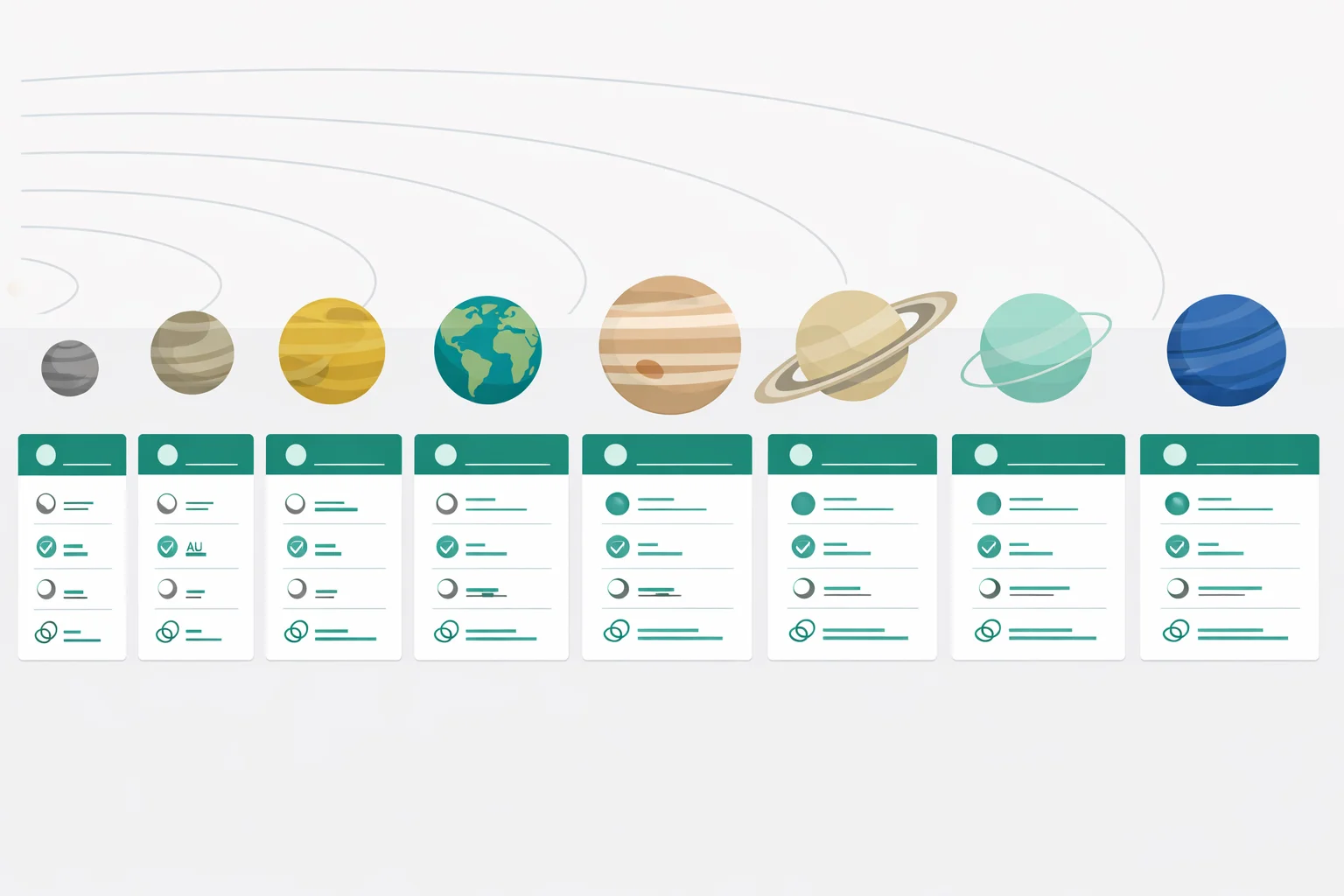
That is what the flight log above is built around. Twenty questions, four legs outward from Mercury, and a deliberate bias towards the facts that have changed or that people confidently get backwards. Here is what sits behind them.
Half the Solar System You Learned Is Now Out of Date
The uncomfortable part of teaching planetary science is how fast the reference numbers rot. Below is a short list of things that were textbook-correct within living memory and are not any more. Every one of them appears in some form on the quiz.
| What you were taught | What's true now | When it changed |
|---|---|---|
| Nine planets | Eight planets, five recognised dwarf planets | August 2006 (IAU vote) |
| Jupiter has the most moons | Saturn does, with 274 confirmed | 2023, extended March 2025 |
| Saturn's rings are as old as Saturn | Cassini data points to 100–400 million years | 2019 (Cassini grand finale analysis) |
| Pluto is a frozen dead rock | It has nitrogen glaciers, haze layers and possible cryovolcanism | July 2015 (New Horizons flyby) |
| Mars is geologically finished | InSight recorded hundreds of marsquakes from a still-warm interior | 2019–2022 |
Notice how many of those come from one spacecraft each. Our picture of the outer solar system is built on remarkably few visits — Uranus and Neptune have been seen close up exactly once, by Voyager 2, in 1986 and 1989. Almost everything printed about those two planets traces back to a few days of data gathered by a probe launched before most people reading this were born.
The Scale Model Nobody Draws Correctly
Here is the practical exercise that fixes more solar system misconceptions than any diagram. Shrink the Sun to a basketball, 24 cm across. At that scale:
- Earth is a 2.2 mm bead — a peppercorn — sitting 26 metres away.
- Jupiter is a 25 mm marble at 134 metres.
- Neptune is a 9 mm pea at 780 metres — eight football pitches end to end.
- The nearest star would be another basketball roughly 6,800 kilometres away. London to Chicago.
Run that in a school field and something clicks that a page diagram never manages: the solar system is overwhelmingly empty. Every poster you have ever seen crams the planets together because the alternative is a sheet of paper that is 99.9% blank. The orbit rail in the quiz above has the same problem, which is why it uses a logarithmic scale — Mercury at 0.39 AU and Neptune at 30.1 AU cannot share a phone screen honestly. It is the identical compromise a Mercator projection makes with Greenland, and it produces the same predictable errors in people's mental models. If that kind of distortion interests you, the geography quiz tests the terrestrial version of exactly this bias.
The scale problem also explains a quiz answer people find implausible. The Sun holds 99.86% of the solar system's mass. Jupiter takes about two-thirds of the remainder. Everything else — seven planets, close to 400 moons, the entire asteroid belt, every comet — shares less than 0.05%. We live in the rounding error.
Why Isn't Mercury the Hottest Planet?
This is the single most-missed question on the flight log, and the reasoning behind the wrong answer is sound: Mercury is 58 million km from the Sun, Venus is 108 million. Closer should mean hotter.
It would, if heat only arrived. Mercury receives about 6.7 times the solar energy Earth does and radiates nearly all of it straight back to space, because it has effectively no atmosphere — a surface pressure around a quadrillionth of Earth's. Noon on Mercury reaches 430 °C; the same spot after sunset drops to −180 °C. Nothing holds the heat.
Venus receives less energy but keeps almost all of it. Its atmosphere is 96% carbon dioxide at 92 bar of pressure, a runaway greenhouse that stabilises the entire surface — poles included, night side included — at roughly 465 °C. There is no cool spot on Venus. Lead melts at 327 °C, so a lead statue would slump anywhere you put it on that planet.
The real lesson buried in this question: on planetary surfaces, atmosphere beats distance. It is also the reason Venus is the standard cautionary example in climate science — NASA's own Venus overview leads with it.
Every Planet, Every Number That Matters
Most planet fact tables online copy each other, moon counts included, which is how 2019 figures are still circulating. These are current as of 2025. Temperatures are surface averages for the rocky planets and cloud-top averages for the giants, because the giants have no surface to measure.
| Planet | Diameter (km) | Distance (AU) | Day | Year | Moons | Mean temp |
|---|---|---|---|---|---|---|
| Mercury | 4,879 | 0.39 | 58.6 d | 88 d | 0 | 167 °C |
| Venus | 12,104 | 0.72 | 243 d (retrograde) | 225 d | 0 | 464 °C |
| Earth | 12,756 | 1.00 | 23 h 56 m | 365.25 d | 1 | 15 °C |
| Mars | 6,792 | 1.52 | 24 h 37 m | 687 d | 2 | −65 °C |
| Jupiter | 142,984 | 5.20 | 9 h 56 m | 11.9 yr | 95 | −110 °C |
| Saturn | 120,536 | 9.58 | 10 h 42 m | 29.4 yr | 274 | −140 °C |
| Uranus | 51,118 | 19.20 | 17 h 14 m (retrograde) | 84 yr | 28 | −195 °C |
| Neptune | 49,528 | 30.05 | 16 h 6 m | 164.8 yr | 16 | −200 °C |
Three quiet oddities live in that table. Venus is the only planet whose day outlasts its year. Uranus and Venus are the only two that spin backwards. And Neptune, discovered in 1846, did not complete a single full orbit of the Sun until 2011 — the first Neptunian birthday any human has witnessed happened well within the internet era.
Here's Where the Moon Count Gets Slippery
Saturn had 62 confirmed moons in 2019. By mid-2023 it had 146. In March 2025 a single announcement added 128 more, taking it to 274 — more moons than every other planet combined, several times over. Nothing new appeared out there. What changed was the technique.
Modern surveys use shift-and-stack: dozens of short exposures are digitally shifted along the path an object would take if it were orbiting at a given distance, then added together. A moon two or three kilometres across, far too faint for any single frame, accumulates into a visible dot. Teams using the Subaru Telescope on Mauna Kea have been running this on the giant planets for years, and Saturn happens to sit in the sweet spot of distance and brightness.
It leaves the word "moon" doing unreasonable work. Ganymede is 5,268 km across — larger than Mercury, with its own magnetic field and a subsurface ocean holding more water than every ocean on Earth. Several of Saturn's 2025 additions are irregular chunks a few kilometres wide on wildly tilted retrograde orbits, almost certainly captured debris. Both get the same label. It is the same definitional mess that has chemists arguing over which element belongs in group 3 of the periodic table — categories drawn up before the data arrived, kept because renaming everything is worse.
Practical takeaway for anyone learning this: memorise moon counts to Mars and treat everything beyond it as a range. Mercury 0, Venus 0, Earth 1, Mars 2 are stable facts. The outer numbers are survey snapshots, and the next run will change them again.
What Actually Got Pluto Demoted?
Almost everyone knows Pluto was reclassified. Far fewer can name the criterion it failed, which is why that question sits in the final leg of the quiz.
The IAU's 2006 resolution set three tests. A planet must orbit the Sun — Pluto does. It must be massive enough for its own gravity to pull it round — Pluto is. And it must have cleared its orbital neighbourhood of other bodies. Pluto has not, and cannot: it shares the Kuiper Belt with thousands of comparable objects and its orbit even crosses Neptune's.
The trigger was Eris, found in 2005 and initially measured as larger than Pluto. Astronomy faced a straightforward choice — admit Eris as the tenth planet and then everything else the Kuiper Belt surveys were about to turn up, or tighten the definition. It tightened.
There is a real dissent worth knowing. A group of planetary geologists, several from the New Horizons mission, argue for a geophysical definition: if it is round because of its own gravity and it is not a star, it is a planet. Under that rule Pluto returns, along with Ceres, Europa, Titan and our own Moon — well over a hundred planets. The argument is that "cleared its neighbourhood" describes where an object is rather than what it is, and there is a fair point in that. It has not carried a vote, but it is a live disagreement among working scientists, not a fringe complaint.
Worth knowing for the quiz: Pluto is smaller than Earth's Moon, has five moons of its own, and Charon is so large relative to Pluto that the two orbit a shared point in the empty space between them. No other pair in the solar system does that.
Why the Flight Log Splits Into Four Legs
The four legs are not decoration. They are weighted to where knowledge actually collapses.
Leg 1 carries eight of the twenty questions across the four rocky planets, because that is where nearly everyone has some footing and a quiz that opens with Neptune's wind speeds loses people at question one. Leg 2 gives Jupiter and Saturn six questions between them — they hold about 92% of all planetary mass, so proportional representation is defensible. Leg 3 gets four, and it is the leg that separates the top two score bands from the rest. Leg 4 is two system-level questions with no single planet attached.
Each planet then owns two or three questions, which is what lets the orbit map light up three ways rather than two. Get all of a planet's questions right and it goes fully lit with a glow ring. Get some right and it stays lit but dimmed. Miss every one and it turns rose — flown past blind. That distinction matters more than the raw score: a partial planet almost always means you knew the famous fact and missed the mechanism. Knowing Saturn has rings but not that they are 90% water ice. Knowing Uranus is tipped over but not that this gives it 21-year seasons.
The explanation appearing immediately after each answer is also deliberate rather than decorative. Testing-effect research — the same body of work behind the retrieval-practice format used in the anatomy quiz — consistently finds that a retrieval attempt followed by immediate corrective feedback produces far better retention than rereading the same material, and that the effect is strongest precisely when the first attempt was wrong. The questions you miss here are the ones most likely to stick. The dinosaur quiz leans on the same mechanism for a harder job: its eight field-test questions all target beliefs a film actively taught you, so each one asks you to unlearn rather than recall. The cloud types quiz applies it to the sky you can actually see from your door — ten drawn field sketches, each with the base height, form and precipitation a synoptic observer would record, and the sourced explanation waiting the moment you commit to an answer.
All Six Flight Log Results, Explained
Scores land in one of six bands. Each describes a recognisable shape of knowledge, not just a number.
🛰️ Mission Director (19–20) — roughly 2% of players. This band is defined by the counter-intuitive answers rather than the hard ones. You resisted Mercury on the temperature question, Mercury again on density, and Jupiter on moon count. Those three trip up nearly every otherwise-strong scorer, because each has a plausible wrong answer sitting right next to it.
🔭 Planetary Scientist (16–18) — about the top 10%. Broad command with one soft edge, and it is almost always legs 3 and 4. Uranus, Neptune and the definitional questions get a fraction of the classroom time the inner planets get, so this is a curriculum gap rather than a personal one.
🧭 Flight Engineer (13–15) — around one player in four. You know the planets as objects and are shakier on them as numbers. Typical for someone who learned this properly once and has been topping it up from documentaries since: names, order and headline features survive, while densities, rotation periods and moon counts quietly drift.
🚀 Cadet Navigator (10–12) — the most common result. Half the system mapped, and the split is geographic. Confidence holds through Earth's neighbours and thins out past the asteroid belt, where Jupiter and Saturn survive as characters and Uranus and Neptune are names in a list.
🌙 Weekend Stargazer (6–9) — roughly one in five. The headline facts landed and the detail did not. Worth remembering that this quiz deliberately skips the questions everyone can already answer — there is no "which planet is closest to the Sun" here — so this band still means you cleared most of what you were genuinely confident about.
📡 Ground Crew (0–5) — under 8% of players. The solar system is currently eight names in a row rather than eight places. This is also the score that improves fastest, because the inner four planets carry eight of the twenty questions and each one hangs on a single memorable fact: hottest, backwards, densest, tallest volcano.
Go Outside and Check One of These Yourself
A quiz result is a snapshot. What actually moves your solar system knowledge is looking at the thing, and three of the facts above are verifiable from a back garden with binoculars you probably already own.
Point them at Jupiter and you will see up to four dots in a line — the Galilean moons, Ganymede among them, the moon that outsizes Mercury. Come back the next night and they will have moved; that is the observation that convinced Galileo not everything orbits Earth. A small telescope at around 25× resolves Saturn's rings, and if you catch Saturn near equinox they thin to a hairline, which is the geometry that tells you how absurdly flat they are. Venus, meanwhile, shows phases like the Moon — the proof that killed the Earth-centred model outright.
The catch is finding them. Planets have no fixed address — they wander, which is what the Greek word means — so the way people locate one is by knowing the fixed backdrop it is currently sitting against. Jupiter spends about a year in each zodiac constellation, and if you cannot pick Taurus or Leo out of the sky you have no frame to notice it against. The constellation quiz tests exactly that backdrop, using real star fields rather than diagrams.
If the ones that got away in your results clustered in a single leg, that is your reading list rather than a verdict. Take the flight again in a few days rather than immediately — spacing the attempts is what makes the second one stick, and the planets you flew past blind are the ones you will notice first when you look up.